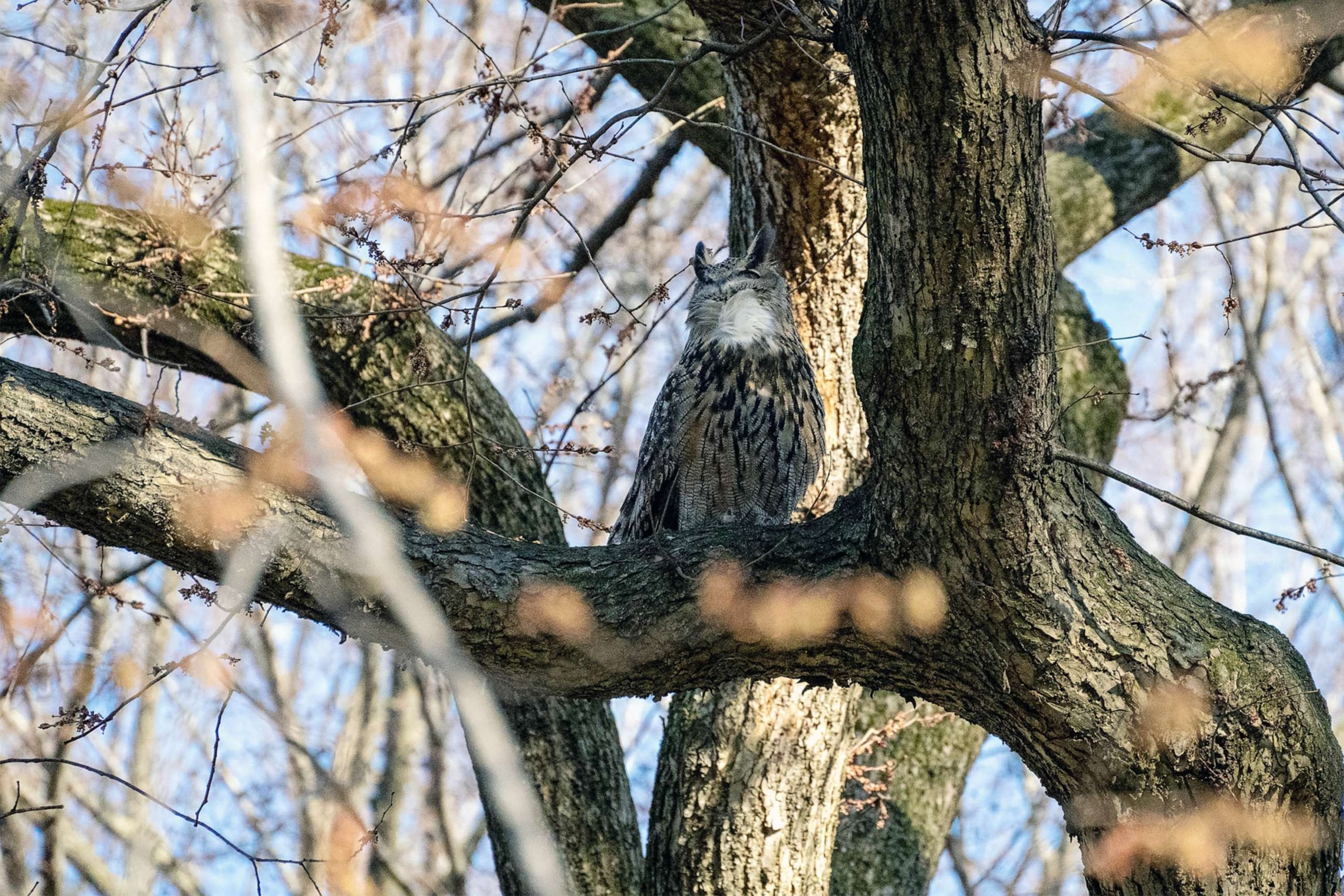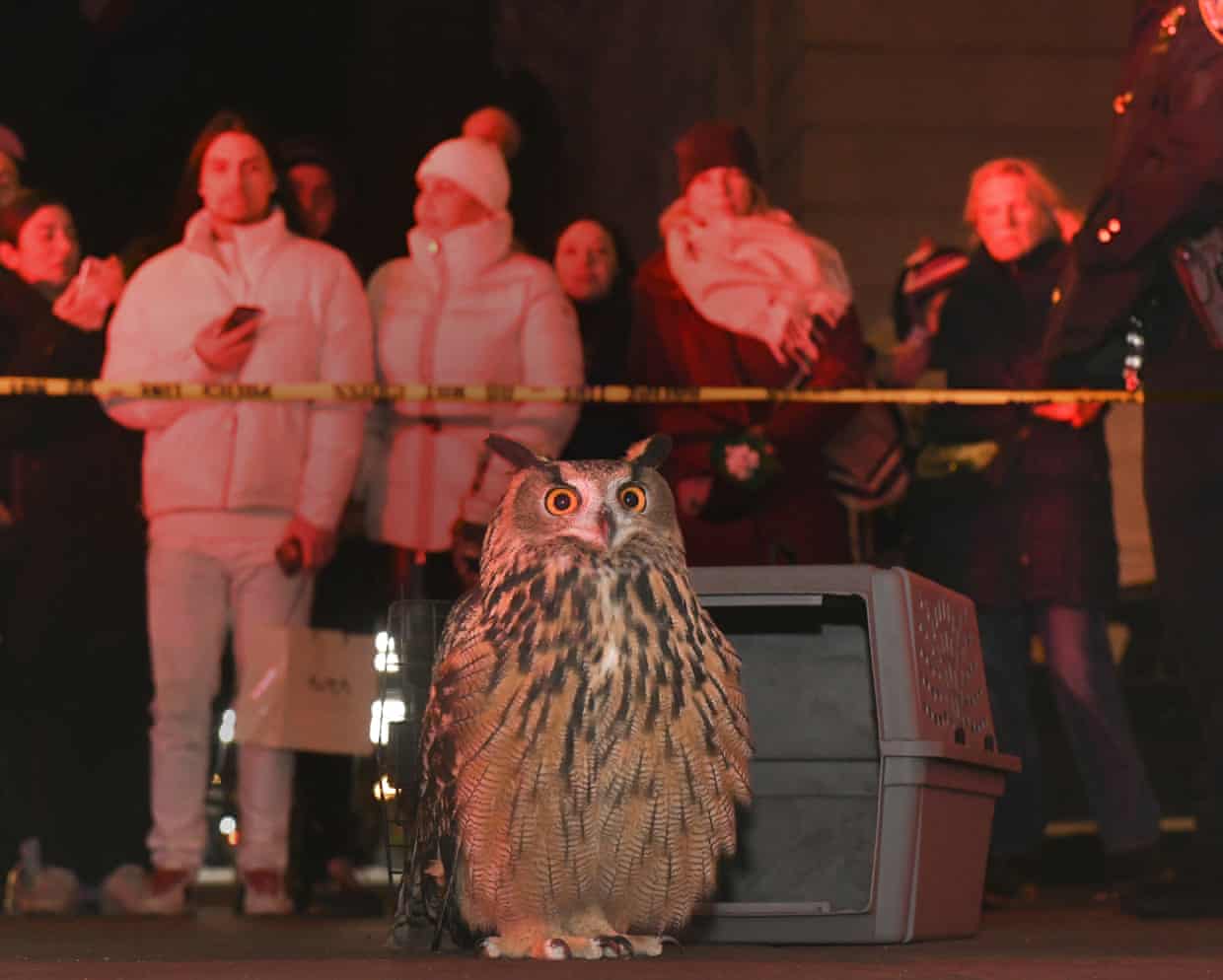
Photo: Benny Polatseck/Sandbox Films.
“There are certain places in New York City that will forever be changed for me by his existence in those places” … a still from Wild Inside.
This story shows the many good things that happened because an owl escaped a New York zoo, including the camaraderie of fans from different backgrounds, the scientific revelations, and the new law about rat control.
But read on. Do you think this owl would have been better off if he stayed in the zoo?
Vivian Ho writes at the Guardian, “Flaco the Eurasian eagle-owl gained a cult following after leaving his life in captivity at the Central Park zoo in 2023 and surviving, against all odds, for more than a year as a free bird in Manhattan.
“Birdwatchers tracked his every move, capturing his vast wingspan and luminous orange eyes with their cameras. His fans got tattoos in his honor. And now [there’s a movie] Wild Inside, a new documentary chronicling Flaco’s year about town. …
“Penny Lane, who directed the documentary, said she felt compelled to tell the story of Flaco because, like so many other New Yorkers, she too found herself swept up in his magic. ‘Owls are uniquely magical creatures,” she said. “They’re associated with other worlds, these mystical realms. So the appearance of a creature like that in New York City … it feels like kind of a fairytale.”
“Flaco escaped from the zoo in February 2023, after someone deliberately cut the mesh of the enclosure where he lived for 13 years. Zoo staff and birdwatchers alike feared for his wellbeing. Flaco did not know how to hunt on his own. Observers noticed he had trouble flying. Attempts to lure him back with live lab rats were unsuccessful.
“But eventually, he figured it out. Local birders documented him successfully hunting and eating some of the city’s many rats. And after two weeks, zoo officials suspended their efforts to recapture him. Flaco had done the impossible: he had learned to be wild again. …
“Lane sought to capture Flaco’s wild fairytale magic in the film, interspersing interviews with awestruck New Yorkers celebrating each Flaco sighting with whimsical background music and dreamy visuals. She spoke to New Yorkers from all walks of life who projected their own experiences on to the owl that triumphed, calling him a survivor and hailing him as another immigrant success story (Eurasian eagle-owls are a non-native species). …
“’We love an underdog,’ Lane laughed. But for the local birding community, Flaco’s story went beyond that. ‘We were watching a zoo animal transform into a wild animal before our eyes,’ Lane said. Flaco’s ability to revert back to instincts he never had to use in his life were raising questions over the true nature of wildness – and if it exists within all of us like it did for Flaco.
“ ‘He was born in captivity. His parents were born in captivity. His grandparents were born in captivity. As far back as I could trace, he was as close to a domesticated wild animal you could get in the sense that he was of a captive lineage,’ Lane said. ‘But he showed pretty quickly that he was not a domesticated animal.’ …
“Just over a year after his escape, Flaco crashed into a building on West 89th Street and died from the impact. A necropsy conducted on his body found that he had been weakened by pigeon herpes virus, which he caught from eating the pigeons that he hunted, as well as four kinds of anticoagulants that are common in the rodenticide used to kill rats – a common cause of death and illness for all wild birds that hunt rats in New York City.
” ‘I was devastated,’ Lane said. She had planned to film Flaco for the entirety of his life, thinking it would be for at least 10 more years. The birdwatchers and naturalists interviewed in the film grappled with questions of if Flaco would have been better off if he had never escaped the zoo at all – no longer free, but alive and safe. ‘You can’t help but feel guilty and implicated,’ Lane said. ‘You loved seeing him so much, but you knew in the back of your mind all the while that this was not a safe place for him.’
“A few months after his death, the city council approved ‘Flaco’s law,’ an initiative that established a pilot schemes to deploy rat contraceptives rather than poison in an effort to curb the population.”
More at the Guardian, here.