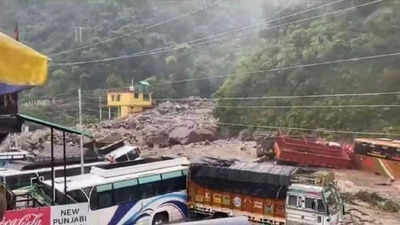
Photo: Times of India. Himachal rains: Chandigarh-Manali highway blocked at multiple places.
Blogger Friends,
Has anything like this happened to you? My June post about earthquake resistant construction in India elicited a cry for help today from a flooded part of the same country.
Here it is.
“saurabh joshi “Aryavrat or Bharat or India “I am from Himachal. Currently buildings have collapsed in Shimla, Manali and Mandi due to Heavy rains. I need to learn about old Earthquake Resistant Structures. Kindly help.”
I did a Google search and found out about the flooding August 14. But I am not someone who can advise about such things. All I do is share stories. I suggested trying to contact the expert in the article at his university.
I wish I could do more. All of a sudden, after posting an article that interested me, I am connected to a person in India who urgently wants my advice on earthquake resistant structures! It’s both wonderful and scary. What would you do? Have you encountered anything similar?
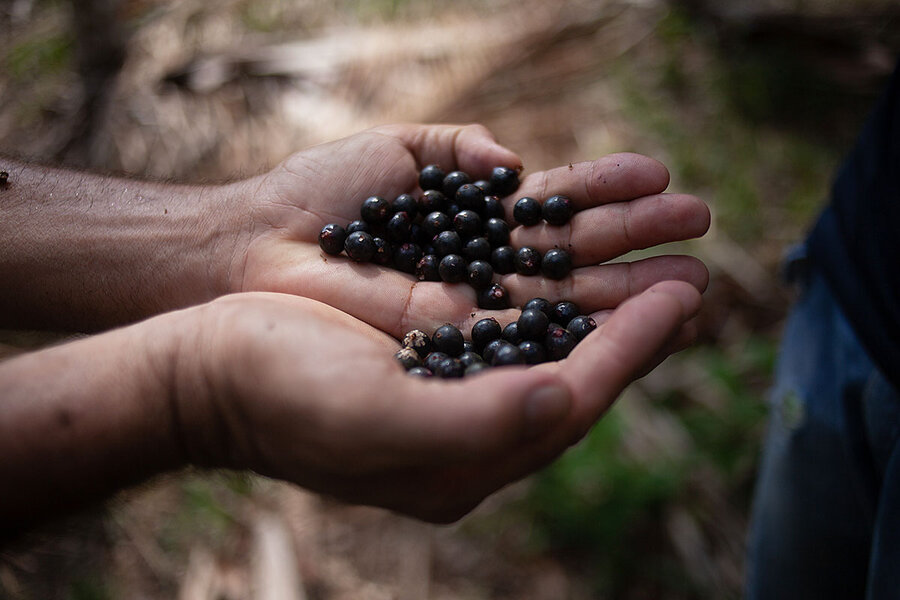
Photo: Ana Ionova. Luis Carlos Gomes, an açaí grower, holds a handful of the berries from his plantation in the Brazilian state of Amazonas.
What is a good product for the rainforest, both for farmers and for the environment? In the coffee arena, my husband and I like Dean’s Beans because of their focus on the environment and shade-grown coffee.
Ana Ionova writes at the Christian Science Monitor about another rainforest crop, acai berries.
“Squinting into the late afternoon sun, Nelson Galvão leans against the trunk of a towering açaí palm. About 20 feet above his head, nestled into the crown of the palm, clusters of deep-purple berries weigh down the tree’s slender branches.
“ ‘Açaí has been good to us,’ Mr. Galvão says. ‘If you know how to care for it right, it brings in a good income. It’s our family’s survival.’
“For the last two decades, Mr. Galvão has been cultivating açaí, a tart berry native to the Amazon rainforest that has become a global health food sensation and a [industry] worth nearly a billion dollars a year. About 2,000 açaí palms grow on his lot here, some 70 miles from the Amazon capital of Manaus, yielding enough pulp each harvest to earn him about $2,150, the equivalent of a minimum wage.
“Mr. Galvão is working hard to make a living without destroying the forest. Instead of toppling trees, he restores the land by planting banana, pineapple, and cupuaçu – a close relative of cacao – in the gaps between his palms.
” ‘Growing up, I saw my parents clearing big pieces of land, clearing everything,’ Mr. Galvão says. ‘Now I know that, if we just destroy without restoring, all this will come to an end.’
“Many of Mr. Galvão’s neighbors have chosen a different path though. The emerald jungle canopy here is fast giving way to cattle pasture, as in much of the Brazilian Amazon, and Mr. Galvão is feeling the impact.
“Açaí palms usually thrive in this sun-drenched corner of the Amazon, where flood plains swell during the rainy season to form a maze of land and water. This year, though, his trees yielded less as Brazil was hit by its worst drought in almost a century. Then this part of the Amazon was struck by devastating flash floods.
“ ‘We see these weather disasters and we really worry. We wonder about future harvests,’ he says. ‘But the cattle ranchers – they are not worried. They cut, cut, cut. They deforest everything. And we, the small growers, are the ones who end up paying the price.’
“Mr. Galvão is not alone in his concerns for the future. The Brazilian Amazon is being razed and burned at a dizzying pace, with deforestation hitting its highest level in 15 years, despite government vows to curb the destruction. Scientists warn the rainforest is nearing a tipping point. …
” ‘Some areas where açaí palms grow today will no longer be suitable in a future climate scenario,’ says Pedro Eisenlohr, professor at the State University of Mato Grosso and co-author of a recent study forecasting climate change in the Amazon. …
“The popularity of this ‘wonder berry’ spread to gyms and surf shacks across Brazil in the 1990s. Before long, açaí made a name for itself abroad too and quickly amassed a loyal following, making its way into smoothies and protein bars in cities like Los Angeles, London, and Tokyo. Exports have grown more than a hundredfold in the past 10 years. …
“The surge in demand for the nutrient-packed berry has been welcome news in the Amazon, promising a path to prosperity for small-scale growers. Although some have sounded the alarm over the unbridled growth, fearing growers may raze virgin forest to make space for more açaí, the berry has proved a sustainable source of income for most growers, often cultivated within the forest.
“Luis Carlos Gomes experienced the açaí boom firsthand. When he was growing up, the fruit was a lunch staple rather than a business opportunity. When he started planting the berry 12 years ago, he was one of few growers in Autazes excited about its potential. But soon that changed.
“ ‘Before, there was no market for açaí,’ Mr. Gomes says. ‘People only picked it for their families to eat. But, all of a sudden, our açaí started selling and selling. And other people got excited about planting it too.’ …
“The industry has come in for criticism due to allegations about the use of child labor, but as the destruction of the Amazon advances, açaí has emerged as a rare bright spot in the fight to save the rainforest. Projects promoting the sustainable cultivation of the berry aim to make preserving the forest more lucrative than razing it. In already deforested areas, planting more açaí is also helping restore degraded forests while providing local people with an income. …
“Now that climate change is threatening the açaí palms, environmentalists worry that some growers, unable to make a living from the forest standing, will move to raze it, turning the land into pasture.
“Mr. Gomes also worries about what climate change might mean for his açaí trees. Still, for now, he says the future is bright.
“ ‘The droughts, the floods – it all worries me, of course,’ he says, steadying a ladder as his son climbs up a palm in search of the very last berries of the harvest. ‘But we are doing our part. We are planting trees. And we’re putting our faith in açaí.’ ”
This story was a reminder to me that every country has kind-hearted people. Too much of the news about Sudan focuses on its leader, his treatment of minorities, and his troubles with the international court. But this story is about Sudanese youth reviving a tradition of service.
Isma’il Kushkush reported the story for the NY Times.
“Their temporary headquarters are a beehive of young volunteers buzzing in and out of rooms, up and down stairs, carrying bags of donated food, medicine and large packets of plastic sheets. …
“They are the members of Nafeer, a volunteer, youth-led initiative that responded swiftly to the humanitarian crisis caused by heavy rains and flash floods that struck Sudan [in August]. …
“The area around Khartoum, the capital, suffered the hardest blow. …
“ ‘We saw that the heavy rains and floods were going to impact the lives of many, and we felt we had a social responsibility to help people,’ said Muhammad Hamd, 28, a Nafeer spokesman. ‘The idea came out of a discussion on Facebook among friends.’
“A ‘nafeer’ is a Sudanese social tradition that comes from an Arabic word meaning ‘a call to mobilize.’ The group’s formation was all the more important because the Sudanese government was slow to respond, some critics say.
“ ‘It was a weak response,’ said Khalid Eltigani, the executive editor of Ilaf, a weekly newspaper. ‘The Nafeer youth broke the silence on the flood situation.’ ” More here.
I love that the latest manifestation of this Sudanese tradition got organized on Facebook.
Photo: Reuters
Men built a barrier to protect houses from rising water in Khartoum, Sudan, the last week of August. More than 300,000 people were directly affected by the flooding.


 Suzanne's Mom's Blog