Feeds:
Posts
Comments

Posts Tagged ‘florida’

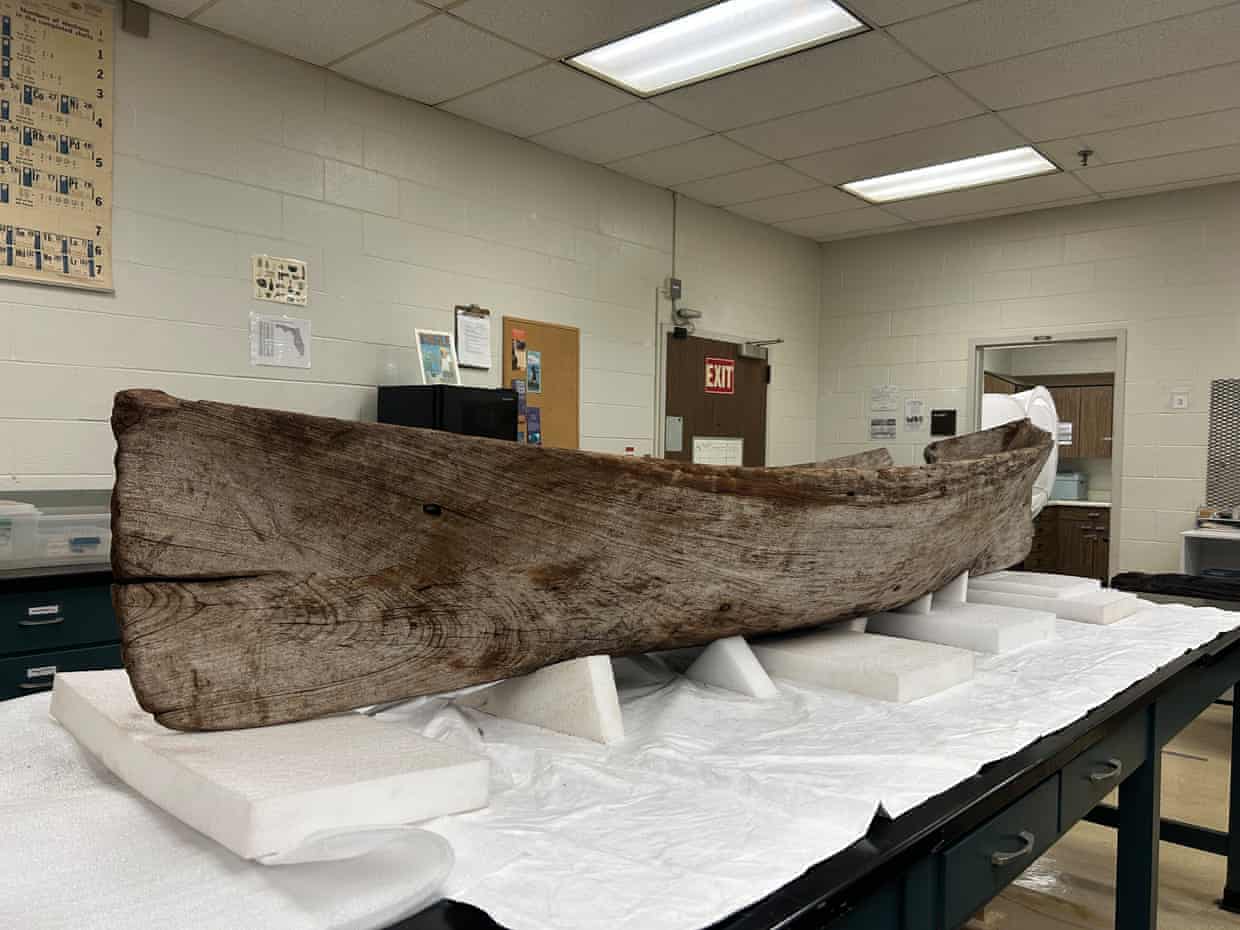
Photo: Florida Division of Historical Resources.
A 16th century canoe was discovered by a resident of Fort Myers, Florida, when Hurricane Ian made landfall in 2022. 

When I was a kid on Fire Island, a big storm always meant there would be treasures on the sand the next day. We would hurry up the sidewalk to the ocean to see how the beach had reshaped itself and what flotsam and jetsam had washed up. Often the shore was littered with shells, jellyfish, or starfish.

Not that we wish for hurricanes, but extra big storms like that can uncover even larger surprises than starfish.

Richard Luscombe notes at the Guardian, “Florida already claims to be the world capital of golf, shark bites and lightning strikes. Now a remarkable discovery following a devastating hurricane has enhanced its position as a global leader in another distinctive field: ancient canoes – some even prehistoric.

“State archeologists have just completed a painstaking preservation of an ancient wooden canoe discovered by a resident of Fort Myers during the cleanup from Hurricane Ian in 2022.

“It joins 450 other log boats or canoes dating back thousands of years recorded or preserved by the Florida division of historical resources. But this one is unusual, officials say, because it is the first they have seen made of mahogany, and probably the first to originate outside Florida, possibly in the Caribbean.

“The age of the fragile 9ft canoe is under analysis through carbon dating and other scientific processes. Investigators are pursuing a theory that it might be a dugout cayuco crafted by Spanish invaders who settled in the region during the 16th century.

“ ‘We compared it to canoes that we have in our collection and previously recorded, and it’s a very unusual form, so that was the first hint it was not necessarily from Florida,’ said Sam Wilford, Florida’s deputy state archeologist. ‘On the surface there’s tool marks made by iron tools, and we know that that is a historical date because that’s when the Europeans introduced iron tools into the Americas.’ …

“ ‘The tree may have died much earlier than when the canoe was constructed from it. It might have been driftwood, or stored somehow before it was made as a canoe.’

Hurricane Ian caused ‘catastrophic’ damage when it slammed into south-west Florida in September 2022 with 150mph winds and a storm surge of 18ft. The canoe is believed to have been pulled from a riverbed and ended up in the yard of a Fort Myers resident, who discovered it as he cleaned up after the storm and alerted state officials.

“ ‘It had been clearly submerged in water; there’s lots of stain marks on it, [but] it was dry when we received it,’ Wilford said, adding that it was then lightly vacuumed and cleaned with soft brushes, and that each stage of its careful conservation was photographed.

“Florida has had more discoveries of old canoes than any other place in the western hemisphere, and more than 200 separate sites have been recorded, officials said. Many of the canoes were made and used by Native American tribes, including the Miccosukee and Seminole tribes, who inhabited large swathes of the state, particularly the wetlands of the Florida Everglades.

“The oldest, Wilford said, is a canoe discovered near Orlando, estimated to come from the middle Archaic period up to 7,000 years ago.

With about one-fifth of Florida covered by water, the prolific use of canoes by its residents throughout history is unsurprising.

“ ‘It’s because of the environment,’ Wilford said. ‘Native Americans and then later on Europeans needed canoes to get around, and then the wet environment also led to preservation.’

“Canoes collected in the state’s historical resources division are stored in what Wilford said was a central archeological collections facility that is not open to the public. But the department operates an artifact loan program, with 26 canoes currently on display at museums across the US.

“ ‘It’s incredibly exciting,’ Wilford said. ‘Every canoe, and every fragment of a canoe, tells a story, and each one is unique.’ ”

More at the Guardian, here. (Although the Guardian has no paywall, I just upped my random donations to an actual subscription as independent journalism seems especially important in these trying times. Even tiny donations are welcome there.)

Read Full Post »

Photo: Noam Brown.
Bending the Bars artists Kashdatt, Chuckie Lee and ZQ recording in the studio. 

Given that the US leads the world in numbers of people incarcerated (1,808,100), more than even China, that’s a lot of human beings we can’t just forget about. We need to find ways for them to be engaged in the world and not give up hope, for our own sakes as well as theirs.

Monica Uszerowicz writes at the Guardian about an experiment in Florida that was organized by inmate advocates and received no help from the system.

“In ‘Locked Down,’ a song by the San Diego-based poet and rapper, Chance, she sings with both foreboding and care: ‘Every day that you wake up you’re blessed / love every breath, ’cause you don’t know what’s next.’

“Chance wrote the song – originally a poem, its title a callback to Akon’s ‘Locked Up’ – while imprisoned in Phoenix, Arizona, during the beginning of the Covid pandemic and subsequent lockdown (‘six feet apart in a five-by-five,’ she raps in the same song, alluding to the virtual impossibility of social distancing in the American prison system). … She shared with me in a recent phone call, ‘It’s crazy how they maintained control and instilled fear within us. When you’re locked up, you ask yourself … are you going to be angry, or are you going to find what your calling and purpose is?’

” ‘Locked Down’ is also one of 16 tracks on Bending the Bars, a hip-hop album featuring original songs by artists formerly or currently incarcerated in Florida’s Broward county jails (with the exception of Chance, a Florida native). Bending the Bars was organized by the south Florida abolitionist organization Chip – the Community Hotline for Incarcerated People – which was initially founded to support inmates during the early days of Covid.

“Nicole Morse, a Chip co-founder and associate professor at the University of Maryland Baltimore County, says the organization began fielding calls in April 2020, primarily from Broward, the county just north of Miami-Dade; the calls were primarily about medical neglect, abuse and an atmosphere of abject fear. …

“In 2021, the data Chip had gathered was used to support a lawsuit filed by the American Civil Liberties Union of Florida and Disability Rights Florida on behalf of individuals suffering from Covid in the Broward county jail.

“Something more hopeful was emerging from those hotline calls, too: creativity. ‘People wanted to share their latest poetry or a song they were developing,’ Morse said. ‘Art was helping people survive an incredibly desperate time.’

“Noam Brown, a children’s musician and Chip committee member, began dreaming up the idea of an album. … Chip hoped to create a platform for the wealth of talent they continually encountered. The organization began fundraising, applying for grants and putting the word out that they were producing an album; Gary Field, an incarcerated organizer, writer and scholar, became the executive producer, helping to connect the artists with Chip.

“Musicians on the inside used two phones to record their songs – one as the microphone to record their vocals, the other to listen to the beat. ‘The challenges were phenomenal,’ Field shared in a phone call. ‘People couldn’t even talk to their families, never mind collaborate on something as complicated as producing a studio album. We were in the middle of a pandemic. There were four phones and 40 inmates trying to use them.’

“Spaces with two easily accessible phones were limited; the duration of any prison phone call is restricted. But Chip covered the costs of the calls, while Brown’s brother, Eitan, worked as the sound engineer, and the Grammy-winning children’s artists Alphabet Rockers helped create beats. Artists who were already out were able to spend time in the studio, including Chance, who returned to south Florida after her release.

“After reconnecting with a former classmate, the two attended a meeting for Chainless Change, a Lauderhill-based non-profit advocating for those affected by the criminal legal system. ‘It was divine – I don’t believe in accidents; I knew I was being called to go back to Florida’ Chance said. She began working with the group and helped organize a poetry event, where she met Field, Brown and Morse. She asked if they had room on the album for one more.

“The result is nearly an hour of uniquely south Floridian hip-hop and R&B, both of which are constellations of so many genres – Caribbean beats, southern bass, Deep City soul, Miami drill – poetic musings on love, loneliness and hope, and demands for systemic change to the draconian and brutal conditions of the Florida prison system. While Morse noted that the album’s sound quality was impaired by technical limitations, Bending the Bars is polished and clear, an accomplishment owed partly to its production and mostly to the ingenuity of its artists: singers, rappers and collaborators like J4, Corvette Cal and Chuckie Lee, all of whom alchemized the tracklist into a textural tapestry: playful, mournful, educational and intentionally dotted with prerecorded interjections from the prison phone line (‘you have one minute remaining’). 

“Field, whose song ‘Tearing Down Walls and Building Bridges’ closes the album, studied political science at Columbia University and received his master’s from Gulf Coast Bible College, and has contributed 2,000 pages of writing to the Massachusetts Institute of Technology civic media project Between the Bars. He knows, intimately, the significance of the writing process.

” ‘I remember, as an inmate back in 2010, what a profound sense of gratitude the opportunity to write gave me,’ he shared. …

“The system often censored mail or blocked phone calls during the recording process. … ‘We had to develop a set of strategies to overcome those barriers,’ they said. ‘The project was made without the cooperation of any prison or jail. Every strategy we came up with for how to get through to people … we can now share those strategies with loved ones of incarcerated folks who don’t have any additional privileged access.’ “

More at the Guardian, here.
Read Full Post »

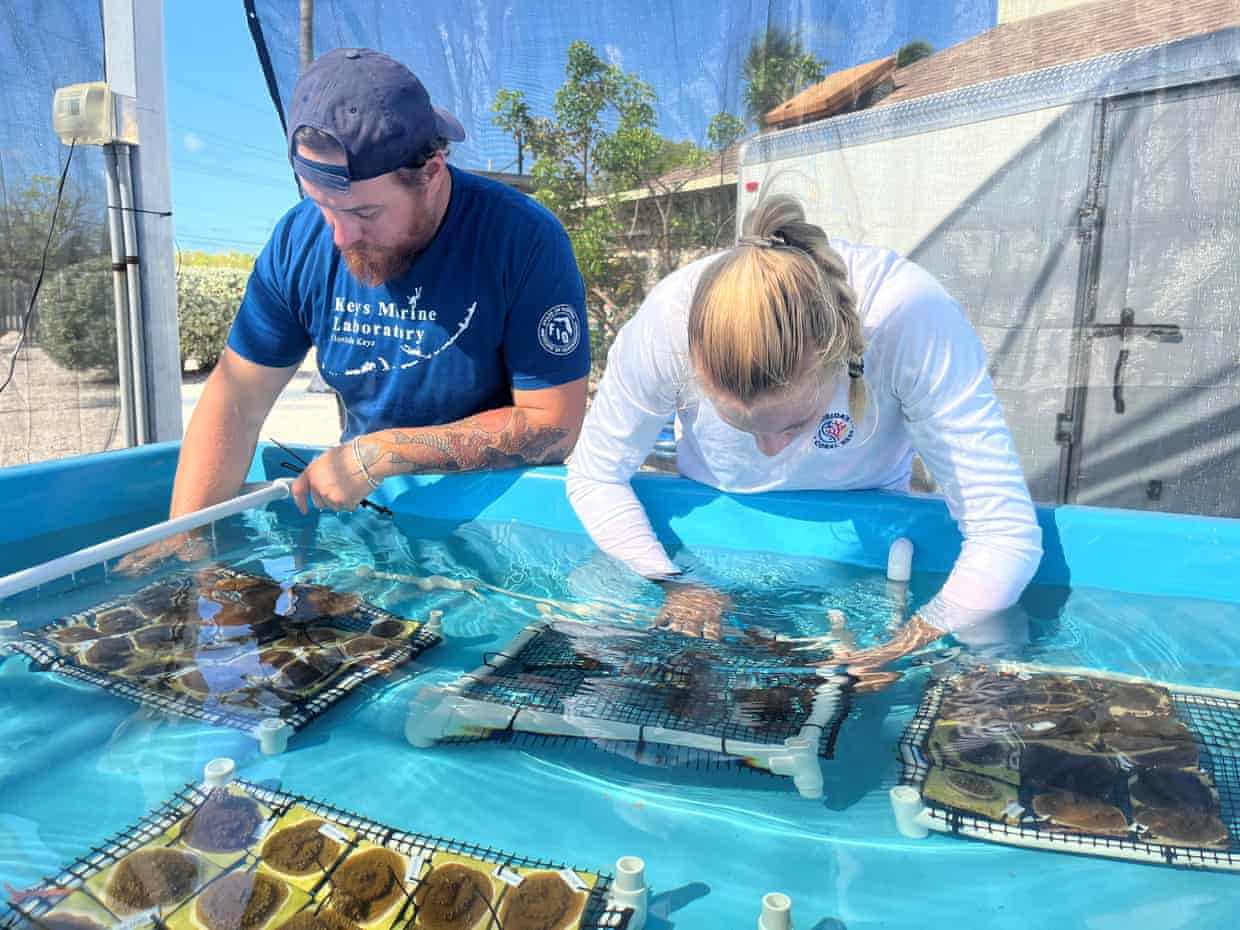
Photo: Keys Marine Lab.
Experts inspect nursery-grown juveniles from the reef-building elkhorn coral species.  They’re testing them to withstand warmer temperatures.

Scientists don’t give up, do they? They will surely have a harder time without federal grants, but I hope they will find ways to keep improving life on Planet Earth.

Take this effort to address the damage that global warming poses to coral. Richard Luscombe reports at the Guardian that a group pf experts are seeking “to save Florida’s dying reefs with hardy nursery-grown coral.”

“A taskforce of experts looking into the mass bleaching and decline of Florida’s delicate coral reefs is planting more than 1,000 nursery-grown juveniles from the reef-building elkhorn species in a new effort to reverse the tide of destruction.

Record ocean heat in 2023 hastened the death spiral for reefs in the Florida Keys, which have lost 90% of their healthy coral cover over the last 40 years, largely because of the climate emergency, according to the National Oceanic and Atmospheric Administration (NOAA).

“Marine biologists from the Keys Marine Laboratory of the University of South Florida (USF) partnered with scientists from Tampa’s Florida Aquarium to develop a large-scale restoration project involving elkhorn coral, which is critically endangered but also one of the fastest-growing and most resilient species.

“[In May], the USF facility in Long Key, halfway along the ecologically fragile Florida Keys island chain, took delivery of 1,050 young elkhorn corals spawned between 2022 and 2023 at the aquarium’s conservation and research center in Apollo Beach.

The corals are acclimatizing in temperature-regulated seawater beds in Long Key.

“They will be distributed to research partners including the Coral Restoration Foundation, the Mote Marine Laboratory, Reef Renewal USA, and Sustainable Oceans and Reefs for planting at seven designated offshore sites around the Keys during the next two months.

“Teams will monitor their progress over the following months and years. While project managers say not all will survive, they hope some of the juveniles will thrive and grow, and the knowledge gleaned will help better inform future recovery efforts.

“ ‘Maybe there will only be 100 out there a year from now, but even if it’s only one out of a hundred that survives that’s particularly tough, we can propagate that one,’ said Cindy Lewis, director of the Keys Marine Laboratory. …

“ ‘The coral juveniles we just transferred are made up of many new mother and father combinations that we hope will be more resilient to future stressors,’ Keri O’Neil, director of the [Florida Aquarium] coral conservation program, said.

” ‘Without human intervention, these parent corals would not be able to breed due to the extent of the loss. They’re a sign that, even during a crisis, we can make a difference. By working together we’re protecting a reef that’s essential to our environment, our economy and the thousands of species that call it home.’

“Lewis said the elkhorn project was a small component of a vast wider effort by numerous universities, environmental groups, and state and federal partners to try to restore as much lost coral as possible. …

“ ‘All these different organizations produced over 25,000 pieces of coral this winter to put out on the reef that are going to make a difference, along with our elkhorn.

“ ‘Even though it seems dismal and depressing, the ray of hope is that we can produce these corals, we can get these corals out there, and that everybody has banded together to work together. No one organization is going to do it all. We need everybody, and we need everybody’s ideas.’ “

More at the Guardian, here. No firewall.
Read Full Post »

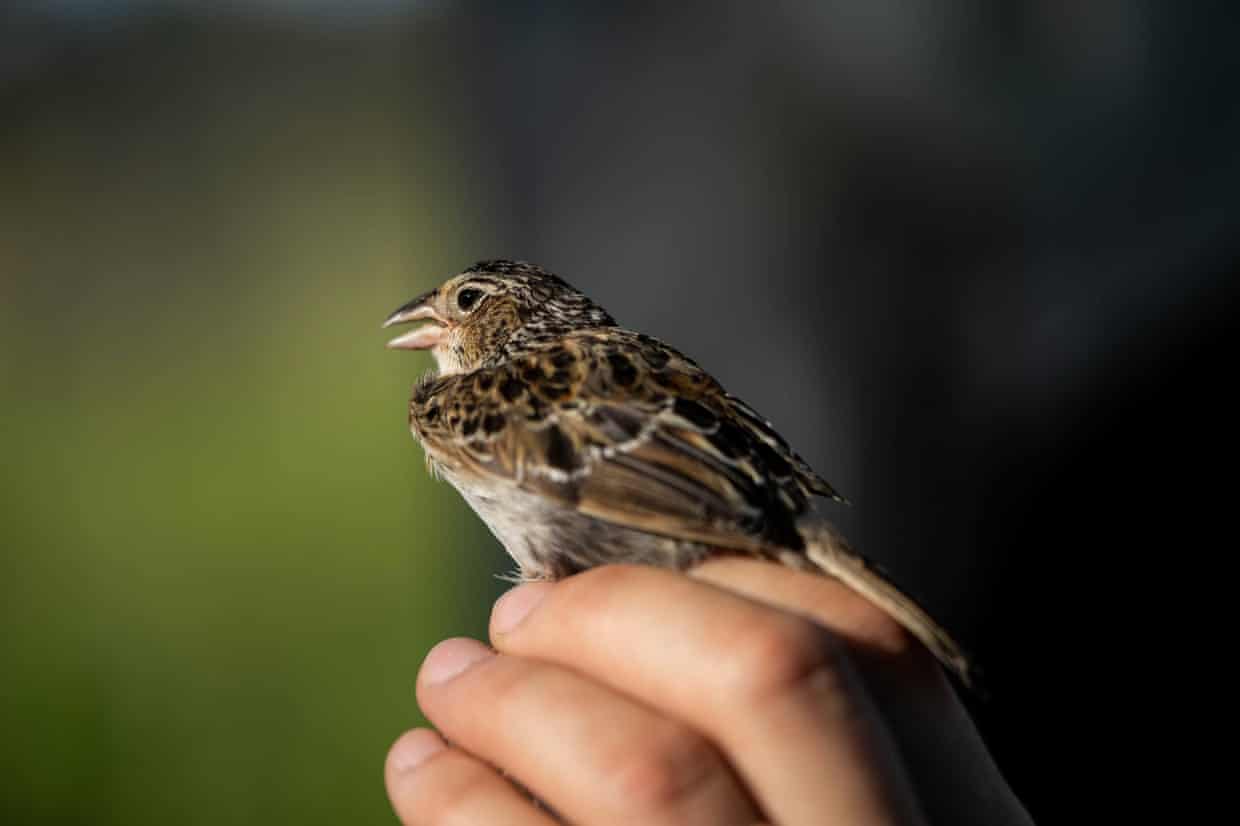
Photo: Carlton Ward Jr.
A grasshopper sparrow in Florida. 

Continuing on the subject of endangered birds, let me introduce Florida’s grasshopper sparrow. Now, you may think that with all the troubles in the world, the future of the grasshopper sparrow is the least of your worries.

But I like how the story represents bigger things — how we can make the world better if we try, how there are people who devote their lives to some small area that has big implcations.

Richard Luscombe writes at the Guardian, “Scientists in Florida are hailing the landmark release this week of a tiny bird only 5 inches tall as an oversized success in their fight to save a critically endangered species.

“Numbers of the Florida grasshopper sparrow, seen only in prairies in central regions of the state, dwindled so severely by 2015, mostly through habitat loss, that authorities took the decision to remove remaining breeding pairs into captivity. Their wager was that a controlled repopulation program would be more successful than leaving the birds to their own devices.

“[Their] gamble was rewarded. Partners joined the Florida Fish and Wildlife Conservation Commission (FWC) to release into the wild the 1,000th bird bred under controlled conditions, adding to an increasingly stable population that researchers believe has turned the tide towards the species’ survival.

“ ‘The recovery and release program diverted the extinction of the Florida grasshopper sparrow,’ said Adrienne Fitzwilliam, lead sparrow research scientist at the FWC’s fish and wildlife research institute.

“The fear was we might just be expediting their demise by bringing in proven breeders, so to see these birds making it in the wild, breeding with wild birds and other release birds, and their offspring going on to breed, has just been incredibly rewarding.’ …

‘Releases, which began in 2019, have taken place at three sites, with the newly freed birds monitored by patient teams of observers with binoculars and lawn chairs at two more. Birds are released in batches at about 40 days of age and, Fitzwilliam said, quickly set about setting up their ‘territory.’

“ ‘There’s a lot of sitting and waiting and watching because their nests are incredibly hard to find,’ she said.

“At the Avon Park military range south of Orlando where the milestone release took place this week, researchers have this year recorded 16 nesting pairs and 30 ‘singing’ males looking for a mate.

“At Three Lakes wildlife management area, the program’s first release site where once only 11 pairs were present, the observers found 40 pairs and 68 males, and are hopeful of more with the breeding season still in progress. …

“ ‘These numbers mean released birds successfully survive, breed and raise young in the wild, which is a huge success,’ Fitzwilliam said. ‘It has diverted extinction and allows partners to research possible landscape-level solutions.’

“Grasshopper sparrows, per their name, eat mostly grasshoppers and seed, and according to the FWC, the loss of large areas of prairie habitats to agriculture fields has vastly reduced their range and numbers. … FWC’s program partners, which include Audubon, White Oak Conservation and the Fish and Wildlife Foundation of Florida (FWF), are researching potentially beneficial land management practices such as roller chopping, which prepares land for controlled burns and speedier regeneration of native grasses. …

“News of the recovery of grasshopper sparrow numbers follows an upbeat report by a coalition of prominent universities for the future of Florida’s wildlife, if the climate emergency is mitigated properly.

“Andrew Walker, FWF president and chief executive, said: ‘These little birds represent a big beacon of hope that our commitment, partnership and holistic approach can save vulnerable wildlife from the brink of extinction.’ “

More at the Guardian, here.

Read Full Post »

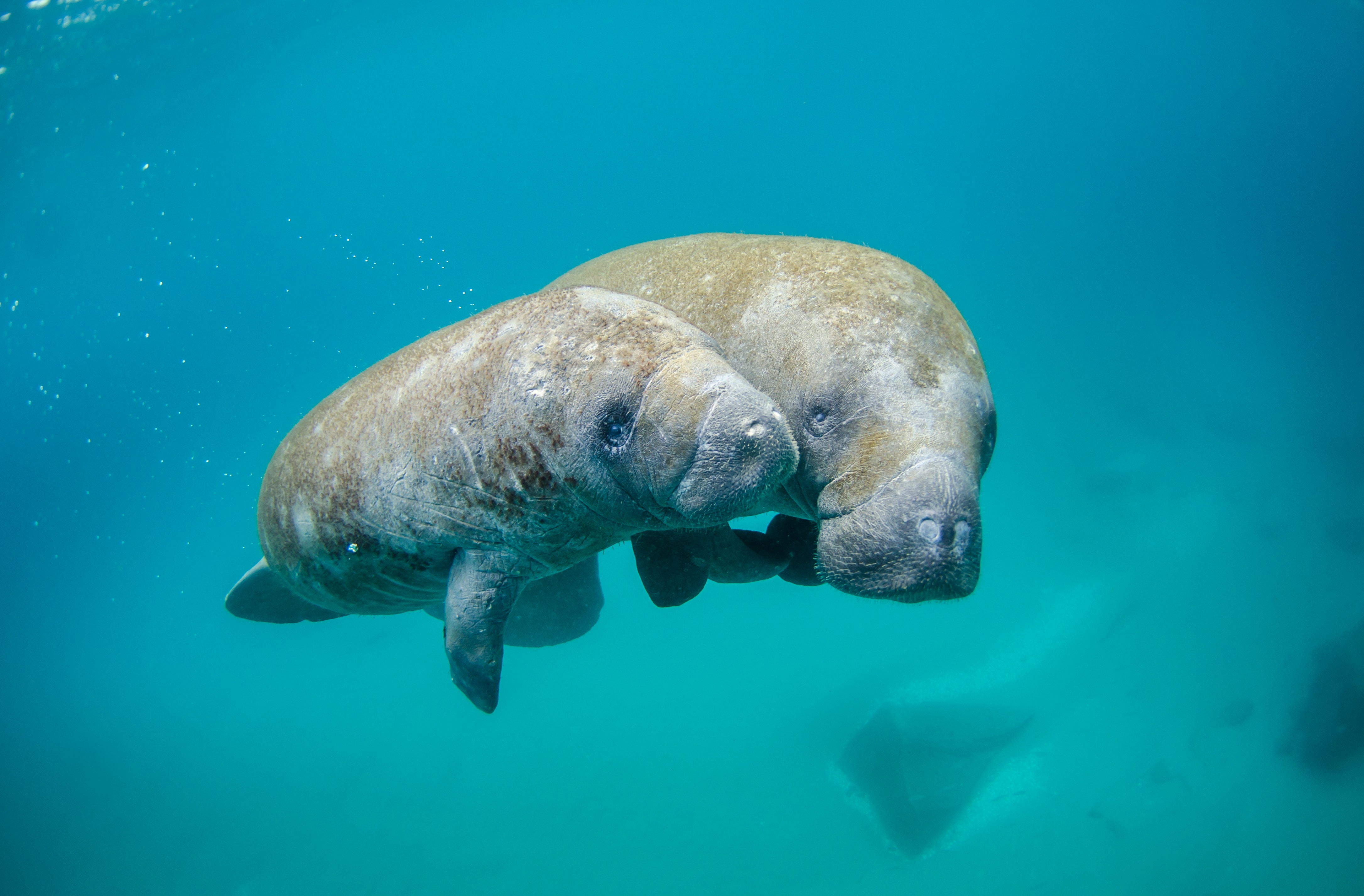
Photo: NOAA [National Oceanic and Atmospheric Administration].
The return of seagrass in Florida is a hopeful sign for the embattled manatee.

One doesn’t normally think of Florida politicians as being big environmentalists, but whatever their motivations for supporting cleaner water, one has to cheer them for putting some funding behind it. Florida treasures like the manatee need the help.

Richard Luscombe reports for the Guardian, “A picturesque expanse of water along Florida’s space coast is offering a modicum of hope for the state’s embattled manatees as wildlife officials review whether to restore the beloved sea cows to the endangered species list.

“The recovery of seagrass, the manatees’ favorite food, in Mosquito Lagoon means that an emergency hand-feeding program that has kept many of the starving aquatic animals alive over the last two winters can be discontinued, at least temporarily.

“While scientists say this might be only a small step in the wider fight to rescue a species that has seen a record die-off in recent years from water pollution and habitat loss, what’s happened at Mosquito Lagoon offers signposts to how the manatees’ battle for survival might ultimately be won.

“ ‘At least in a portion of the lagoon, we are seeing a rather rapid resurgence of the Halodule variety of seagrass that, even if we don’t know exactly how it happened, does tell us that it’s much more resilient than we might have been thinking,’ said Dennis Hanisak, a professor of marine botany at Florida Atlantic University’s Harbor Branch Oceanographic Institute, and director of its seagrass nursery. …

“Hanisak and his team, in partnership with the Florida fish and wildlife commission (FWC), have focused their restoration efforts on the lagoon in northern Brevard county, one of the most popular feeding grounds for manatees during the colder winter months.

“That’s where the majority of manatee deaths, an unprecedented 1,100 in Florida in 2021, 10% of the population, and another 800 in 2022, occurred. They were part of what federal and state authorities classify as an ongoing unusual mortality event (UME) with the majority of fatalities through malnutrition and starvation, a reflection of the loss of about 90% of the lagoon’s seagrass to algae blooms and pollutants.

“It’s too early to say exactly what role the seagrass nursery project has had there; Hanisak says it has ramped up in size and resources in recent years as wildlife agencies respond to the disaster with improved funding.

“It’s one of several projects underway in Florida [and] a prominent component of a catalog of FWC manatee habitat restoration schemes, themed mostly around improvements in water quality and aquatic vegetation, that experts believe has potential to turn years of declining numbers into a robust recovery. …

“[In January], Florida’s governor Ron DeSantis announced a $100m award of state funds for water-quality improvements in the Indian River Lagoon, one of North America’s most biologically diverse waterways. The cleaner the water, the better the seagrass. …

“Hanisak and his students have steadily been building the capacity of the seagrass nursery at multiple locations. That seagrass will ultimately be transplanted into the Indian River Lagoon and elsewhere. …

“It remains to be seen if this year’s drop in manatee deaths in Florida is a one-off, or represents the start of a recovery. But more abundant seagrass in Mosquito Lagoon, which led to the welcome suspension of the experimental lettuce-feeding project, bodes well.

“Lawmakers also appear to be at least partly on board. Thompson said the Florida legislature provided an additional $20m in fiscal year 2022-23 to the FWC to enhance captive manatee support facilities and manatee habitat enhancement to supplement the previous year’s $8m. …

Patrick Rose, a veteran aquatic biologist and executive director of the Save the Manatee Club [said] the extra funding, which his group lobbied for, is welcome [but] ‘a drop in the bucket literally to what needs to be done.’ Ultimately, Rose said, manatees need clear, clean water to survive. Without it, seagrass will not flourish. …

“ ‘Nutrients are the direct cause of harmful algal blooms which have been so intense that they literally cut the light off to the seagrasses, and the seagrasses die,’ he said.”

More at the Guardian, here.
Read Full Post »

Photo: Coral Restoration Foundation.
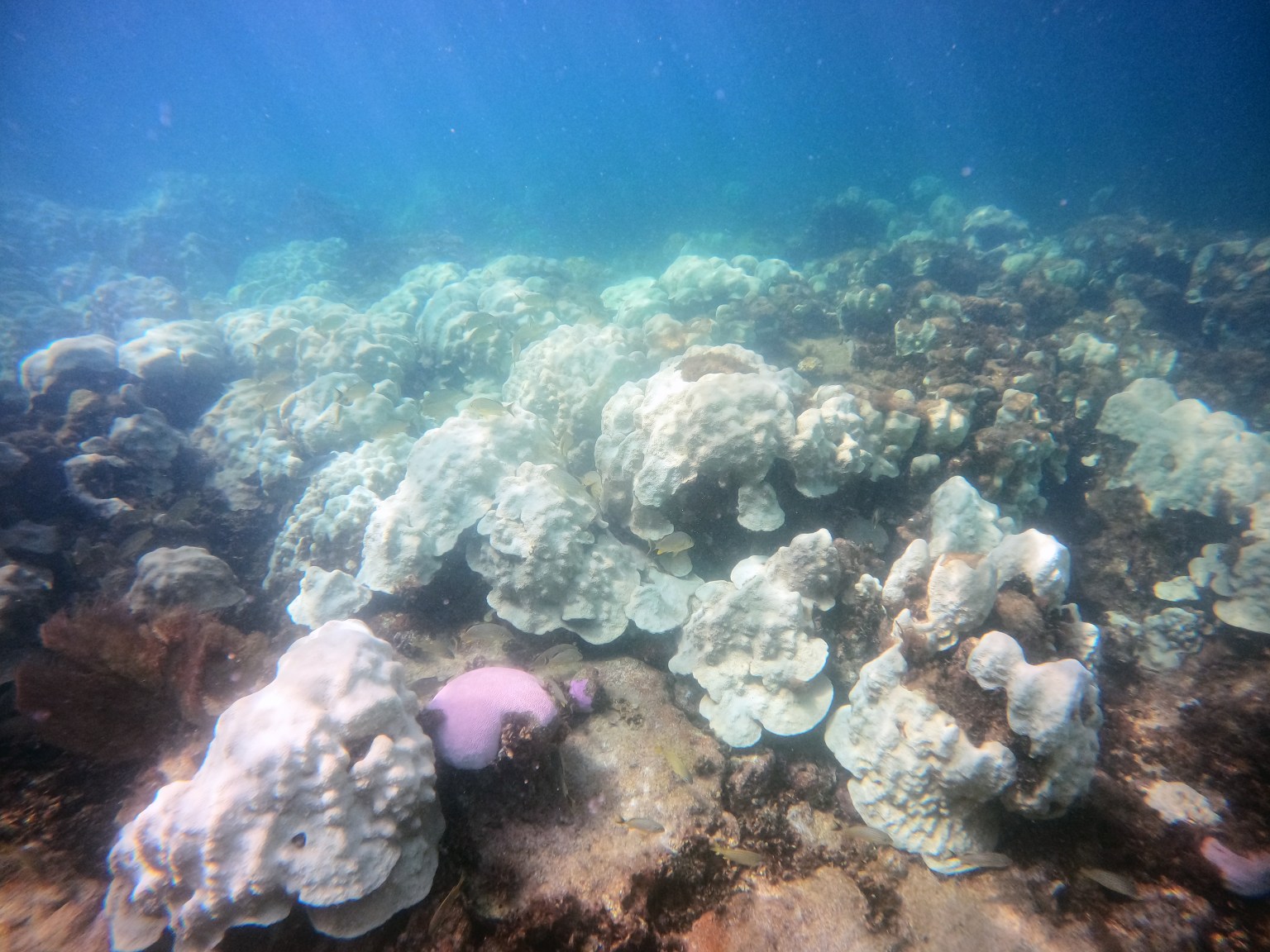
Severe bleaching and mortality in the Middle Florida Keys. Photo taken on July 24th.

One doesn’t always think of television news as going deep on a serious and complex problem, but I have to give credit to Florida’s WFLA for taking on dying ocean reefs. The sad tale makes me think we humans are like lobsters who don’t notice the water is boiling until it’s too late.

“Once colorful coral cities overflowing with marine life, transforming into ghost towns, or better stated, ‘Ghost reefs’ seemingly overnight.

“ ‘We are surprised by the pace. It is unprecedented what we have seen,’ said Scott Atwell the communications and outreach manager for the Florida Keys National Marine Sanctuary.

“Atwell told WFLA Chief Meteorologist and Climate Specialist Tuesday: ‘We’ve never seen anything like this. Some are not even bleaching, they are going straight to dead.’

“ ‘Straight to dead’ illustrates just how extreme the marine heatwave is and how quickly it’s evolving. When under stress, typically coral bleach first, expelling their symbiotic algae partners which give them their vibrant hues, and turn white. Then sometime later, if the heat persists, the coral can succumb and die.

“But right now in the Florida Keys, there are reports of rapid mortality. Coral is dropping like dominoes across much of the reef tract from Key Largo to Key West – the third largest tract in the world and the only shallow water reef system in the U.S. mainland.

“About 25% of marine life depends on coral reefs during some stage of their life. If coral reefs vanish it will have cascading consequences across ocean ecosystems and the life that it supports. …

Mission: Iconic Reefs, a large-scale NOAA-led coral restoration initiative reports that the most recent seafloor temperature at Sombrero Key (off Marathon) is 93.4F and at Looe Key (off Big Pine Key) is 89.6F. According to Mission: Iconic Reefs the ‘optimal’ temperature for reef-building corals maxes out at 84 degrees.

“Although tropical corals live in warm water, they are very sensitive to just a couple of degrees Fahrenheit spike in sea surface temperatures, especially if it lasts for too long. NOAA Coral Reef Watch says at four weeks, coral can begin to show signs of stress. If the heat last eight weeks, a bleaching event becomes likely. [In July, we passed] the eight-week mark. …

“Bill Precht is a coral reef scientist in South Florida. In his 45 years studying coral, he’s never been so concerned about the Keys’ iconic reefs, ‘If things progress as they have started … the likelihood of catastrophic levels of mortality are high.’

“As a result of this unprecedented event, NOAA Mission: Iconic Reefs and their partner organizations are racing against the clock to rescue coral from the reefs and bring specimens into the lab where they can buy some time until the ocean cools back down.

“So the natural question is, when the coral die, can they recover? Dr. Katey Lesneski, the Coordinator of NOAA Mission: Iconic Reefs was asked that question by PBS News Hour and here’s what she said, ‘Once they die there are other reef organisms that will settle on that skeleton, take up space, and the coral tissue cannot grow back, unfortunately.’

“So the teams are taking drastic measures to gene bank two fragments from each unique genetic individual of staghorn and elkhorn corals, listed as threatened under the Endangered Species Act. In other words, they are preserving the genetic material so that if much of the coral is lost, there is a way to restore it.”

More at WFLA, here. Startling graphs. No firewall.

Read Full Post »

Photo: University of South Florida.
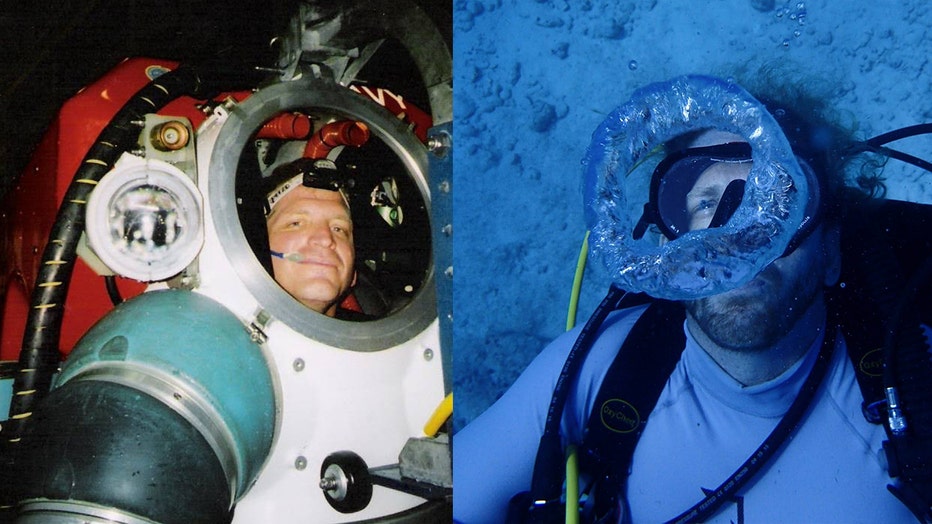
Joseph Dituri retired from the Navy as a commander after 28 years and went back to school. He is now a hyperbaric medicine researcher and associate professor at the University of South Florida.

How much do you love the ocean? Enough to live in it for more than 75 days without coming up? In May, Kyle Melnick at the Washington Post wrote about a guy who did that.

“Joseph Dituri, a hyperbaric medicine researcher and associate professor at the University of South Florida, has been living in an underwater pod in Key Largo, Fla., since March 1. He’s exploring whether living underwater is possible through daily tests on his brain, heart, lungs and blood.

“On [his] 73rd day at Jules’ Undersea Lodge — Dituri believes he broke the world record for the longest stint living underwater. But Dituri, 55, is still determined to live submerged for 100 days to complete his experiment.

“ ‘It’s not about the world record,’ Dituri told the Washington Post. ‘It’s about living underwater and in an isolated, confined, extreme environment. I have 100 days as the mark, but it’s only because I couldn’t afford to spend 200 days.’

“Dituri has long been fascinated with water. He grew up near the Atlantic Ocean in Long Island and served in the U.S. Navy for nearly 28 years before retiring as a commander in December 2012.

“Around that time, Dituri was scuba diving near Orange County, Calif., when he said he saw an 11-inch sea lice. He had believed all sea lice were only a few millimeters long. He wondered what other species he could discover in the sea.

“Dituri knew living underwater was possible. In 2014, two Tennessee professors stayed in Jules’ Undersea Lodge, an underwater hotel in Key Largo, for 73 days. Since watching his military colleagues suffer concussions during the wars in Iraq and Afghanistan, Dituri has studied treatments for traumatic brain injuries. He wondered whether living underwater in a pressurized environment could aid brain injuries. …

“Dituri needed more degrees to become a researcher, so he earned a PhD in biomedical engineering from the University of South Florida in December 2017. In 2019, Dituri and four friends stayed at Jules’ Undersea Lodge for five days to test underwater life. But Dituri wanted to be submerged longer, and by himself, to see how his brain and body would respond. …

“Before Dituri went underwater, doctors recorded his vitals, including blood pressure, cholesterol, calcium levels, muscle inflammation and stem-cell health. He also underwent anxiety and depression exams with psychologists.

“Dituri booked a 100-square-foot pod — similar to a 10-by-10-foot room — that rests 22 feet underwater. The lodge gets electricity, oxygen and water from a cord connected to land. Dituri also attached an ethernet cable to a router on land for internet access. The pod has a small kitchen, toilet, shower and bedroom.

“Every three days, Dituri said his research colleagues swim to his pod to deliver food, including eggs and salmon, in a pressurized container. But Dituri can only cook in a microwave because of the increased pressure in the sea. He also makes Café Bustelo coffee every morning. Dituri still teaches his hyperbaric medicine and biomedical engineering classes virtually three days per week for the University of South Florida.

“He exercises with resistance bands and takes vitamin D supplements. But his main research has come from tests on his body. He frequently takes urine samples and has undergone electrograms, which record brain and heart activity. …

“Dituri said that his cholesterol and stress have dropped, that he spends more of his rest in REM or deep sleep, and that he has produced stem cells at a faster rate. …

“Still, Dituri has missed human touch. He only sees his girlfriend and three daughters virtually. … On Saturday, Dituri’s 80-year-old mother, Mary, will take a scuba-diving course so she can visit her son.”

More at the Post, here.

Read Full Post »

Photo: Sydney Walsh for NPR.
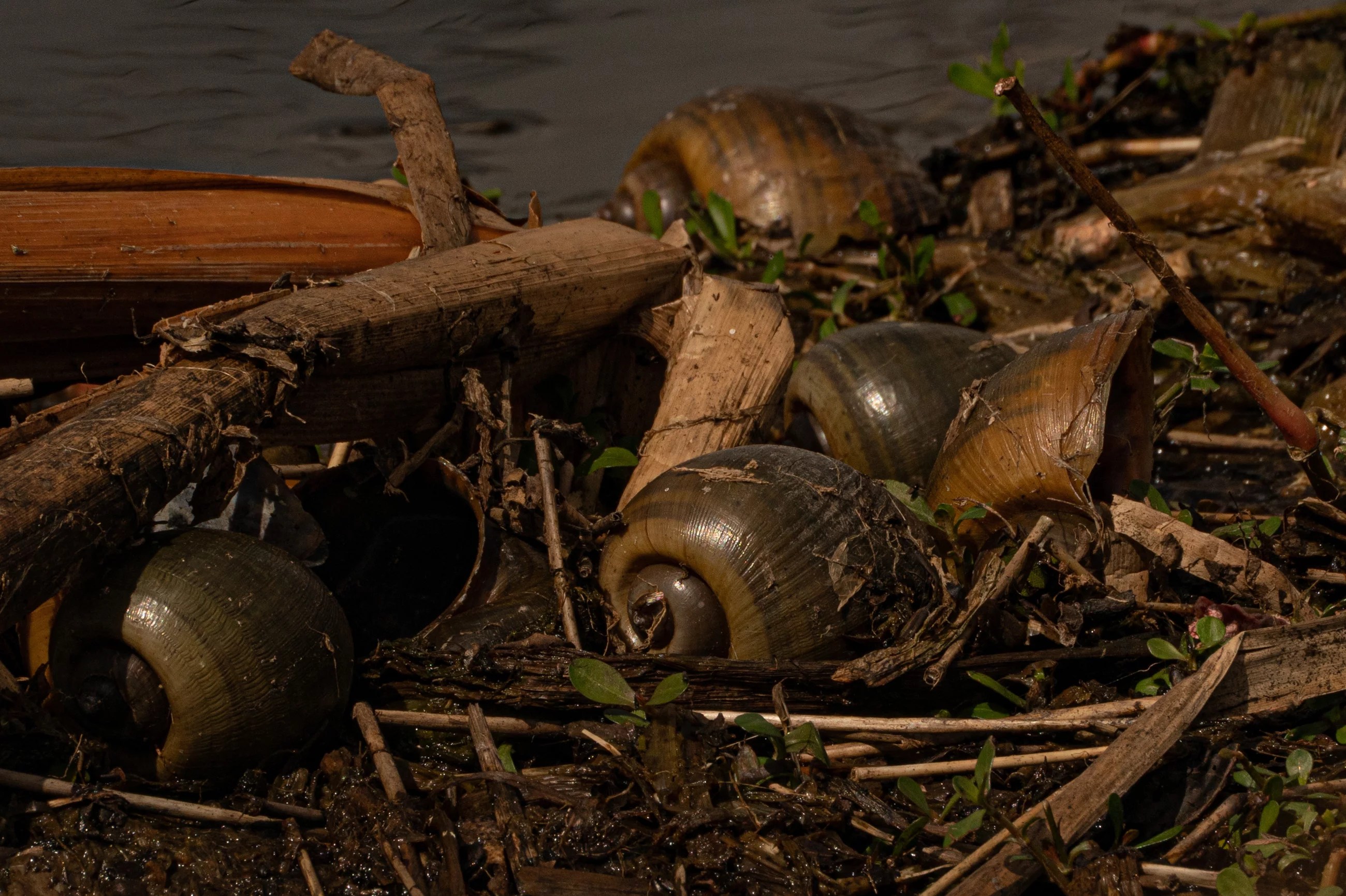
Apple Snail shells along the banks of Lake Okeechobee in Moore Haven, Fla. The snails are an invasive species, but they are helping an endangered bird stage a comeback.

“It’s an ill wind that blows nobody good.” We don’t like invasive species as a rule, but in today’s story, one kind is saving an endangered bird. Proving once again that life is complicated.

Greg Allen reports at NPR (National Public Radio), “In Florida’s Everglades, few species are more closely tied to the habitat’s health than an endangered bird, the snail kite. The Everglade snail kite is a raptor, similar to a hawk, that eats just one thing: snails.

“Over the last century, as much of the Everglades was drained, the bird’s population declined precipitously. But the kite has bounced back recently thanks to an exotic snail. It’s a rare case of an invasive species having a positive impact.

Robert Fletcher, a University of Florida professor who directs a snail kite monitoring program, says the invasive species was first spotted in 2004. Within a few years, it had expanded through much of the Everglades. ‘And it was around that time,’ he says, ‘that we started to see snail kite number increase.’

“Few people pay closer attention to the snail kite than Tyler Beck. He manages Florida’s the endangered bird’s population for Florida’s Fish and Wildlife Conservation Commission. On the western edge of Lake Okeechobee, Tyler Beck uses an airboat to motor through marshes looking for kites. … Overhead, [one] alarmed kite makes a rapid clicking call as it hovers and swoops over the airboat.

“University of Florida researcher Brian Jeffrey wades through thigh-deep water toward the area he thinks the nest might be. Jeffrey directs a field team that monitors Florida’s snail kite population. He finds the nest, but it’s 20 feet up, too high to count the eggs or see if any have hatched. Other members of his team will be back soon with a ladder to check on the nest.

“Jeffrey has three field teams that cover thousands of square miles counting and tracking Florida’s snail kites. The kites—and the field teams–range from Everglades National Park on the southern tip of Florida all the way up to Paynes Prairie Preserve State Park, near Gainesville. …

“Snail kites aren’t flashy. Males are a slate gray, females a splotchy brown. They get their name from their ability to seemingly float in the air. They were one of the last bird species discovered in the U.S. because of where they live, often hidden in the Everglades.

“Beck says the species is uniquely adapted to subsist almost entirely on a resource usually abundant in the freshwater marshes: apple snails. ‘They have these really long talons that hook around the shell and get a good grip on it to lift it out of the water and carry it away,’ he says. And, they have a long, hooked bill they use to pry the snails from their shells.

“Over the past century, as much of their habitat was drained and water stopped flowing through parts of the Everglades, the snail kite population plummeted. It was one of the first birds put on the endangered species list in the 1960’s. Droughts contributed to the snail kite’s decline and by 2007, there were fewer than 800 remaining. ‘Right shortly after that though, this invasive snail came in, and just started flourishing, getting into every wetland, having these big population booms,’ Beck says. …

“Beck eases the airboat up next to a willow tree where he’s spotted a nest. Standing in the boat, this one is at eye level. He says, ‘We’ve got two little nestling snail kites. These are probably about ten days old. The parents, you can hear them over us, they’re upset that we’re at their nest.’ Beck and Jeffrey mark the location, water levels, height of the nest and then motor away. The parents soon return, carrying snails.

“No one’s sure about how the exotic snails were introduced into the Everglades. They’re related to Florida’s apple snails and are commonly used in home aquariums. The invader, the Island apple snail, is found in similar habitat in South America and is larger than its Florida cousin. …

“Efforts to restore Florida’s Everglades have helped the snail kite, bringing back native vegetation and restoring the flow of water to once-parched marshes. It’s been in the works for more than 30 years with a cost of more than $20 billion. But progress is incremental and hard to measure. In the meantime, scientists say the invasive snail may have saved the snail kite.

“But University of Florida scientist Robert Fletcher is concerned about the potential impact the species will have on the Everglades over the long-term. He says, ‘What we should be thinking about is how do we restore native snails to get those benefits.’ “

More at NPR, here. Lots of pictures. No firewall.

Read Full Post »

Photo: Stephanie Hanes/The Christian Science Monitor.
A jogger runs on a path in Babcock Ranch, Florida, on Nov. 3, 2022. Babcock Ranch, which calls itself America’s first solar-powered town, survived Hurricane Ian with little to no damage.

When does the bottom line get in the way of building something to last? Too often.

But there are always outliers. At the Christian Science Monitor, I learned recently about housing developers in Florida who give “careful consideration of how the built environment will respond to an increasingly harsh climate.”

Stephanie Hanes writes, “As Hurricane Ian moved toward Florida’s west coast in late September, Amy Wicks drove around this rapidly growing community, trying to figure out what she hadn’t thought of yet. She checked for any debris that might be blocking water runoff paths; she took note of the restored wetlands; she hoped that no alligators had taken up residence in the drain pipes.

“Eventually, she returned to her own home here, hunkered down with her husband and three children, and listened as freight train winds moved over Babcock Ranch, a 4-year-old planned community some 20 miles inland from Fort Myers. At that point, she says, she could only hope that the unique storm water system she had designed and monitored over the past decade would be up for the task. …

“The storm sat overhead for nearly 10 hours, dumping more than a foot of rain on this swath of old Florida cattle ranches and newly built cul-de-sacs.

“By the time it subsided, it was clear that something extraordinary had taken place in Babcock Ranch. Created as a sort of laboratory for green development in Florida, and intentionally designed to survive extreme weather, the town proved remarkably resilient in the face of a Category 4 hurricane.

“Unlike surrounding areas, it did not flood, in large part because of Ms. Wicks’ years of planning and her unique stormwater management design that mimicked natural systems rather than fighting them. It did not lose power, thanks not only to its 700,000-panel solar grid and battery backup system, but also to the power line hardening developers undertook with their utility provider, Florida Power and Light. And because Babcock Ranch owns and operates its own water plant, which also survived the storm, it was the only town in Charlotte County that did not go under a boil-water alert. …

“Across the state, there is a small but growing effort to build more resilient communities in Florida – an effort to shift a yearslong pattern of rapid development that many here say exacerbates water shortages and other environmental risks. …

“With a constant flow of new homebuyers – an average of nearly 1,000 people move to Florida each day, according to oft-repeated state statistics – developers have tried to acquire as much land as possible, and as quickly as possible. That often means buying up faded ranches or long-ignored swaths of swamps and forest – green-covered lands that must be flattened and cleared to make way for housing developments and roads and shopping centers.

“Indeed, to meet building codes that require homes to be graded above street level, developers will typically bulldoze the landscape, dig storm ponds, and then use the fill from those holes to prep building sites, explains Timothee Sallin, co-CEO of Cherrylake, a landscape company working across the Southeast that has become a leader in sustainable design.

“Traditionally, developers would replant that denuded landscape with the types of species that outsiders tend to think about when they imagine Florida – green St. Augustine grass, colorful azaleas, draping bougainvillea. The problem, Mr. Sallin says, is that these plants aren’t native to the state, so they require a lot of inputs to stay healthy, such as water, fertilizer, and pesticides. They also struggle to thrive in soil devoid of organic material and nutrients.

“ ‘The developers have to mass grade a site to build efficiently and economically,’ he says. ‘The most efficient thing to do is to raze it and bring in fill. But that creates soils that are difficult to work with.’

“Meanwhile, because the natural topography of the land has been erased, and the natural water collection systems of wetlands and marshes eliminated, the man-made drainage system becomes the only way to capture water. This can be a problem in some storms – particularly those with unusually heavy rains thanks to climate change.

“All of this, says [Jennison Kipp, a resource economist with the University of Florida and the state coordinator for Sustainable Floridians] creates a system without resilience, suffering from both too much and too little water. ‘The landscapes are on life support,’ she says. …

“According to the state’s central water authority, the region will face a 235 million gallon a day shortfall by 2035 unless demand and usage patterns change. This is one of the reasons why when 27,000 acres of ranch land came up for development just south of Orlando – part of a 300,000 acre swath owned by the Church of Jesus Christ of Latter-Day Saints – executives at the development company Tavistock decided to approach the project differently. …

“To plan Sunbridge, which is about two-thirds the size of Washington, D.C., [Clint Beaty, senior vice president of operations for Tavistock and the lead on the Sunbridge project] and others at Tavistock coordinated with representatives from the University of Florida’s Institute of Food and Agricultural Sciences, the Sustainable Floridians, and other groups. They came up with a plan to use native landscaping – even eschewing the popular St. Augustine grass for the more drought and heat resilient (although occasionally browner) Bahia grass. They are saving and relocating some of the old live oak trees on the property. All of the new homes will be wired for solar panels and electric vehicle plug-ins, and one model house version boasts Tesla solar shingles and a battery backup system.

“Meanwhile, to help move away from fertilizers, scientists have built a living laboratory along a walking path at the development’s community center, called Basecamp, where they are testing the viability of different species of native plants as well as different sorts of compost amendments to soil and the impact on pollinator species. Mr. Beaty is also working to figure out how to arrange for large scale composting and food-waste recycling for the community.”

More at the Monitor, here. No firewall. Subscriptions welcome.

Read Full Post »

Photo: federico-giampieri-R0lftflMYPw-unsplash.
Generations share the love of fishing.

Today’s story is about a guy who provides outings to fatherless children — on Father’s Day and year-round.

Cathy Free wrote about him at the Washington Post.

“It was hard not to notice the 8-year-old boy across the street who stormed in and out of his own house. The boy, a neighbor of William Dunn in Lakeland, Fla., did it often enough that Dunn wanted to see if he could help.

“ ‘I wondered what was going on in his life, so one day, I decided to ask him,’ said Dunn, 57. ‘He told me that he didn’t have a father, and I realized there might be something I could do for him.’

“Dunn had grown up fishing with his dad and had helped him for a time with his lobster business in the Florida Keys.

‘Fishing always brought me peace and it taught me how to be patient,’ he said. ‘When you’re on the water, you can forget about your problems and just appreciate the moment.’

“Dunn, who has three children of his own, approached the boy’s mother and asked for permission to take him fishing.

“One Saturday afternoon on the water soon led to another, and pretty soon he was teaching the boys’ friends and other kids in the neighborhood how to rig a line, hold a fishing pole and reel in a big catch. That was 15 years ago.

“Since then, he’s taken groups of kids out almost every weekend to fish. Most of them didn’t have father figures in their lives, and had never fished before.

“Some of them were foster kids who had shuffled for years from one home to the next, he said. ‘They’d been through a lot and they’d seen a lot, and their lives were difficult,’ Dunn said. ‘But when they were fishing, all of that faded away.’ …

“In the beginning, Dunn spent a good chunk of his paycheck from his job selling tires to help fund the weekend fishing expeditions on charter boats, he said. Then in 2018, he started the nonprofit Take a Kid Fishing Inc. in Lakeland, a city with dozens of lakes located between Tampa and Orlando.

“In the past 3½ years, he and a small group of volunteers have introduced more than 2,500 kids — most without fathers around — to the experience of spending peaceful time on the water, and the exhilaration of nabbing a fish. …

“ ‘I’m the youngest of six and I always had a great relationship with my dad,’ he said. … ‘He told me that fishing isn’t about what you catch — it’s about the memories you make.’ …

“Through public and private donations to his nonprofit, he said he’s able to go deep-sea fishing with up to 20 kids at a time, or take smaller groups on Saturday lake outings on a charter boat.

“ ‘We only keep the fish we need and toss the rest back,’ he said. ‘And at the end of the day, I’ll help to fry up the catch and feed the kids fish tacos for dinner.’ …

“Terra Pryor of Lakeland, Fla., said all three of her children have struggled emotionally since their dad, Richard Pryor, died in a car accident in January 2020. ‘I was especially worried about my son, Jayden, who was 10 then,’ said Pryor, 32. ‘He was really close to his dad and felt he needed to take over the man of the house role immediately … I was wondering what to do to help him, and then I learned about Take a Kid Fishing.’

“Jayden, now 12, has become a devoted fisherman thanks to regular outings with Dunn, he said.

“ ‘Will has helped me to grow by taking me fishing,’ he said, noting that he once caught a shark that Dunn helped him to cut loose.

“ ‘I hope he knows I mean it when I say, “Thank you,” ‘ Jayden said.”

More at the Post, here.

Read Full Post »

Photo: Sciencing.
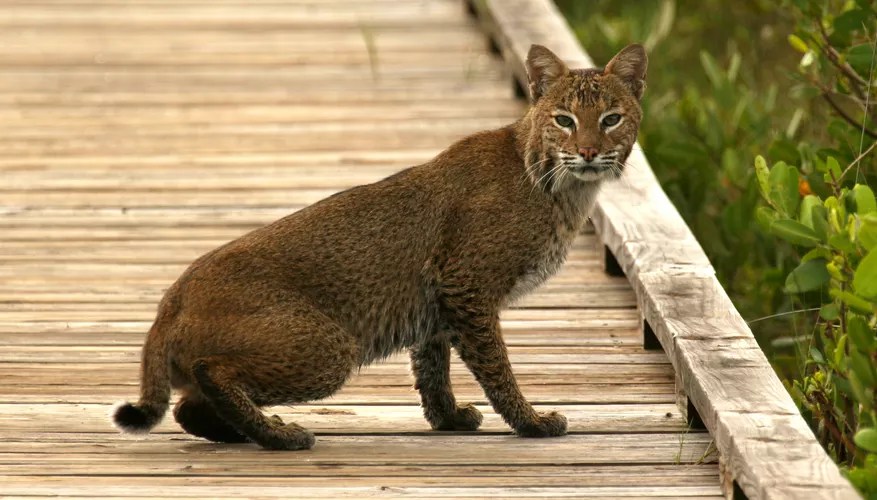
As boa constrictors from Latin America increase in Florida, bobcats that love boa eggs may help to keep them in check.

Story lovers of a certain age assume that the champion snake challenger of all time is the mongoose — to be precise, a brave cobra-fighting mongoose in India called Rikki-Tikki-Tavi.

But in Florida, where non-native boa constrictors are increasing, other snake predators are gaining attention. Recently, scientists were surprised to learn that one of them is the bobcat.

Matt Kaplan reports at the New York Times, “The voracious appetite of the invasive Burmese python is causing Florida’s mammal and bird populations to plummet. With little natural competition to control the big snake’s numbers, the situation looks desperate. But new observations suggest that the bobcat, a wildcat native to Florida, might be able to help.

“A team of ecologists collected evidence recently of a bobcat devouring python eggs in the Big Cypress National Preserve in Florida, and last month reported their findings in the journal Ecology and Evolution. It’s hard to say whether this individual cat was more adventurous than the average bobcat, but it suggests one potential way the python’s proliferation could be limited — by other animals eating their unhatched young.

“The event was captured by a motion sensitive camera that a team led by Andrea Currylow, an ecologist at the U.S. Geological Survey, deployed in June 2021 near the nest of a large female Burmese python. The camera had been put in place to better understand the reproductive biology of these huge snakes. A few hours after installation, the snake slithered away and the camera snapped shots of a bobcat arriving and eating python eggs during the early evening. …

“Apparently the feline decided that it rather liked what it had found because it came back for another snack three times that night. The next morning the bobcat returned to cache uneaten eggs in the ground to consume at a later date. That evening the bobcat returned again, but, this time, the python was back on her nest. Weighing about 20 pounds, the feline was clearly aware that the 115-pound python posed a serious threat and, rather than trying to eat more eggs, it padded around the nest at a safe distance for a few minutes before leaving.

“The next night the camera took a photo of the two predators in a face-off. Apparently, the bobcat felt the clutch was worth fighting for because it returned in the morning and aggravated the python enough to prompt an attack. …

“Precisely how the duel ended is unclear but when the researchers arrived that evening to collect the camera, they found the snake sitting on a badly damaged nest.

“ ‘We thought the snake must have caused the damage herself by somehow crushing her own eggs,’ Dr. Currylow said, ‘but then we saw the photos and, well, it was just incredible.’ …

“While it is possible that this interaction was just an isolated incident, it is also possible that native species are beginning to respond to the presence of the python. …

“Reptile eggs are already a part of the Florida bobcat diet. Bobcats are known to eat sea turtle eggs, and these may have similarities to python eggs. …

“Of course, the big difference between python nests and those of sea turtles is that the snake nests are usually guarded. But Dr. Currylow also points out that female pythons typically go without food until their eggs are about to hatch. That might be the main reason the bobcat survived its adventure.”

We’ll see. The boa may adapt, too. I remember how the mother cobra, Nagaina, felt about her eggs in the Kipling story.

More at the Times, here. For more on the boa invasion, check out the Smithsonian, too.

Read Full Post »

Photo: West Volusia Beacon.
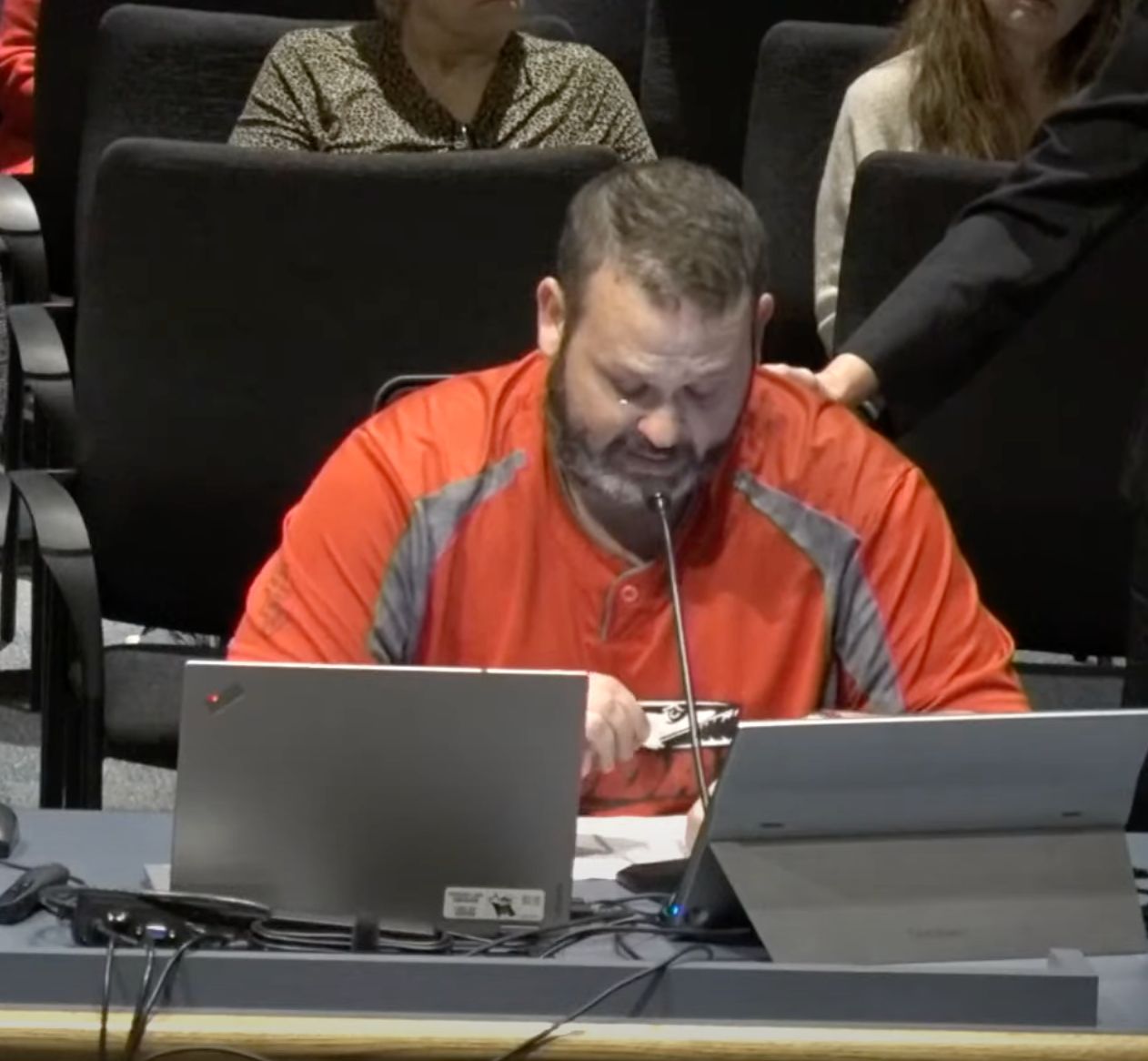
Charles Peacock, a paraprofessional at New Smyrna Beach High School, tells the Volusia County School Board that he has recently been made homeless.

It pains me to think how little most of those entrusted with educating America’s children — daycare professionals, teachers, teachers’ aides — are paid. We are talking about work that any country should give the highest respect and reward.

In today’s story, a popular Florida teaching assistant confesses that he cannot find housing on his income. The shame he feels should be for us.

Kyle Swenson wrote at the Washington Post recently about the moment Charles Peacock went public.

“They called his name and Charles Peacock hustled up to the microphone to address the Volusia County School Board. The public comment period gave him three minutes. He had practiced his speech, but the 40-year-old knew that somewhere in that time frame, his emotions would overwhelm him.

“He introduced himself as a teacher’s assistant — called a ‘paraprofessional’ in the district — at New Smyrna Beach High School, a school of nearly 1,900-students near Daytona Beach, Fla. The divorced father of three detailed how overworked he and his colleagues are, how the ranks have thinned due to high demands and low compensation.

“Then he paused, knowing that his next sentences swung from workplace complaint to raw confession.

‘I myself, like most others, have to work multiple jobs in order to simply scrape by. I put in 80-plus hours each week, every week, between four jobs to barely make it,’ he said, the words bobbing along on muffled sobs.

“ ‘After four years with the county, I make a minimum salary which equates to less than a thousand dollars per month.’

“Peacock stopped, took a breath, and looked at the board.

“ ‘I personally have been made homeless,’ he said. ‘At least one of your employees — one who is great at their job, has been nominated for para of the year, who loves his students beyond measure — is homeless. Living out of his car. Crashing on couches from time to time. Getting showers at friend’s houses. I dare you to look me in the eyes right here, right now, and tell me that this is okay.’

“His three minutes were up.

“Peacock … represents a large number of Americans who struggle outside the reach of public policy because they don’t fall inside the traditional definitions of poverty. He was homeless, but he technically wasn’t poor.

“Untangling the difference for the board, or explaining it in public, was nothing compared with knowing that after the meeting that his family would now have questions.

“ ‘It wasn’t hard facing the board,’ he said later. ‘Facing my kids was harder.’

“Peacock’s typical day starts at 7 a.m. He is at the school by 8 a.m. He is done by 4 p.m., but then it’s off to a local bar where he works security. That gig ends between midnight and 2 a.m. Weekends, he umpires youth baseball games.

“For all of this scramble, Peacock estimates he makes somewhere between $22,000 to $25,000 each year.

“ ‘It was exhausting, and I was not the only one of my colleagues trying to keep this kind of schedule,’ he said. ‘We were all exhausted.’ …

“For decades, poverty experts have warned that the federal government’s official measurement misses a larger chunk of Americans. One measure that has since emerged has been pioneered by the United Way: the ALICE threshold, or Asset Limited, Income Constrained, Employed. Since 2009, United Way and its partners have used the criteria to take a high-definition snapshot of people in Peacock’s position — those living above the federal poverty line but scrambling to pay for necessities. …

“After his divorce, Peacock could only afford to rent a bedroom in a friend’s house. The profession he had chosen — he makes $11.65 an hour — alone could not support his basic needs.

” ‘I make next to nothing doing a job that I love,’ Peacock told the board in November. ‘But when does that love get outweighed by the need to survive, and dare I say, thrive? … If I’m in this situation, how many other paras are on the brink?’

“He decided to speak before the board and publicly detail his own situation. ‘That was difficult, trying to swallow my pride.’ “

More at the Post, here.

Read Full Post »

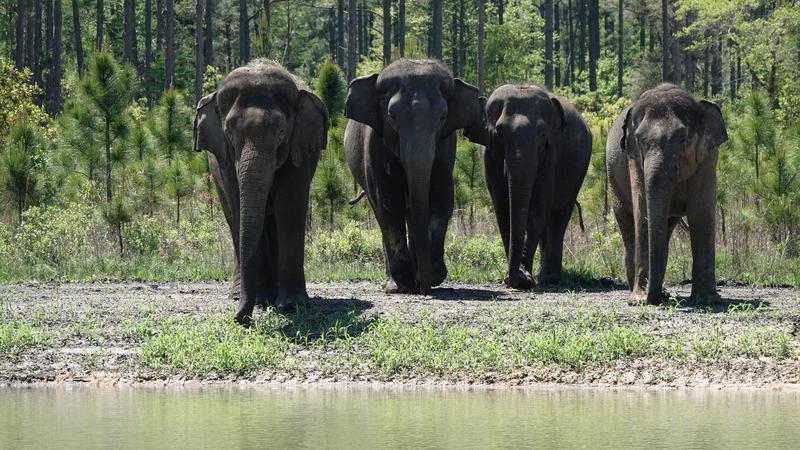
12 Asian elephants have arrived at White Oak Conservation.
Stephanie Rutan / Via White Oak Conservation

Because of the heat wave, I went out for my walk at 5:30 this morning, while it was still pleasant. I saw a bluebird, a couple rabbits, and a snapping turtle that crossed a bridge and launched herself 20 feet into the river. That was her choice.

The subjects of today’s story went a long time without having choices like the ones snapping turtles, wild rabbits, and bluebirds enjoy. Having spent many years doing tricks in the circus, they now reside at a 135-acre sanctuary where staff say they can hide for days at a time. Life is not completely natural, but it’s better than the circus.

Cathy Free reports at the Washington Post, “For about two decades, elephants that performed with the Ringling Bros. and Barnum & Bailey Circus were sent to a reserve in central Florida when they became too old to balance on two legs and parade around arenas doing tricks and dancing for large crowds. …

“In recent weeks, the former circus elephants have begun moving to a 135-acre sanctuary, one that is not affiliated with the circus that for years was accused of mistreating and abusing the gentle giants.

“Three weeks after being let loose in the White Oak Conservation center in Yulee, Fla., the first group of elephants has been exploring the new surroundings, and staff members say they don’t see some of them for days at a time. When they do spy the large animals, they say, they are swimming in the deep end of a pond or having a dust bath, followed by a nap in the shade. They also snack on watermelon and banana buffets.

“Employees say it was an emotional moment to watch the elephants walk out of their barn together for the first time into the lush acreage.

“ ‘There was more than one wet eye that day,’ said Michelle Gadd, who leads the White Oak preserve for endangered and threatened species such as cheetahs, rhinos, okapi, zebras and condors. …

“Ringling Bros. retired all of its elephants in 2016, ending a 145-year tradition, after pushback from the public about the pachyderms being forced to perform. … A year-and-a-half after the elephants were retired, the circus closed shop because of declining ticket sales. …

“Philanthropists Mark and Kimbra Walter arranged to purchase all 32 of the former Ringling Bros. elephants and have them transported 200 miles from Central Florida to Yulee, outside Jacksonville. The Walters bought the 17,000-acre White Oak sanctuary in 2013, and have been expanding it since. …

“Eventually, the elephant portion of the refuge will cover 2,500 acres and feature nine linked areas with enough water holes, forests, grasslands and wetlands to support the entire herd, said Nick Newby, 41, who leads the elephant caretaker team and helped plan the habitat.

“ ‘We wanted it to be as natural as possible, and we wanted to consider the social dynamic as well,’ Newby said. ‘Elephants are very sociable animals, so we like to study them, see what their personalities are like and then try to mix and match them with other elephants they might like to cohabitate with.’ …

“For Newby, who has worked with elephants for 18 years (mostly in zoos), there was a sense of elation as he watched the animals wander through their new home.

“ ‘It’s all about the elephants, so to see them out there doing natural elephant behaviors like swimming, was exhilarating and rewarding,’ he said. …

“Asian and African elephants are endangered in the wild because of loss of habitat and illegal poaching, [Gadd] said. The World Wildlife Fund estimates that there are about 415,000 elephants in Africa, while less than 50,000 remain in Asia.

“Wildlife conservation studies have shown that between 15,000 and 20,000 elephants are held in zoos or are still used by safari companies and circuses around the world. …

“Plans haven’t yet been developed for the public to view the elephants from afar, but Newby said the ultimate goal would be for somebody to look through a pair of binoculars at the White Oak refuge and feel as though they were watching elephants in their natural habitat.

“ ‘The gentle giants at the sanctuary are ambassadors for elephants in the wild,’ he said. ‘It’s our duty to make sure that their future is better than their past, and that their tomorrows are better than their yesterdays.’ ”

More at the Post, here.

Read Full Post »

victoriaprice-wfla

Photo: Twitter via at Deadline

Years ago I read an article in which a dermatologist lamented how conflicted he felt when he saw a stranger on the street with an obvious skin cancer. Should he tell the person to see a doctor? Should he mind his own business? I was shocked that it was even a question. If you see a stranger with her coat on fire, are you going to say it’s not your problem and walk away?

Thank goodness there are Good Samaritans out there. One woman who failed to mind her own business probably saved the life a young television reporter recently.

Cathy Free writes at the Washington Post, “As a television news reporter in Tampa, Victoria Price is accustomed to finding her inbox full of emails from viewers offering story ideas, criticism and praise, along with the occasional fashion critique.

“When she opened an email in June that had a small message in the subject line but was otherwise empty, Price, 28, was tempted to dismiss it as a bad joke or spam. But then she impulsively decided to hand her phone to her boyfriend, Ryan Smith.

“ ‘I said, ‘”Look at this weird email I just got,” ‘ recalled Price, an investigative journalist for NBC affiliate WFLA. A woman from out of state had seen a report by Price on the evening news a few hours earlier and had spotted something that troubled her, she said.

‘Hi, just saw your news report,’ the viewer wrote. ‘What concerned me is the lump on your neck. Please have your thyroid checked. Reminds me of my neck. Mine turned out to be cancer. Take care of yourself.’

“Price, who had never noticed anything unusual about the appearance of her neck, said she didn’t think the message was worth taking seriously. Smith thought otherwise. …

“Several weeks later, after she had had an ultrasound and a blood panel screening, Price received startling news: She had papillary thyroid cancer that had started to spread to her lymph nodes. Her doctor recommended that she have surgery as soon as possible.

“ ‘It was explained to me that I had a large nodule growing right in the middle of my thyroid, and it was pushing my gland so that it bulged from the side of my neck,’ Price said. ‘That’s what the woman who emailed me had noticed. Fortunately for me, she reached out about it.’

“On July 27, Price underwent surgery at Tampa General Hospital to have her thyroid removed. Her surgeon also removed 19 cancerous lymph nodes, she said, and she was relieved to learn that she didn’t immediately need to do any follow-up treatment apart from daily hormone replacement medicine. …

“A few days before the surgery, in a post on Twitter, Price alerted WFLA viewers to her diagnosis and thanked the observant stranger who may have saved her life.

“ ‘As a journalist, it’s been full throttle since the pandemic began,’ she wrote. ‘Never-ending shifts in a never-ending news cycle. We were covering the most important health story in a century, but my own health was the farthest thing from my mind. Until a viewer emailed me last month. Turns out, I have cancer, [and] I owe it to one of our wonderful @WFLA viewers for bringing it to my attention.’ …

“Now back at work, Price said she hopes to launch a foundation before year’s end to promote thyroid cancer awareness for young adults.

“ ‘I’ve learned that for young people, particularly women between ages 20 and 35, this is the most commonly diagnosed cancer,’ she said, with about 53,000 people diagnosed every year. …

“If not for that alert viewer, Price said, she might have gone for months without knowing she had a problem. … ‘It’s very humbling to know that this person took the time to shoot me this little email. Your health is your wealth — without it, you don’t have anything. …

” ‘I’m so incredibly thankful for what she did. If she hadn’t sent that email, I may have never seen my doctor, and the cancer would have continued to grow. I just want to thank her from the bottom of my heart.’ ”

More at the Washington Post, here.

Read Full Post »

ylzbpavkn4i6vjb7nn4knyfwne

Photo: Samsung
Sixth-graders at the Downtown Doral Charter Upper School in Florida worked with teacher Rebeca Martinez on a device to detect sediment buildup in a storm drain. The students’ project, which aims to stop flash floods, was among five grand-prize winners in the Samsung Solve for Tomorrow Contest.

To my way of thinking, no amount of money is too much to pay teachers like those guiding the middle school students in today’s story to tackle a science competition. Whether in public or private school, teachers build the future, but since most students are in public schools, the type of education there is the most critical and most in need of funding. Every child should have opportunities to stretch themselves.

Lela Nargi reports at the Washington Post, “In late May, storms flooded streets in Miami-Dade County in Florida. The floods made cars sink and turned roads into brown rivers.

“A team of local middle school students has a plan to stop this ongoing problem.

“Alyssa Neuber, Bianca Verri and Jose Pirela are sixth-graders at Downtown Doral Charter Upper School. They designed a device to warn city workers when and where there is a danger of flooding. The team is one of five grand-prize winners of the Samsung Solve for Tomorrow Contest. The contest asked for science, technology, engineering and math (STEM) solutions to the biggest challenge facing a school community.

‘I’ve been living here my entire life, and all of us have encountered problems with flooding,’ says Bianca. ‘We knew that was the problem we were going to tackle.’

“Flash flooding can happen when storm drains get plugged up and, especially during hurricanes, overflow into streets. It’s the leading cause of weather-related deaths in the United States.

“The students’ device uses a laser system called lidar, which stands for ‘light detection and ranging.’ The device, if approved by the city government, could be attached to Doral’s 2,575 storm and manhole drains — one device per drain. If a drain gets clogged with sediment, the device could send a computer alert to the city’s stormwater management office. Then the stormwater manager could send someone to clean the drain.

“ ‘We had our class help us in the beginning to find information about how we were going to use lidar,’ says Jose.

“The three STEM whizzes then started to work more closely with their science teacher, Rebeca Martinez. They figured out what each of them is good at. … Class parents who were engineers and website coders helped them figure out the details.

“Starting in March, the school was closed, so team meetings went virtual. Luckily, says Bianca, ‘We already had a prototype device, and we just had to tweak it some more.’

“They also had to pitch their idea virtually to contest judges. …

“A team from Dougherty Valley High School in San Ramon, California, made a wildfire alert. At Fairfield Senior High School in Fairfield, Ohio, students designed an app to prevent deaths of kids left in hot cars. Students at the North Carolina School of Science and Mathematics in Durham invented an app that helps people recycle. And in Wisconsin, kids at Omro High School created a sensor that lets ice fishers know when it’s safe to walk on frozen lakes.

“Each of the five teams won $100,000 for technology and supplies for their science classrooms.” More at the Washington Post, here.

Read Full Post »

Older Posts »