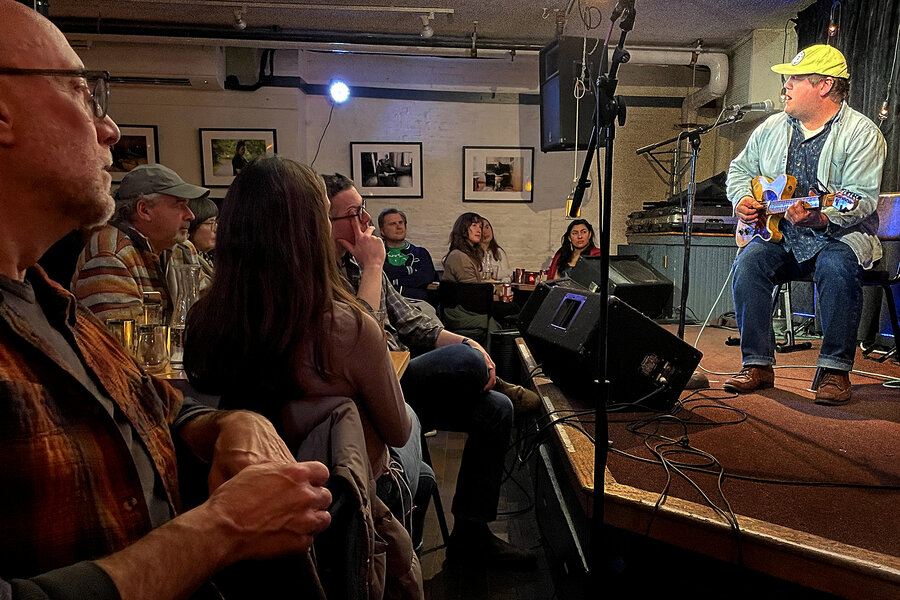
Photo: Melanie Stetson Freeman/CSM Staff.
Folk musician Jake Xerxes Fussell performs at Club Passim, one of his favorite venues, in Cambridge, Massachusetts.
My son has a goofy impression of who I was in the 1960s. He describes some kind of hippy personality, which I never had. I was more of a folkie — in the sense that I loved folk music and followed that crowd, went to those concerts.
I don’t think folk music has been cool with young people for many years, but I was interested to read at the Christian Science Monitor about one young musician who is keeping it alive and moving it forward. Simon Montlake has the story.
“In the summer of 1993, Fred Fussell, a folklorist and museum curator in Columbus, Georgia, packed his family van for a monthlong road trip to document the crafts and traditions of Native American tribes. He brought along his son, Jake, who had just finished fourth grade and was riding shotgun, where he kept a daily tally of roadkill.
“That summer, the Fussells visited artisans from Native communities in Oklahoma, Texas, and Louisiana, those whose forebears had been expelled from the Southeast in the 1800s but kept alive their spiritual ties to the land. Jake took charge of a Sony tape recorder. He taped his father’s interviews, learning to ‘sit back and shut up’ while people talked, which ‘is the key to good documentation,’ says the elder Mr. Fussell.
“His young son also recorded performances, which included music. … Jake liked vernacular arts and crafts, and he showed an early talent for drawing. But what lit his fire were the songs he heard at folk festivals his father put on in Georgia, songs that had been passed down from generation to generation and performed like the oral traditions of Homeric verse. …
“ ‘I always knew I would play music because music was the thing that was a constant source of joy,’ the younger Mr. Fussell says today.
“His family’s circle of friends included musicians, from blues singers to bluegrass pickers, and veteran collectors of traditional songs who never stopped looking for more. … From this unusual upbringing, Jake Xerxes Fussell has emerged as one of the most singular interpreters of folk music and all its tributaries. …
“ ‘He’s a real-deal folk singer. And there’re not very many of those,’ says Eli Smith, organizer of the Brooklyn Folk Festival. …
“From spirituals and jigs to fiddle tunes and sea chanteys, folk music is part of America’s cultural bedrock. It has long braided commercial music – from the folk revivalists of the 1950s and 1960s, who include Pete Seeger and Bob Dylan. …
“Some traditional songs arrived with the European migrants who brought their fiddles and hymnbooks to Appalachia and other regions. Others sprang from the Black experience of enslavement and freedom. …
“Mr. Fussell draws on that inheritance to create music that sounds both contemporary and timeless. His creative process carries him down rabbit holes of archival research and experimentation with musical motifs, even while tinkering on his guitar at home or on tour.
“He adds melodies when none exist and transposes verses, acting as both a caretaker and a remodeler of songs. …
“He started as a toddler on pots and pans, banging out rhythms at home. Then he got a drum kit and was ‘immediately good,’ says Coulter Fussell, his older sister. … From drums, Mr. Fussell moved to the upright bass, which he learned at school from a teacher who played in a bluegrass band. When he was 13 years old, his teacher asked him to take over as the bassist at a weekly gig at a barbecue restaurant.
“ ‘Everybody went there on a Friday night,’ says Ms. Fussell, who is now a quilter in Water Valley, Mississippi. ‘The band would play, and it was these scruffy grown men and then little Jake up there.’ …
“He was also listening to rock and hip-hop on the radio and going to shows, including of Georgia’s R.E.M., whose lead singer, Michael Stipe, had studied drawing with Mr. Rosenbaum at the University of Georgia. But rock bands lacked the raw passion and poetry of the traditional songs he heard growing up. ‘None of that stuff really spoke to me in any real deep way,’ he says.
“Mr. Fussell also fell hard for the music of Mr. Dylan, whom Mr. Rosenbaum had known in Greenwich Village in the early 1960s. But it was another local musician and family friend, Precious Bryant, who would influence Mr. Fussell’s rhythmic guitar picking and give him a taste of life on the road.
“Since Ms. Bryant, a country-blues artist, didn’t drive, it was Mr. Fussell’s mother, Cathy, who would drive her to shows. Her eager son began to take that role once he got a driver’s license. He would also visit Ms. Bryant at her rural trailer home, bringing along his guitar. ‘She would play, and I would play along,’ Mr. Fussell says.
“ ‘Jake always liked older people. He liked listening to older people. He liked hanging around with older people,’ says his mother, a retired English teacher and quilter.”
Lots more at the Monitor, here. No paywall. Tiny Dest Concert at YouTube here.
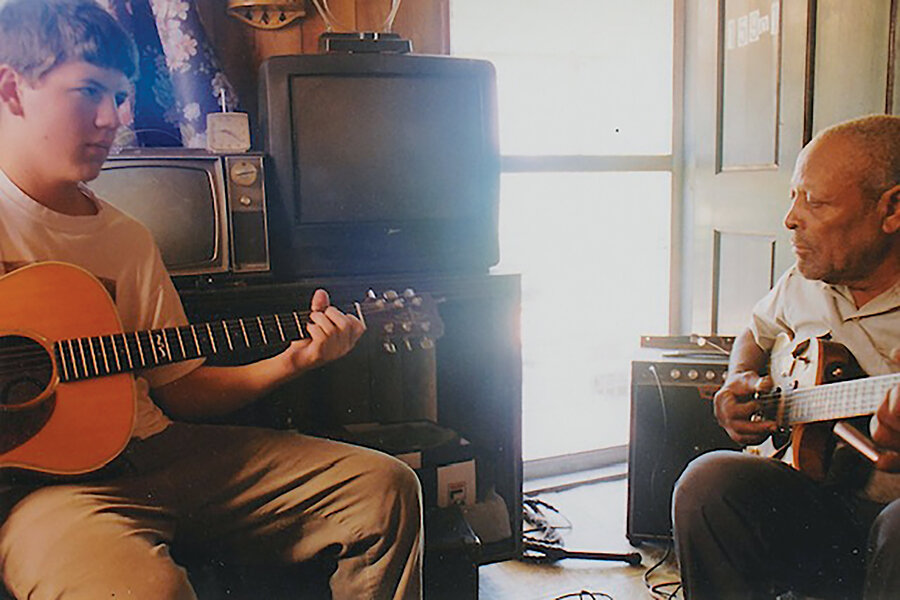
Photo: Jake Xerxes Fussell
As a youngster, Jake Xerxes Fussell soaked up the wisdom of older generations. Here he is jamming with George Daniel, a blues musician, in Macon County, Alabama, around 1996.


 Suzanne's Mom's Blog