Feeds:
Posts
Comments

Posts Tagged ‘font’

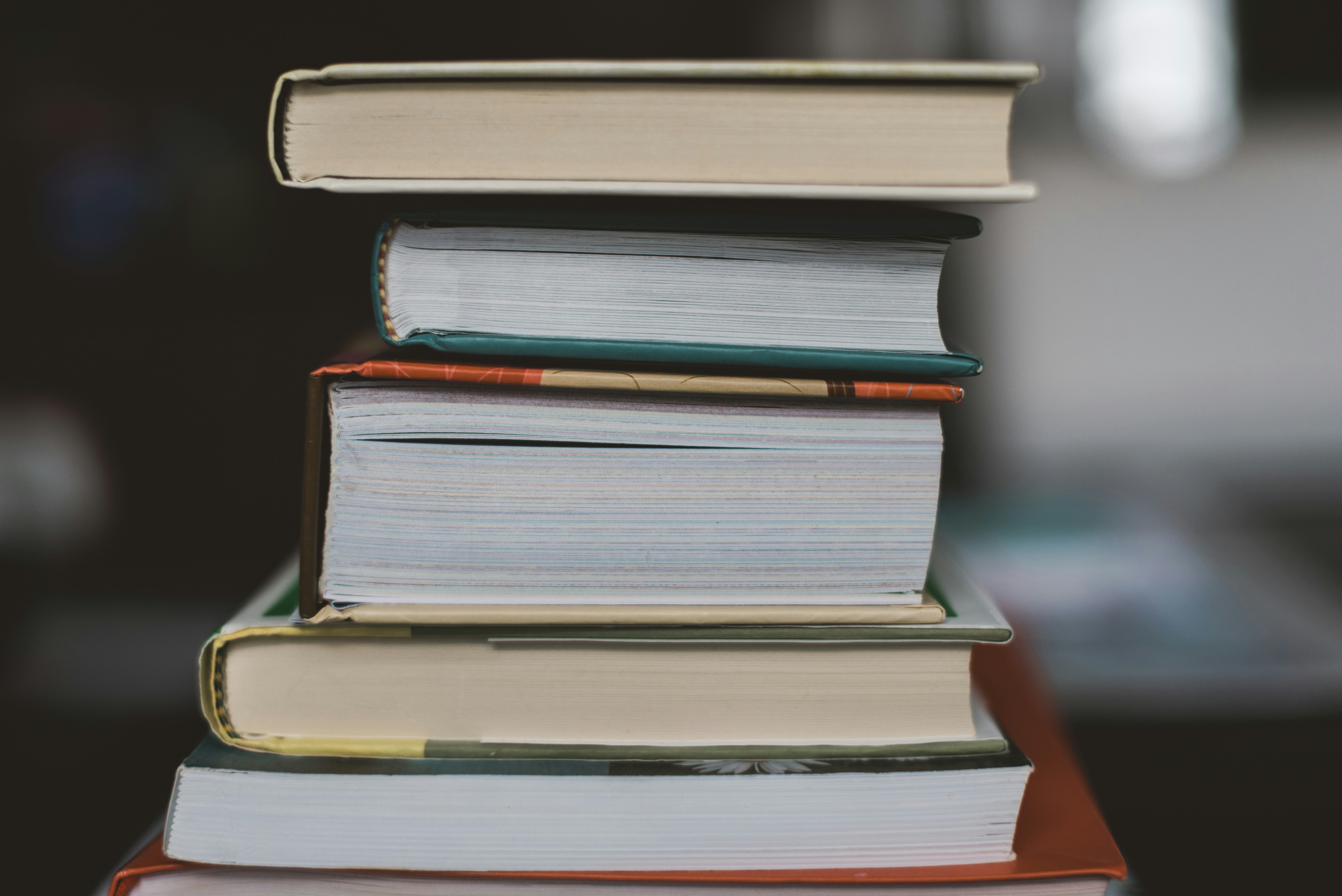
Photo: Claudia Wolff/Unsplash.
Do books use too much paper?

Those of us who still prefer a solid book to a pale, digital imitation may sometimes wonder whether we are encouraging the use of too much paper, especially since overstocks can end up in landfills.

Curiously, at least one publisher is thinking along the same lines.

Elizabeth Segran writes at Fast Company, “Over the past three years, HarperCollins’s designers have put their skills toward a new mission: saving paper. In an effort to reduce the carbon footprint of each book, they’re tweaking fonts, layout, and even the ink used. The goal is to pack more into each page, while ensuring that the pages are as readable as ever. And so far, these subtle, imperceptible tweaks have saved 245.6 million pages, equivalent to 5,618 trees.

“HarperCollins’s Christian publishing division, Zondervan Bibles, first came up with the idea of using design to save paper. Bibles have historically used upwards of 2,500 pages. In 2015, Zondervan’s designers determined that if they used different fonts and adjusted the page layout, they could reduce the number of sheets used. It would also cut HarperCollins’s printing costs. They developed a new compact typeface called the NIV Comfort Print. Ultimately, it saved more than 350 pages per bible, resulting in a total savings of 100 million pages in 2017. Stacked up, that would be the equivalent to four times the height of the Empire State Building.

“Tracey Menzies, the VP of creative operations and production at HarperCollins, wanted to see if the company could apply these learnings to other kinds of books. … The team got to work. They tested their theories with a large book in their catalog — more than 600 pages — by creating 50 versions of it using different fonts. HarperCollins uses a wide range of off-the-shelf fonts in its books, rather than custom ones. As the team ran the experiments, they observed that some fonts were more compact, resulting in fewer total pages, while remaining easy to read. So they curated a list of 15 fonts they determined are the most eco-friendly, which will be the preferred fonts from now on.

“In the end, the designers found that clever font selection, coupled with a thoughtful layout design that reduced white space, resulted in more words per page. For instance, in one example, the same text set to Garamond Pro resulted in many more words on the page compared to Bembo. Both fonts are fairly similar, with a classic serif look. And when you place them side by side, the differences are imperceptible. ‘The goal is to make these changes without the reader even seeing the difference,’ says Menzies.

“But there were also many complexities in the process. For instance, they had to consider the heaviness of the font. One font they used frequently is Bodoni, which was first created in 1798, and appears frequently in HarperCollins books. As a very heavy font, they realized they could fit more words on a page, while keeping it readable. But they also found that with very large letters, like subheadings, the ink would bleed through the paper, making it hard to read the words on the next page.

“ ‘The designer is always balancing out not just a single page, but also what’s on the page before and the page after,’ says [Leah Carlson-Stanisic, associate director of design at HarperCollins]. ‘Ultimately, this ended up with finding fonts that used less ink, in addition to less paper, which is also better for the planet.’

“Still, there is complex math involved with cutting pages from books. Printers produce very large sheets, which are then cut and folded into what ultimately becomes segments of 16 pages. When trying to cut pages from the book, designers need to be able to remove multiples of 16 pages. For the book So Fetch, for instance, using a more eco-friendly font saved nearly a million pages in total over the entirety of its print run. ‘We want to make sure our big titles, by prominent authors, are using these eco-fonts,’ says Carlson-Stanisic. ‘It adds up a little bit at a time, saving more and more trees.’ …

” ‘When we experimented with these fonts, we realized they weren’t a limitation at all,’ Menzies says. ‘It was simply a different approach that didn’t sacrifice aesthetics. Now, our designers are constantly questioning how we do things and thinking about ways to make things more sustainable.’

More at Fast Company, here.

Read Full Post »

A collection of fonts from Nap Time Alternative.

When I was a kid and my father was a reporter for a Rockland County paper called the Journal News, he took me once to see how type was laid for printing. The newspaper was still using metal type. The typesetter explained how he had to think “mirror image” for the words to come out right when printed. I have been interested ever since.

The days of metal type are gone except among artisans, but the topic of type is still interesting to me. Sara Friedman at Hustle has a story on some new fonts and the struggle of independent “foundries” to get visibility.

“Ten years ago, Cindy Thomason was walking down the stairs at home when she heard her phone ring.  On the other end was an executive from Warner Bros. Entertainment, calling to let her know that a font she designed would be featured in the upcoming blockbuster adaptation of the Great Gatsby.

“ ‘I had to sit down,’ Thomason says. ‘I’m just somebody who decided to design a font on a whim.’

“A nurse in suburban Virginia, Thomason began tinkering with fonts in her free time using a software package she bought for $100. She’d listed the font, which she named Grandhappy, on an online marketplace called MyFonts

“That’s where producers from Warner Bros. found it, and bought it to use as Jay Gatsby’s handwriting in the 2013 film.

It should have been a dream come true, a big break for a hobbyist font designer. But Thomason’s cut for her design’s feature-film cameo was a whopping $12 — not even enough to recoup what she paid for her design software. 

“Thomason’s story isn’t an anomaly. … With 4.5k independent artists selling on MyFonts today, many struggle to attract customers and to make a living in an oversaturated market.  

“It’s only getting harder, as designers must compete with and abide by the terms of one company that’s approaching behemoth status: Monotype. The company owns not only many of the world’s most popular fonts but also exchanges like MyFonts where font designers bring their work to market. 

“The industry is inching toward a monopoly, and it’s leaving independent designers with fewer places to go. …

“Monotype arrived at the end of the 19th century. The company was founded in Philadelphia by Tolbert Lanston, whose monotype machine invention allowed for increased speed and efficiency when producing type. Over the next few decades, Monotype, by then with branches in the US and the UK, developed popular typefaces such as Gill Sans, Perpetua, and Times New Roman. 

“In the last half of the 20th century … the mechanized process of Monotype’s signature machine faded out, replaced by phototypesetting and then digital typesetting, bringing fonts to screens. …

“Monotype [went] public with stock-ticker name TYPE in 2007. The retooled Monotype saw its annual revenues climb from $107m in 2010 to $247m in 2018 and became a powerhouse. …

“Monotype has claimed its purchases made life better for customers, who only have to navigate a licensing agreement from one company to access a bevy of fonts. But one font designer believed the acquisition of Hoefler & Co. felt like ‘a kraken eating up the industry.’

“MyFonts is known in the industry for being the gold standard for audience reach. Ellen Luff, who runs Ellen Luff Type Foundry and whose Larken font (starting at $42) is a MyFonts bestseller, told the Hustle there’s little choice but to use the site.

“ ‘When you’re independent, you’ve got your freedom, which is great. But then you have to balance being overlooked.’ …

“The power of Monotype and MyFonts isn’t the only obstacle for independents. Luff has spotted her fonts being used by corporations such as Apple and NASA, sometimes without her permission.  Luff says half of her clients come from retrospective licensing agreements made after she’s found her designs being used illegally. But going up against large companies is no easy feat for independent designers who have no legal teams to support them in negotiations.”

More at the Hustle, here. No paywall. Interesting pictures.

Read Full Post »

Photo: Newshub
Sans Forgetica is a typeface meant to aid memory. It was invented by researchers at RMIT in Melbourne, Australia.

There’s a new memory-boosting font that you can download for free and use for short texts. The inventors say you wouldn’t want to use it for long texts like a novel because it would give you a headache. But I say, what good is a typeface if you can’t read novels with it?

Lisa Martin writes at the Guardian, “Australian researchers say they have developed a new tool that could help students cramming for exams – a font that helps the reader remember information.

“Melbourne-based RMIT University’s behavioural business lab and design school teamed up to create ‘Sans Forgetica,’ which they say uses psychological and design theories to aid memory retention.

“About 400 university students have been involved in a study that found a small increase in the amount participants remembered – 57% of text written in Sans Forgetica compared with 50% in a plain Arial.

“Typography lecturer Stephen Banham said the font had an unusual seven-degree back slant to the left and gaps in each letter.

“ ‘The mind will naturally seek to complete those shapes and so by doing that it slows the reading and triggers memory,’ Banham told the Guardian.

“Senior marketing lecturer Janneke Blijlevens said the concept of ‘desirable difficulty’ underpinned the font’s design. …

“The font was designed with year 12 students cramming for exams in mind but could also be used to help people studying foreign languages and elderly people grappling with memory loss.” More at the Guardian, here.

I can see that having to work harder to read something may cause memory to fire on more burners, but when I was a kid, a friend who purported to analyze handwriting told me that broken letters like this indicated a criminal mind!

Read Full Post »

Although my husband and I are not in any design field, we’ve enjoyed watching videos like Gary Hustwit’s Helvetica (the history of a typeface) and his Objectified (on industrial design). It’s  interesting to see how designers think about things like a new font or machine.

Recently at National Public Radio’s Weekend Edition, Ari Shapiro talked about a new typeface meant to represent Sweden.

He reports, “Nearly every country has a national flag, a national anthem, a national bird. Not many countries have a national typeface. Sweden recently commissioned a team of designers to come up with a font to represent the country on its websites, press releases, tourism brochures and more. …

“The typeface that [Soderhavet] designers created looks pretty much the way you would expect a Scandinavian typeface to look, too.

” ‘The Scandinavian tradition is pretty humble, easygoing and clean,’ says Stefan Hattenbach, one of the designers of the new Sweden Sans. Less is more, you could say.’

“He started by collecting images of old Swedish street signs and company logos. He pulled images of Swedish wallpaper, cars and furniture, and looked for what he calls the red thread running through it all.

” ‘There’s an expression in Sweden, too,’ Hattenbach says. ‘We say lagom, which is not too much and not too little.’ ”

The ancient Greeks had a similar expression: “Nothing in excess.” The only letter with a flourish is q. Says Hattenback, “Q is not used that much, so you can often be a little more playful with that.”

See what you think of Swedish Sans, below, and read the rest of the NPR story here.

Swedish Sans, by Soderhavet
A typeface to represent official Sweden

Read Full Post »