Photo: Erika Schultz / The Seattle Times.
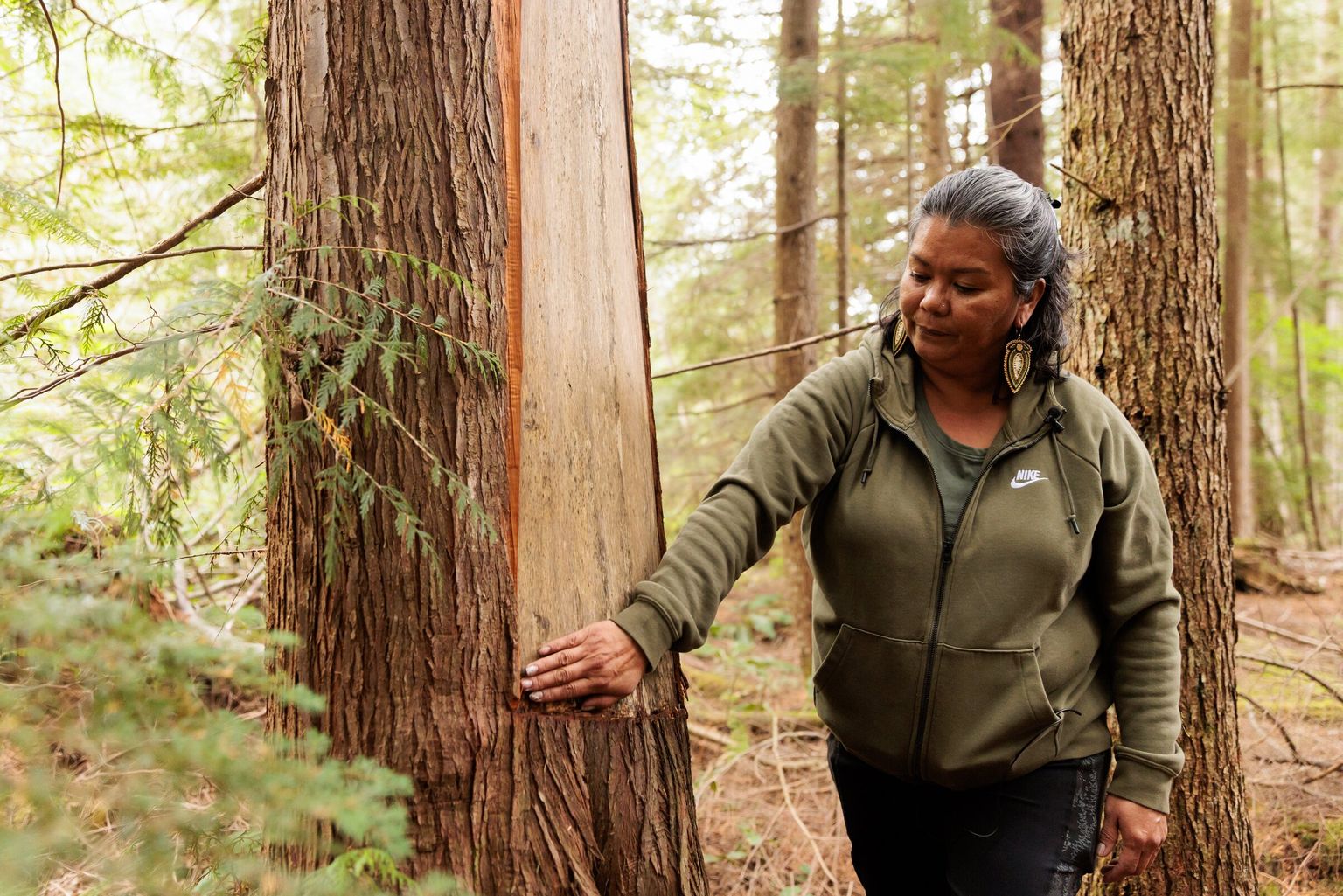
Gail White Eagle, a master cultural traditions specialist and master weaver at Muckleshoot, shows a cedar tree where she has traditionally stripped cedar bark for weaving baskets, hats, and more.
There’s always something more to learn about the generations that inhabited North America before European settlers came. Today’s article explains how indigenous people both used and managed forests, and how some continue to do so today.
Environmental reporter Lynda V. Mapes writes at the Seattle Times, “On a promontory above Puget Sound, a Douglas fir with arms bent at right angles stands above a quiet cove, where shellfish would have been gathered, long before this place was settled by newcomers. This tree was deliberately shaped by generations of hands into its current form, to mark what was here for countless years: rich clam beds, and a gathering site. … Modified trees are a connection interweaving generations of the region’s first people tightly as a cedar basket.
“ ‘It is the sacred fingerprint of the ancestors that shaped this place,’ said Sam Barr, a Samish tribal citizen and tribal historic preservation office supervisor for the Stillaguamish Tribe.
“Another tree, a cedar near the tree on the promontory over the cove, is elaborately trained to grow with branches at 90 degree angles low on its trunk that also were cut and recut so the branches would fork, and then fork again. The result is an elaborate candelabra. This is a marker tree, Barr said, that may have denoted the village that was here — today a housing development. It may also have indicated the direction toward the confluence of the deltas of the Skagit and Stillaguamish rivers that also fork and refork. …
” ‘People don’t think about it much, but we truly are living in an Indigenous garden, from which the gardeners have been forcibly removed,’ Barr said. ‘The entire landscape around the Pacific Northwest was carefully managed and stewarded by Indigenous hands. And there are traces of this everywhere.’
“Trees were stripped for bark for weaving, trees were planked for building materials, trees were made to serve as indicators of everything from trails, to a water source, a rich area for harvest, village or sacred place. …
“Trees are slow growing, and for a marker tree, it takes multiple generations of a family to curate it. … The presence of modified trees all over the landscape today, and continued traditional use of cedar in particular, binds tribes up and down the West Coast. … The Snoqualmie Tribe recently identified — and the state registered as an archaeological site — a modified tree in a lot being cleared for new homes in the Wedgwood neighborhood of Seattle. …
“Gail White Eagle, a Muckleshoot master weaver, said she always looks forward to this moment, as she paused the tribal van at a yellow gate that opens to a forest road in the foothills of Mount Rainier. She was about to enter Tomanamus Forest, 105,000 acres of forest land in King, Pierce and Lewis counties purchased by the Muckleshoot Indian Tribe in 2013. …
“The forest is in part of the territory ceded by the tribe in its treaty with the U.S. in 1855. Taking the forest back into tribal ownership was an act of healing, White Eagle said. Every tribal member can request a key to the gate, unlike at other forests that used to be theirs, now owned by other governments, corporations and individuals.
“A soft misty rain was falling as she walked into the forest, looking for trees from which she had harvested bark the previous spring. … She explained the harvesting process, which always begins with asking permission before taking anything.
She gives an explanation to the tree that its bark will be put to good use. And she often leaves a gift at the tree’s base, such as a bit of tobacco, sage or smoked fish.
“It’s a gesture of thanks and reciprocity in the relationship she holds with this tree, and this forest.
“White Eagle put her hand gently on the healing bark scar, and explained she is careful never to take a piece wider than two hands’ length. She chooses trees only big and robust enough for her to hug. And she pulls bark only in spring, when trees are full of sap, making the harvest easier on her and the tree. A tree can be harvested multiple times over many generations of users, if the harvest is done correctly.
“Tree wounds that penetrate bark damage the cambium layer, vascular tissue that is vital to movement of water and nutrients in a tree. The tree will seal and close the wound, compartmentalizing it with healing lobes to cover it and prevent rot. As long as a tree is not girdled — cut entirely around its circumference, severing all the vascular tissue — it will continue to live.
“Sometimes modified trees are recorded by tribes and government land managers as archaeological sites. But much more often, these trees are known only to the families that use them.
“Jacob Earnshaw is an independent archaeologist based in Victoria, B.C., who works to find and register modified trees as archaeological sites. His work has been entered as evidence in a right and title case in B.C. with the Nuchatlaht First Nation, who are working to prove their long presence on the northern half of Nootka Island on the northwest coast of Vancouver Island, to regain control of lands they never ceded. That case has not yet been resolved.
“Earnshaw has documented more than 1,000 years of cutting and pulling bark for harvest on Vancouver Island. The trees show management of these forests, Earnshaw said, by the island’s first people to protect what was an exhaustible resource. ‘What we are looking at is woodland management by these people who were thought of as hunter-gatherers,’ he said.
“That term is a myth, says Chelsey Geralda Armstrong, assistant professor in the Department of Indigenous Studies and School of Resource and Environmental Management Studies at Simon Fraser University in Burnaby, B.C. The first people didn’t just pick up what they needed here and there; they managed and cultivated their land and waters just as they do today — and evidence of their ancestors’ practices persists in the landscape.
“Armstrong teamed up with Earnshaw and other researchers to publish a 2022 paper that described forest gardens on Vancouver Island with still-evident remnants of cultivation, transplanting and all the other usual horticultural arts. The gardens were just part of the associated archaeological evidence of long prior use, including clam gardens, village sites, shell middens and trees in the nearby forest bearing scars of harvest for bark and other needs.
“Their work shows that far from an unpeopled wilderness, the Northwest Pacific Coast was a managed and stewarded place for thousands of years.” More at the Seattle Times, here.

 Suzanne's Mom's Blog