Feeds:
Posts
Comments

Posts Tagged ‘fresco’

Photo: Tony Jolliffe/ BBC.
Newly uncovered frescoes in Pompeii depict Paris (of Troy) and his surprisingly peaceful kidnapping of Helen (of Greece) — the act that triggered the Trojan War.

Art from the ancient world can make you think twice about what you know. When you picture the Greek myth in which Paris steals the most beautiful woman in the world from her husband Menelaus, do you ever imagine her going quietly? I don’t. But judging from newly uncovered frescoes, people in Pompeii did. It puts a whole different cast on the Trojan Wars.

Jonathan Amos, Rebecca Morelle, and Alison Francis report at the BBC, “Stunning artworks have been uncovered in a new excavation at Pompeii, the ancient Roman city buried in an eruption from Mount Vesuvius in AD79.

“Archaeologists say the frescos are among the finest to be found in the ruins of the ancient site. Mythical Greek figures such as Helen of Troy are depicted on the high black walls of a large banqueting hall. …

“A third of the lost city has still to be cleared of volcanic debris. The current dig, the biggest in a generation, is underlining Pompeii’s position as the world’s premier window on the people and culture of the Roman empire. …

“It was likely the walls’ stark color was chosen to hide the smoke deposits from lamps used during entertaining after sunset. ‘In the shimmering light, the paintings would have almost come to life,’ [Park director Dr Gabriel Zuchtriegel] said.

“Two set-piece frescos dominate. In one, the god Apollo is seen trying to seduce the priestess Cassandra. Her rejection of him, according to legend, resulted in her prophecies being ignored. The tragic consequence is told in the second painting, in which Prince Paris meets the beautiful Helen – a union Cassandra knows will doom them all in the resulting Trojan War.

“The black room is the latest treasure to emerge from the excavation, which started 12 months ago – an investigation [featured] in a documentary series from the BBC and Lion TV … in April. …

“Staff are having to move quickly to protect new finds, removing what they can to a storeroom. For the frescos that must stay in position, a plaster glue is injected to their rear to prevent them coming away from the walls. Masonry is being shored up with scaffolding and temporary roofing is going over the top. …

“Excavations in the late 19th Century uncovered a laundry in one corner. The latest work has now revealed a wholesale bakery next door, as well as the grand residence with its black room. The team is confident the three areas can be connected, physically via the plumbing and by particular passageways, but also in terms of their ownership. The identity of this individual is hinted at in numerous inscriptions with the initials ‘ARV.’ The letters appear on walls and even on the bakery’s millstones.

” ‘We know who ARV is: he’s Aulus Rustius Verus,’ explained park archaeologist Dr Sophie Hay. ‘We know him from other political propaganda in Pompeii. He’s a politician. He’s super-rich. We think he may be the one who owns the posh house behind the bakery and the laundry.’

“What’s clear, however, is that all the properties were undergoing renovation at the time of the eruption. Escaping workers left roof tiles neatly stacked; their pots of lime mortar are still filled, waiting to be used; their trowels and pickaxes remain, although the wooden handles have long since rotted away.

“Dr Lia Trapani catalogues everything from the dig. She reaches for one of the thousand or more boxes of artifacts in her storeroom and pulls out a squat, turquoise cone. ‘It’s the lead weight from a plumb line.’ Just like today’s builders, the Roman workers would have used it to align vertical surfaces.

“She holds the cone between her fingers: ‘If you look closely you can see a little piece of Roman string is still attached.’

“Dr Alessandro Russo has been the other co-lead archaeologist on the dig. He wants to show us a ceiling fresco recovered from one room. Smashed during the eruption, its recovered pieces have been laid out, jigsaw-style, on a large table.

“He’s sprayed the chunks of plaster with a mist of water, which makes the detail and vivid colours jump out. You can see landscapes with Egyptian characters; foods and flowers; and some imposing theatrical masks.

” ‘This is my favorite discovery in this excavation because it is complex and rare. It is high-quality for a high-status individual,’ he explained.”

At the BBC, here, read that there’s a dark side to what they’re finding. No paywall.

Read Full Post »

Photo: Archaeological Park of Pompeii.
A well-preserved fresco depicting the myth of Phrixus and Helle was recently uncovered at Pompeii, a city buried in 79 CE.

Have you ever felt curious about a Greek myth? Once you start digging in, you find there’s always another story behind the story. Consider the Golden Fleece of Jason and the Argonauts‘ quest. That’s a tale stirred up anew by a discovery at Pompeii.

As Rhea Nayyar reports at Hyperallergic, “Archaeologists in Italy recently uncovered a 2,000-year-old fresco in remarkable condition on the walls of the House of Leda, a Pompeii mansion under excavation since 2018 that’s recognized for its exquisite art. Painted as if it were a framed artwork on a yellow wall, the fresco depicts the Greek mythological tale of Phrixus and Helle with vibrant pigments and crisp dimensions that have been preserved beneath volcanic ash since 79 CE, after the eruption of Mount Vesuvius.

“According to the tale, Phrixus and Helle were twin children born to the Boeotian king Athamas and a nymph named Nephele. Athamas remarried to a mortal woman named Ino who hated her step-children and devised a plan to have Phrixus sacrificed by the order of an oracle so she could secure her own son’s right to the throne. Phrixus [the boy] and Helle [the girl] escaped from Boeotia with the help of the Golden Ram that flew them across the sea, but Helle sadly fell off of its back mid-flight and drowned in the ocean. Phrixus found safety with King Aeëtes of Colchis, and later married his daughter Chalciope. The fresco depicts the frequently referenced scene of Helle drowning while reaching out for her brother’s hand as the Golden Ram prepares to soar away.

“Gabriel Zuchtriegel, the director of the Pompeii Archaeological Park [says] ‘history has repeated itself’ … Phrixus and Helle were ‘two refugees at sea.’ …

“The discovery came along during the conclusion of the Great Pompeii Project that was spearheaded by the Italian government in 2012 to further excavate, stabilize, and restore structures across the ancient city amidst research efforts, climate emergencies, and increased tourism. Earlier this month, Zuchtriegel shared in an official statement that the next phase for Pompeii was to develop it from an urban planning standpoint that engages surrounding towns and cities and promotes further educational opportunities for history and culture.”

More at Hyperallergic, here. No paywall. Subscriptions welcomed.

More on the Greek myth from Greek: “Helle, for unknown reasons, fell off the ram and drowned in the strait between Europe and Asia, which was named after her the Hellespont, meaning the sea of Helle (now Dardanelles). Phrixus survived all the way to Colchis, where King Aeëtes, the son of the sun god Helios, took him in and treated him kindly, giving Phrixus his daughter, Chalciope, in marriage. In gratitude, Phrixus sacrificed the ram to Poseidon and gave the king the Golden Fleece of the ram, which Aeëtes hung in a tree in the holy grove of Ares in his kingdom, guarded by a dragon that never slept. Phrixus and Chalciope had four sons, who later joined forces with the Argonauts.”

See what I mean about the way each myth makes you want to research another myth? I’m quite intrigued by a “dragon that never slept.” Even Smaug sleeps, for goodness’ sake!

Read Full Post »

Photo: Marica S. Tacconi, CC BY-SA.
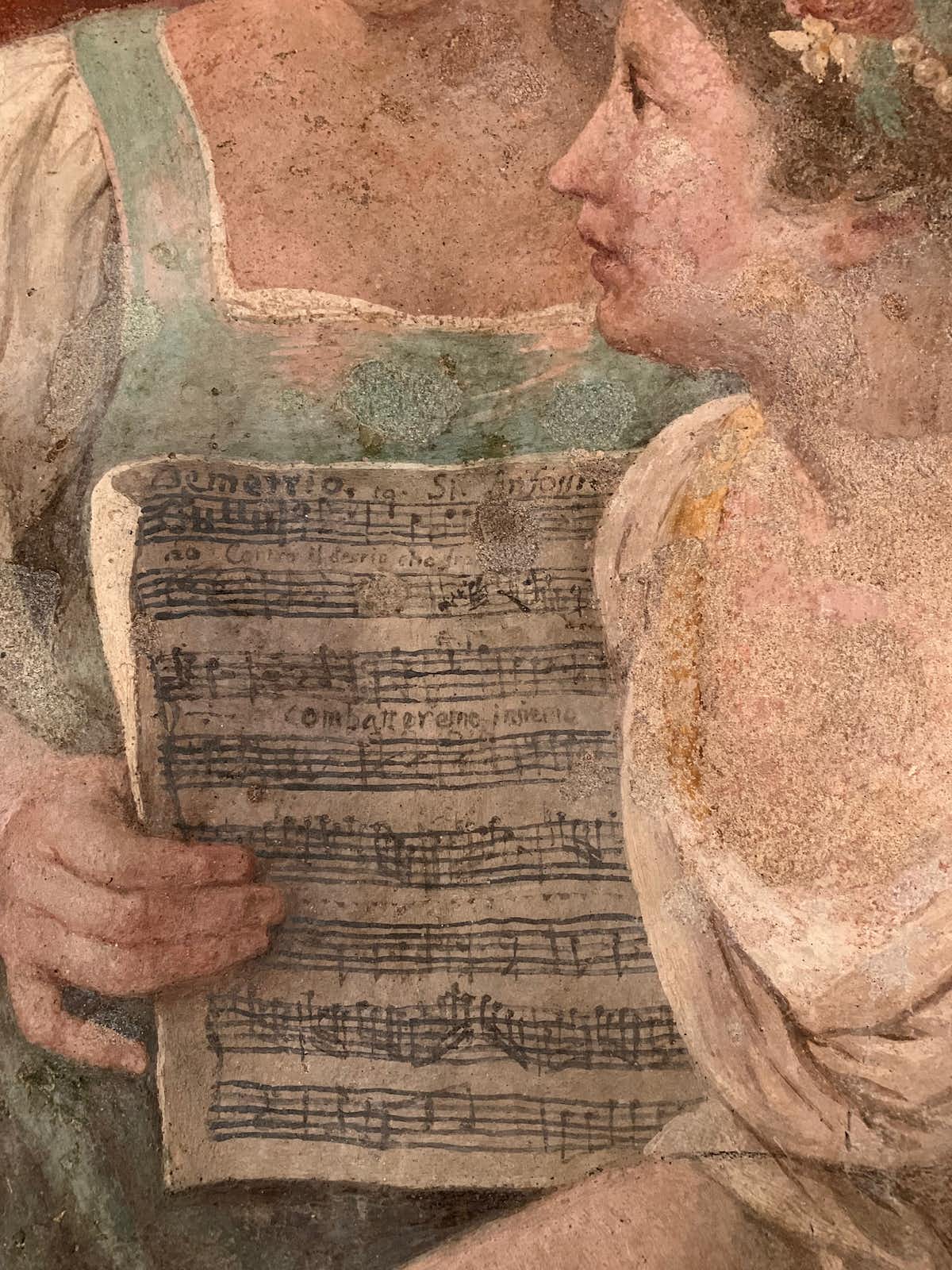
The musical score depicted in Jacopo Guarana’s fresco in a Venetian orphanage. 

I know there is a lot of drudgery in historical research and archaeology, but what fun to discover clues about the past that can be brought to life in the present!

That’s what Marica S. Tacconi, professor of musicology and art history at Penn State, does. At the Conversation, she writes about her determination to bring back music painted on the walls of a Venetian orphanage centuries ago.

She begins by asking the reader to imagine today’s rock stars “teaching at an orphanage or homeless shelter, offering daily music lessons” and says “that’s what took place at Venice’s four Ospedali Grandi, which were charitable institutions that took in the needy – including orphaned and foundling girls – from the 16th century to the turn of the 19th century.

“Remarkably, all four Ospedali hired some of the greatest musicians and composers of the time, such as Antonio Vivaldi and Nicola Porpora, to provide the young women – known as the ‘putte’ – with a superb music education.

“In the summer of 2019, while in Venice on a research trip, I had the opportunity to visit the Ospedale di Santa Maria dei Derelitti, more commonly known as the Ospedaletto, or ‘Little Hospital, because it was the smallest of the four Ospedali Grandi.

“As a musicologist specializing in the music of early modern Venice, I was especially excited to visit one of the hidden gems of the city: the Ospedaletto’s music room, which was built in the mid-1770s. …. Little did I know that I would encounter music that hasn’t been performed in nearly 250 years.

“As we entered the stunning music room, I was immediately struck by its elegance and relatively small size. In my mind, I had envisioned a large concert hall; instead, the space is intimate, ellipse-shaped and richly decorated.

“Overshadowed by the more prominent Ospedale della Pietà, not much is known about the music-making that took place for centuries behind the walls of the Ospedaletto. But one of the greatest clues to its venerable history as a music school is literally on one of its walls.

“A fresco on the far wall of the room, painted in 1776-77 by Jacopo Guarana, depicts a group of female musicians – likely portraits of some of the putte – at the feet of Apollo, the Greek god of music. Some of them play string instruments; one, gazing toward the viewer, holds a page of sheet music. …

“The music notation was quite legible, and the composer’s name was inscribed in the upper-right corner: ‘Sig. Anfossi.’

“I took several photos of the fresco. I wanted to learn as much as I could about that piece of music painted on the wall. …

“Armed with those clues on the wall, I continued my research in the days following the visit to the Ospedaletto. I learned that the music by ‘Signor Anfossi’ shown in the fresco was drawn from the opera Antigono, composed by Pasquale Anfossi (1727-97) on a libretto by Pietro Metastasio. The work premiered in Venice at the Teatro San Benedetto in 1773.

“The text of the [aria] is legible in the excerpt on the wall. It reads, ‘Contro il destin che freme, combatteremo insieme’ – ‘Against quivering destiny, we shall battle together.’

“Like many works from the 17th and 18th centuries, the entire opera is lost. I was determined to find out, however, if that particular aria had survived. … Luck was on my side: To my delight, I found a copy of the aria in a library in Montecassino, a small town southeast of Rome. Why was that particular excerpt chosen to be displayed so prominently on the wall?

“Like other institutions in Venice, the Ospedaletto faced financial hardship in the 1770s. Evidence suggests that the putte of the Ospedaletto were likely involved in raising the funds for the decoration of the music room. The new hall enabled them to give performances for special guests and benefactors, which brought in substantial donations. Together with Pasquale Anfossi, who was their music teacher from 1773 to 1777, they rallied behind their beloved institution, saving it – at least temporarily – from financial destitution. …

“Incidentally, the putte may also have wanted to honor their teacher, as Pasquale Anfossi, too, is portrayed in Guarana’s fresco, directly behind the young woman holding up his music.

“One of the aspects I find most rewarding about the study of older music is the process of discovering a work that has been neglected and unheard for hundreds of years and bringing it back to modern audiences.

“Inspired by the Ospedaletto’s music room, [my colleague] Liesl Odenweller and I have embarked on a collaborative project that brings back not only the aria on the wall but also other music from the institution that has gone unheard for centuries … thanks to a generous grant from the Gladys Krieble Delmas Foundation, the Venice Music Project. …

“Because the music of the past was written in a notation that’s different from that used today, it’s necessary to translate and input every mark of the original score – notes, dynamics and other expressive marks – into a music notation software to produce a modern score that can be easily read by today’s musicians.

“By performing on period instruments and using a historically informed approach, the musicians of the Venice Music Project and I are excited to revive this remarkably beautiful and meaningful music. Its neglect is certainly not a reflection of its artistic quality but rather likely the result of other composers, such as Vivaldi and Mozart, taking over the spotlight and overshadowing the works of other masters.”

More at the Conversation, here. The author has a nice description of her colleague testing the room’s exceptional acoustics.

Read Full Post »