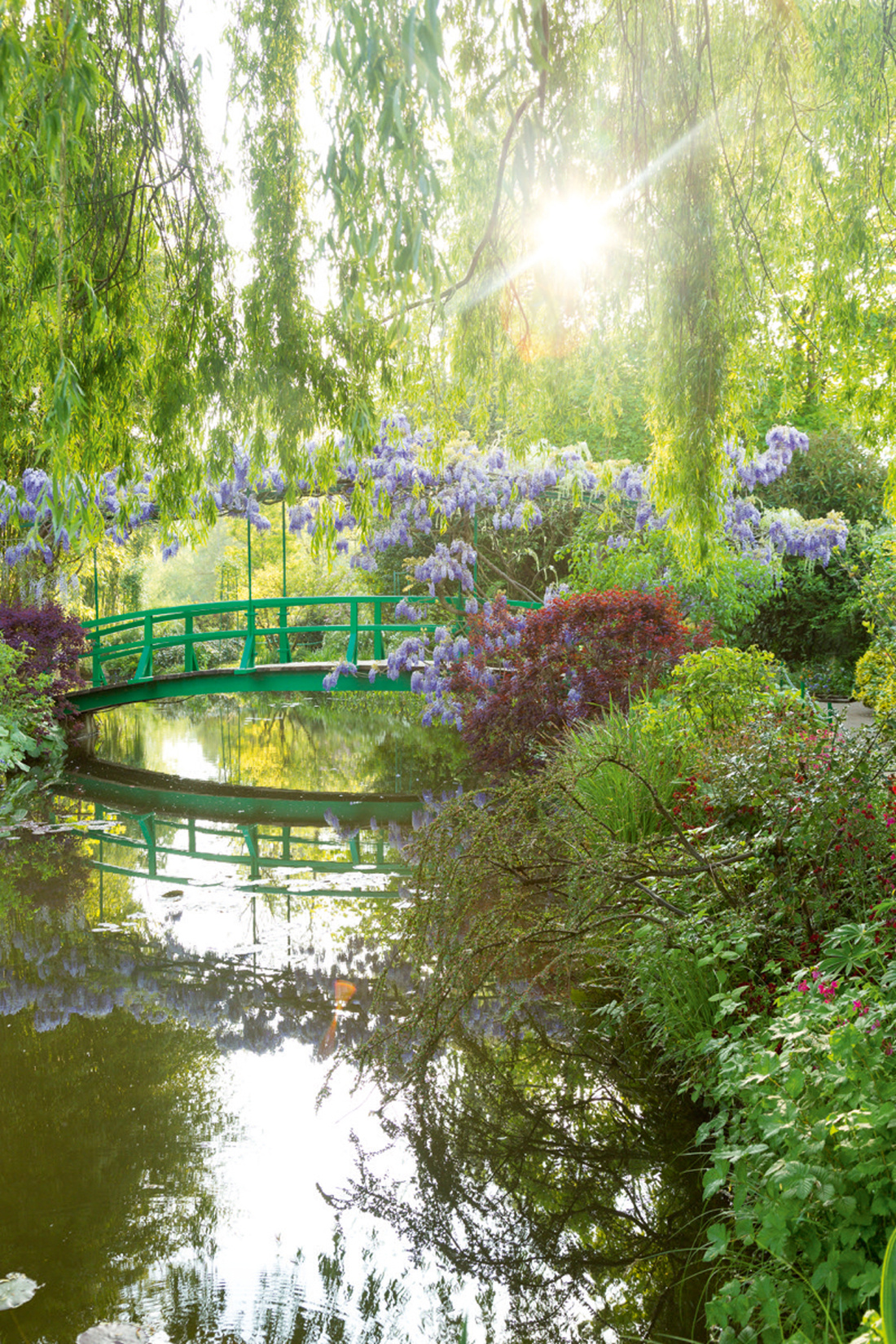
Photo: Eric Sander
Monet’s water garden and the Japanese footbridge in Giverny, France. Gilbert Vahé has been working to maintain the aesthetic of the Impressionist painter’s gardens since 1977.
I’ve always admired historic preservation efforts that save beautiful, old buildings while giving them new, modern purposes. There is a recognition of beauty as both immutable and changeable.
Similarly, ensuring a garden continues to look the same as when an artist painted it is a matter of germinating, blooming, dying, and rebirth. You can’t preserve a garden in amber.
Casey Lesser writes at Artsy about a horticulturist who practices a complicated art that is at the mercy of the seasons.
“Each year, from late March to early November, more than 500,000 people travel to Giverny, France, to visit a place they’ve primarily seen in paintings,” Lesser writes.
“They arrive to find a charming pink farmhouse with emerald-green shutters, set among brilliant flowerbeds that overflow with tulips, lavender, or sunflowers, depending on the season. They follow signs to a tunnel, and are led to an oasis of weeping willows and bamboo shoots, where they can amble along a pond packed with waterlilies, before crossing a familiar Japanese footbridge cloaked in wisteria.
“More than just the idyllic inspiration and open-air studio behind some of the world’s most famous paintings, Claude Monet’s gardens in Giverny have long been understood as a total work of art in their own right. …
“On July 10th, Jean-Yves Le Drian, French Minister for Europe and Foreign Affairs, announced that the site would be a candidate for a UNESCO World Heritage Site designation. That achievement is due in no small part to Gilbert Vahé, Giverny’s head gardener. …
“Vahé’s post at Giverny began with the restoration of the gardens in 1977. While Michel Monet, the artist’s son, had left the property to Paris’s Académie des Beaux-Arts upon his death in 1966, with a view for it to become a museum, it went untouched for a decade.
“An initiative to revive the garden eventually materialized thanks to the French philanthropist and curator Gérald Van der Kemp, who is also known for spearheading the restoration of the Palace of Versailles, and who would go on to become the first director and curator of at Giverny. In 1970, he set up the Versailles Foundation in New York, which was backed by American patrons, and would also fund Giverny. But it was not until an auspicious meeting with Vahé that the gardens really began to take shape. …
“The process of revitalizing the gardens was slow, spanning a long four years. Vahé worked alongside a team of fellow gardeners, including one who had worked alongside Monet himself. …
“Monet had bought the farmhouse and its land in 1883, stumbling upon it while on a walk, and later permanently traded the avenues of Paris for the rolling hills of Normandy. After fitting the house to his needs — painting its walls in hues of blue and yellow, setting up a studio, and hanging it with his collection of Japanese prints — he turned to the gardens. …
“The plants we see today are not exactly the ones that Monet painted a century ago, and they’re not all placed where they were when the artist lived, but Vahé believes that’s not what’s important. Rather, he works to maintain the original aesthetic — a certain profile of color and light — that corresponds to Monet’s vision.”
More at Artsy, here. The article includes some pictures you’ll like.


 Suzanne's Mom's Blog