Feeds:
Posts
Comments

Posts Tagged ‘gardens’

Photo: Judith Jockel/Guardian.
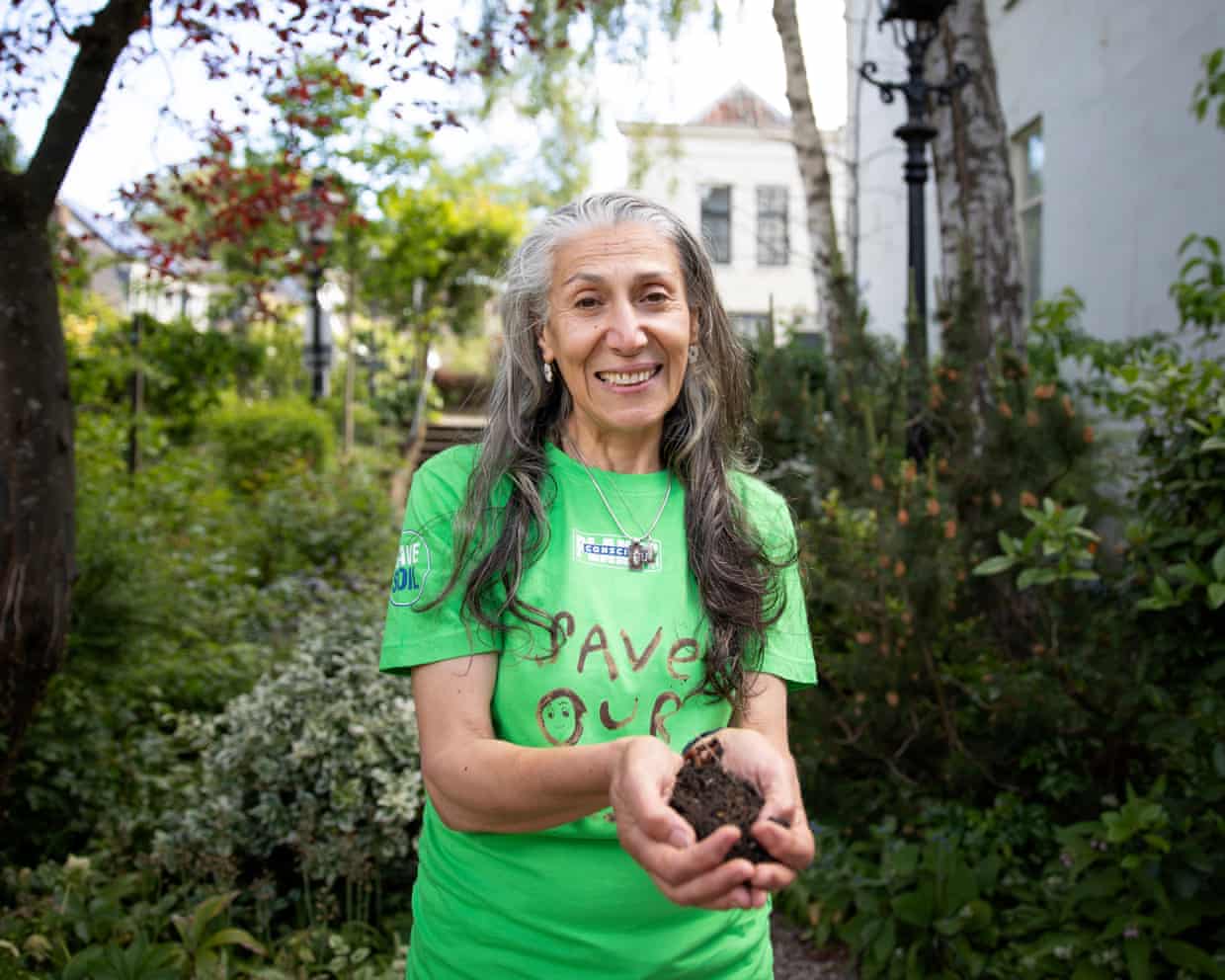
Iranian-born Sousan Samadani learned about the Save the Soil movement at age 60 and jumped in with both feet. Here she is in her adopted home of Utrecht in the Netherlands. 

Once upon a time, most of us were pretty clueless about soil — what made for good soil and why good soil is important. Age 60 was the first time Sousan Samadani realized that modern civilization had been degrading soil and what that meant for the planet. She didn’t just feel shocked. She leaped into action.

Paula Cocozza writes at the Guardian, “Sousan Samadani was watching videos on YouTube one day when she came across a post about how the world’s soil was degrading so rapidly that it was in danger of extinction.

“The video – posted by the Save Soil movement – ‘was like a shock for me,’ Samadani says. …

“Samadani made a decision in that moment: she was ‘going to be with this movement, fully, 100%.’ According to Unesco, 90% of global soil could be degraded by 2050. Save Soil was launched by the spiritual leader ‘Sadhguru’ Jaggi Vasudev, who announced a trip in 2022 to raise awareness: a 19,000-mile motorbike ride through Europe, the Middle East and India.

“A team of volunteers had already been booked to accompany Vasudev – so Samadani, 65, who lives in Utrecht in the Netherlands, decided to make her own shadow journey. While Sadhguru travelled to 27 countries, Samadani made it to all those and more, continuing on to Nepal, Suriname, Guyana and French Guiana, helping out at campaign events.

“Other than three flights, she traveled by bus and train, and even hitchhiked from Turkey to Georgia. She stayed in hostels or with volunteers, or in ‘the cheapest hotel I could find.’

“She travelled for three months, and sometimes went days without a proper meal because she would arrive at a station with her rucksack and rush off to campaign straight away.

“Samadani had never even been involved with activism before. So why soil, and why now?

“Ever since she was a child growing up in Iran, Samadani says, she has felt huge empathy for others – her stomach would churn at the idea of others suffering whenever she heard an ambulance, and she would pick up banana skins from the ground so people wouldn’t slip on them.

“She was born in Kermanshah, near the border with Iraq. Her father had a snack bar there, but when she was 19, the family, who are Bahá’ís, moved to Shiraz to escape persecution. … People of Bahá’í faith have been persecuted in Iran since the Iranian revolution, facing the seizure of property, imprisonment and even execution for their religious beliefs.

“Before the snack bar, Samadani’s father had a farm on which he grew wheat, and a garden full of fruit trees – ‘apricots, pomegranates, apples, plums, grapes – and there were sheep, cows, goats, turkeys and chickens. Everyone said it was an amazing, amazing garden,’ she says.

“The family left that property before Samadani was born. She never saw it, not even in photographs, but her parents talked about it, and the picture of it, the scent of all those blossoms, has lingered clear and fragrant in her mind.

“In Shiraz, she played piano (sometimes for seven hours a day) at a cultural centre. When the teacher moved away, Samadani, then in her 20s, took over her job, giving piano lessons to 40 children a week.

“She married and had two children and, in 1995, at the age of 35, left with them for the Netherlands ‘as a refugee.’ In Iran, Bahá’í people are not allowed to go to university. …

“In the Netherlands, she taught piano and tended a garden that she rented by the year. ‘I had flowers. I had potatoes, tomatoes, onions, different kinds of beans and fennel and carrot,’ she says. …

“Samadani’s newfound love of campaigning has been transformative. ‘It’s where my life of adventure started,’ she says. To raise awareness, she has skydived and cycled almost 400 miles from Chennai to Coimbatore in southern India. … ‘My wish is to bring safe soil to Iran, because it needs it very, very badly,’ Samadani says.”

More at the Guardian, here. No firewall.
Read Full Post »


Photo: Eric Sander
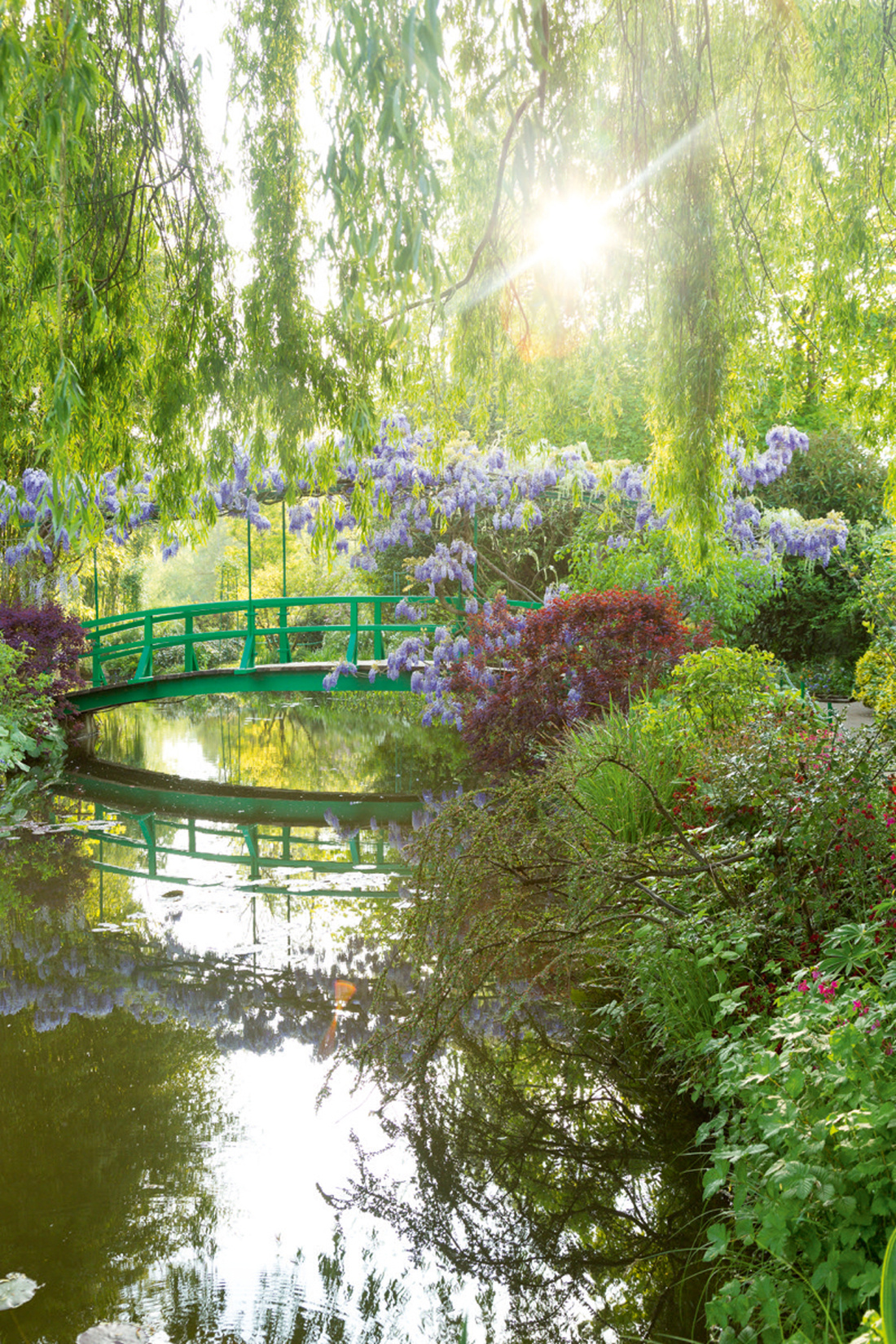
Monet’s water garden and the Japanese footbridge in Giverny, France. Gilbert Vahé has been working to maintain the aesthetic of the Impressionist painter’s gardens since 1977.

I’ve always admired historic preservation efforts that save beautiful, old buildings while giving them new, modern purposes. There is a recognition of beauty as both immutable and changeable.

Similarly, ensuring a garden continues to look the same as when an artist painted it is a matter of germinating, blooming, dying, and rebirth. You can’t preserve a garden in amber.

Casey Lesser writes at Artsy about a horticulturist who practices a complicated art that is at the mercy of the seasons.

“Each year, from late March to early November, more than 500,000 people travel to Giverny, France, to visit a place they’ve primarily seen in paintings,” Lesser writes.

“They arrive to find a charming pink farmhouse with emerald-green shutters, set among brilliant flowerbeds that overflow with tulips, lavender, or sunflowers, depending on the season. They follow signs to a tunnel, and are led to an oasis of weeping willows and bamboo shoots, where they can amble along a pond packed with waterlilies, before crossing a familiar Japanese footbridge cloaked in wisteria.

“More than just the idyllic inspiration and open-air studio behind some of the world’s most famous paintings, Claude Monet’s gardens in Giverny have long been understood as a total work of art in their own right. …

“On July 10th, Jean-Yves Le Drian, French Minister for Europe and Foreign Affairs, announced that the site would be a candidate for a UNESCO World Heritage Site designation. That achievement is due in no small part to Gilbert Vahé, Giverny’s head gardener. …

“Vahé’s post at Giverny began with the restoration of the gardens in 1977. While Michel Monet, the artist’s son, had left the property to Paris’s Académie des Beaux-Arts upon his death in 1966, with a view for it to become a museum, it went untouched for a decade.

“An initiative to revive the garden eventually materialized thanks to the French philanthropist and curator Gérald Van der Kemp, who is also known for spearheading the restoration of the Palace of Versailles, and who would go on to become the first director and curator of at Giverny. In 1970, he set up the Versailles Foundation in New York, which was backed by American patrons, and would also fund Giverny. But it was not until an auspicious meeting with Vahé that the gardens really began to take shape. …

“The process of revitalizing the gardens was slow, spanning a long four years. Vahé worked alongside a team of fellow gardeners, including one who had worked alongside Monet himself. …

“Monet had bought the farmhouse and its land in 1883, stumbling upon it while on a walk, and later permanently traded the avenues of Paris for the rolling hills of Normandy. After fitting the house to his needs — painting its walls in hues of blue and yellow, setting up a studio, and hanging it with his collection of Japanese prints — he turned to the gardens.  …

“The plants we see today are not exactly the ones that Monet painted a century ago, and they’re not all placed where they were when the artist lived, but Vahé believes that’s not what’s important. Rather, he works to maintain the original aesthetic — a certain profile of color and light — that corresponds to Monet’s vision.”

More at Artsy, here. The article includes some pictures you’ll like.

Read Full Post »

The big thermometer on the garage may have said 40 degrees when I woke up this morning, but I’m still thinking spring.

My husband has planted an array of annuals and perennials, and both kids are seeding lawns.

Since I am rather a fan of Mass Challenge winners and I also had a heartfelt testimonial from Mimsey, I encouraged both families to try a 2010 Mass Challenge winner, Pearl’s Premium grass seed.

Mimsey said that she had thrown Pearl’s into a wooded area next to her house, expecting nothing. Before she knew it, a lovely velvety carpet had grown there. Sounded to me like the beans Jack’s mother threw away that led to Jack’s adventures at the top of a beanstalk.

And speaking of plants, the plant identification site Mister Smarty Plants, a big supporter of this blog, needs my support tonight. So if you would like to help him get recognition at a Mass Innovation Night on June 10, vote for him here. It took me a while to figure out the voting. You have to vote for four entries in the event and make a comment. But you don’t have to give your name. Thanks!

Read Full Post »

The plant-identification site Mister Smarty Plants, which I first blogged about here on May 23, 2011, just keeps getting better.

One innovation from the past year has been rounding up tweets containing photos of flowers and plants that people around the world want help identifying and bringing them to the site to be identified by the growing number of readers.

I used to get a lot of identifications right, but Mister Smarty Plants queries are quite exotic now, which makes the site both exciting and challenging.

Today, John announced a new design with special features like kudos to the week’s most successful plant identifiers.

The Smarty Plants concept has always been that the more people who come to the site with their questions, the more who will be available to identify plants. John has been persistent about finding new ways to reach the folks who need the service.

Even if you think you don’t know much about plants, check it out. It’s almost like playing a game, and believe it or not, there are people in other parts of the world who don’t know what a dandelion is.

MisterSmartyPlants

Read Full Post »