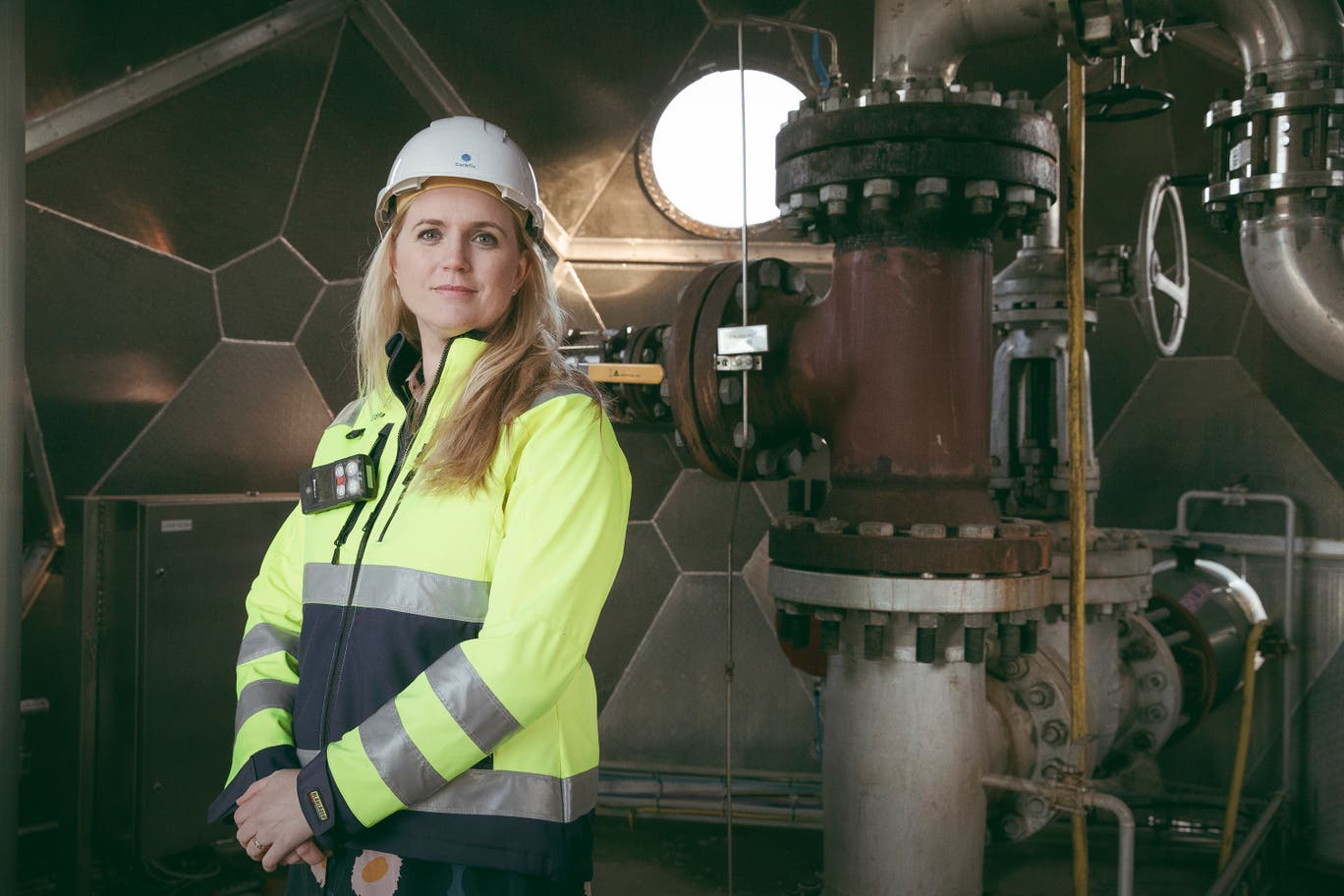
Photo: Heida Helgadottir for the Washington Post via the Independent.
Edda Aradottir is the chief executive of Carbfix, a company that captures CO2 byproduct from the largest geothermal plant in Iceland. Many Icelandic start-ups are tackling climate change.
File this one under Hope. And maybe book a trip to the innovation hub called Iceland.
Hannah Hall has a report at the Washington Post on Icelandic companies that are taking on global environmental challenges.
“The electric red and green glow of the production facility resembles the Icelandic aurora borealis. Algae in their growth stage flow through hundreds of glass tubes that travel from floor to ceiling, all part of a multistep process yielding nutrients for health supplements. Soon, all parts of each alga will be used.
“The facility, operated by Icelandic manufacturer Algalif, is a space of inspiration for Julie Encausse, a 34-year-old bioplastic entrepreneur. During a July summer storm, Svavar Halldorsson, an Algalif executive, was guiding her through a tour of the company’s newest facility on the Reykjanes Peninsula.
“By the end of 2023, this new facility aims to triple its production. After Algalif dries the microalgae and extracts oleoresin, a third of this output then goes toward health supplements. Algalif has traditionally used the rest as a fertilizer. Now Encausse, founder and chief executive of the bioplastic start-up Marea, hopes to use that leftover biomass to create a microalgae spray that can reduce the world’s reliance on plastic packaging.
“Her newest partnership with Algalif is part of a start-up network in Iceland that focuses on inventive and creative technologies to address the climate and sustainability crisis. The Sjavarklasinn (‘Iceland Ocean Cluster’) network includes environmental entrepreneurs working across several industries.
“Thor Sigfusson founded the network in 2012 after conducting research on how partnerships between companies in Iceland’s technology sector helped expand that industry. At the time, he found that the fishing industry was not experiencing the same collaboration or growth.
“ ‘Even though companies were in the same building together, fishing from the same quotas and facing similar challenges, they were closed off,’ said Alexandra Leeper, the Iceland Ocean Cluster’s head of research and innovation.
“Three cod hanging on the wall of the second-floor entryway are the first thing to greet any visitor to the Iceland Ocean Cluster. Lightbulbs shine from their centers, and the dried scales filter the light to fill the space with an amber glow. The precise design is one that underlines the group’s belief that using 100 percent of a fish or natural resource can give rise to innovative technologies. …
“Encausse and Marea co-founder Edda Bjork Bolladottir have partnered with the cluster for 2½ years. Encausse says that involvement was core to their company’s inception.
“ ‘There is a collaborative mind-set when being on an island,’ she said. ‘We need to work together to survive, and this was passed from generation to generation.’
“In a country about the size of Kentucky, the people of Iceland have had to learn how to guard their resources. Encausse has discovered that often means using 100 percent of any material — a lesson she’s now implementing in her work with Algalif. She created a food coating from Algalif’s leftover biomass, a product she’s named Iceborea — in a nod to theaurora borealis.
“ ‘We are repurposing it and making something with value that gives it another life to avoid using more plastic,’ Encausse said. Once Algalif’s factory expands over the next year, it will have 66 tons of microalgae leftovers that Encausse’s company can tap each year.
“When sprayed onto fresh produce, Iceborea becomes a natural thin film and a semipermeable barrier that can protect against microorganisms. Iceborea can either be eaten with produce or washed off, reducing the need for plastic packaging.
“[Edda Aradottir] is the chief executive of Carbfix, a company capturing CO2 byproduct from the largest geothermal plant in Iceland, Hellisheidi, and injecting it into stone to be buried underground.
“Carbfix’s successful trials have marked a global milestone for carbon sequestration. It also has received international recognition — and Aradottir’s leadership has already served as a model for growing start-ups and other founders in the cluster trying to tackle extensive environmental concerns. …
“Another Icelandic company, GeoSilica, harvests silica buildup from the Hellisheidi waste stream to make health supplements.GeoSilica reaches the Icelandic and European markets, and its chief executive, Fida Abu Libdeh, is also working with the Philippines to pilot her silica-removal technology to create similar sustainable factory processes.
“A Palestinian from Jerusalem, Abu Libdeh moved to Iceland in 1995 at age 16, a transition she described as difficult because of the language barrier and the country’s small immigrant population. In 2012, she graduated from the University of Iceland after studying sustainable energy engineering and researching the health benefits of silica. That same year, she and Burkni Palsson co-founded GeoSilica.
“Ever since moving to Iceland, she was impressed with how the country produced electricity through geothermal sources. …
“GeoSilica is not formally part of the Iceland Ocean Cluster, but the network it has fostered reflects the same collaborative approach. Abu Libdeh has worked with cluster companies and held investor meetings at its headquarters. It’s a place that founders want to be, she said, where they want to learn from each other even if they are competitors in their fields.
“While there has been progress over the years, Abu Libdeh said, it’s still a challenge for women to enter this entrepreneurial space. In 2020, less than 1 percent of investment went to women-founded start-ups, according to a recent European Women in Venture Capital report. …
“What began as a dozen start-ups in 2012 has now grown to more than 70 members and associated firms connected to the Iceland Ocean Cluster. … There are now four sister clusters in the United States, as well as one in Denmark and one in the Faroe Islands.
“The Alaska Ocean Cluster, which was the first to follow the Icelandic model, has already accelerated policy change in the United States. Sen. Lisa Murkowski (R-Alaska) proposed legislation last year to create ‘Ocean Innovation Clusters in major U.S. port cities, which would provide grants along the U.S. coastline and the Great Lakes.
“ ‘I’ve learned a great deal from our friends in Iceland who created a roadmap of innovation and public/private partnership when they established the first Oceans Cluster in Reykjavik,’ Murkowski said in an email.”
More at the Post, here.
/cdn0.vox-cdn.com/uploads/chorus_asset/file/7064023/Screen%20Shot%202016-09-08%20at%209.32.45%20AM.png)

 Suzanne's Mom's Blog