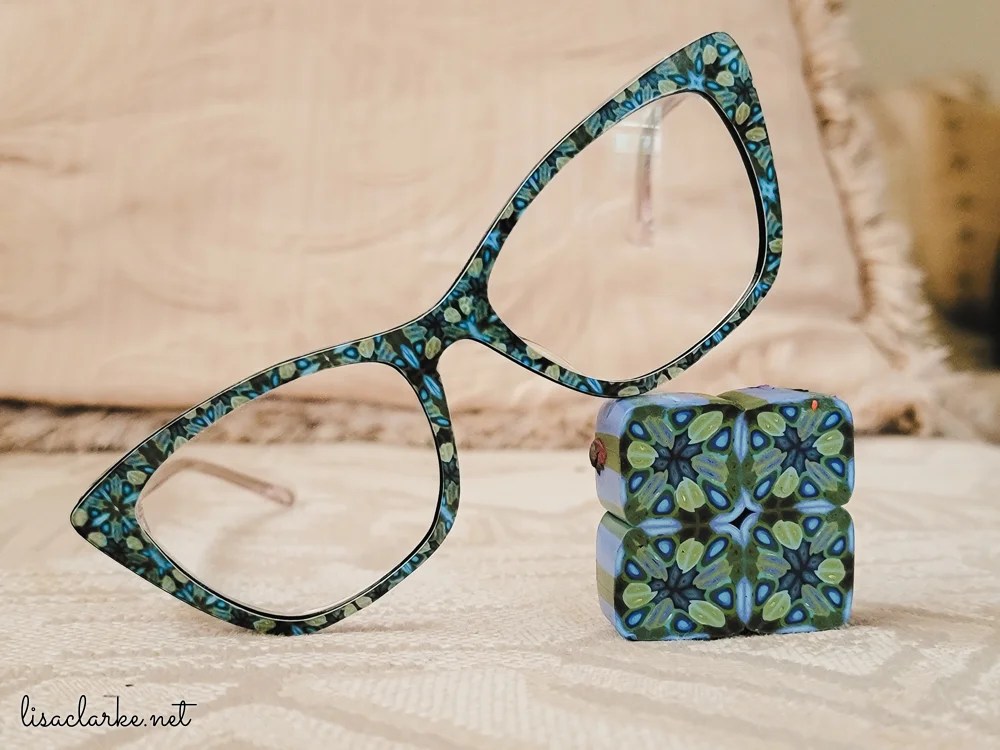
Photo: Lisa Clarke.
Magnetic topper for Pair eyewear.
I was in elementary school when I got my first pair of glasses. At that time, people would say, “You look like Private Secretary,” a character in a television show of the same name. My wiseacre dad, however, couldn’t resist saying, “Men seldom make passes at girls who wear glasses.”
Nowadays, we know that glasses not only correct vision but make a fashion statement. And as Gabrielle Emanuel reports at National Public Radio (NPR), there’s even research about the connection between glasses and income.
She writes, “Jasmin Atker calls her reading glasses her best friend – and a companion she does not take for granted. But her spectacles do something most best friends don’t do: They help her make a lot more money.
“Atker, 42, is a grandmother who lives in Manikganj, Bangladesh, on a small family farm. It started as a cattle farm producing milk. After she got glasses through the nonprofit groups VisionSpring and BRAC in 2022, Atker says, her improved vision enabled her to set up a vegetable patch. She even learned how to grow mushrooms. She now sells mushrooms as well as pumpkins, watermelon and spinach at the market. Atker estimates that her monthly income has jumped from 9,000 to 10,000 Bangladeshi taka to closer to 15,000 to 17,000 taka – the equivalent of about $150.
” ‘Before, when I tried to cut vegetables and wanted to see if there were any insects or not, I couldn’t see properly,’ Atker says, speaking through an interpreter. ‘After [I got] the glasses, the average time that I take for each task has reduced significantly. And I can do more work … [and] I have this sense of independence.’
“There’s now data that suggests Atker’s story is common. For the first time, researchers have directly linked glasses and income. The study – published April 3 in PLOS ONE – found a dramatic increase in earnings with a very low-cost change: a new pair of reading glasses.
“The researchers went to 56 villages in Bangladesh and found more than 800 adults ages 35 to 65 who are farsighted – that is, they could not see well up close. Half were randomly selected to get glasses; the other half got glasses after eight months. In that time, the researchers found that income grew by 33% for those with glasses – from a median monthly income of $35 to $47 – and that people who were not in the workforce were able to start jobs after getting reading glasses. …
” ‘In a lot of low- and middle-income countries, glasses are still tightly regulated,’ says Dr. Nathan Congdon, a co-author of the study and chair of Global Eye Health at Queen’s University Belfast. People often have to get a prescription from a vision specialist before they can purchase glasses, even reading glasses. This proves to be a huge hurdle for those living in poverty and those in remote areas, he says.
“The study did more than quantify the income gains from glasses. The researchers also taught community health workers in just a few hours how to help people pick the right reading glasses. …
” ‘It’s a little bit like buying a pair of trousers where you’ve got small, medium, large, extra large – four or five, six different sizes,’ says Congdon. This makes reading glasses easier and cheaper to produce.
” ‘The glasses themselves cost maybe $3-4. And using village health workers, we can make the cost of delivery very inexpensive as well,’ said Congdon. ‘So the whole thing can really just be a handful of dollars to deliver something that’s potentially quite life changing.’
“This study’s findings fit with past studies that link glasses to productivity. For example, Congdon was involved in a study, in India, where tea pickers given glasses were more productive. Similarly, cataract surgery has been shown to increase economically valuable activities by 40% to 50%.
“The villagers in the study worked in a wide range of professions: shopkeepers, farmers, craftspeople and weavers, for example. Only about a third of them were literate. So the reading glasses weren’t for reading as much as for other daily tasks, like threading a needle, quickly figuring out change at a cash register or weeding and sorting grain on a family farm.
“What the participants had in common is they had presbyopia – as do over a billion people today. This condition happens naturally as people age. …
“Congdon would like to see regulations loosen to improve access to reading glasses. He says the regulations, the cost and a general lack of awareness have meant many people who need glasses go without. When searching for participants, his team met almost nobody in the Bangladeshi villages with glasses.
“Congdon, who is an ophthalmologist himself, largely blames his own profession. ‘Ophthalmologists and optometrists may be advising the government that they should tightly regulate access to these products [to] strengthen their professions. They may see themselves as gatekeepers of quality,’ he says. ‘I wouldn’t be recommending that we just hand out distance glasses, but I do think that for near [vision] glasses that’s a reasonable thing to do.’
“He says some for-profit companies and countries have successfully experimented with providing people with glasses. ‘Dozens of companies in coffee, tea, chocolate, textiles and other visually intensive sectors – they started to offer these programs, all across India and in many African countries,’ Congdon says.” More at NPR, here. No firewall.
I work with an ESL teacher who sees to it that students who need glasses take advantage of special programs. You have to jump through some hoops, but glasses make a huge difference in their lives.


 Suzanne's Mom's Blog