Feeds:
Posts
Comments

Posts Tagged ‘global warming’

Photo: Francisco Kjolseth/Salt Lake Tribune.
Dropping lake levels on the Great Salt Lake, along the north side of Antelope Island, continue to expose more reef-like structures called microbialites on Wednesday, Jan. 4, but the lake benefited from an epic snowfall this past winter.

Good news/bad news on climate change today. Utah’s Great Salt Lake, in danger of disappearing entirely, got recharged after heavy snow in the mountains this past winter. So what does its future look like now?

As Dan Stillman reported at the Washington Post in April, “Just three months ago, scientists issued a report with a dire warning: Utah’s Great Salt Lake, after decades of drying that had only accelerated in recent years, was on track to disappear in five years. Now a record snowpack, fueled by more than 800 inches of snow during the season in some locations, offers a glimmer of hope for the Western Hemisphere’s largest saltwater lake and an important economic driver for the state.

“The Great Salt Lake reached its record low in November when it dipped to 4,188.6 feet above sea level, having lost more than 70 percent of its water since 1850, according to the report published in January by researchers at Brigham Young University. [However] the lake had risen three feet in a little more than five months, primarily because of snow and rain dumped directly into the lake by a season-long series of water-loaded storms. …

“ ‘While we celebrate our progress, we must continue to prioritize water conservation efforts and make sustainable water management decisions for the future of this vital ecosystem and for water users throughout the basin,’ said Candice Hasenyager, director of the Utah Division of Water Resources, in an email.

“This season’s record snowpack promises to push water levels even higher in the coming weeks as warmer temperatures melt the snow and runoff enters the lake. The statewide average snowpack, which is measured by calculating the amount of water contained in the snow, reached 30 inches on Thursday, beating the previous record of 28.8 inches in 1952.

“ ‘This year’s snowpack is nothing short of miraculous. After so many years of drought, this definitely feels like an answer to prayers,’ Brigham Young University ecologist Ben Abbott said in an email. Abbott was the lead author for the January report, which warned of ‘widespread air and water pollution, numerous Endangered Species Act listings, and declines in agriculture, industry, and overall quality of life’ if the lake were to vanish.

“Despite its recent rise, the lake is still six feet below what is considered ‘the minimum acceptable elevation for the lake’s ecological and economic health,’ according to Abbott. … Even if the water level recovers to an ‘acceptable’ level, the longer-term sustainability of the lake will depend on water management decisions and conservation efforts. …

“Historically, management of the Great Salt Lake watershed has prioritized human water usage over the health of the lake, with most of the river and stream water flowing toward the lake diverted for home, business and agricultural use. A February assessment by a team of Utah researchers and state officials found that 67 to 73 percent of the decline in water levels is due to natural and human water use.

“Water levels have been further diminished in recent years by an intense drought, made more likely by climate change, which has only finally started to ease with this winter’s record snowfall. In March 2021, the federal drought monitor showed most of the state in extreme or exceptional drought, the two driest out of five drought categories. In the latest report, [extreme] and exceptional drought have disappeared, with most of the state classified under the two least severe drought categories.

“Reduced inflow of fresh water into the lake results in high salinity levels that have far-reaching consequences including the release of toxic dust, poor air quality, the collapse of food webs and loss of brine shrimp that feed fish and shrimp sold worldwide. …

“More controlled water releases, such as the one coordinated by city and county officials in early March, could not only reduce flood risks this spring but also help restore the lake closer to a healthy water level. Yet regardless of how much improvement comes from spring runoff, Abbott stands by the cuts in water consumption he and his co-authors recommended in their report earlier this year.

“ ‘We’ve got to keep our eye on the conservation ball,’ Abbott said. ‘To replenish Great Salt Lake, we need to reduce our consumptive water use by 30 to 50 percent.’ “

More at the Post, here.

Read Full Post »

Photo: Wikimedia.
Devastation on the island nation Vanuatu (near Australia) after Cyclone Pam in March 2015. Vanuatu is one of the countries most vulnerable to climate change. Already this year it was hit by two Category 4 cyclones, blamed on global warming.

Today’s story by Michael Birnbaum at the Washington Post could be subtitled The Mouse That Roared. That’s because a tiny nation vulnerable to climate change is pushing the world’s highest court to take a stand.

“The small Pacific island nation of Vanuatu won a major victory to advance international climate law [in March] after it persuaded the U.N. General Assembly to ask the world’s highest international court to rule on the obligations of countries to address climate change.

“The request for an advisory ruling from the International Court of Justice is expected to clarify the legal obligations of countries to address climate change — and to create a path for them to be sued if they fail to do so. The U.N. effort was a significant outcome for Vanuatu, an archipelago nation of 320,000 people that is suffering from climate-change-driven natural disasters. In recent weeks, it was hit by two Category 4 cyclones, the severity of which its leaders blamed on global warming. Thousands of people are still living in shelters.

“The country has used its moral authority and ability to stage action at the United Nations to achieve outsize results on climate issues. The U.N. General Assembly approved the measure by acclamation, with neither the United States nor China standing in the way of the effort despite uncertainty in advance whether they would seek a formal up-or-down vote.

“[The] decision was also a measure of how much global attitudes about the urgency of addressing climate change have shifted in recent years. A similar effort in 2011 by two other island nations, Palau and the Marshall Islands, failed at the United Nations. This time, Vanuatu obtained co-sponsorship from more than 120 countries, including Britain, France, Germany and other industrialized nations with a long history of high emissions.

“ ‘It is a matter of basic survival for us,’ Vanuatu Climate Change Minister Ralph Regenvanu said in an interview.

‘We can’t do anything economically and politically because we don’t have any power. What we can use is our sovereignty as a United Nations member state.’ …

“Having the International Court of Justice weigh in creates a ‘pretty clear pathway to recognizing that states have a duty not only not to violate fundamental human rights, but states have a duty to avoid transboundary harm through activities under their control,’ said Carroll Muffett, president of the Center for International Environmental Law, a D.C.-based nonprofit that works to use international law to address ecological issues.

“He compared an advisory ruling to consulting a lawyer while being engaged in behavior that falls in a legal gray zone.

“ ‘It’s like when you send a note to your lawyer, and you get a lawyer’s note back saying what you’re doing is illegal,’ he said. ‘It puts you on notice that you could be held accountable for your actions.’ …

“As Vanuatu gained support for the U.N. action, it was careful to try to build consensus, with its leaders saying they are not suing anyone nor seeking to create new international obligations. Instead, they say, they are seeking to clarify how preexisting international agreements apply to climate change. …

“Neither the United States, which is the world’s largest historical emitter, nor China — which is soon poised to overtake the United States on that count — opposed the measure. The two superpowers have been competing for influence among Pacific island nations as they seek to project power across that ocean, giving the small countries outsize leverage despite their minuscule economies and populations.

“But even as the United States stood aside and allowed the referral to be approved without objection, a U.S. diplomat also said the Biden administration believes diplomacy is a better way to achieve action on climate issues than inside a courtroom.

” ‘Launching a judicial process, especially given the broad scope of the questions, will likely accentuate disagreements and not be conducive to advancing our ongoing diplomatic and other processes. In light of these concerns, the United States disagrees that this initiative is the best approach for achieving our shared goals,’ diplomat Nicholas Hill told the General Assembly after the measure was approved, speaking on behalf of the State Department.

“Vanuatu’s policymakers said they had tried to craft their work in a way that would win broad acceptance.

“ ‘We have deliberately tried to make this as noncontentious as possible,’ Regenvanu said. ‘Once we get the question before the court, then the process of submissions begins, and there might be a slight change of tactic there. Because obviously we want the highest level ambition in that opinion.’

“The effort began four years ago in a classroom at the University of the South Pacific in Fiji. Law students there decided that an advisory opinion from the International Court of Justice could be an effective tool to advance climate justice. They worked to convince their governments to follow suit.

“Vanuatu has also promoted a global fossil fuel nonproliferation treaty, advocating a total phaseout of oil, coal and gas as quickly as possible. And it has been a leader on international efforts to create a system to compensate the worst-hit countries for ‘loss and damage’ from climate change.”

More at the Post, here.

Read Full Post »

Photo: Josep Lago/AFP/Getty Images.
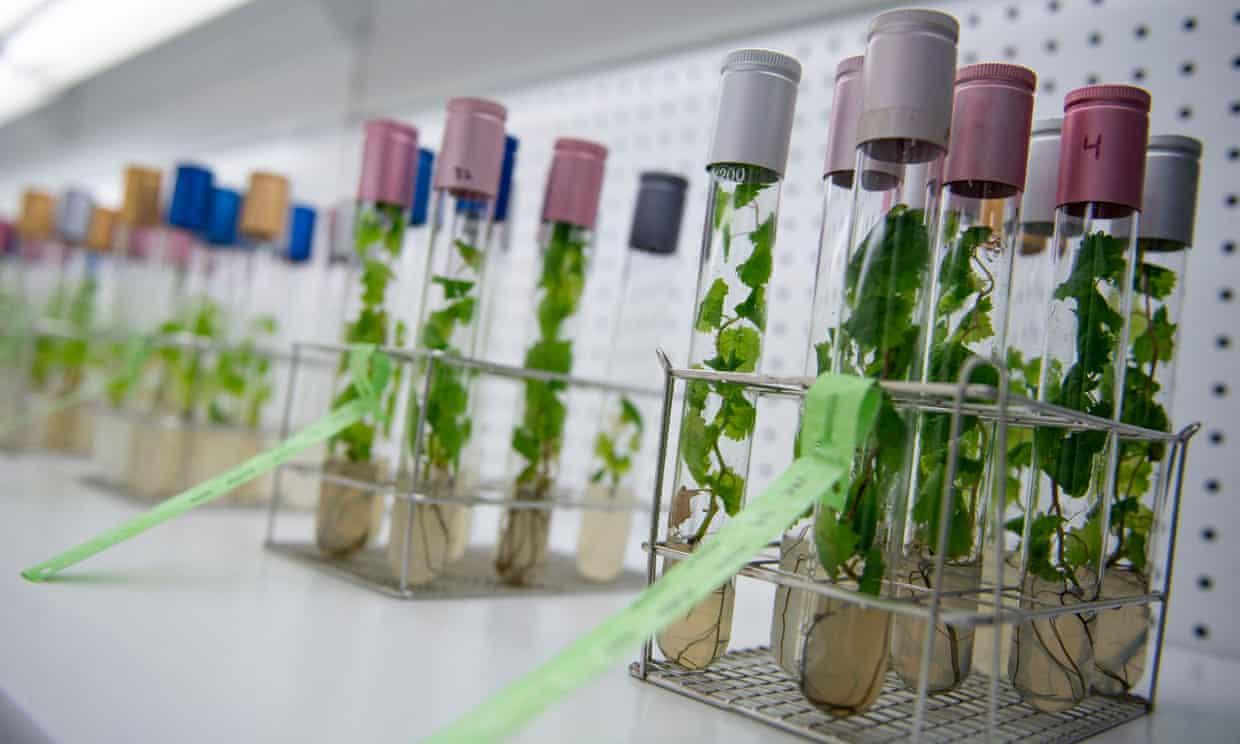
Ancient grape varieties in the laboratory at the Familia Torres vineyard near Barcelona. 

Here we go, Humans! More adapting.

Today’s story is about pragmatic grape growers adapting to climate change by seeking out grapes that can handle more heat. Too bad they have to do this, but what they learn may help other growers — and all of us.

Ashifa Kassam covers the topic for the Guardian: “The ads – tucked in the corners of local newspapers and directed at winemakers – began turning up across Catalonia in the 1980s. ‘If you know where to find any uncommon grape varieties, please get in touch,’ they read.

“Dozens of tips came pouring in, shepherding Miguel A Torres in his search for long-forgotten wine grapes. But it wouldn’t be until a decade later, as the climate crisis began wreaking havoc on vines, that the fourth-generation winemaker realized his foray into the past could play a key role in tackling what lies ahead.

“ ‘I simply wanted to recover the heritage – the ancient traditions and vines – left to us by our ancestors,’ said Torres, the president of Familia Torres winery.

‘And then we realized that some of these varieties take longer to ripen, meaning they might be able to help us in a warming world.’

“It was a glimmer of hope as the wine industry grapples with a changing climate. Extreme weather, drought and steadily rising temperatures have laid bare a crop that is extremely sensitive to change. In Spain, rising temperatures have meant grapes ripening more quickly, leaving winemakers rushing to harvest in hopes of protecting the carefully concocted balance between the fruit’s sugars and acidity.

“ ‘Climate change is the worst threat the sector has ever faced,’ said Torres. …

“In California, vintners are embracing grapes such as mourtaou, a nearly extinct variety from south-western France, to create peppery reds, while some in France’s Cognac region are toppling more than a century of tradition to trial climate-resistant grapes. In Bordeaux, concerns about the climate crisis recently helped to secure the approval of six new grape varieties, including castets, a disease-resistant variety that had been on the brink of disappearing.

“The reasons these grapes fell into disuse varies widely, said José Miguel Martínez Zapater, the director of the Institute of Grapevine and Wine Sciences in La Rioja. Some were abandoned in the late 19th century as the phylloxera plague forced European grape growers to chase efficiency, while others were discarded as winemakers sought to comply with strictly defined appellations or consumer preferences for certain grapes.

“Martínez Zapater’s publicly funded institute is one of several across Spain that have been peering into the past to bolster wine grape diversity – a years-long process that involves identifying the varieties, testing out their characteristics and seeking official approval for their use. … ‘People are finding varieties in different areas that they consider interesting.’

“In Spain – home to a €5bn-a-year wine production industry [$5,390,000,000] whose production outpaced all other EU countries in 2021 – much is on the line. Last year, the country experienced its hottest year since record-keeping began; since 2015 the country has sweltered through four of its hottest years on record.

“At the Agrarian Technological Institute of Castilla y Leon, known as ITACyL in Spanish, two decades of research have led to the recovery of more than a dozen varieties of grapes. The list includes estaladiña, a grape whose last recorded reference stretches back to 1914, and cenicienta, a grape close to extinction before it was revived to make fruity reds.

“ ‘The wines they make are very distinct and interesting,’ said José Antonio Rubio Cano, who heads the viticulture and woody crop department at the institute. … He stressed, however, that the embrace of these long-overlooked varieties is just part of the broader efforts needed as the industry adapts to a changing climate. ‘There’s no one solution,’ said Rubio Cano. ‘It has to be a set of things; we have to pay more attention to the vines, be more aware of how their fruits are ripening and we need to develop a deeper understanding of the vineyard and the different varieties.’ …

“The Caserío de Dueñas vineyard is taking the institute’s research to the next level, planting hectares of eight of the recovered varieties to test out how the grapes behave in a real-world scenario.

“ ‘I find it super-interesting,’ said Almudena Alberca [who in 2018 became Spain’s first female master of wine and is] the technical director for Entrecanales Domecq, the vineyard’s owner. ‘The possibilities are endless.’ …

“Four decades after Torres placed his first ad seeking forgotten grapes, Familia Torres has begun releasing small quantities of wines made from the fruits of his quest, such as forcada and pirene. The wines tell a story that is both steeped in the past and nods at the enormous challenge that lies ahead as the climate crisis tightens its grip, said Torres.

“ ‘I’ve always said that the wine sector is the canary in the coal mine,’ he added. ‘The consequences that vineyards are living through right now should make everyone take notice.’ ”

More at the Guardian, here. No firewall; donations encouraged.

Read Full Post »

Does humanity sometimes do the right thing? Yes indeed. Hard to imagine but true: every country in the world signed on to combatting the danger of depleted ozone.

Scott Dance reports at the Washington Post that “a new assessment of Earth’s depleted ozone layer released [in January] shows that efforts to repair the vital atmospheric shield are working, according to a panel of U.N.-backed scientists, as global emissions of ozone-harming chemicals continue to decline.

“At this rate, the ozone layer could recover to 1980s levels across most of the globe by the 2040s, and by 2066 in Antarctica, the report concludes. Ozone loss is most dramatic above the South Pole, with an ozone ‘hole’ appearing there every spring.

“Those improvements will not be steady, scientists stressed, given natural fluctuations in ozone levels and the ozone-inhibiting influence of volcanic eruptions like the massive one from underwater Pacific Ocean volcano Hunga Tonga a year ago.

“But scientists said the latest ozone data and projections are nonetheless further proof of the success of the Montreal Protocol, the global 1987 agreement to phase out production and use of ozone-depleting substances. …

“A recent decline in observed levels of the chemical known as CFC-11, in particular — which as recently as 2018 had been observed at higher-than-expected levels and traced to China — is proof that societies can collaborate to address a confounding environmental problem, said Martyn Chipperfield, a professor at the University of Leeds who serves on the scientific panel. …

“Ozone is a molecule made of three oxygen atoms, and it proliferates in a layer of the stratosphere about 9 to 18 miles above the ground. It can exist at ground level, too, where it is a product of air pollution on hot summer days and considered a health hazard. But in the atmosphere, it serves as an essential shield protecting Earth’s life from harmful ultraviolet radiation.

“In the same way that UV lights eradicate pathogens like the virus responsible for covid-19, the sun’s radiation would make it impossible for life to thrive on Earth if not for the ozone layer’s protection.

UV-B, a high-energy form of solar radiation, damages DNA in plants and animals, disrupting a variety of biological processes and reducing the efficiency of photosynthesis.

“The Montreal Protocol, which has been approved by every country in the world, protects the ozone by outlawing the manufacturing and use of substances that destroy it when they come in contact with it in the atmosphere. That largely includes a class known as chlorofluorocarbons, or CFCs, which contain ozone-depleting chlorine and were used in refrigerators, air conditioners and aerosol cans.

“The treaty was expanded in 2016 through the Kigali Amendment to include hydrofluorocarbons or HFCs, a replacement for CFCs that do not harm the ozone but are a type of greenhouse gas that warms the planet more potently than carbon dioxide. The U.S. Senate ratified the amendment in September. …

“ ‘We can already see HFCs are not increasing as fast as we thought they would because countries are starting to implement their own controls,’ said Paul Newman, one of four co-chairs of the Scientific Assessment Panel of the Montreal Protocol.

“Still, it is possible forthcoming data on ozone levels will prompt some concerns that the ozone layer is not recovering as quickly as the report concludes, he said. Newman said he expects that will be because the Hunga Tonga eruption blasted so much material into the atmosphere. Volcanic eruptions are known to accelerate ozone depletion.

“Progress would likely also be slowed if humans pursue geoengineering to reverse global warming by injecting sunlight-reflecting particles into the upper atmosphere, Newman said. The panel, which considered the potential impact of that practice for the first time … found that, depending on the timing, frequency and amount of such injections, the particles could alter aspects of atmospheric chemistry that are important in ozone development.”

More at the Post, here.

Read Full Post »

Photo: Suzanne and John’s Mom.
Frances Moore Lappé, author of Diet for a Small Planet, founded the Small Planet Institute, which focuses on social solutions to environmental, hunger, and political challenges.

The environmental radio show Living on Earth is staying on top of concerns about our global food system and the role it plays in “environmental crises like global warming and water pollution even as it fails to adequately feed billions of people.” Diet for a Small Planet author Frances Moore Lappé recently joined host Steve Curwood to discuss how “embracing the plant world in our diets connects to climate, health, and democracy.”

“STEVE CURWOOD: Our present food system is polluting and wasteful. For starters, about a third is thrown away, tossed from kitchens and plates in rich places and spoiled where people can’t afford to refrigerate. And many industrial growing systems pollute and waste as well, using too much water, land and chemicals in ways that also add to climate disaster. Yet around the world more than 2 billion people are food insecure.

“Fifty years ago Frances Moore Lappé wrote the bestselling Diet for a Small Planet in a bid to address the hunger crisis, and along the way she seeded a plant-centered food revolution in the kitchens of America. She joins me now from Belmont, Massachusetts. … Frankie, just to be clear, what is a plant-centered diet?

“FRANCES MOORE: Well, it’s embracing the plant world. When I moved from meat, you know I grew up in Texas cow town, right. So people said oh you’re giving up so much and I said, no, no, no, it’s the plant world that has all the taste differences, the color, the shapes, the textures, you know, it’s where all the yummy stuff is. And so for me being plant centered is I don’t follow recipes a lot but going into the kitchen and looking, you know, seeing what’s there and finding out spices and herbs I love and for example, I turned a basic beans and rice dish into an Italian dish by just changing the herbs that are used in it. It’s called Roman Rice and Beans in Diet for a Small Planet. …

“CURWOOD: So what’s changed in the last 50 years since you wrote Diet for a Small Planet? …

“MOORE: We’re sort of moving in two directions at once because we’ve got it now we know what to do and all over the world, people are aligning with nature to grow our food [but] the dominant extractive approach that is so dangerous and so unnecessary is still going strong. …

“Our food system globally contributes about 37% of greenhouse gas emissions and about 40% of that is from the livestock sector. So that’s a huge contribution. And now I’m calling it a plant- and planet-centered diet because if we really addressed this crisis and grew a healthy plant-centered diet, that would cut the agricultural greenhouse gas emissions by about two-thirds. A professor at the University of Minnesota calculated that it would be the equivalent to removing basically all the vehicles off the planet.

“CURWOOD: Now, people listening to us need to be reassured that you’re not saying you can never eat meat, you’re just telling us to make it a rare occasion. …

“MOORE: I really want to be big tent and to welcome people if they are eager to align with their body because there’s a lot of evidence that this plant-centered stuff is really good for us. … Any step we can take, I celebrate.

“CURWOOD: Now, the meat production industry has gone to great lengths to concentrate operations. …

“MOORE: What woke me up at age 26 [was] that I saw meat production as a protein factory in reverse. Consider this, we use about 80% of our agricultural land to produce livestock, but they give to us only 18% of our calories. So right there, that is pretty darn inefficient and for beef, one estimate says that of the grains fed to livestock we get about 3% to 5% of the calories and protein that we eat from all of that grain that gets fed to livestock in this country. So it’s really hard to imagine anything less efficient. …

“CURWOOD: Tell me a little bit more about the the health risk of red meat.

“MOORE: Well, I was actually shocked to learn recently that the WHO, the World Health Organization, has deemed red meat a probable carcinogen. And when I looked into it a bit that has to do with heme iron in red meat. … And then on processed meat, the WHO has deemed processed meat a carcinogen. …

“CURWOOD: Why [is] the food we eat is also linked to the health of our democracy in your view? …

“MOORE: Our democracy [is] the taproot crisis and we also have a living-planet crisis and we also have an economic crisis [of] concentration of wealth, but the taproot is democracy, because that is the way that we make decisions together to solve problems. [If] we’re going to solve these huge problems of our environment and the impact of farming on climate change, which is quite significant, we have to have democracy. And what we have now I think of as a very corrupted form because private interests those who are benefiting very much from fossil fuels and from the meat-production industry and [they] have tremendous power in Washington. There are now 20 corporate lobbyists in Washington for every single person that you and I elect to represent us in Washington. That is problematic, that is what I call a corrupted system, and that’s why I think it’s so important, Steve, we’ve got to solve these problems, and we’ve got to have democracy to solve them.”

More on that at Living on Earth, here. No firewall.

Read Full Post »

Photo: Serious Shea.
Community members stand by a tree planted in Senegal during the launch of the Great Green Wall Corporate Alliance, an initiative that is part of larger efforts to prevent desertification in Africa’s Sahel region. “Serious Shea,” says the Christian Science Monitor, “is transforming a previously firewood-dependent shea industry in Burkina Faso.”

When it comes to human rights and climate justice, corporations can get into the act. It can even boost their brand. Blogger Rebecca told me about a clothing company, Fair Indigo, where she buys clothes because the cotton is organic and she knows the workers are paid a fair wage. I myself have bought cotton towels at Patagonia, which has protected the environment for decades and now promises not to use cotton from Chinese forced labor.

At the Christian Science Monitor, Taylor Luck, Whitney Eulich, Ahmed Ellali, and Sandra Cuffe write about how various countries are working on water conservation — and how certain companies are helping.

“In Guatemala, farmers are setting up ‘living fences’ around fields, creating a buffer of roots to protect their soil during increasingly strong rainy seasons. In Jordan, local Bedouin communities and authorities are pioneering resilient desert agriculture in a region that has been hit by longer and more intense heat waves.

“And in Burkina Faso, William Kwende has been working to revolutionize shea butter production – by substituting renewable energy for traditional wood-burning methods that result in deforestation. He has introduced an approach with 100% renewable energy, self-sustaining biomass burners, and a closed water system, which is curbing emissions while also reducing crop losses. 

“At a time of global strain on food production, including an emerging famine in parts of East Africa, his story symbolizes the potential for using innovation to adapt to a changing climate.

The business Mr. Kwende co-founded, called Serious Shea, is designed to promote reforestation and to secure fairer wages and independence for the local women at the heart of the process. 

“A key part of the innovation: Serious Shea’s eco-processing centers transform shea tree biomass into natural biofertilizer and biochar, enriching soils that are at risk of desertification and reducing reliance on expensive imported chemical fertilizers. 

“ ‘People talk about water and food imports, but when you talk about food crises and adaptation, fertilizer is at the heart of it,’ Mr. Kwende tells the Monitor on the sidelines of COP 27 [Conference of Parties 27], this year’s global climate summit, at Sharm el-Sheikh. …

“Across the globe, innovative ideas like that are greatly needed. Extreme weather events are affecting the vital sector of food production – with the shifts especially hard for Indigenous communities and small-scale farmers. In Peru, rising temperatures have upended the livelihoods of alpaca farmers. In Pakistan, massive floods have sidelined several million acres from crop production. In Somalia and Kenya alone, drought threatens to push millions into food-poverty and starvation. …

“With its own farmers suffering losses amid intense heat waves and drop in Nile waters, atop the food-security crisis in the Horn of Africa, Egypt has placed agriculture front and center to an unprecedented degree at the current [COP]. …

“Agriculture experts say some of the solutions will involve mass-produced technologies such as battery-operated farm equipment. But it will also involve the rise and transfer of hundreds of local, homegrown solutions emerging across the world, many of which advocates say can cut carbon, improve resilience, and be replicated elsewhere. 

“In Mexico, where last summer eight of 32 states experienced moderate to extreme drought and where half of all municipalities in the country face water shortages, some farmers turn 2-liter soda bottles upside down over saplings to capture morning dew or dig holes and line them with organic materials like leaves, to retain rainfall around young trees.

“To the south in Peru, Alina Surquislla’s family has never seen anything like the current effects of rising temperatures in their three generations of alpaca herding. 

“There’s no water; the grass is turning yellow and disappearing for lack of rain,” says Ms. Surquislla. Alpacas are dying out at worrying rates. Speaking over a Wi-Fi satellite connection while walking at nearly 16,000 feet above sea level in the Apurimac region … for now, she says the answer for herders is to go to higher and higher elevations in search of water and grazing.

“Water is also scarce in Jordan. There, local Bedouin communities and authorities are scaling up pioneering desert agriculture in Al Mudawara, a border region near Saudi Arabia that has been hit by longer and more intense heat waves in the past few years. 

“Since 2019, under a directive by Jordan’s King Abdullah, each family in the area has been tending to 6-acre plots of yellow corn and green onions, watered from an underground aquifer. The crops have proved resilient to more frequent 120 degree F temperatures, sprouting up into green waves amid reddish desert sands that have not been utilized for agriculture in modern history. 

“Now over 4,000 acres of corn stalks stand 3 feet high and onions sprout in Al Mudawara. These provide alternative sources of income and living for Bedouin families, many of whom have been forced to abandon traditional camel shepherding due to the mounting costs of imported animal feed. …

“Says Abu Fahed al Huweiti, former director of the Al Mudawara Agricultural Cooperative that has steered the project. ‘It has given a new hope for people here.’

“In Tunisia, amid the lush fig and olive groves of Djebba, clinging to the tops of the Gorraa mountain, farmers continue a centuries-old terraced farming that has helped them cope with massive heat waves and drought that has hit much of Tunisia. 

“A series of cement-lined canals crisscross down the hill through the terraced farms, carrying water from natural springs fed by winter’s snow to groves of figs, pomegranates, quince, and olives on a rotating basis of collective water-sharing. 

“This ingenious method of traditional Berber farming provides timed irrigation of entire land plots, allowing local farmers to grow not only trees but also herbs and diverse flora and fauna, feeding livestock and chickens – all from the same measured water delivery. …

“ ‘We in Djebba keep using the same old techniques because it has shown success. It is an inherited model of coexistence and represents the ideal use of available water resources,’ says Fawzi Djebbi, Djebba farmer, activist, and head of the annual Djebba Fig Festival.  ‘Here we use the water as a collective resource from the mountains. This water belongs to all of us.’  

“Knowledge- and expertise-sharing has also been critical to speeding up farmers’ adaptation to the pummeling effects of severe weather events. 

“The CCDA, an Indigenous and small farmers movement for land rights and rural development in Guatemala, is working with many of their 1,300 affiliated communities around new techniques to help farmers adapt. This year’s rainy season has been one of the longest and heaviest this century, for example.

“One technique is planting trees and plants with deep roots around crop plots. The plants are a buffer against erosion, provide shade during the hot and dry season, and sometimes include edible plants as well. …

“Global organizations are seeking to spread helpful practices and information. The United Nations Food and Agriculture Organization (FAO) has been teaming up with Vodafone to get early warning systems and messages to rural farmers across Africa to better prepare for projected climate trends and to provide advice on mitigation measures.” 

More at the Monitor, here.

Read Full Post »

Photo: The American Chestnut Foundation via Living on Earth.
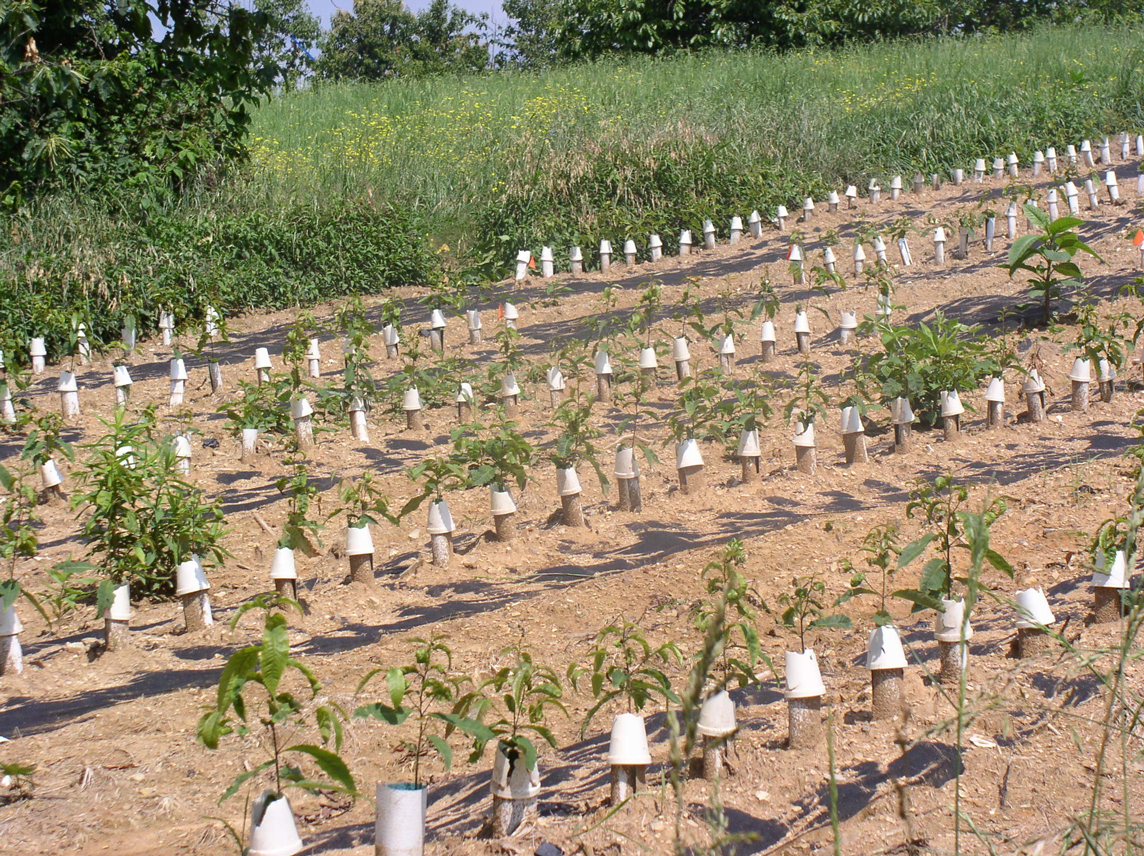
Towering American Chestnuts were once a staple of life for people across Appalachia and elsewhere in the Eastern United States. An initiative in mining country aims to bring them back.

Growing up, I heard from my father about how sad he was as a kid when American Chestnuts began to die off. Children really do not like loss. Thomas Brannon in today’s article was a kid who loved chestnuts, too. He is one of the people working to restore the trees that covered his grandparents’ land before they sold the mining rights.

Elena Shao starts the New York Times story with the director of operations at a tree-planting nonprofit.

“Michael French trudged through a thicket of prickly bramble, unfazed by the branches he had to swat away on occasion in order to arrive at a quiet spot of hilly land that was once mined for coal. Now, however, it is patched with flowering goldenrods and long yellow-green grasses and dotted with tree saplings.

“The sight, he acknowledged, would seem unimpressive to most. Yet it might be Mr. French’s most prized accomplishment. To him, the young trees symbolize what could be a critical comeback for some of the country’s vanishing forests, and for one tree in particular, the American chestnut.

‘I don’t see it how most people see it,’ he said. ‘I look at this and I see how it’s going to be in 80 to 100 years.’

“By then, Mr. French envisions that the chestnut, a beloved tree nearly wiped out a century ago by a blight-causing fungus, will be among those that make up an expansive forest of native trees and plants.

“Billions of chestnuts once dominated Appalachia, with Americans over many generations relying on their hardy trunks for log cabins, floor panels and telephone poles. Families would store the trees’ small, brown nuts in attics to eat during the holiday season.

“Now, Mr. French and his colleagues at Green Forests Work, a nonprofit group, hope to aid the decades-long effort to revive the American chestnut by bringing the trees back onto Appalachia’s former coal mines. Decades of mining, which have contributed to global warming, also left behind dry, acidic and hardened earth that made it difficult to grow much beyond nonnative herbaceous plants and grasses.

“As coal continues to decline and many of the remaining mines shut down for good, foresters say that restoring mining sites is an opportunity to prove that something productive can be made of lands that have been degraded by decades of extractive activity, particularly at a moment when trees are increasingly valued for their climate benefits. Forests can capture planet-warming emissions, create safe harbor for endangered wildlife species and make ecosystems more resilient to extreme weather events like flooding.

“The chestnut is a good fit for this effort, researchers say, because the tree’s historical range overlaps ‘almost perfectly’ with the terrain covered by former coal mines that stretched across parts of eastern Kentucky and Ohio, West Virginia and western Pennsylvania.

“Another advantage of restoring mining sites this way is that chestnut trees prefer slightly acidic growth material, and they grow best in sandy and well-drained soil that isn’t too wet, conditions that are mostly consistent with previously mined land, said Carolyn Keiffer, a plant ecologist at Miami University in Ohio. …

“ ‘We humans brought in the nonnative fungus that killed the tree,’ Dr. Keiffer said, referring to the parasitic fungus that was accidentally introduced to North America in the late 1800s on imported Japanese chestnuts. … ‘Maybe we can be the ones to bring the trees back.’

“That calling has always motivated Thomas Brannon, even as a third grader in the 1940s planting trees with his siblings on his family’s land in eastern Ohio, the property that Mr. French visited in August.

“ ‘If I can make that 230 acres look better, then that’s enough for me,’ Mr. Brannon said.

“His grandparents sold mining rights to parts of the property in 1952, and nearly four decades of coal mining followed. In 1977, the federal government passed the Surface Mining Control and Reclamation Act, requiring mining companies to return land to the general shape it had before the mining activity.

“As a result, mining companies would backfill excavated land, packing rock material tightly against the hillside so it wouldn’t cause landslides, said Scott Eggerud, a forester with the Office of Surface Mining Reclamation and Enforcement, the agency that enforces the mining law. To prevent erosion, mining companies would plant aggressive, mostly nonnative grasses that could tolerate the heavily compacted soil. …

“In theory, compacting land and greening it up quickly was a good idea, in terms of preventing erosion and water contamination, said Sara Fitzsimmons, chief conservation officer at The American Chestnut Foundation. But it made re-establishing forests difficult. …

“When Green Forests Work arrived on the Brannon property in 2013, they focused on undoing some of the damage done to the land, bringing in bulldozers with giant ripping shanks that dig three to four feet deep into the soil, loosening up the dirt and pulling up rocks.

“By springtime, the group had planted upward of 20,000 seedlings, a mix of 20 different native tree species including the American chestnut, the Virginia pine and a variety of oaks.

“They also planted 625 chestnuts in a one-acre space they called a progeny test to evaluate the health of hybridized chestnut trees — fifteen-sixteenths American chestnut and one-sixteenth Chinese chestnut — that were crossbred by scientists at the American Chestnut Foundation, a nonprofit group formed in the 1980s.”

More at the Times, here. Still more at the environmental radio show Living on Earth. No firewall.

Read Full Post »

Photo: Waterstudio/Dutch Docklands Maldives via dezeen.
Maldives Floating City is planned to accommodate up to 20,000 residents. Badly needed. Global warming is sinking the country.

Is it possible to reverse the harm we’ve done to the planet after burning so much fossil fuel? For the people of Maldives, time is of the essence, and they’re not waiting to find out.

Alice Finney writes at dezeen, “The Maldives has partnered with architecture studio Waterstudio to create a brain-shaped floating city that will house 20,000 people in a lagoon near the country’s capital.

“Called Maldives Floating City, the development will contain 5,000 low-rise floating homes floating within a 200-hectare lagoon in the Indian Ocean. As sea levels rise, so too will the city, which will be built upon a series of hexagonal-shaped floating structures.

“In the Maldives, 80 per cent of the country sits less than one metre (three feet) above sea level. With the Maldives islands predicted to be uninhabitable by 2100 due to rising sea levels, the government of the Maldives hopes to offer up to 20,000 locals and foreigners the opportunity to move to the floating city as early as 2024.

“Construction is planned to begin later this year on the development, which will be 10 minutes by boat from the Maldivian capital Male.

” ‘This first-of-its-kind island city offers a revolutionary approach to modern sustainable living perched against a backdrop of the azure Indian Ocean,’ said the studio. …

“Maldives Floating City is among a number of floating city proposals, including Oceanix Busan by architecture firms BIG and Samoo and tech company Oceanix that are designed to offer a housing solution to rising sea levels and global temperature increases.

“However, developer Dutch Docklands claims that none have been attempted on this scale and at this speed with full governmental support.

” ‘While attempts at floating cities have been tried before, none have featured Maldives Floating City’s most compelling selling points: full-scale technical, logistical and legal expertise,’ explained Dutch Docklands.

“The development, which is set to be fully completed by 2027, will be composed of a series of hexagonal islands modeled on the geometric shapes of a local coral called brain coral. When combined and viewed from above the development will resemble a brain. …

“The living platforms will support houses, hotels, restaurants, shops, a hospital, a school and a government building. …

” ‘As a nation at the front lines of global warming, the Maldives is perfectly positioned to reimagine how humankind will survive — and, indeed, thrive — in the face of rising seas and coastal erosion,’ said the Dutch Docklands.

” ‘Inspired by traditional Maldivian sea-faring culture and developed in close cooperation with Maldivian authorities, Maldives Floating City homes will eventually be joined by hotels, restaurants, stylish boutiques and a world-class marina.’

“The Intergovernmental Panel on Climate Change (IPCC)’s Sixth Assessment Report 2022, states that small island nations such as the Maldives may become completely uninhabitable as the world is on track to warm by two to three degrees this century.

” ‘The world faces unavoidable multiple climate hazards over the next two decades with global warming of 1.5°C (2.7°F)’ the report by the United Nations’ climate change panel said. ‘Even temporarily exceeding this warming level will result in additional severe impacts, some of which will be irreversible. Risks for society will increase, including to infrastructure and low-lying coastal settlements.’

“Viable solutions for urban development into the ocean listed in the report include elevating houses on stilts and creating ‘amphibious architecture’ that can float on the surface of rising floodwater.”

Oy. I try to find hopeful stories for the blog, but I think I failed on this one. We really need to reverse what we’ve done. I know climate is not the same as weather, but the extremes of weather we are seeing should convince even nonbelievers that something is going on. I left for my walk at 5:15 am today to “beat the heat.” It was already 80F (26.6 C)!

More at dezeen, here.

Read Full Post »

Photo: Tony Jolliffe/BBC.
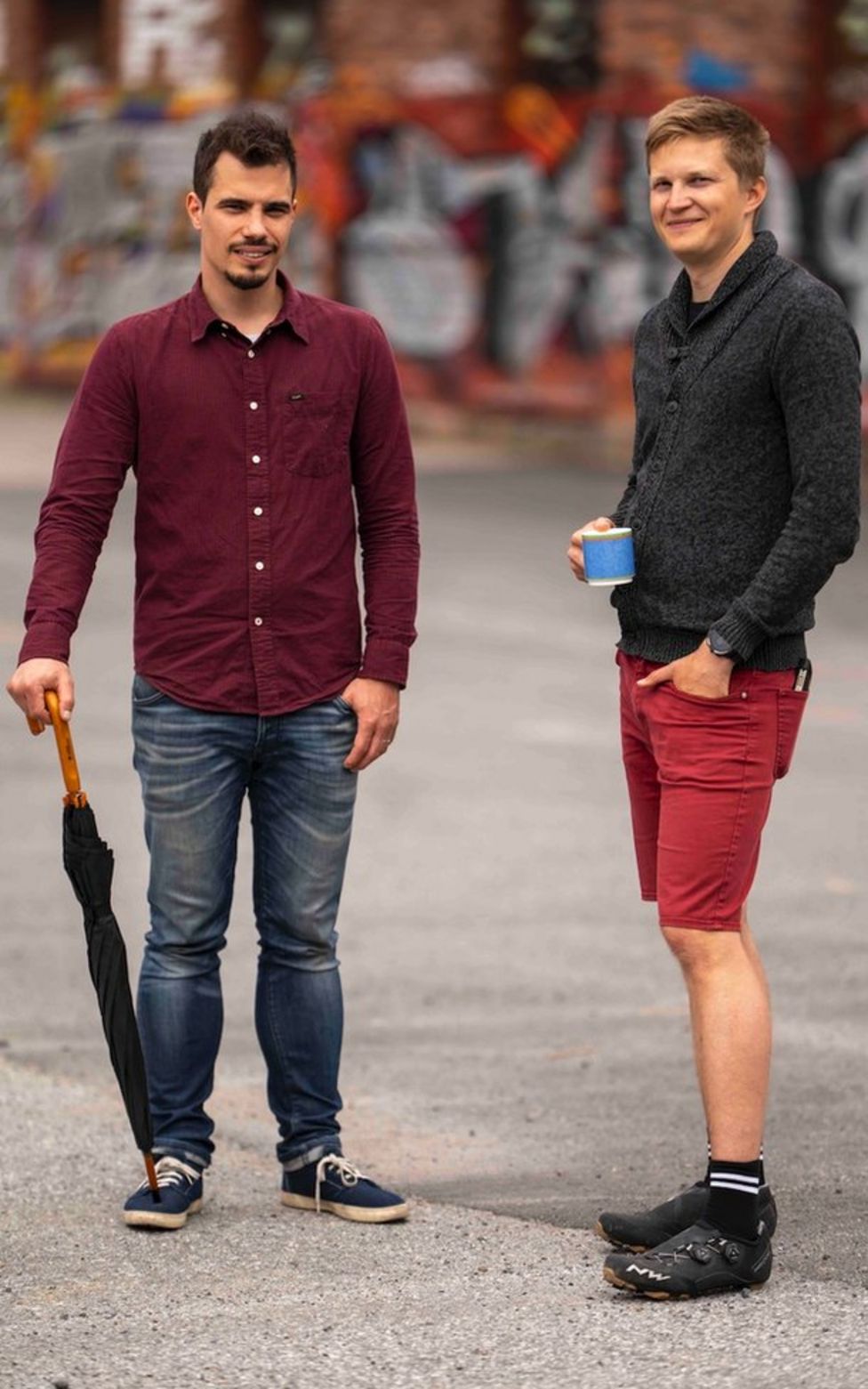
Finnish researchers Markku Ylönen and Tommi Eronen, who came up with the sand-battery idea. Don’t these guys look just like the kind of young people you’d expect to tackle something impossible?

The big challenge for renewable energy sources like solar and wind has always been storage. Where is there a battery big enough and powerful enough to store the energy until it’s needed?

Bring on a couple wiz kids who think about daunting problems like global warming and overdependence on Russian gas.

Matt McGrath writes at the BBC, “Finnish researchers have installed the world’s first fully working ‘sand battery,’ which can store green power for months at a time. …

“Using low-grade sand, the device is charged up with heat made from cheap electricity from solar or wind. The sand stores the heat at around 500C (~932 degrees Fahrenheit), which can then warm homes in winter when energy is more expensive.

“Finland gets most of its gas from Russia, so the war in Ukraine has drawn the issue of green power into sharp focus. It has the longest Russian border in the EU and Moscow has now halted gas and electricity supplies in the wake of Finland’s decision to join NATO.

“Concerns over sources of heat and light, especially with the long, cold Finnish winter on the horizon are preoccupying politicians and citizens alike. But in a corner of a small power plant in western Finland stands a new piece of technology that has the potential to ease some of these worries.

“The key element in this device? Around 100 tonnes of builder’s sand, piled high inside a dull grey silo.

“These rough and ready grains may well represent a simple, cost-effective way of storing power for when it’s needed most.

“Because of climate change and now thanks to the rapidly rising price of fossil fuels, there’s a surge of investment in new renewable energy production. But while new solar panels and wind turbines can be quickly added to national grids, these extra sources also present huge challenges.

“The toughest question is about intermittency — how do you keep the lights on when the sun doesn’t shine and the wind doesn’t blow? …

“The most obvious answer to these problems is large-scale batteries which can store and balance energy demands as the grid becomes greener.

“Right now, most batteries are made with lithium and are expensive with a large, physical footprint, and can only cope with a limited amount of excess power.

“But in the town of Kankaanpää, a team of young Finnish engineers have completed the first commercial installation of a battery made from sand that they believe can solve the storage problem in a low-cost, low impact way.

” ‘Whenever there’s like this high surge of available green electricity, we want to be able to get it into the storage really quickly,’ said Markku Ylönen, one of the two founders of Polar Night Energy who have developed the product.

“The device has been installed in the Vatajankoski power plant, which runs the district heating system for the area.

“Low-cost electricity warms the sand up to 500C by resistive heating (the same process that makes electric fires work). This generates hot air which is circulated in the sand by means of a heat exchanger.

“Sand is a very effective medium for storing heat and loses little over time. The developers say that their device could keep sand at 500C for several months.

“So when energy prices are higher, the battery discharges the hot air which warms water for the district heating system which is then pumped around homes, offices and even the local swimming pool.

The idea for the sand battery was first developed at a former pulp mill in the city of Tampere, with the council donating the work space and providing funding to get it off the ground.

” ‘If we have some power stations that are just working for a few hours in the wintertime, when it’s the coldest, it’s going to be extremely expensive,’ said Elina Seppänen, an energy and climate specialist for the city. ‘But if we have this sort of solution that provides flexibility for the use, and storage of heat, that would help a lot.’ …

“One of the big challenges now is whether the technology can be scaled up to really make a difference — and will the developers be able to use it to get electricity out as well as heat? The efficiency falls dramatically when the sand is used to just return power to the electricity grid. …

“Other research groups, such as the US National Renewable Energy Laboratory are actively looking at sand as a viable form of battery for green power. But the Finns are the first with a working, commercial system, that so far is performing well, according to the man who’s invested in the system.

” ‘It’s really simple, but we liked the idea of trying something new, to be the first in the world to do something like this,’ said Pekka Passi, the managing director of the Vatajankoski power plant.”

One of the aspects of this approach that I like best is that it doesn’t use lithium, a “blood mineral,” the mining of which often hurts local communities.

Check out the graphic at the BBC, here, to see how the sand-battery works.

Read Full Post »

Photo: Tohumtoprak.
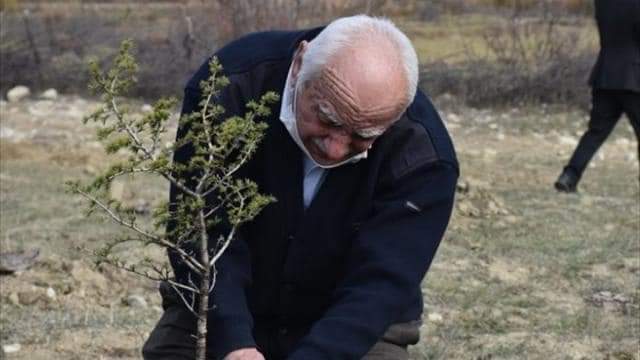
Working with his team and villagers, retired forest chief Hikmet Kaya has helped create a forest on once-barren land in Turkey.

Around the world, people have learned that planting trees can help us fight back against global warming. But it’s not as easy as sticking them in the ground. You have to ensure they live. And thrive.

Jessica Stewart reports on one initiative at My Modern Met, “Hikmet Kaya has proved that good intentions and hard work can yield big rewards. The retired Turkish forest management chief has posed proudly in front of the barren land that he and his team have transformed into a lush forest.

“He began his career in the town of Sinop in 1978 and while he retired 19 years later, his legacy has continued to grow — literally.

“Working together with his team and villagers, he brought in and planted 30 million saplings over the course of his tenure. Long after his retirement, these trees have continued to grow; and today, this barren stepped land has undergone an incredible transformation. … Needless to say, he admits he’s very happy with the results.

“It’s a wonderful example to set for the rest of the country. According to Global Forest Watch, Turkey has seen a 5.4% decrease in tree cover since 2000. … Combatting deforestation often comes down to governmental policy changes, which makes it important for individuals to know who they are voting for and to make sure their environmental concerns are heard. Still, that hasn’t stopped people from taking matters into their own hands and taking action.”

More at My Modern Met, here (where you’ll also find links to tree-planting stories from the Philippines, Pakistan, and Ethiopia).

There’s a tree maven in India who worked without help. You may have read about him. I’ll share Andrei Tapalaga‘s History of Yesterday story in case you missed the news.

“When talking about saving the environment, most people come with the comment of ‘how much difference will I make?’ … In this article, I want to present a man who has defied any kind of odds and showed the world that if you set your mind to something it will become possible.

“Jadav ‘Molai’ Payeng spent 40 years of his life planting trees, gaining the nickname of ‘Forest Man’ in India for transforming a [barren island] into a forest. [At this point] Payeng had covered 1,400 acres with trees. There is no exact number of trees as he never kept track, but we are looking at around 1.5 million trees planted in 40 years.

“Payeng was born in 1963 near the small rural town of Jorhat, India. From a young age, he saw a small island near the coast of the Brahmaputra River suffering from erosion. In many of his interviews taken by the media in India, he described that he had spent some of his [childhood] playing in that forest and it was heartbreaking seeing its vegetation slowly die.

“That is why in 1979, when Payeng was 16 years of age, he decided to plant at least one tree a day for as long as he lives, calling it giving back to Mother Nature. … The start to this incredible journey was difficult, not only [considering] the road ahead, but it was simply difficult to find tree seeds to plant. His vision was not to plant only one type of tree, but many different types. …

“As the years went by, the problem of finding seeds was solved as the trees he had planted years ago started to give seeds. With more seeds, he was able to plant even more trees every day. The island is surrounded by a flowing river, so the water supply was never a problem. …

“There are many people out there just like Payneg who have dedicated most of their life toward an honorable cause but rarely get noticed. The media in India actually discovered Payeng by mistake when in 2008, a herd of over 100 wild elephants strayed into the forest he had created.

“Payeng notified the forest department about the elephants and they thought he was crazy at first as there was no forest on the island. Upon the forest department’s inspection of the island, the community around Jorhat told them about Payeng’s efforts, at which point the media from India bombarded Payeng. [He] was also made an official forester for the forest he had created on Majuli island.

“In 2012 Payeng was interviewed by the Times, where he confessed that he had always asked for help but no one wanted to assist him. … Now the island is greener than ever whilst being inhabited by all sorts of wildlife from rabbits to tigers and even rhinos. The plantation of trees had slowed down as Payeng is becoming old and tired. However, he is trying to make his children continue what he had started.”

For more on Payeng’s initiative, click at History of Yesterday, here.

Read Full Post »

Photo: Kendal Blust/KJZZ via Fronteras.
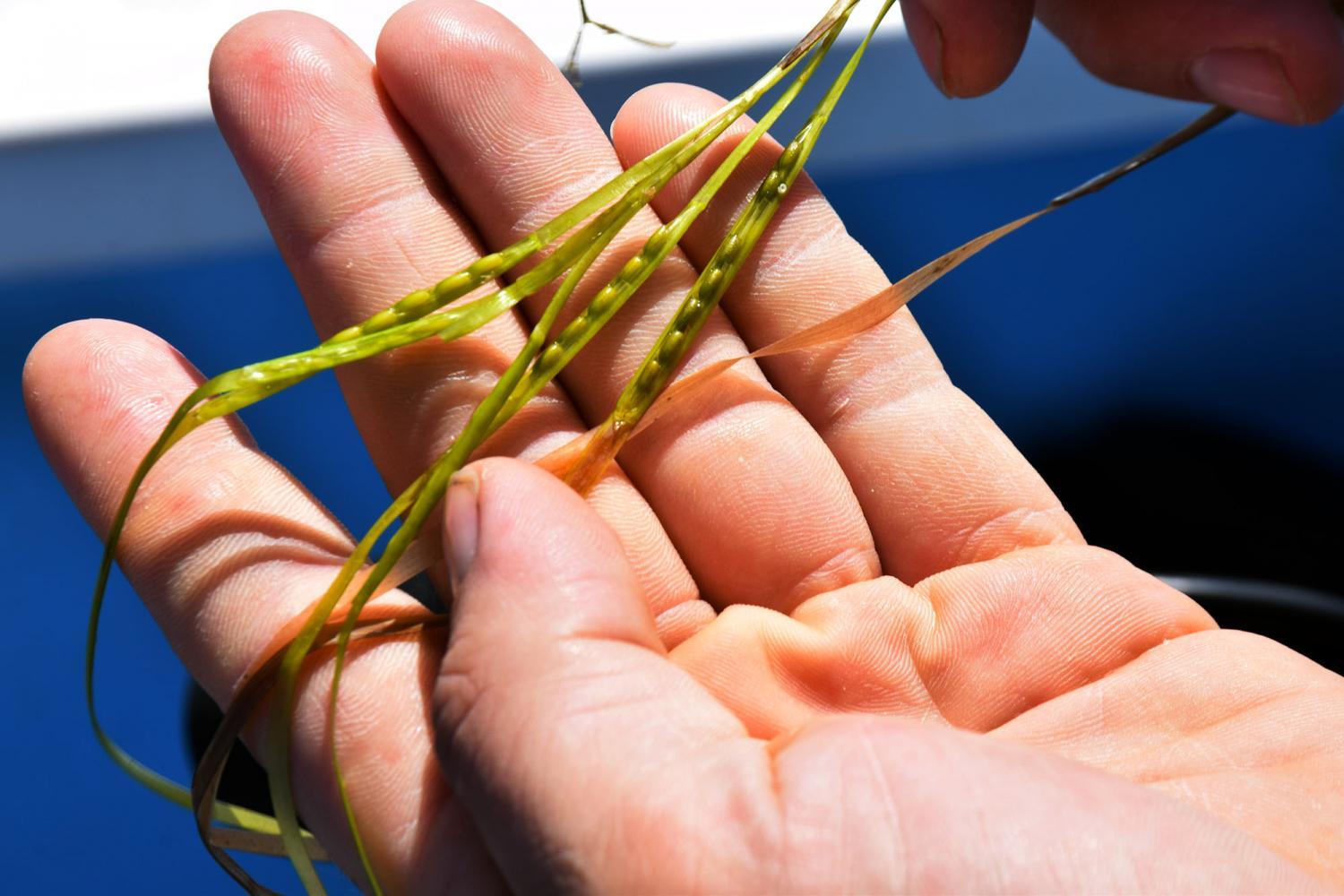
These eelgrass seeds are fresh from the sea.
Mexico’s indigenous Comcáac people have managed to protect 96% of the precious eelgrass that grows in their region.

I have long known about beach grass and how it can hold the dunes and protect the land in a hurricane. I know about how easily the roots die if you walk on beach grass and why, when “Keep Off the Dunes” signs aren’t obeyed, houses wash away.

But I’m learning there’s another fragile grass that helps the environment. This one lives in the sea and captures carbon.

Sam Schramski has the story at Public Radio International’s the World.

“At a two-day festival on the coast of northern Mexico [last] month, scientists, chefs and local residents gathered to celebrate eelgrass — a unique type of seagrass that grows in the Gulf of California. 

“Seagrass is on the decline in the world’s oceans, but the Indigenous Comcáac people who live in the region have managed to protect the eelgrass that grows in their waters. 

” ‘From my parents, I learned about medicinal plants and the songs of plants, as well as about traditional foods,’ said Laura Molina, who is Comcáac.

“She remembers how her mom made tortillas out of flour ground from eelgrass seeds known as xnois in Comcáac language, a mix between wild rice and nori seaweed. 

Seagrass is getting a lot of attention these days because of its capacity to store carbon, estimated to sequester up to half the so-called ‘blue carbon’ in the world’s oceans and coastal ecosystems — putting it on par with global forests.

“Ángel León, a Spanish chef and owner of Aponiente restaurant, has made it his personal mission to protect threatened seagrass beds off the Spanish coast. He’s interested not only in the plant’s environmental benefits but also its culinary potential in the kitchen as a nutrient-rich superfood. …

“Seagrass is down about 30% globally since the late 1800s. Through León’s restaurant and related nongovernmental organizations, he has heavily financed seagrass restoration projects.” More at the World, here. Listen to the audio version there.

Kendal Blust at Fronteras also wrote about the festival: “In the small Comcaac village of Punta Chueca, on the Sonoran coast of the Gulf of California, a group of women gathered around a white sheet piled high with dried zostera marina, or eelgrass.

“One woman sang an ancestral song dedicated to the plant, known as hataam, as others beat the dried eelgrass and rubbed it between their palms to remove its small, green seeds. Xnois, as the seeds are known in the Comcaac language, cmiique iitom, are an ancestral food.

“ ‘The Comcaac are the only people, the only Indigenous group, that consumes the seed,’ said Erika Barnett, a Punta Chueca resident who has been heavily involved in restoration efforts.

“Eelgrass seed has been a part of their culture for millennia, she said. Traditionally, the flour was used to make tortillas and a hot drink combined with honey and sea turtle oil. And because it’s quite filling, it used to be carried by Comcaac during sea journeys. …

“Barnett said her great-grandparents were probably the last members of her family to collect and eat the xnois seeds. Her father, now 76, last tasted it when he was just 7.

” ‘That’s was the last time he ate it,’ she said. ‘It’s very ancient, but it’s no longer eaten like it used to be, and most younger people have never tasted it. So this effort is really rescuing our culture.’ …

“Now, Barnett is part of a team working to bring the tradition back to their community — both because of the plant’s nutritional value and its ecological benefits. Eelgrass creates habitat for sea turtles and fish, protects the coastline and captures carbon.

“ ‘It’s important for us to revive these traditions so they can be passed on to future generations,’ she said. ‘But I think we need to show the community that it can be done, first. That it’s hard, but we can harvest the seeds.’

“So for weeks in April, a group of women and girls harvested eelgrass the way their ancestors would have. They waded into the sea to collect plants floating near the shore, then dried, thrashed and winnowed them. …

“ ‘One of the missions of Aponiente is to look to the sea with hunger,’ said Greg Martinez, a chef and biologist. … Martinez said the restaurant is committed to discovering the gastronomic potential in the ocean, both for our health and for the planet.

“And eelgrass has a lot of potential. For one thing, it captures and holds carbon below the water’s surface. Known as blue carbon, it can help mitigate climate change.

“ ‘But it doesn’t only sequester carbon,’ Martinez said. ‘It also protects coastlines. It serves as a habitat for thousands of different species that come to breed in their protection. It buffers waves so if you have a tsunami or another storm it protects the coastline in that way as well.’

“Despite the swath of ecosystem services seagrasses provide, however, seagrass beds currently are disappearing from the world’s oceans, he said. And that makes it especially important to protect the abundant meadows in the Canal del Infiernillo, a channel between the coast and the massive Tiburon Island that is entirely within Comcaac territory.”

More at Fronteras, here. Nice pictures. Both news sites are free of firewalls.

Read Full Post »

Photo: Murdo MacLeod/The Guardian.
Camryn Stewart, 14, and Naomi Bell (right) open the salmon season on Scotland’s River Dee with the first casts.

So many good people trying to make the world better! Each one has their own area of action. It may be health, sports for kids, peace, housing, justice, the environment, art, teaching school. You name it. Today’s story is on people doing something about the effects of global warming where they live — along Scotland’s rivers.

Severin Carrell reports at the Guardian that “millions of trees are being planted beside Scotland’s remotest rivers and streams to protect wild salmon from the worst effects of climate heating.

“Fisheries scientists have found rivers and burns in the Highlands and uplands are already too warm in summer for wild Atlantic salmon as they head upstream to spawn, increasing the threat to the species’ survival.

“Fisheries on the River Dee in Aberdeenshire, one of the country’s most famous salmon fishing rivers, have planted 250,000 saplings along key tributaries. They plan to plant a million in the Dee’s catchment by 2035. …

“In 2018, the year Scotland recorded the lowest rod catch for salmon since records began, climatic changes meant water temperatures in 70% of salmon rivers were too warm for at least one day that summer. They exceeded 23C [73.4 Fahrenheit], a temperature that induces stress and behavioural change. …

“Marine Scotland scientists found that only 35% of Scotland’s rivers, which stretch for 64,000 miles (103,000km), have adequate tree cover.

“Lorraine Hawkins, the river director for the Dee District Salmon Fishery Board, a statutory body, said: ‘These rivers and burns are the nursery grounds for young fish and it’s the young fish which will be affected by summer temperatures – their feeding and growth rates are affected. If it gets hotter, we will see fish dying.’

“Fishery boards across Scotland have similar tree-planting programs, to provide essential shade to lower water temperatures. Many will be fenced off to prevent the saplings from being eaten by deer. Hawkins said these projects improved the overall health and biodiversity of rivers across the uplands, increasing insect life, leaf fall, managing essential nutrients and flood control.

“Alan Wells, the director of Fisheries Management Scotland, an industry body, said climate forecasts were clear that water temperatures would continue to climb, even if governments succeed in limiting climate heating. …

“He said, ‘This will get worse. We need to grow trees now to create that cooling shade.’

“The dramatic decline in wild salmon numbers is blamed on numerous factors: climate change affecting food availability; weirs and other obstructions in rivers; predation by soaring seal populations; sea lice attracted by fish farms; bycatch by trawlers at sea and poor river quality. Wells said that while Scottish ministers were proposing new conservation strategies, he remained frustrated with the slow pace of change.

“The Dee marked the start of its angling season [in February] by inviting two female anglers who won a fundraising competition last year to make the first cast, an annual ceremony at Banchory. …

“Camryn Stewart, 14, one of the first cast fishers, said she had been brought up fishing by her parents, Deirdre and Jim. The sport is targeting women and children as it strives to expand its participation and appeal. …

“ ‘I have been surrounded by people who fish, and I’ve wanted to fish all my life,’ she said. ‘We need more people fishing. … We gain so much from it. Just being outside and being in the wild. Even if you don’t catch anything, you come back from the day fulfilled.’ ”

More at the Guardian, here. No firewall.

Read Full Post »

Photo: Dougie Barnett/NatureScot.
Flanders Moss in Scotland has seen the return of key bog plants such as sphagnum (peat moss) and cottongrass — so important now that we know bogs can store the carbon we don’t want in the atmosphere.

My father-in-law sold peat moss, among other agricultural products, for his entire career. He usually got the peat from Canada, although other people source it from places like Germany and Ireland. In Moat, Ireland, our friend James Hackett relied on peat for warming the house. (Burning it was not the best thing for his health.)

Today’s story is about Scotland’s heightened focus on protecting peat bogs so they can store carbon and fight global warming.

Phoebe Weston reports at the Guardian, “Flanders Moss bog is slumped on the flat, farmed landscape of the Carse of Stirling in Scotland like a jelly fungi. It wobbles when you walk on it, and a metal pole goes down eight metres before reaching hard ground. This lowland-raised bog is a dome of peat fed mainly by rainfall and it acts like a single organism – the whole thing has to be looked after for any part to be in really good shape. If it is drained in one area it will affect the water level across the entire bog.

“For much of human history peat bogs have been thought of as wastelands. This 860-hectare [~2,200 acres] site has been hacked away and drained since the early 1800s to make space for fertile farmland below. …

“It is now recognized that peat bogs are among the greatest stores of carbon and, after decades of restoration, the holes in the peat at Flanders Moss have been patched up. Areas that used to be purple with heather are turning green as key bog plants such as sphagnum (peat moss) and cottongrass come back. The bog rises out of the land like a sponge and ‘breathes’ as changes in the weather and water level cause it to swell and contract.

“Researchers in Scotland are tracking ‘bog breathing’ using the latest satellite technology that can detect just a few millimetres of change. … Thanks to the restoration work, the water table has risen [and] is now at the surface. As the bog draws in water from the surrounding land, it helps manage flood risk. Flanders Moss bog has removed [about 2,200 acres] from the Forth catchment, reducing flooding downstream. …

“The Scottish government-funded Peatland Action project, which started in 2012, is helping revive 25,000 hectares [~61,776 acres] of degraded peatland. In 2020, the Scottish government committed [about $300 million] over 10 years to bog restoration in a bid to lock carbon in the land. …

“It takes about a month to process the satellite data for a third of Scotland, which is available through the Copernicus Open Access Hub. The technology is still in development but is likely to be cheaper than ground-based mapping. …

“Despite these restoration efforts, Flanders Moss is still a net emitter of carbon. … Stopping these emissions and preventing further degradation are the primary objectives of the restoration project.

“Bogs work on a different timeframe than humans. They form slowly … taking up to 1,000 years to grow one metre. But [David Pickett, who manages the site with his National Nature Reserve] team has jump-started recovery. ‘We’ve done most of the big work here,’ he says. ‘Now, it’s a question of waiting. The process of fixing this site will last 100 years, and the benefits of work being done now will only be seen by the next generation.’

“It’s easy to see why bogs weren’t popular. They are stores of partly decayed organic matter, which are too acidic and devoid of nutrients to support healthy trees. But this bog is colorful and has a fresh, earthy smell. As well as being a fantastic store of carbon, this ancient, watery land – healthy peat is about 90% water – is also rich in wildlife, including rare lizards, dragonflies and even snakes.

“ ‘There isn’t headline sexy stuff like puffins and seals but you go around the boardwalk and it’s a fantastic place,’ says Pickett. ‘I always used to think bogs must have been named on a Friday after a really bad week. We’re trying to change the perception of bogs but it’s a hard sell.’ ”

More at the Guardian, here.

Read Full Post »

Photo: Biosphere2.
Biospheres in Arizona gather ancient wisdom to aid future generations.

Now that we know human activity is the main reason for dangerous global warming, it’s time to turn to indigenous tribes and learn to step more lightly on Plant Earth. That’s the thinking behind a biosphere project in Arizona.

Samuel Gilbert reports at the Washington Post, “Indigenous peoples have known for millennia to plant under the shade of the mesquite and paloverde trees that mark the Sonoran Desert [in Arizona], shielding their crops from the intense sun and reducing the amount of water needed.

“The modern-day version of this can be seen in the Santa Catalina Mountains north of Tucson, where a canopy of elevated solar panels helps to protect rows of squash, tomatoes and onions. Even on a November afternoon, with the temperature climbing into the 80s, the air under the panels stays comfortably cool.

“Such adaptation is central to the research underway at Biosphere 2, a unique center affiliated with the University of Arizona that’s part of a movement aimed at reimagining and remaking agriculture in a warming world. In the Southwest, projects are looking to plants and farming practices that Native Americans have long used as potential solutions to growing worries over future food supplies. At the same time, they are seeking to build energy resilience.

“Learning from and incorporating Indigenous knowledge is important, believes Greg Barron-Gafford, a professor who studies the intersection of plant biology and environmental and human factors. But instead of relying on tree shade, ‘we’re underneath an energy producer that’s not competing for water.’

“On both sides of the Arizona border with Mexico, scientists are planting experimental gardens and pushing the potential of an ‘agrivoltaic’ approach. Thirsty crops such as fruits, nuts and leafy greens — which require elaborate irrigation systems that have pulled vast quantities of water from underground aquifers and the Colorado and other rivers — are nowhere to be found. …

“Southern Arizona is an epicenter of the movement not just because of the intense environmental pressures that the region faces but because of the presence of the Tohono O’odham Nation southwest of Tucson.

“The Tohono O’odham have farmed in the Sonoran Desert for several thousand years. Like many Indigenous groups, they now are on the front lines of climate change, with food security a paramount concern. Their expansive reservation, nearly the size of Connecticut, has just a few grocery stores. It is a food desert in a desert where conditions are only getting more extreme.

“Since the early 1970s, a group of Nation members have run the San Xavier Cooperative Farm and grown ‘traditional desert cultivars’ in accordance with their ancestral values — particularly respect for land, water and plants.

“Sterling Johnson, a member of the Tohono O’odham Nation, has worked for the past decade to share that expertise broadly. His partner, Nina Sajovec, directs the Ajo Center for Sustainable Agriculture, a Native American-governed food justice organization that several years ago founded its own seed bank and already has distributed over 10,000 seeds to farmers.

“ ‘We’re all about using what is out there,’ Sajovec said. Among the center’s heirloom varieties: 60-day corn, a fast-maturing desert-adapted vegetable, and the tepary bean, a high-protein legume particularly suited to the climate because of leaves that can fold to withstand direct sunlight during the peak of summer.

“Johnson captures precipitation during the Arizona monsoon season to sustain crops on his field in the desert lowlands. ‘It’s using the rainwater,’ he explained, ‘using the contour lines, using your environment and nature to grow food.’ …

“Perhaps even more daunting than the rising temperatures of climate change are the water shortages that many parts of the world will confront. In Tucson, the Santa Cruz River is now dry because of too much diversion and burgeoning demand, according to Brad Lancaster, an expert on rainwater harvesting.

“ ‘The majority of the water that irrigates landscapes and Tucson and Arizona is not local water’ but tapped from the Colorado River, Lancaster said. Unless severe drought conditions reverse and the river level improves, mandatory federal cutbacks mean farmers will lose a significant amount of that critical resource starting next year.

“ ‘The goal is how can we use rainwater and storm water, passively captured, to be the primary irrigator,’ said Lancaster, who lives in a local neighborhood that has been transformed through passive water harvesting into an ‘urban forest,’ with wild edible plants such as chiltepin pepper and desert hackberry lining the sidewalks.

“He is planning a similar system at Tumamoc Resilience Gardens, using basins and earthen structures to spread water across the landscape and reduce channelized flows. Nabhan, who also is involved in the site’s design, sees it as replicable and, more importantly, scalable. …

“ ‘We’ve had 5,000 years of farmers trying out different strategies for dealing with heat, drought and water scarcity,’ said [Gary Nabhan, an ethnobotanist and agrarian activist who focuses on plants and cultures of the Southwest], walking around his own creation at his home in Patagonia, a small town about 18 miles north of the Mexico border. The fenced space holds 40 species of agave, three species of sotol, prickly pear and other varieties of cactuses and succulents.

“ ‘The key concept,’ he said, ‘is that we’re trying to fit the crops to the environment rather than remaking the environment.’ ”

More at the Post, here. Lots of great photos.

Read Full Post »

Photo: Aaron Ufumeli/EPA.
Author Tsitsi Dangarembga has joined the Future Library, offering a work that won’t be read for 100 years. 

There are many ways artists can highlight how global warming is hurting the planet. Katie Paterson, for example, once created an installation that allowed people to listen in on the sound of glaciers melting. Now she has come up with the idea of a Future Library in hopes that it will still exist in 100 years so that people can read the works of the celebrated authors who have joined the project.

Alison Flood reports on one such author at the Guardian. “Tsitsi Dangarembga made the Booker shortlist for her most recent novel, This Mournable Body, the story of a girl trying to make a life in post-colonial Zimbabwe which was praised as ‘magnificent’ and ‘sublime.’ Her next work, however, is likely to receive fewer accolades: it will not be revealed to the world until 2114.

“The Zimbabwean writer is the eighth author selected for the Future Library project, an organic artwork dreamed up by the Scottish artist Katie Paterson. It began in 2014 with the planting of 1,000 Norwegian spruces in a patch of forest outside Oslo. Paterson is asking one writer a year to contribute a manuscript to the project – ‘the length of the piece is entirely for the author to decide’ – with Margaret Atwood, Ocean Vuong and Karl Ove Knausgård already signed up. The works, unseen by anyone but the writers themselves, will be kept in a room lined with wood from the forest in the Deichman library in Oslo. One hundred years after Future Library was launched, in 2114, the trees will be felled, and the manuscripts printed for the first time.

“The artwork ‘perfectly expresses my yearning for a human culture that centres the earth’s sustainability,’ said Dangarembga. ‘I share with many other dwellers of our beautiful planet a deep sense of concern for our home’s wellbeing.’ …

“The author, whose acclaimed debut Nervous Conditions (1988) was the first novel written in English by a black woman from Zimbabwe, said she was already “settling on the story” she would tell. She was not worried about the fact that she will never know how her writing is received.

‘I’m always my first audience. … A lot of my life has been writing into the void. So I’m used to writing into the void.’

“Paterson said that Future Library was ‘honoured’ to include Dangarembga. … ‘Tsitsi Dangarembga’s words have shaped the world. Praised for her ability to capture and communicate vital truths, the Zimbabwean novelist is admired worldwide as a voice of hope,’ said Paterson. ‘She examines oppression, discrimination, and systemic racism, through writing that is brave and unforgettable.’ …

” ‘I don’t think of myself in those terms,’ Dangarembga said. ‘So it’s really a great honour, I’m very pleased about it.’

Nervous Conditions, to which This Mournable Body is a sequel, was named by the BBC as one of the 100 books that shaped the world. Currently in Harare, the Zimbabwean author is working on a piece of non-fiction, and a speculative young adult novel. She is also awaiting a trial date after she was arrested during anti-corruption protests in Harare last year, and charged with intention to incite public violence. Authors and free speech organisations have called for the charges to be dropped, describing them as an outrage.”

More at the Guardian, here.

Photo: Giorgia Polizzi.
Novelist Margaret Atwood with artist Katie Paterson at the inauguration of the Future Library forest in Norway. 

Read Full Post »

« Newer Posts - Older Posts »