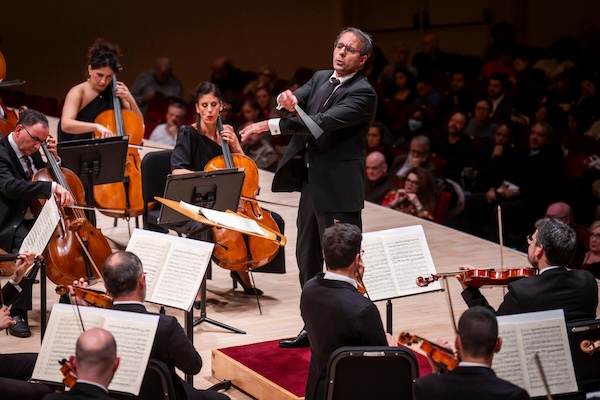
Photo: Chris Leee.
Saleem Ashkar conducted the Galilee Chamber Orchestra last November at Carnegie Hall. The orchestra has equal numbers of Arab and Jewish musicians.
Looking for a bright spot in the frightening new world order? No need to go farther that the Galilee Chamber Orchestra and the reasons why people of good will were determined to make music with equal numbers of supposedly hostile tribes.
David Patrick Stearns wrote at the Philadelphia Inquirer last fall, “On the face of it, the Galilee Chamber Orchestra could be an impossible meeting of musical minds.
“Comprising ‘equal numbers of both Jewish and Arab musicians,’ as its website notes, the orchestra has a 13-year history, and is now on a high-prestige tour with celebrated pianist Bruce Liu that includes the Kimmel Center on Nov. 19 and New York’s Carnegie Hall Nov 20.
“Based in Nazareth (known as the ‘Arab capital of Israel’), the orchestra’s common ground on this tour includes Mozart among other composers whose nationalities, from centuries past, now feel like neutral territory — while still speaking to the present.
“ ‘Classical music has become something that belongs to the world. If you go to Japan or Brazil, they feel that Mozart and Beethoven belong to them as much as anybody else.’ … said Nabeel Abboud-Ashkar, executive director of Polyphony Education, the conservatory where the orchestra is based. ‘Once you’re part of this cultural world, you instantly connect with so many people.’ …
“With that kind of mandate, it’s no surprise that the orchestra, in its last U.S. tour in 2022, was acclaimed for generating more sound than a typical chamber orchestra. This year, its 42 players draw from Polyphony students, faculty, graduates, and nearby professionals.
“Structurally, the conservatory/orchestra setup resembles Venezuela’s much larger El Sistema but also is meant to have an ethnicity mixture more like the Spain-based West-Eastern Divan Orchestra. Galilee Chamber Orchestra is firmly planted in its Jewish/Arab balance and in Israel, a country with a 20% Arab population.
“The tour program includes the Mozart Piano Concerto No. 23 with Paris-born, Montreal-raised pianist Liu, a 2021 winner of the International Chopin Piano Competition. The presence of Symphony No. 3 (‘Scotch’) by the Jewish composer Felix Mendelssohn isn’t meant to make a statement but is a piece the orchestra has wanted to do for a few years.
“Also, Abboud-Ashkar’s brother Saleem Ashkar, conductor of the tour, has considerable history with the composer, having also been the soloist in both piano concertos in a well-received, major-label recording with the Leipzig Gewandhaus Orchestra.
“More intentional is the inclusion of Nocturnal Whispers by Arab composer Nizar Elkhater, whose own Israel-based ensemble, named Abaad, seeks to fuse Western and Eastern musical styles
“The orchestra’s concerts haven’t been subject to the kinds of in-concert interruptions and demonstrations that have greeted the Israel Philharmonic and the Jerusalem Quartet in Europe and the U.S.
“But years of war, however, have strained the orchestra and conservatory in tangible ways. Planning is more provisional than ever. Concerts can be canceled on short notice, lessons planned to be in-person can suddenly switch to online, getting home from a European tour can be impeded and delayed by new conflict outbreaks in the Middle East.
“Among the musicians, tensions are heightened by constantly seesawing events, said Abboud-Ashkar. After the attack of Oct. 7, 2023, the whole operation was suddenly in unfamiliar territory, he said. …
“ ‘We feel everything that is happening around us,’ Abboud-Ashkar said in a Zoom interview from Nazareth. ‘Some people might think we’re being naive and ask … “How can you talk about collaboration and partnership being equal … with horrific things happening in Gaza?” …
‘We believe that what we’re doing has an impact. Even if it’s just making it a little better, we’re moving the needle in the right direction.’
“The main enemy may well be despair. Within the orchestra and conservatory, lack of hope for war resolution can turn into loss of musical motivation.
“ ‘On the other hand, there are cases where people show incredible empathy for others,’ said Abboud-Ashkar. ‘There’s a commitment to having this (musical) dialogue … and having more consideration for each other. When you’re in distress … you’re motivated to continue and to always find a way. You fight for your space and your values and hope there are still enough people out there who shared them. We’re going to stay together because this is what we believe in.’ ”
I am so touched by this idea of moving “the needle a little in the right direction.” That is all any of us can do, but we really must do it in order for all the little bits to add up. More at the Inquirer, here.

 Suzanne's Mom's Blog