Feeds:
Posts
Comments

Posts Tagged ‘listening’

Art: Scott Wilson.

I had a college roommate whose father was an English professor in Colorado. He had a custom of reading Dickens to the family, not phasing out the custom just because the kids grew up. My roommate loved it and always looked forward to being read to when she went home on school vacations.

This is not a common thing, although it was at one time. What it gave people in terms of doing something together while soaking up a good yarn — and sometimes beautiful writing — has never been replaced. With those cadences in your head, you may even learn to write better.

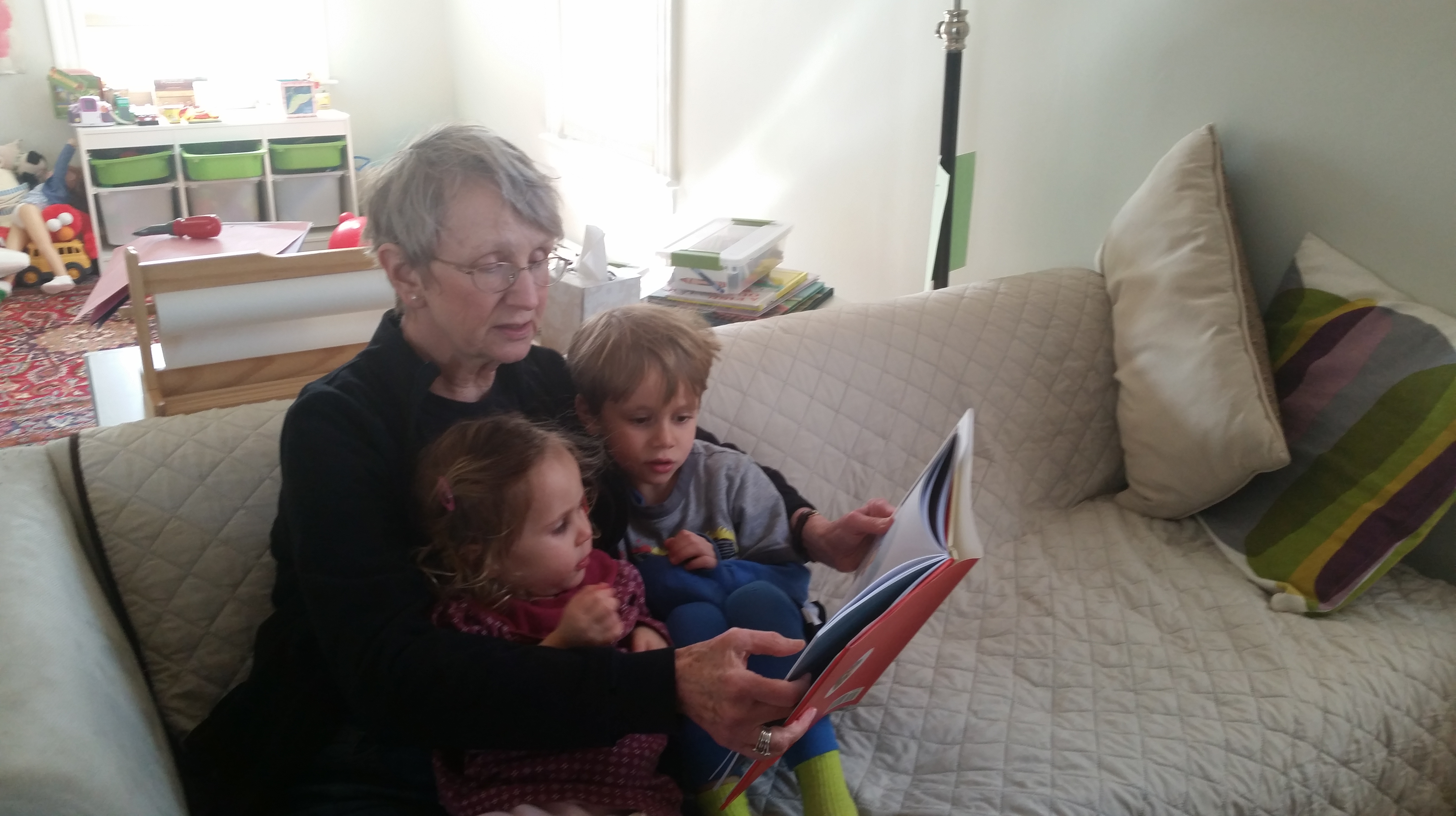
At the Christian Science Monitor, Sherilyn Siy writes, “Every night after dinner, our 14-year-old daughter picks up her Rubik’s Cube, and our 12-year-old son stretches out on the tatami, his head on the beanbag. Our 4-year-old son settles into the crook of my legs, fitting himself into the space formed by my cross-legged seat like a puzzle piece. Story time’s about to start. My husband, who started listening in a couple of years ago, now leans back against the ornate wooden post in our tatami room, stretching out his legs. Then, I pick up our chapter book and continue from where we left off.

“I have always loved reading to my children. When they were younger, reading together was about language exposure, filling their world with the expansive vocabulary that books provide. As a multinational family – American, Filipino, and Chinese – living in the Japanese countryside, we have helped our children stay connected to English through books. I’m not the kind of mom who builds train tracks or towers, but if the kids hand me a storybook, I’ll always read to them.

“I started reading to my children when my oldest was 8 months old. When they were smaller, stories helped them process big emotions, as well as learn new words. We began exploring chapter books when my older kids were about 7 or 8 years old, starting with fun, lighthearted stories before moving on to longer and more complex books. 

“At first, illustrations played a big role in their comprehension and enjoyment of stories. Today, they take pleasure in visualizing scenes through words alone. Now that they’re older, reading together is no longer just about language acquisition; it is about connection.

“I select our books carefully. We reach for classics like Lois Lowry’s The Giver and its sequels, compelling middle grade fiction like Kelly Yang’s Front Desk, and books that simply capture our interest, like William Kamkwamba and Bryan Mealer’s The Boy Who Harnessed the Wind. Sometimes, the choices come from my kids. My daughter read a Japanese translation of Ban This Book, by Alan Gratz, and enjoyed it so much that we read the original English version together. That book became a favorite, not just for the story but for the conversations and inside jokes it sparked.

“In one of our favorite parts, the main characters decided that the best way to hide their banned books was to create fake covers for them. The moment I read aloud some of the ridiculous titles they came up with, the whole family lost it. My kids were doubled over, hands clutching stomachs, as we gasped for air between fits of laughter. 

“Other moments were quieter but just as meaningful. While reading Front Desk, I was deeply moved by a scene in which the immigrant parents of the main character talk after the mother is attacked and then hospitalized. The father, crying, says, ‘I promised when I married you that I’d take care of you, and I’ve failed you.’ I was struck by the depth of his devotion to his wife in the face of the harsh realities of their immigrant life. I couldn’t get the words out. My children knew the words carried something deep for me. …

“The story of a young Chinese immigrant family navigating life in America, as portrayed in Front Desk, felt personal for us – my kids saw reflections of their own identity in it. Although The Boy Who Harnessed the Wind is set in Malawi, we saw striking parallels to Filipino ingenuity and resilience in the face of hardship. David Walliams’ Grandpa’s Great Escape celebrates the wisdom and adventurous spirit of elders, reminding us of the Chinese emphasis on respecting them. …

“We bring all kinds of emotions to the table – frustration, exhaustion, lingering tension from the day. But when we start reading, it’s like tuning in to the same frequency, finding common ground even if we had been at odds just minutes before. The shared experience provides a reset, a neutral space where we can just be together. …

“I hold on to these evenings, these moments when we all gather around the same story. I may not be able to shield my children from every storm that adolescence and life brings, but for a few minutes each day, I can offer them a hearth in a story.” More at the Monitor, here.

I love the mention of the 14-year-old’s Rubik’s Cube. The kids I know often need something to fiddle with while listening to a story.

Read Full Post »

Photo: John.

People absorb information differently, so to each his own. I hope today’s attempt to explain scientific differences between reading a book and listening to one doesn’t make you think reading is necessarily better than listening. We all know the vital importance of being read to as a child.

Let’s see what Stephanie N. Del Tufo, assistant professor of education & human development at the University of Delaware, has to say at Science Alert, via the Conversation.

“As a language scientist, I study how biological factors and social experiences shape language. My work explores how the brain processes spoken and written language, using tools like MRI and EEG.

“Whether reading a book or listening to a recording, the goal is the same: understanding. But these activities aren’t exactly alike. Each supports comprehension in different ways. Listening doesn’t provide all the benefits of reading, and reading doesn’t offer everything listening does. Both are important, but they are not interchangeable.

“Your brain uses some of the same language and cognitive systems for both reading and listening, but it also performs different functions depending on how you’re taking in the information.

“When you read, your brain is working hard behind the scenes. It recognizes the shapes of letters, matches them to speech sounds, connects those sounds to meaning, then links those meanings across words, sentences and even whole books. The text uses visual structure such as punctuation marks, paragraph breaks or bolded words to guide understanding. You can go at your own speed.

“Listening, on the other hand, requires your brain to work at the pace of the speaker. Because spoken language is fleeting, listeners must rely on cognitive processes, including memory to hold onto what they just heard.

“Speech is also a continuous stream, not neatly separated words. When someone speaks, the sounds blend together in a process called coarticulation. This requires the listener’s brain to quickly identify word boundaries and connect sounds to meanings.

“Beyond identifying the words themselves, the listener’s brain must also pay attention to tone, speaker identity and context to understand the speaker’s meaning.

“Many people assume that listening is easier than reading, but this is not usually the case. Research shows that listening can be harder than reading, especially when the material is complex or unfamiliar.

“Listening and reading comprehension are more similar for simple narratives, like fictional stories, than for nonfiction books or essays that explain facts, ideas or how things work. My research shows that genre affects how you read. In fact, different kinds of texts rely on specialized brain networks.

“Fictional stories engage regions of the brain involved in social understanding and storytelling. Nonfiction texts, on the other hand, rely on a brain network that helps with strategic thinking and goal-directed attention.

“Reading difficult material tends to be easier than listening from a practical standpoint, as well. Reading lets you move around within the text easily, rereading particular sections if you’re struggling to understand, or underlining important points to revisit later.

“A listener who is having trouble following a particular point must pause and rewind, which is less precise than scanning a page and can interrupt the flow of listening, impeding understanding.

“Even so, for some people, like those with developmental dyslexia, listening may be easier. Individuals with developmental dyslexia often struggle to apply their knowledge of written language to correctly pronounce written words, a process known as decoding. Listening allows the brain to extract meaning without the difficult process of decoding.

“One last thing to consider is engagement. In this context, engagement refers to being mentally present, actively focusing, processing information and connecting ideas to what you already know.

“People often listen while doing other things, like exercising, cooking or browsing the internet – activities that would be hard to do while reading. When researchers asked college students to either read or listen to a podcast on their own time, students who read the material performed significantly better on a quiz than those who listened.

“Many of the students who listened reported multitasking, such as clicking around on their computers while the podcast played. This is particularly important, as paying attention appears to be more important for listening comprehension than reading comprehension. …

“Each activity offers something different, and they are not interchangeable. The best way to learn is not by treating books and audio recordings as the same, but by knowing how each works and using both to better understand the world.”

More at the Conversation, here.

Read Full Post »

In spring 2008, during a sometimes distressing primary season, an African American coworker and I decided to try something under the radar at work.

We decided to invite other colleagues of good will to help create a monthly lunch-hour discussion group on Race in America.

At first it was slow going. Some people we invited were suspicious. Would we be seen as troublemakers? Was it “legal”? Would it be just a gripe fest about our workplace?

My friend was supervising our high school interns at the time, and several of those showed up. One or two white employees came. Black colleagues were more wary. On days that no one came, one of us was bound to say to the other, Maybe this isn’t going to work. At which point, the other would say, Let’s give it another month.

Little by little, attendance grew. We kept the focus on topics in the news and participants’ life experiences. There was no agenda. We’d say, Does anyone have a topic they want to discuss today? There were always topics. We agreed to keep what was said inside our basement meeting room. There was zero hierarchy. What everyone brought to the table was openness and a willingness to listen.

We listened. We asked questions. We argued, with respect. We laughed. We worried. We learned. There were so many gradations of opinions, based on individuals’ experiences. There was never unanimity of one race versus another.

One participant said last year the monthly discussions had really opened his eyes and changed some of his views profoundly.

My friend retired a couple years ago and I left in January, but the group is still going strong under new leaders. I really miss it. I cannot tell you how many times I have wanted to hear what members have to say about something in the news or something I see in my town. I feel like I hardly know my own views without adding the nuances of what my former colleagues are thinking and feeling.

This past week, I’ve read lots of advice about what people of good will can do about race relations and injustice: join demonstrations and meetings, write government representatives, open their hearts to losses on both sides, listen to young activists, stand on their right not to show an I.D. (Fifth Amendment). Maybe some of those ideas are good.

But I still love the idea of creating a group where people of different races and backgrounds listen to one another’s way of seeing things. Over the eight years, Race in America members have come and gone, but participants routinely say that the group works because of the trust that is built.

For getting started, it worked well that we were two friends — one identifying as African American, one as Caucasian. She needed me, and I needed her. I never felt I should go up to a black colleague I didn’t know and pitch a discussion on race. She was a star at that.

Maybe it’s a hopelessly small thing for combating what we see in the news. But I do think people of different races have too few opportunities to listen to one another about matters that touch the heart.

120715-Fed

Read Full Post »