Feeds:
Posts
Comments

Posts Tagged ‘grandfather’

Photo: Time magazine.
Time has named Tejasvi Manoj, a 17-year-old at Lebanon Trail High School in Frisco, Texas, Kid of the Year.

Gone are the good old days when cybercriminals used dead giveaways like terrible English! Today they are more and more plausible, laying new traps for anyone not internet savvy, especially old folks like those in my retirement community. I hear the stories.

Jeffrey Kluger reports at Time magazine about teenager Tejasvi Manoj, who wanted to do something about that.

“The unnamed cybercriminals trying to scam seniors out of their money got more than they bargained for when they targeted Tejasvi Manoj’s grandfather back in February 2024.

“Tejasvi, then a 16-year-old junior at Lebanon Trail High School in Frisco, Texas, was driving home from Scouting America camp with her father when he suddenly noticed five missed calls on his phone — all from his 85-year-old father. He called back, and the older man reported that he had received an urgent email from another relative, Tejasvi’s uncle, asking for $2,000 to settle an unexpected debt. Given the apparent emergency, Tejasvi’s grandfather was prepared to transfer the funds — but her father urged him not to and the grandfather, at the suggestion of his wife, then called the uncle to see if the request was legitimate.

“ ‘I never asked you for money,’ came the response. ‘Please don’t send anything until I can look into what’s going on.’

“It was a near miss for the unsuspecting senior. The fact that criminals would seek to take advantage of an old man’s lack of sophistication about the workings of the internet galled Tejasvi. When she got home she went to her room and immediately began researching how common such scams are. Very common, it turns out. …

“Seniors represent a target-rich cohort for the bad guys. They’re typically retired, sitting on pensions and 401(k)s, and may be naive to the techniques favored by con artists. … . According to the Federal Trade Commission, the number of older adults who lost more than $10,000 to online scams increased fourfold from 2020 to 2024. For those who lost $100,000 or more, the increase was seven-fold, for a total of $445 million in 2024 alone. …

“Older Americans clearly need protection, and Tejasvi was determined to provide it. Within the year she had built and launched Shield Seniors, a website designed to educate the 60-plus demographic about what online scams look like, analyze suspicious emails and messages users upload, and, if the communications prove fraudulent, provide links to report them. The site is currently available in a private preview mode only, pending more R&D and fundraising, but is already — like its creator — making itself known. Tejasvi was recognized with an honorable mention in the 2024 Congressional App Challenge; delivered a 2025 TEDx talk in Plano, Texas, about the need to build ‘digital bridges’ to all demographics; and makes occasional appearances at local assisted-living facilities, demonstrating her website and teaching seminars about cybercrime.

“ ‘I remember going to my first seminar and I was super nervous,’ says Tejasvi, whose work has earned her recognition as TIME’s Kid of the Year for 2025. …

“Shield Seniors didn’t come easy. For one thing, Tejasvi had a lot of other activities to attend to. She is active in Scouting America — recently receiving her Eagle Scout rank — and plays violin in her school orchestra. She tutors Bhutanese refugees online in math and English through an organization called Vibha, a nonprofit involved in workforce and scholastic development in India. She also does volunteer work — serving on the leadership board of the North Texas Food Bank Young Advocates Council and packing meals, with the social-enterprise company TangoTab, for families facing food insecurity.

“ ‘I started volunteering in sixth grade,’ she says. ‘I think it’s really important; if you’re lucky yourself, you want to make sure other people feel loved and lucky too.’

“Shield Seniors presented another way to do that, and Tejasvi was well prepared to do the coding that would make the project possible. … Tejasvi began coding in eighth grade, taking cybersecurity classes and attending summer programs sponsored by the nonprofit Girls Who Code. She has also gotten involved in Cyber-Patriot, a joint Air Force and Space Force program to spark interest in cybersecurity and STEM disciplines among young people. …

“In February, after an early version of the site was ready, a story about Shield Seniors and Tejasvi appeared in the Dallas Observer, bringing her to the attention of the people at AARP. ‘They set up a meeting where I walked them through the website, and they were very impressed,’ Tejasvi said. …

“The website that has resulted from all of this work is equal parts intuitive, smart, and artful. Shield Seniors is divided into four principal sections. The first is labeled ‘Learn,’ and helps users master the basics of internet security, such as the importance of creating strong passwords, understanding privacy settings, knowing what information to share and what not to share, and, most important, recognizing what a scam looks like. … ‘Be careful with unexpected messages, especially those that rush you or seem too good to be true.’

“The second section, labeled ‘Ask,’ takes users to a chatbot that answers questions. Interacting with a population that was already approaching middle age when the internet appeared, Tejasvi’s bot keeps its answers simple—holding them to two sentences or even less. …

“The third section, labeled ‘Analyze,’ is where the true brains of the site live. When users click this tab they’re directed to a page that allows them to upload a suspicious text or email, which an AI system will then analyze with what Tejasvi says is 95% accuracy at determining what’s a scam and what’s not a scam. Then, it goes beyond just providing a digital thumbs-up or down.

“ ‘It will also explain why,’ she says, ‘because our goal for Shield Seniors is to make sure older adults are independent and know what to look for.’ …

“Finally, the site includes a ‘Report’ section that allows users to rat the fraudsters out. The site provides links to 14 private and government groups that accept and act on complaints, including the FBI, the Better Business Bureau, the Social Security Administration, AARP, the SEC, and the Consumer Financial Protection Bureau. Just which group is the right one to contact depends on just which kind of fraud was committed. The FBI, for example, is a sort of one-stop-shopping site for all manner of cybercrime, including identity theft, computer intrusions, investment fraud, phishing, and ransomware. The Consumer Financial Protection Bureau responds to complaints involving financial products and services including bank accounts, credit reports, and payments made or requested.”

More at Time, here.

Read Full Post »

Images: Brett Hawkes photos; Ally Rzesa illustration.

When do people get interested in researching family history? Some people never. Others — like my cousin who has made his genealogy hobby an obsession — very young. In today’s article, a 71-year-old from Massachusetts got the bug when he started going through the photos his grandfather took in France.

Travel writer Christopher Muther reports for the Boston Globe about Brett Hawkes and the stacks of old photos he used to re-create his grandfather’s journeys in WWI.

“For the better part of a century, the boxes and their mostly-forgotten contents collected dust while occupying real estate in attics throughout Massachusetts.

“But for Brett Hawkes … they inspired a once-in-a-lifetime journey that spanned 600 miles across the French countryside.

“Hawkes received the boxes of old photos and letters when his mother passed away in 2013. He said he glanced at them occasionally, but otherwise, they remained stored away, collecting another decade of dust. He came upon them again in the winter of 2022 while cleaning his office, but this time, the more he studied them, the more he was drawn to what he saw.

The pictures, taken in 1917 on the frontlines of the war in France, showed soldiers fighting in trenches, bombed buildings, and previously idyllic fields transformed into hastily-dug cemeteries.

“But his grandfather also took pictures of everyday life in the small towns where he was stationed. There are pictures of friends he made, soldiers playing football in a snowy field, and peaceful streets.

“ ‘I stared at these old photos and thought, “Oh my God, look at these churches bombed to the ground.” I started wondering what they look like now,’ Hawkes said. ‘I happened to find a photo he took of a famous chateau, and I Googled it and saw it was all renovated.’

“That’s when the idea for his trip took root. He devised a plan to find the locations of as many of the photos as possible — thankfully, his grandfather had labeled the towns where pictures were taken — and re-create his grandfather’s 1917 route in France. …

“Alton Hawkes entered the war just months after America’s entry and was sent for further training in Abainville before being stationed in the villages of Warmaise, Chepoix, and Broyes, about 70 miles north of Paris.

“Brett said his grandfather, who studied engineering, was also an avid amateur photographer and collector, which made reconstructing the route easier. He also had letters that his grandfather had written home to his family, outlining some of his more benign activities.

“ ‘What boggled my mind was that he took these photographs of the destruction and fighting that would be classified today,’ he said. ‘The more I learned, the more I became emotionally involved. It’s part of the reason why Ancestry.com and 23andMe are so popular. People want to feel an emotional connection with the past.’

“Hawkes has two skills that made the trip possible. The first was years of cycling experience. When he was 16, his neck was broken in a severe car accident. As a result, the right side of his body was paralyzed. Over time he regained the use of his body, but the former athlete continued walking with a limp. While he could no longer run or play sports, he could cycle, which remains his passion.

“His other skill is the ability to speak French and a general love of French culture. He brushed up on his French before the trip, but he spoke no English for three weeks on the road.

“ ‘Being able to speak French helped form bonds and broke down barriers with the people I met,’ he said. …

“Those meetings with residents are what made his trip a success. He would roll into small farming towns and seek out cafes where he would strike up conversations with locals. If the town was too small for a cafe, he knocked on the doors of houses that his grandfather had photographed, or he would seek out the mayor of a town he was visiting for assistance in finding buildings or bridges.

“ ‘I’m an older guy. I wasn’t threatening. I couldn’t punch myself out of a paper bag,’ he said. ‘I think that helped a lot.’

“When word spread through these tiny towns of the American retracing his grandfather’s WWI route, strangers would show up at bed and breakfasts where Hawkes was staying with information about locations in the photographs and stories about the war that had been handed down. …

“ ‘I started to really go through a transition. It became more than a vacation, it became a passion. It was an incredible experience. It’s hard to explain, but that’s really what happened. I went through a transformation.’

“He found the field where the French government awarded his grandfather the Croix de Guerre for his bravery in battle. In one photo, his grandfather stood on a pile of rubble that had once been a church. Hawkes found the location with a new church in its place. It was the same with historic buildings that had been repaired or rebuilt. Just like his grandfather, the younger Hawkes was there to document it all.

“ ‘He guided me from heaven,’ Hawkes said.”

More at the Globe, here.

Read Full Post »

Photo: Russ Dillingham/Sun Journal.
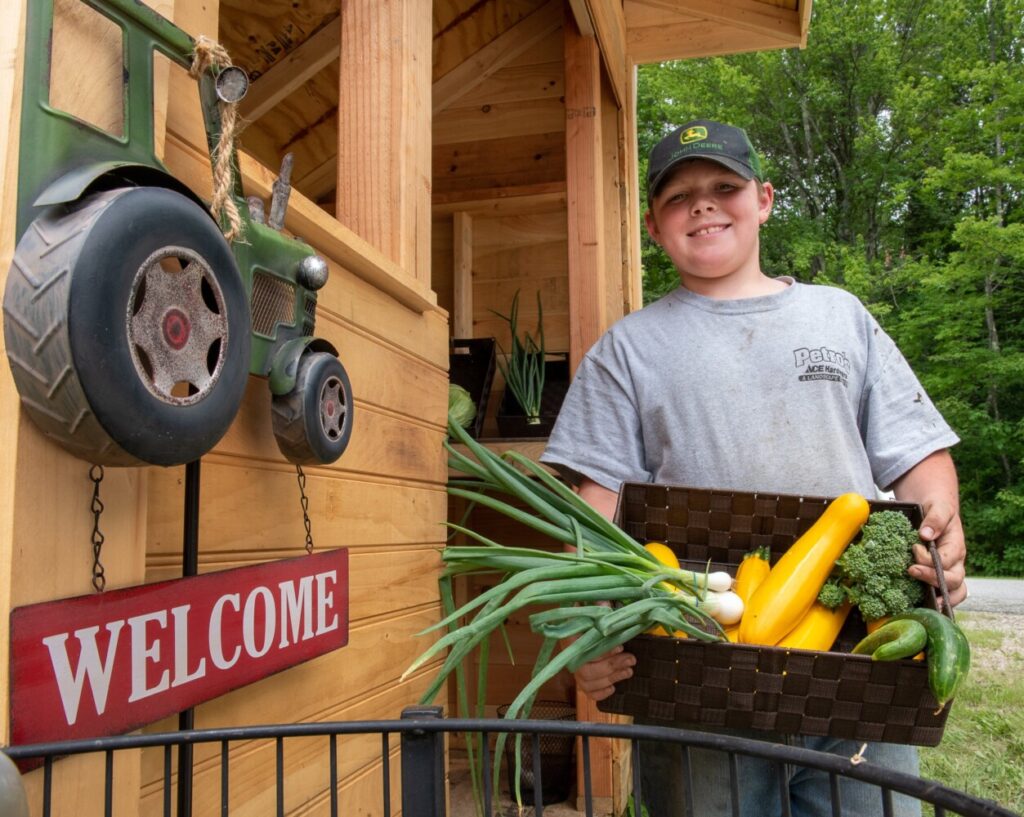
Brayden Nadeau, seen here at age 10, shows off vegetables he grew on his grandfather’s land in Auburn, Maine.

How great to see a kid who’s into agriculture! Cathy Free at the Washington Post reports on a 12-year-old farmer in Maine who got hooked on farming at age 2. There’s a lot to ponder here about what a close relationship with a grandparent can lead to.

“Brayden Nadeau was 2 when he helped his grandpa steer a John Deere tractor, and he was 3 when he helped feed the hogs and chickens on the family farm in Minot, Maine.

“At age 5, when he was asked by his kindergarten teacher what he hoped to do for a living one day, nobody was surprised when Brayden said he was going to be a farmer, said his mother, Kari Nadeau. …

“Brayden, now 12 and in seventh grade, is already on his way to achieving his career goal. On his own initiative, he does much of the work on his grandfather Dan Herrick’s 25-acre farm, and on the 275 acres that neighbors let Herrick use to grow hay, Kari Nadeau said. Brayden plants, tends and harvests produce, and sells his bounty.

“For the past two years, he has run Brayden’s Vegetable Stand, selling fresh food such as corn, cabbage and tomatoes. He used his savings to buy a new store structure in May 2021 for about $7,000 and install it at the edge of his grandfather’s farm. He posts live updates on Facebook about what’s fresh each day.

“He works on the farm and at his store 10 hours a day in the summer, and four hours a day (mostly after school) when school is in session. He’ll restock his store before school at 7:30 a.m. and leave an honor box for customers to drop in their money.

“Brayden said he puts most of his earnings into savings, but uses some of the money to add improvements to his veggie stand, such as a new floor.

“ ‘I’ve become his employee,’ joked Herrick, 64, adding that he still harvests hay on the farm but has allowed Brayden to take over most other responsibilities. ‘I taught him the basics, and he took it from there. … Brayden pretty much runs the show now. [He] knows how to use the equipment better than I do.’

“Brayden said it’s his favorite way to spend his days. ‘I really enjoy it — even getting up at 5 in the morning,’ he said. ‘I’m not into video games and goofing around on my phone like some of my friends. I’d rather be busy on the farm.’ …

“Maine was among the top five states with declining farmland between 2012 and 2017, according to a survey done by the U.S. Department of Agriculture. In rural towns like Minot in southern Maine, many families eventually sell their farms or stop working the land because their children find other ways to make a living, said Herrick, who has farmed for most of his life.

“ ‘It’s a hard job, and you really have to enjoy doing it,’ he said. …

“Brayden’s sense of duty to the farm has also helped to foster a close relationship with his grandparents, said his grandmother, Marie Herrick, 60.

“ ‘Nobody has ever asked Brayden to do this — there’s just nowhere else he’d rather be,’ she said. ‘It’s been a joy all these years to watch him learn everything he can from Dan.’

“At 6:30 every morning, one of Brayden’s parents drives him two miles to the Herricks’ farm, and he goes to work.

“Brayden said he feeds the livestock (100 chickens, 60 pigs, 30 laying hens, 20 turkeys and six cows), cleans stalls, picks ripe produce and gathers eggs. Then he stocks the shelves in his vegetable stand, which he operates until Thanksgiving.

“Every spring, he said, he starts his vegetables from seed, then puts them into the ground. To make the task of caring for the plants easier, he recently bought a drip irrigation system with money he’d saved from his produce sales. …

“His customers said they look forward to seeing what he has to offer each day, from broccoli and tomatoes to eggplant and summer squash. Brayden also sells bacon and sausage made from his grandpa’s hogs and loaves of his grandma Marie’s fresh zucchini bread, as well as jars of her zucchini relish.

“ ‘Zucchini is probably the favorite thing I plant,’ he said. ‘It’s always been amazing to watch something grow from an itty-bitty seed.’

“Some of his customers feel the same way about watching Brayden grow.

“ ‘He’s the hardest-working kid I’ve ever known,’ said customer Wendy Simard, 48, who was also Brayden’s reading teacher at Minot Consolidated School. …

“Simard said that when she taught Brayden in first grade, he was drawn to books about farming, and liked drawing pictures of tractors, pigs and cows.

“ ‘Now he comes in to tell our pre-K students all about vegetables, and he’ll bring in a baby pig at the end of every year to show the kids,’ she said.”

More at the Post, here.

Read Full Post »

Here’s a heartwarmer about how a groom raised by his grandfather got a hospital’s help to make the perfect wedding.

Shandana Mufti writes at the Globe: “When Danny Weaver and fiancée Paula Hatch-O’Loughlin set a wedding date for Aug. 10 at Old Orchard Beach, Maine, they never imagined that they would say their vows on June 25 at Emerson Hospital in Concord.

“But that was before Danny Weaver’s grandfather, Donald Weaver, who raised Danny Weaver and whom he considers the ‘greatest man and friend I have ever known,’ fell ill. And when Donald Weaver’s condition rapidly deteriorated on June 25, Danny Weaver, Hatch-O’Laughlin and the nursing staff at Emerson Hospital came together to organize a wedding in fewer than three hours. …

“ ‘They had the huge courtyard all blocked off,’ Danny Weaver said, describing the event. ‘They had 50 chairs lined up outside, they had music going, they picked songs for when she walked down the aisle. They literally wheeled my grandfather outside – poles, IVs, they brought it all outside.’ …

“Perhaps most importantly of all, Donald Weaver loved the ceremony. Danny Weaver said that even the next morning, his grandfather couldn’t stop talking about the beauty of the wedding.

“Donald Weaver died peacefully on June 26.”

More.

Photo: Emerson Hospital
(L-R) Joey O’Loughlin, Jarrod Hatch, Jillian O’Loughlin, Daniel Weaver Jr., Kylie Weaver, Paula Hatch-O’Loughlin, Danny Weaver and Donald Weaver gather after Paula and Danny were married at Emerson Hospital.

Read Full Post »