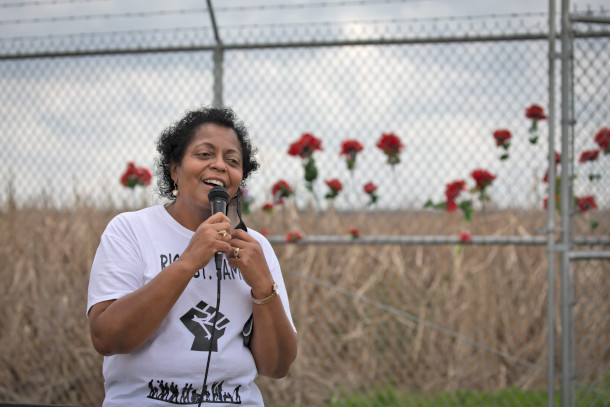
Founder of RISE St. James and 2021 Goldman Environmental Prize winner Sharon Lavigne speaks at the first annual African American Celebration at the grave site of enslaved ancestors at the Buena Vista Cemetery. The land was purchased by Formosa Plastics for a proposed petrochemical complex.
Ever since textile artist Jamie Bourgeois did a fabric-dying experiment with the polluted waters around Louisiana’s Cancer Alley, I’ve been supporting the Louisiana Bucket Brigade and Rise St. James — grassroots nonprofits fighting back against industries like Formosa Plastics.
So I was delighted to see that radio show Living on Earth interviewed a leader of that fight.
“In the aftermath of Hurricane Ida, the communities of the Louisiana region known as ‘Cancer Alley’ were left to deal with destroyed homes, no electricity, and polluted water. That’s on top of the toxic air they breathe every day because of industrial pollution, and Black residents have been fighting for environmental justice there for decades.
“Sharon Lavigne is the founder of RISE St. James and a 2021 Goldman Prize recipient for her work in organizing against a massive Formosa plastics plant, and she joins Host Steve Curwood to discuss the hurricane’s impacts and the health effects of industrial pollution in her community.
“STEVE CURWOOD: The climate emergency is in a downward spiral, as President Joe Biden recently observed when he visited areas hit hard by Hurricane Ida and its aftermath. …
“The poor and disadvantaged are especially hard hit from big cities to places like former farmland along the Mississippi. This 85 mile stretch between Baton Rouge and New Orleans is called Cancer Alley, and it’s the site of some of 150 petrochemical plants, a notorious source of toxic chemicals for locals on a normal day. But in the aftermath of Hurricane Ida many plants released even more pollutants than average as they dealt with high winds, high water and as much as 15 inches of rain.
“Many residents of this region are low income, descendants of the Black slaves who once toiled on the vast sugar plantations of the lower Mississippi. … Sharon Lavigne lives on land bought by her grandfather in St James Parish. She retired as a special education teacher to devote herself full time to advocacy as founder of RISE Saint James, an environmental justice group working to stop even more toxic industrial development in cancer alley. Her organization and others sued Formosa, a Taiwanese company that wants to build an ethane cracking plant nearby. That prompted the Army Corps of Engineers and the courts to require an updated environmental impact statement of the facility and earned Sharon the 2021 Goldman Environmental Prize for North America. …
“SHARON LAVIGNE: I live on the west bank of the Mississippi River in St. James Parish, and Hurricane Ida, it just, it has so much destruction. So many homes have their roof off. Some of the homes are totally demolished. And when it came, it stayed here while it didn’t move fast like it normally moves like hurricanes normally move. So this one was the worst I have ever experienced. …
“In the master bedroom, over half a room, the insulation, and the sheet rock is all on the beat, the carpet is wet. Everything is, I hope, I hope I can salvage the furniture, because that was my mother’s bedroom set. And I hope I can save it but we have to get all the stuff all insulation and sheet rock off of it first, to see how much we can save. … We don’t have electricity right now. We don’t have anything. …
“CURWOOD: Sharon, I understand you’re the founder of RISE St. James. That’s its a grassroots environmental organization. You mobilized against this $12.5 billion plastics manufacturing plant. Now what kinds of toxic pollutants [went] into release? What were the chemicals involved?
“LAVIGNE: Benzene. Benzene is one, and that’s cancer causing. Formaldehyde. There’s a whole bunch of chemicals, a whole lot of greenhouse gases that they’re going to release in the air and into the water. … Even though we have twelve refineries and industries in the fifth district where I live. They don’t care. They want to add some more to us. So once they add this industry to us, we’re not going to be able to live. It’s going to be too much in the air for us to breathe and live. We are having trouble breathing. Now we have people with asthma. We have people with all all types of respiratory illnesses. We have people with cancer all up and down this river. …
“And our governor approved this industry. Our parish officials approved this industry and they live here in St. James. That’s the part that hurt me, because they live here with us. … I don’t care if I don’t have any money. I’m going to fight for my community. And this is where I’ve been all my life. And this is where I want to stay. …
“CURWOOD: What about the location of this plant? …
“LAVIGNE: This plant would be two miles from my home. It would be one mile from a church and a school, public school. And that’s when I said no more. … I didn’t know how many we had, to be honest with you, until I went to a community meeting. And when I went to that meeting, I found out so many things that were going on, and all the chemicals and the people that were sick. One lady was on oxygen and she had cancer. … I said, I asked them, ‘Why don’t we fight from Formosa?’
“And they said, ‘Oh, the governor approved that. And they said the parish council is gonna approve it too and once they approve it, it’s a done deal. There is nothing you could do about it.’ And I told them, ‘We need to do something about it because we have too many. And they said, ‘Oh, Sharon, you are wasting your time. You can’t fight industry.’ …
“I prayed and I asked God what I should do. And he told me to fight. So that’s when I started to fight. I didn’t know what to do to fight. I didn’t know how to do this, this type of thing because I was never involved in involved in environmental issues, I was never involved in anything in the parish. We formed RISE St. James in October of 2018. Then we started meeting other organizations in New Orleans and different places, in that we formed a coalition and we called it Coalition against Death Alley. …
“The governor came down here in 2019, November 1st. … When somebody came to me, and asked me if I will speak to the governor, I said, ‘Sure, I sure would.’
“I said, ‘Governor, I would like you to stop Formosa. Don’t let it come into our neighborhood.’ And this is what he answered me: ‘I’m going to do a health study.’ … I was so hurt. I was so let down because he just threw it off like it was nothing.”
Then the community filed lawsuits. Read more at Living on Earth, here.

 Suzanne's Mom's Blog