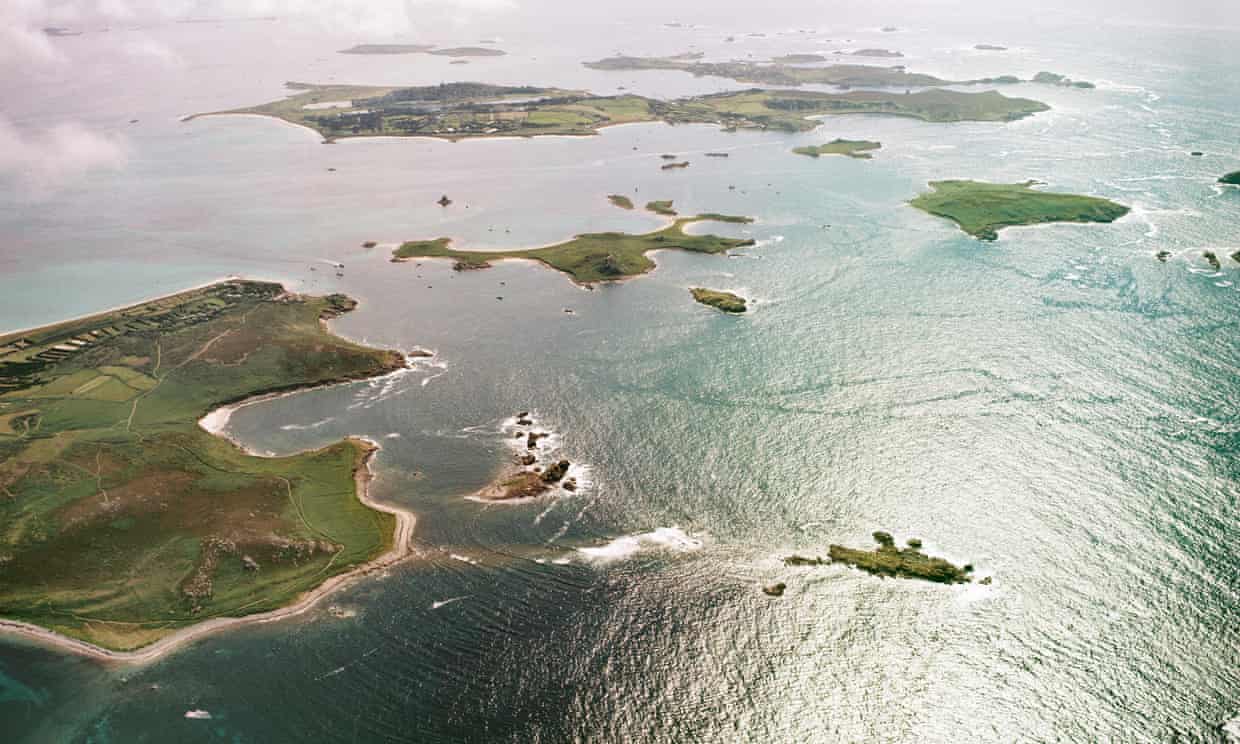
Photo: Historic England Archive.
An aerial view of the Isles of Scilly, with St Martin’s in center left and Tresco and Bryher in the background. A discovery on Bryher has led to insight into women warriors.
Today’s archaeological story is set in a British island cluster with a name that sounds like “silly.” A discovery there adds to the evidence that there have always been women who have served in male bastions.
Caroline Davies reports at the Guardian, “For decades archaeologists have puzzled over whether the stone-lined burial chamber, which was discovered in 1999 on Bryher Island, contained the remains of a man or a woman.
“Excavations revealed a sword in a copper alloy scabbard and a shield alongside the remains of the sole individual, objects commonly associated with men. But a brooch and a bronze mirror, adorned with what appears to be a sun disc motif and usually associated with women, were also found. The grave is unique in iron age western Europe for containing both mirror and sword.
“Now a scientific study led by Historic England has determined the remains are that of a woman, a discovery that could shed light on the role of female warriors during a period in which violence between communities is thought to have been a fact of life.
“Original attempts to establish sex by traditional methods, such as DNA analysis, failed because of disintegration of the bones. All that could be seen of the skeleton was a dark soil stain where the body had once lain, with only small pieces of bone and teeth. …
“Scientific advances, in particular the development of a sophisticated technique at the University of California, Davis, meant it was possible to test tooth enamel, according to research findings published in the Journal of Archaeological Science: Reports.
“Dr Glendon Parker, an adjunct associate professor in the department of environmental toxicology at UC Davis, said: ‘Tooth enamel is the hardest and most durable substance in the human body. It contains a protein with links to either the X or Y chromosome, which means it can be used to determine sex. This is useful because this protein survives well compared to DNA.
“ ‘Our analysis involved extracting traces of proteins from tiny pieces of the surviving tooth enamel. This allowed us to calculate a 96% probability that the individual was female.’
“The main form of warfare 2,000 years ago is likely to have been raids – surprise attacks – on enemy settlements. The mirror and weapons found in the grave are all associated with warfare.
“It is thought that mirrors may have be used in the iron age for signaling, communicating and coordinating attacks. They also had ritualistic functions, as a tool to communicate with the supernatural world to ensure the success of a raid or ‘cleanse’ warriors on their return.
“Dr Sarah Stark, a human skeletal biologist at Historic England, said … ‘Although we can never know completely about the symbolism of objects found in graves, the combination of a sword and a mirror suggests this woman had high status within her community and may have played a commanding role in local warfare, organizing or leading raids on rival groups. …
” ‘This could suggest that female involvement in raiding and other types of violence was more common in iron age society than we’ve previously thought, and it could have laid the foundations from which leaders like Boudicca would later emerge.’ ”
I guess all British people know who that is, but since I don’t, I went to Wikipedia.
“Boudica was a queen of the ancient British Iceni tribe, who led a failed uprising against the conquering forces of the Roman Empire in AD 60 or 61. She is considered a British national heroine and a symbol of the struggle for justice and independence.
“Boudica’s husband Prasutagus, with whom she had two daughters, ruled as a nominally independent ally of Rome. He left his kingdom jointly to his daughters and to the Roman emperor in his will. When he died, his will was ignored, and the kingdom was annexed and his property taken. … The historian Cassius Dio wrote that previous imperial donations to influential Britons were confiscated and the Roman financier and philosopher Seneca called in the loans he had forced on the reluctant Britons.
“In 60/61, Boudica led the Iceni and other British tribes in revolt. They destroyed Camulodunum (modern Colchester) … at that time a colonia for discharged Roman soldiers. Upon hearing of the revolt, the Roman governor Gaius Suetonius Paulinus hurried from the island of Mona (modern Anglesey) to Londinium, the 20-year-old commercial settlement that was the rebels’ next target.
“Unable to defend the settlement, he evacuated and abandoned it. Boudica’s army defeated a detachment of the Legio IX Hispana, and burnt both Londinium and Verulamium. In all, an estimated 70,000–80,000 Romans and Britons were killed by Boudica’s followers. Suetonius, meanwhile, regrouped his forces, possibly in the West Midlands, and despite being heavily outnumbered, he decisively defeated the Britons. Boudica died, by suicide or illness, shortly afterwards. The crisis of 60/61 caused Nero to consider withdrawing all his imperial forces from Britain, but Suetonius’s victory over Boudica confirmed Roman control of the province.”
More at the Guardian, here. No firewall. Donations encouraged.


 Suzanne's Mom's Blog