Photo: Silicon Ranch.
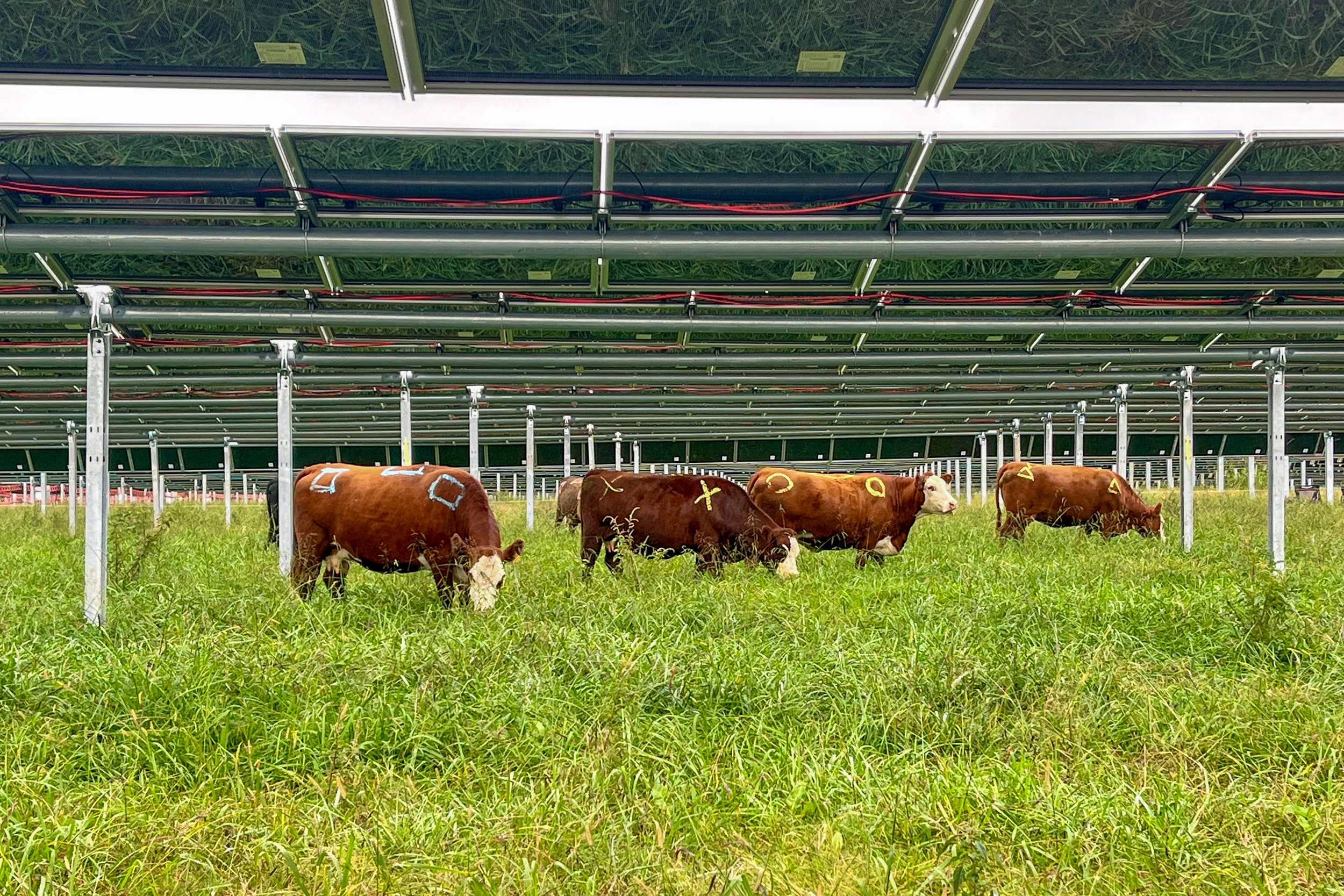
Cattle have been marked for an animal behavior study, showing each cow’s interaction with the solar equipment on Silicon Ranch’s Christiana Solar Farm.
If the cows in the picture above look a little strange, it’s because they are part of a study to see if they can coexist with solar panels, as sheep have already done successfully.
Dan Gearino writes at Inside Climate News, “It is unusual to have a utility-scale solar array in Kentucky, and even more unusual that the grounds crew here is a live-in flock of more than a thousand sheep. …
“The property is a farm and a power plant, and the developer, Silicon Ranch, is using this site to test how to maximize the income from both businesses. The work is part of an effort by solar companies and farmers searching for ways to efficiently utilize the hundreds of millions of acres in the United States used for livestock grazing..
“Nick de Vries, Silicon Ranch’s chief technology officer, walked along a row of panels, explaining that his company and others have largely figured out how to integrate sheep farming and solar. The next step is to replicate the process with cattle, he said. …
“The combination of solar and cattle could transform the renewable energy landscape, opening up vast stretches of land for solar development, contributing to a transition away from climate-warming fossil fuels.
“It also would address concerns about solar encroaching on food production and agribusiness, de Vries said. That’s an important factor in Kentucky, which ranks in the bottom 10 in the country in utility-scale solar installed capacity. …
“Inside Climate News visited this farm to discuss [Silicon Ranch’s] CattleTracker and check on the progress of agrivoltaics — the integration of solar and agriculture — at a time when the [federal] administration is eliminating renewable energy subsidies and cutting budgets for research grants.
“Developing solar with cattle presents a major opportunity to expand solar energy, given the vast size of the U.S. beef industry, but it also poses some significant challenges.
“ ‘They’re very large animals,’ de Vries said. ‘They scrape on things. They like to rub.’ …
“He views the challenges with cattle as surmountable. He stepped to a nearby row of panels and pointed out which parts can withstand contact with a cow, and which are vulnerable.
“The main idea behind CattleTracker is that panels are vulnerable when turned at close to vertical angles because they are then low enough for cows to bump into them. The solution is to adjust the tracker system — the machines that tilt the panels throughout the day to capture the sun — so that the panels stay at close to a horizontal angle when cows are present.
“In a typical ranch, workers move the herd to a different part of a property every few days so the animals can have fresh grass and avoid manure pileup. Solar panels can operate with normal tracking most of the time when cows are away, and with limited tracking when cows are present. The system has controls to set the mode. …
“An inevitable part of the conversation is that animal agriculture and Americans’ meat-heavy diets are major contributors to climate change. Solar grazing is an attempt to marry a climate solution to a climate problem, with the expectation that the result is a net positive. …
“Silicon Ranch’s work on CattleTracker includes determining how to manage biodiversity and increase the land’s capacity to store carbon. …
“Solar grazing started with sheep, with some of the earliest U.S. examples coming online in the early 2010s. It’s a natural fit. Sheep are small enough that they’re unlikely to come into contact with panels. The panels provide shade and the animals eat grass, reducing the need for mowing.
“ ‘I just can’t even stress how awesome this opportunity is,’ said Daniel Bell, the farmer whose sheep live at the Silicon Ranch solar array in Lancaster. …
“In at least one way, the timing of Cattletracker’s rollout is not ideal. [The] administration is phasing out and cancelling many of the programs and grants that helped to subsidize renewable energy. …
“Silicon Ranch has benefitted from help in the form of government-funded research at universities and national labs to better understand the effects of solar grazing on soil and other environmental and animal health factors. But de Vries downplayed the harm of having less government support.
“ ‘I don’t think that there should be agrivoltaic subsidies,’ he said. ‘You should strive for a good business solution, and then find what’s going to make it replicable, not limited to grants.’ “
More at Inside Climate News, here.

 Suzanne's Mom's Blog