Feeds:
Posts
Comments

Posts Tagged ‘greek’

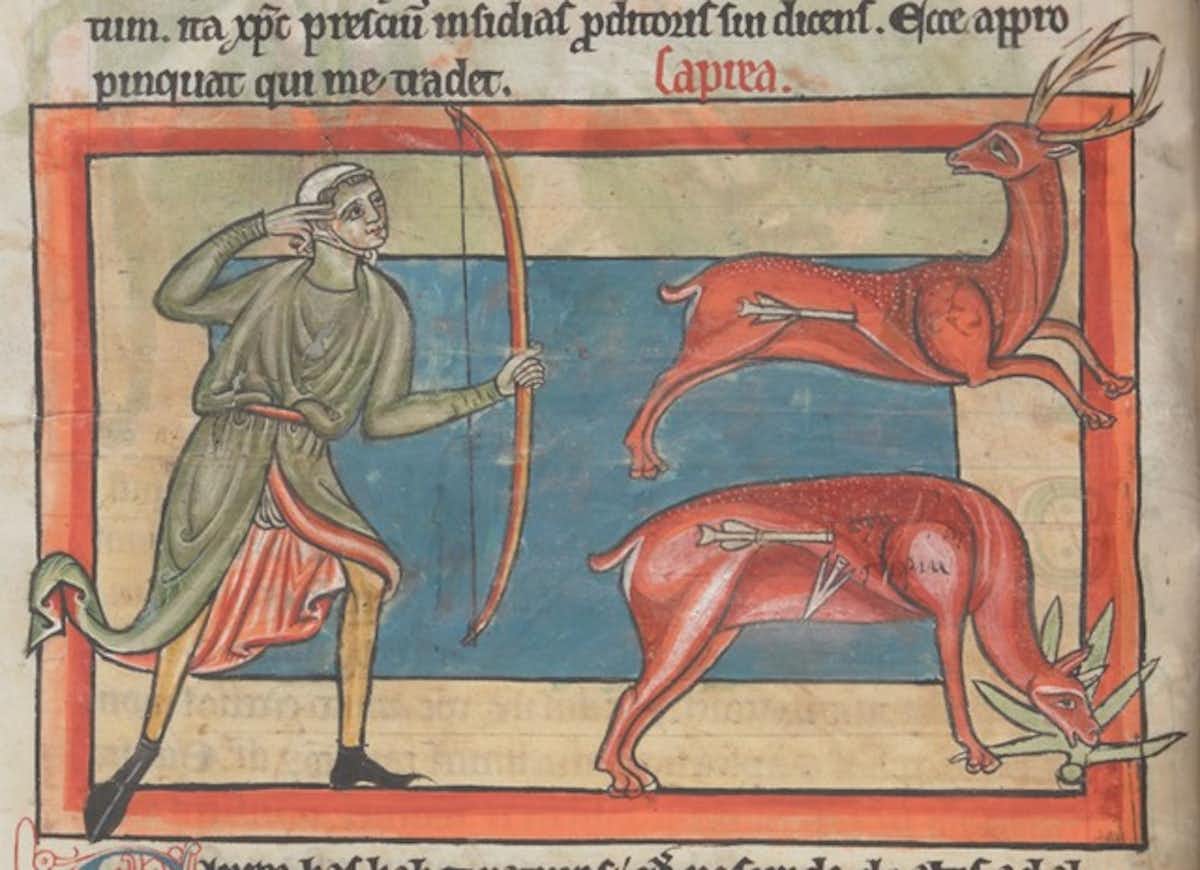
Photo:  British Library, Harley MS 4751 (Harley Bestiary).
As a hunter lands several arrows in his quarry, a wounded doe nibbles dittany to heal herself.

I think we don’t give enough credit to ancient wisdom. Researchers of former times may have been ignorant of cars and computers and smart phones, but why do we think they were unintelligent? (I’m a little cranky because I recently attended a talk on reflexology that barely mentioned traditional Chinese medicine.)

Today we learn that art works from centuries ago suggest humans were observing animals self-medicating long before contemporary scientists started publishing papers on the practice.

Adrienne Mayor, a classics, history and philosophy of science scholar at Stanford University, writes in the Conversation, When a wild orangutan in Sumatra recently suffered a facial wound, apparently after fighting with another male, he did something that caught the attention of the scientists observing him.

“The animal chewed the leaves of a liana vine – a plant not normally eaten by apes. Over several days, the orangutan carefully applied the juice to its wound, then covered it with a paste of chewed-up liana. The wound healed with only a faint scar. The tropical plant he selected has antibacterial and antioxidant properties and is known to alleviate pain, fever, bleeding and inflammation. …

“In interviews and in their research paper, the scientists stated that this is ‘the first systematically documented case of active wound treatment by a wild animal’ with a biologically active plant. …

“To me, the behavior of the orangutan sounded familiar. As a historian of ancient science who investigates what Greeks and Romans knew about plants and animals, I was reminded of similar cases reported by Aristotle, Pliny the Elder, Aelian and other naturalists from antiquity. A remarkable body of accounts from ancient to medieval times describes self-medication by many different animals. The animals used plants to treat illness, repel parasites, neutralize poisons and heal wounds.

“The term zoopharmacognosy – ‘animal medicine knowledge’ – was invented in 1987. But as the Roman natural historian Pliny pointed out 2,000 years ago, many animals have made medical discoveries useful for humans.

Indeed, a large number of medicinal plants used in modern drugs were first discovered by Indigenous peoples and past cultures who observed animals employing plants and emulated them.

“Some of the earliest written examples of animal self-medication appear in Aristotle’s ‘History of Animals‘ from the fourth century BCE, such as the well-known habit of dogs to eat grass when ill, probably for purging and deworming.

“Aristotle also noted that after hibernation, bears seek wild garlic as their first food. It is rich in vitamin C, iron and magnesium, healthful nutrients after a long winter’s nap. The Latin name reflects this folk belief: Allium ursinum translates to ‘bear lily,’ and the common name in many other languages refers to bears.

“Pliny explained how the use of dittany, also known as wild oregano, to treat arrow wounds arose from watching wounded stags grazing on the herb. Aristotle and Dioscorides credited wild goats with the discovery. Vergil, Cicero, Plutarch, Solinus, Celsus and Galen claimed that dittany has the ability to expel an arrowhead and close the wound. Among dittany’s many known phytochemical properties are antiseptic, anti-inflammatory and coagulating effects.

“According to Pliny, deer also knew an antidote for toxic plants: wild artichokes. The leaves relieve nausea and stomach cramps and protect the liver. To cure themselves of spider bites, Pliny wrote, deer ate crabs washed up on the beach, and sick goats did the same. Notably, crab shells contain chitosan, which boosts the immune system.

“When elephants accidentally swallowed chameleons hidden on green foliage, they ate olive leaves, a natural antibiotic to combat salmonella harbored by lizards. Pliny said ravens eat chameleons, but then ingest bay leaves to counter the lizards’ toxicity. Antibacterial bay leaves relieve diarrhea and gastrointestinal distress. Pliny noted that blackbirds, partridges, jays and pigeons also eat bay leaves for digestive problems.

“Weasels were said to roll in the evergreen plant rue to counter wounds and snakebites. Fresh rue is toxic. Its medical value is unclear, but the dried plant is included in many traditional folk medicines. Swallows collect another toxic plant, celandine, to make a poultice for their chicks’ eyes. Snakes emerging from hibernation rub their eyes on fennel. Fennel bulbs contain compounds that promote tissue repair and immunity.

“According to the naturalist Aelian, who lived in the third century BCE, the Egyptians traced much of their medical knowledge to the wisdom of animals. Aelian described elephants treating spear wounds with olive flowers and oil. He also mentioned storks, partridges and turtledoves crushing oregano leaves and applying the paste to wounds.”

Need more proof that modern science sometimes just reinvents the wheel? Read the Conversation, here. No paywall. Fun artworks.
Read Full Post »

In ancient times, Arabic translations of Greek helped spur scientific inquiry.

You may have seen that there are contemporary publishers planning to use artificial intelligence to translate texts. Ha! What could possibly go wrong? If you have ever used Google Translate, you know the answer to that: AI works only up to a point.

Today’s excerpt from Josephine Quinn’s book How the World Made the West, focuses on benefits that came from the traditional type of translation.

“In the eighth-century CE the Abbasids undertook to collect the wisdom of the world in their new capital at Baghdad. … The operation was lavishly funded by [the second Abbasid caliph, al-Mansur] as well as by members of his household, courtiers, merchants, bankers, and military leaders. …

“What is often now called the ‘Translation Movement’ … was part of a wider commitment by Islamic scholars and political leaders to scientific investigation that also saw caliphs commission new works of science, geography, poetry, history, and medicine.

The real legacy of the Arabic translations is the impetus they gave to further thought. 

“It is well-known that classic works of Greek science and philosophy were translated into Arabic before they were translated into other European languages — including Latin. What is less well-known is that the point of translating foreign works was not to preserve them but to build on them. As links around the Mediterranean continued to increase, that Arabic scholarship began to reach western Europe, and to change the way people there thought.

“Back in Baghdad, as so often happened, cultural change began from the outside — and in this case with the collection and comparison of foreign knowledge. The fundamental model and first material for the Abbasid translation project came from Iran, where sixth-century Sasanian shahs had commissioned Persian translations of important Indian and Greek works.

“Living Iranians were an inspiration too. … Persian scholars had already started to translate classic works of their own literature into Arabic. This ensured their preservation, and advertised the history and high culture of Iranian lands. Sasanian intellectuals also maintained useful links with scientific traditions farther east, above all with Indian mathematicians, the most advanced in the ancient world, and they had already translated important works from Sanskrit into their own language. …

“Incorporating the work of Greek thinkers into the Arabic canon was by contrast a declaration of cultural hegemony over the rump Roman empire at Constantinople, where older learning had been set aside in favor of Christian genres from sermons to saints’ lives, and where ancient science and philosophy now moldered in archives and monasteries.

“More immediately, the project took inspiration from the contemporary intellectual culture of western Asia, revitalized by the unification under Islam of regions once subject to either Persia or Rome. … This world produced well-traveled intellectuals expert in topics from military strategy to astrology, and comfortable in Greek, Syriac, Middle Persian (Pahlavi), and now Arabic as well.

“The final key component came from farther east. Paper had been invented in China in the second century BCE and by the second century CE it is found in the trading oases of the Tarim Basin. … As paper was much cheaper to produce than papyrus, it finally made writing in great quantity a practical prospect.

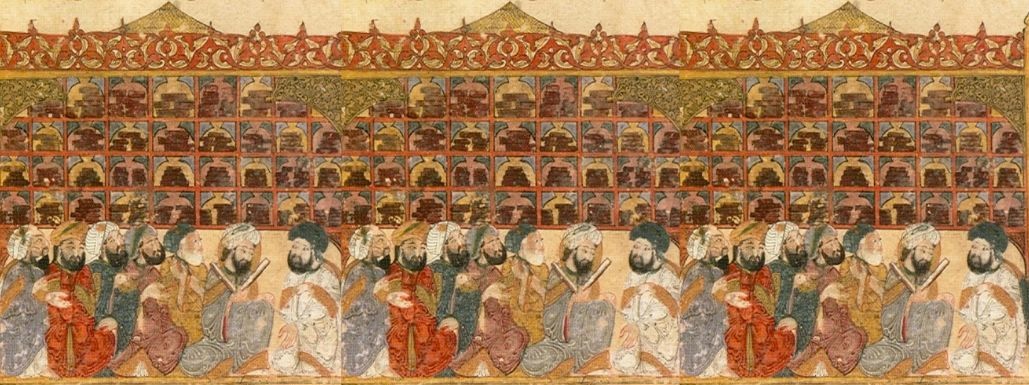
“In the early ninth century scientific scholarship in Baghdad coalesced around a library called the ‘House of Wisdom’ (Bayt al-Hikma), and the translation efforts were put on a more organized footing. … Persian scholars translated into Arabic works that had already been translated from other languages into their own, and since there was comparatively little direct Greco-Arabic bilingualism, Arabic translations of Greek works were often made from Syriac versions. …

“We have a useful guide to the foreign works considered worthy of investigation in the form of an encyclopedia entitled Keys of the Sciences written by Muhammad ibn Musa al-Khwarizmi (c. 780–850), a Persian-speaking mathematician and astronomer from the central Asian oasis of Khwarazm, south of the Aral Sea, who worked at the House of Wisdom.

“He divided the work into two books: one describes ‘Islamic religious law and Arabic sciences,’ defined as law, theology, grammar, secretaryship, poetry, and history; the other is devoted to ‘the sciences of foreigners such as the Greeks and other nations’: philosophy, logic, law, medicine, arithmetic, geometry, astronomy/astrology, music, mechanics, and alchemy. …

“Practical Greek texts also found their way into the collection, on topics from engineering to military tactics to falconry. Popular literature included books of fables, ‘wisdom sayings,’ and letters supposedly exchanged between famous historical figures. …

“Some of the Greek texts were acquired through personal request, even from the caliph himself. Other manuscripts were found on investigative missions. [A] tenth-century compendium of literature written in Baghdad reports that camel-loads of old works were discovered in a pagan Greek temple that had been locked since the arrival of Christianity, getting worn and gnawed at by pests. …

“Most ancient science was indeed lost to western Europe for almost a millennium: such works were usually written in Greek, even by Romans, and they disappeared with the knowledge of that language. …

“Greek texts were far from the only inspiration for Arabic science. [But the] manipulation, criticism, and sometimes outright rejection of foreign works by intellectuals working in the Islamic world catalyzed a scientific revolution.”

More at Literary Hub, here.

Read Full Post »

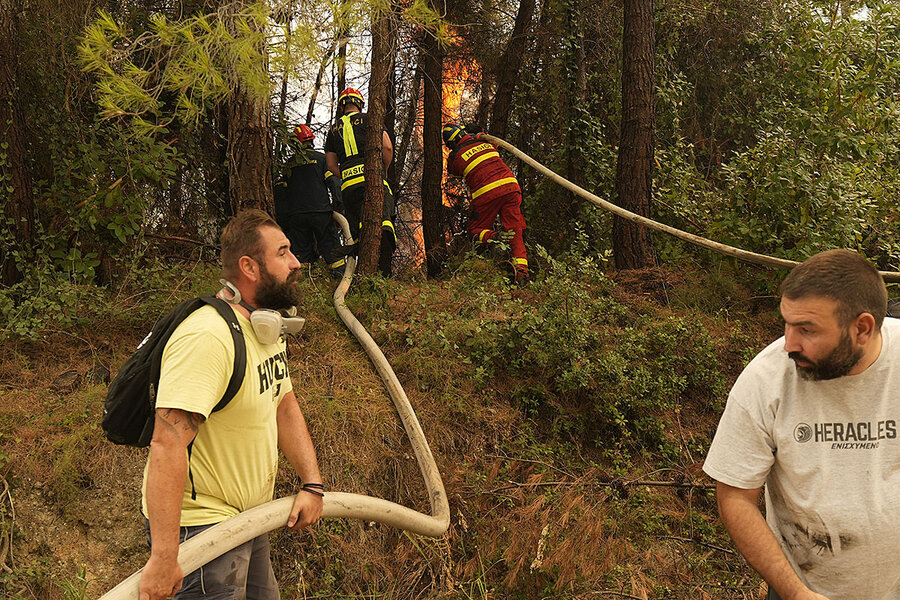
Photo: Petros Karadjias/AP.
Firefighters try to extinguish a fire in Avgaria village on Evia, an island about 115 miles north of Athens, Aug. 10, 2021.

The Greek government was doing nothing to fight the raging fires on Evia island, and some mainland folks watching the disaster on television couldn’t stand what they were seeing. So they took matters into their own hands.

Tony Rigopoulos and Dominique Soguel reported the story for the Christian Science Monitor.

“Volunteers were the first – and at times only – line of defense against the wildfires that engulfed the Greek island of Evia this week, leaving charred olive trees in a sea of ashes.

“Some were brave local youth. Others came from other parts of the country, shocked into action by the inadequacy of the government response as it scrambled to fight an unprecedented number of fires across multiple fronts, including the capital, Athens.

“Wherever they came from, the volunteers, as well as grassroots support from nearby cities and towns to get supplies into fire-stricken areas, have helped save lives and property from roaring blazes across the island, located just northeast of Athens. The destruction the fires caused is nonetheless catastrophic for many living on Evia, especially in its heavily wooded north. But the actions of volunteers helped prevent loss of life and keep a bad situation from becoming that much worse.

“[The fire] broke out on Aug. 3 and continued to smolder through Thursday. A sinister smoke hung over the small western port of Aidipsos early Wednesday as firefighters and volunteers from other parts of Greece arrived to help Evia.

“The blaze had spared the port, an important entry point to the island, but consumed more than 110,000 acres just beyond. Some villages continued to burn, adding to the bitterness of residents who say the government prioritized fighting a wildfire at a large forest near Athens and allowed the fires on Evia to grow into a huge front that was impossible to battle.

“Known for its fierce winds that stayed mercifully calm in recent days, the island’s north boasted beautiful pine forests that went up in flames all the same, along with vineyards and olive groves. Thousands of residents work either in small honey or resin production facilities. …

Said soccer coach Vaggelis Bekakos, ‘The volunteers saved Evia because there was no one there to help.’ …

“After the fierce wildfires of 2016, says the coach, residents of Limni created a volunteer corps of firefighters and rescuers who received proper training. They are bound by an oath to drop their day jobs and serve any time that there is a fire alert. Mr. Bekakos credits their heroic acts to save the town – broadcast on national TV – with inspiring villagers in other parts of the island to also fight the flames, rather than flee.

“ ‘We were asking the fire service to spray some water on a house that was beginning to burn and they would answer, “We have no such order. Our order is to evacuate the people, not to spray water,” ‘ he recalls. …

“Greece had to battle nearly 600 fires in the span of just eight days, issuing 65 evacuation alerts and evacuating 63,000 people, according to Nikos Hardalias, the deputy minister of crisis management. ‘What I know is that the choices we made saved lives,’ he told journalists on Tuesday. ‘We didn’t underestimate any fire. … We had to deal with a situation that was unique for the fire service: 568 fires!’ …

“Five days after the start of the fires, Marinos, a native of the southern part of Evia who now studies in Athens, went with his friends to the scorching north because there appeared to be no government effort to bring the flames under control.

“ ‘We took branches from trees to hit the flames until they died,’ says Marinos, who didn’t give his last name. ‘Later a man came from the village with his car, carrying the watering tank he uses for his vines. We used that water too. We used anything we could find. …

“ ‘It’s not only the houses, it’s the forest. Their whole life is now in the past. What can they do after this?’

“Maria Papadopoulou, a native of Athens, has devoted days to delivering food and water packages to those in need, shuttling villagers to safety, and rescuing and feeding the few animals that survived the inferno. She agrees that the loss of the forest is a huge problem. ‘The forest and the animals are gone forever,’ she says. ‘In a few days, all the volunteers will leave and the people of the villages will be really alone then. They will continue to live in this huge cemetery.’ ”

More at the Monitor, here.

Read Full Post »

Photo: Sir Cam.
Says Professor James Diggle, “When I was able to sign off the final proofs … I literally wept with joy.”

Once when I was in high school in New York, my father had a temporary stay at Lenox Hill Hospital, and I trotted over in my green uniform and my monstrous stack of school books to pay him a visit. When the doctor came in, he asked me what I was studying, and my father proudly told him I was learning Ancient Greek. That’s when the doctor burst our bubble. He said he’d studied Greek for five years and never had a use for it.

Well, I ended up studying it for five years, too, and although I can’t say I ever had a practical application for it, I don’t regret it. So I was interested in today’s article about the newest, biggest ever Ancient Greek lexicon. There’s a funny angle to the story that makes me think the book would never have been purchased back in those days by that demure girls school, where the students tittered over Aucassin et Nicolette as if it were Fanny Hill.

Alison Flood reports at the Guardian, “Victorian attempts to veil the meanings of crude ancient Greek words are set to be brushed away by a new dictionary 23 years in the making. It is the first to take a fresh look at the language in almost 200 years and promises to ‘spare no blushes’ for today’s classics students.

“The late scholar John Chadwick first came up with the idea to update HG Liddell and Robert Scott’s 1889 dictionary, the Intermediate Greek-English Lexicon, in 1997. An abridged version of a lexicon published in 1843, the Liddell and Scott had never been revised, and is packed with antiquated terms and modestly Victorian translations of the more colourful ancient Greek words. Despite this, it remains the most commonly used reference work for students in English schools and universities.

“It was initially thought that Chadwick’s project would take five years, but Cambridge professor James Diggle, who was then chair of the advisory committee, said it soon became clear that the Intermediate Lexicon was ‘too antiquated in concept, design and content,’ and the team would need to start afresh.

“Diggle and his fellow editors then set out on the ‘Herculean task’ of rereading most examples of ancient Greek literature, from Homer to the early second century AD. They then worked through the 24 letters of the Greek alphabet to create a modern guide for today’s students to the meanings of ancient Greek words and their development through the years. The lexicon is the first to be based on an entirely new reading of the Greek texts since 1843.

‘At the outset of the project I undertook to read everything which the editors wrote. I soon realized that if we were ever to finish I had better start to write entries myself,’ said Diggle.

“ ‘The moment of greatest relief and joy was when I was able to sign off the final proofs and say to the publisher, “It’s finished. You can print it.” You can’t imagine what it was like, to realize that we had finally got there. I literally wept with joy.’

“The completed Cambridge Greek Lexicon, which is being published by Cambridge University Press, runs to two volumes and features around 37,000 Greek words, drawn from 90 authors and set out across 1,500 pages.

“The new dictionary’s editors ‘spare no blushes,’ Diggle said, when it comes to the words that ‘brought a blush to Victorian cheeks.’ The verb χέζω (chezo), translated by Liddell and Scott as ‘ease oneself, do one’s need,’ is defined in the new dictionary as ‘to defecate’ and translated as ‘to shit.’ …

“Antiquated and offensive language also gets a makeover. While Liddell and Scott defined βλαύτη (blaute) as ‘a kind of slipper worn by fops,’ in the Cambridge Greek Lexicon it is described as ‘a kind of simple footwear, slipper.’ …

“The Cambridge Greek Lexicon also begins each entry with the root meaning of a word, a fundamentally different approach to the 19th-century lexicon, which started entries with a word’s earliest appearance in literature.

” ‘Take a word like πόλις, which will be familiar to many in its English form “polis,” ‘ said Diggle. “Our article shows the variety of senses which the word can have: in its earliest usage “citadel, acropolis”; then, more generally, “city, town” and also “territory, land”; and, more specifically, in the classical period, “city as a political entity, city-state”; also, with reference to the occupants of a city, “community, citizen body.” ‘ “

More at the Guardian, here.

Read Full Post »

WP_20160826_07_16_07_Pro
Sandra and I have been keeping an eye on a neighbor’s lotus all week, hoping to see it bloom. Today was the day. Above is what the lotus looked like at 7:30 a.m. Below is the lotus at 8 a.m., at the end of our walk.

This exciting development sent me to the Tennyson poem about Odysseus landing on the island of lotus eaters. I don’t think I had ever read the whole thing. Here are excerpts.

A land where all things always seem’d the same!
And round about the keel with faces pale,
Dark faces pale against that rosy flame,
The mild-eyed melancholy Lotos-eaters came.

Branches they bore of that enchanted stem,
Laden with flower and fruit, whereof they gave
To each, but whoso did receive of them,
And taste, to him the gushing of the wave
Far far away did seem to mourn and rave
On alien shores; and if his fellow spake,
His voice was thin, as voices from the grave;
And deep-asleep he seem’d, yet all awake,
And music in his ears his beating heart did make. …

Surely, surely, slumber is more sweet than toil, the shore
Than labour in the deep mid-ocean, wind and wave and oar;
O, rest ye, brother mariners, we will not wander more.

I’d say that’s an early example of an altered state.

According to wikipedia, however, our lotus is Nelumbo nucifera, whereas the one that hooked the Greek mariners was probably Ziziphus lotus, which doesn’t look nearly as pretty.

Sandra was interested in the showerhead-like seed pod. If you get close, you can see a blue-ish seed peeking out of every hole.

And what amazing seeds they are! As the invaluable wikipedia reveals, “An individual lotus can live for over a thousand years and has the rare ability to revive into activity after stasis. In 1994, a seed from a sacred lotus [in Northeastern China], dated at roughly 1,300 years old ± 270 years, was successfully germinated.”

WP_20160826_07_56_21_Pro

Read Full Post »

Back when Suzanne was a Girl Scout, one of the mothers (I think it was Grace) came up with a spring project, a recipe for a Greek cookie that the girls could mold into bunny shapes for Easter.

It was called koulourakia, and it was yummy. I still have a copy of the recipe the mom printed by hand. She had provided the girls with an extra challenge by listing all the ingredients as anagrams: trebut for butter, gusra for sugar, kilm for milk, and so on. They had to translate before getting started baking.

I looked online for relevant pictures. I love that the Greek recipe with the most rabbit-like photos was from a South Indian cooking site, here.

For the Girl Scout bunnies, we didn’t twist the dough as in the picture but instead formed it into fat bunny shapes.

Someone remind me to make this recipe next year.

Photo: Zesty South Indian Kitchen
Greek Easter Cookies (koulourakia)

Read Full Post »

I don’t know what it is about stories like this, but they really float my boat.

Here is an ordinary woman, a hairdresser who loves hairdressing, who tried to recreate an ancient hairstyle and ended up making a discovery that got published in a scholarly journal. What it took was being openminded, curious, and persistent.

As Abigail Pesta writes in the Wall Street Journal, Janet Stephens tried to re-create on a mannequin a hairdo she had seen on a bust of the Roman empress Julia Domna at the Walters Art Museum in Baltimore.

” ‘I couldn’t get it to hold together,’ she says. Turning to the history books for clues, she learned that scholars widely believed the elaborately teased, towering and braided styles of the day were wigs.

“She didn’t buy that. Through trial and error she found that she could achieve the hairstyle by sewing the braids and bits together, using a needle. She dug deeper into art and fashion history books, looking for references to stitching.

“In 2005, she had a breakthrough. Studying translations of Roman literature, Ms. Stephens says, she realized the Latin term ‘acus’ was probably being misunderstood in the context of hairdressing. Acus has several meanings including a ‘single-prong hairpin’ or ‘needle and thread,’ she says. Translators generally went with ‘hairpin.’

“The single-prong pins couldn’t have held the intricate styles in place. But a needle and thread could. It backed up her hair hypothesis.

“In 2007, she sent her findings to the Journal of Roman Archaeology. ‘It’s amazing how much chutzpah you have when you have no idea what you’re doing,’ she says. ‘I don’t write scholarly material. I’m a hairdresser.’

“John Humphrey, the journal’s editor, was intrigued. ‘I could tell even from the first version that it was a very serious piece of experimental archaeology which no scholar who was not a hairdresser—in other words, no scholar—would have been able to write,’ he says.

“He showed it to an expert, who found the needle-and-thread theory ‘entirely original,’ says Mr. Humphrey, whose own scholarly work has examined arenas for Roman chariot racing.

“Ms. Stephens’ article was edited and published in 2008, under the headline ‘Ancient Roman Hairdressing: On (Hair)Pins and Needles.’ ”

More.

Photographs: Janet Stephens

Read Full Post »

Back in the day, I was a great fan of Mary Renault. I took her every word as gospel, down to the conversations Theseus had with Ariadne, because the stories generally meshed with what I knew from studying ancient Greek.

The Bull from the Sea was about the sea god Poseidon, who also is the god of earthquakes. I remember Renault’s description of the eerie stillness in the air before an earthquake and the strange behavior of the creatures.

So I am not at all surprised to read in the Washington Post that animals at the National Zoo knew before this week’s earthquake actually quaked that something was about to happen.

“The zoo documented a broad range of animal behavior before, during and after the tremor … . For example, a gorilla, Mandara, shrieked and grabbed her baby, Kibibi, racing to the top of a climbing structure just seconds before the ground began to shake dramatically. Two other apes — an orangutan, Kyle, and a gorilla, Kojo — already had dropped their food and skedaddled to higher turf. The 64 flamingos seemed to sense the tumult a number of seconds in advance as well, clustering together in a nervous huddle before the quake hit. One of the zoo’s elephants made a low-pitched noise as if to communicate with two other elephants. And red-ruffed lemurs emitted an alarm cry a full 15 minutes before the temblor, the zoo said.

“During the quake, the zoo grounds were filled with howls and cries. The snakes, normally inert in the middle of the day, writhed and slithered. Beavers stood on their hind legs and then jumped into a pond. Murphy the Komodo dragon ran for cover. Lions resting outside suddenly stood up and stared at their building as the walls shook. Damai, a Sumatran tiger, leaped as if startled but quickly settled down. Some animals remained agitated for the rest of the day, wouldn’t eat and didn’t go to sleep on their usual schedule.” Read the full story.

And while we’re on the subject, please read about 96 percent of a certain kind of male toad abandoning their breeding ground five days before the 2009 L’Aquila, Italy, earthquake! (That lead came via Andrew Sullivan’s blog.)


Read Full Post »