Feeds:
Posts
Comments

Posts Tagged ‘greenland’

Photo: Soren Ryesgaard.
A boat looks tiny cruising by the rockslide gully of a destroyed glacier in Greenland recently. Rockslide plus global warming equals a surprise.

I don’t remember reading about this mysterious rumble at the time, but I’m always interested when scientists are stumped. I like how they approach figuring out a new phenomenon. Here’s hoping that science will continue to guide us the future. For one thing, unlike business or politics, it is usually collaborative, as seen in this story.

Kasha Patel wrote at the Washington Post, “The strange rumble was detected mid-September last year. An odd seismic signal appeared at scientific stations around the globe, but it didn’t look like the busy squiggles of an earthquake. A day passed, and the slow tremor still reverberated. When it continued for a third day, scientists worldwide began assembling to discuss what was causing the grumble in the ground.

“Some initially thought the seismic instruments recording the signal were broken, but that was quickly nixed. Maybe it was a new volcano emerging before their eyes, others said. …

“ ‘No one had ever seen this. We have nothing to compare it with,’ said Kristian Svennevig, a geologist at the Geological Survey of Denmark and Greenland.

“Nine days later, the vibrations greatly dissipated. But the mystery of the USO [Unidentified Seismic Object] lasted much longer. A year later, the puzzle has been solved, according to a study published in the journal Science [in September 2024]. It took about 70 people from 15 different countries and more than 8,000 exchanged messages (long enough for a 900-page detective novel) to crack the case.

“The short answer: A mega-tsunami created waves that sloshed back and forth in a fjord in Greenland, creating vibrations that traveled around the world.

“The long answer begins in the atmosphere. As greenhouse gas concentrations increase due to climate change, those heat-trapping gases accelerate ice melt particularly around Earth’s poles. On Sept. 16 last year, that extra heat thinned a glacier in eastern Greenland over time so much that it could no longer support the mountain rock above it.

“A 500-foot-thick piece of metamorphic rock, about a third of a mile wide and long, fell and triggered a massive landslide. Rock and ice, enough to fill 10,000 Olympic-size swimming pools, let loose as fast as 47 meters per second and ran for more than a mile. The avalanche plunged into the Dickson Fjord, triggering a 650-foot-high tsunami — one of the highest seen in recent history.

“Farther away from the fjord, tsunami waves reaching 13 feet high damaged an unoccupied research station and destroyed cultural and archaeological heritage sites, including an old trapper hut that had never been affected by tsunamis during its century-old history. …

“Meanwhile, in the fjord, the mega-tsunami wave traveled back and forth in the inlet and created a standing wave called a seiche. We often see small-scale seiches — this rhythmic oscillation in water — in a swimming pool or bathtub. This tsunami source was so energetic that the seiche radiated seismic waves globally, shaking the planet for nine days before it petered out.

“Members of the Danish military sailed into the fjord only days after the event to collect drone imagery of the collapsed mountain face and glacier front and scars left by the tsunami.

“Of course, Svennevig and many of his close colleagues didn’t fully know of the connection between the tsunamigenic landslide and the seiche as the events unfolded, which is detailed in the study.

“At the time, they were scratching their heads about the data at the seismograph stations. The seiche appeared as a single slow vibration, like a monotonous-sounding hum, as opposed to the frantic lines of a typical earthquake reading. The wave peaked every 92 seconds, which is slow compared with an earthquake. …

“ ‘When we started doing this research, nobody had any ideas about what was the root cause,’ said Carl Ebeling, a co-author of the study and a seismologist at the Scripps Institution of Oceanography at the University of California at San Diego. ‘Even for a large landslide under normal circumstances, it would be hard to see that on a global scale, so something special is going on here.’

“As some scientists investigated the peculiar seismic data, another group of authorities and researchers had heard of a large tsunami in a remote fjord in eastern Greenland. The two teams, among others, joined forces, quickly growing into a 24/7 international collaboration via a messaging system. The group brought a variety of local field data and remote, global-scale observations.

“ ‘We knew there was a landslide and a tsunami. You could pull the seismic signal of those,’ Svennevig said. ‘But then there was this other seismic signal that continued for nine days, and they were taken from roughly the same area, so they must be associated somehow.’ …

“The breakthrough came when they received new bathymetry data of the fjord, similar to a topographic map, from the Danish military, which allowed them to better map the seabed in the computer models. Once incorporated, the team used an unprecedentedly high resolution model to show how the landslide direction, along with the uniquely narrow and bendy fjord channel, led to the nine-day seiche.”

More at the Post, here.
Read Full Post »

Photo: Adeline Heymann/One Ocean Expeditions.
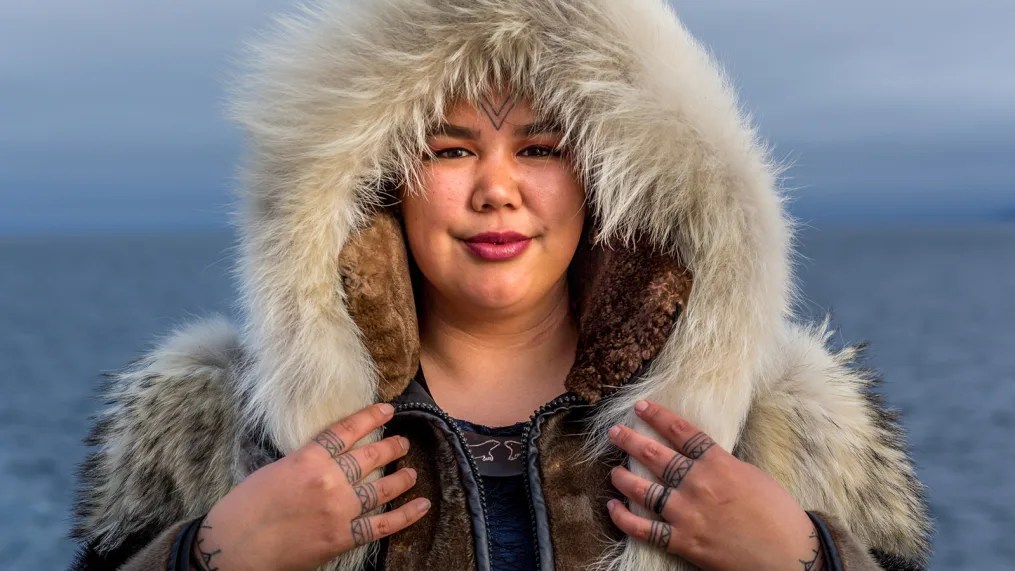
Candice Pedersen, a guide for One Ocean Expeditions in the Arctic, tells passengers that Inuit women feel empowered reclaiming traditional tattoos for themselves.

I love the radio show called The World because of the international focus. It always has a deeper take on mainstream media stories, and you can hear music you’re unlikely to be exposed to anywhere else. Recently, Joshua Coelda, Sejersdal Dreiager, and Shirsha Chakraborty reported about a tradition that is coming back from the brink: Inuit tattoo art.

“Najannguac Dalgård Christensen, 35, pulled back her sleeve on one forearm to reveal a pair of tattoos shaped like train tracks across her wrists. …

“These are traditional Inuit tattoo patterns that speak to her Indigenous Inuit heritage. The markings, she said, represent Sila, a word that carries many meanings, including ‘breath,’ ‘sky,’ ‘spirit’ and ‘universe.’

“To Christensen, who got the tattoo several years ago, it also means ‘the Greenlandic belief that we should be aware of who we are and what we can be, and that is attached to each other.’

“In precolonial times, Inuit women of Greenland, and across much of the Arctic, would have tattoos on both their bodies and faces, holding important pre-Christian spiritual meaning. Today, some Greenlandic Inuit like Christensen are reclaiming their identity through this long-lost art. 

“She said that she didn’t always embrace her Greenlander identity — because it is often associated with negative stereotypes about the Inuit diaspora living in Denmark, who colonized the North American island three centuries ago.  

“ ‘I felt empowered by getting the tattoos because it was like there was some kind of relief that I didn’t have to be embarrassed about being a Greenlander anymore,’ Christensen said. …

“The custom itself is far from new, but tattoos were some of the first traditions to be discouraged when Danish-Norwegian missionaries started colonizing the island at the beginning of the 18th century. The missionaries found tattooing incompatible with Christian faith, [Randi Sørensen Johansen, intangible cultural heritage curator at the Greenland National Museum and Archives] said. …

“As the custom disappeared, so did much of the knowledge about the tattoos’ meaning. ‘We didn’t have that tradition of writing down,’ Johansen said — Inuit passed knowledge through oral storytelling. …

“Inuit would use amulets to protect them from ‘unwelcome spirits,’ but also to help certain attributes or ensure a successful childbirth, among other things. It is likely, Johansen said, that Inuit tattoos were seen as a kind of amulet, giving strength, help or protection to the women or — in rarer cases — men who had gotten them.

“The tattoos were most often made as linear patterns across the brow and vertical lines on the chin made by using both a puncture or dot technique and a sewing technique. The latter technique consisted of pulling sinew dipped in soot under the skin with a needle made of animal bone, curator Johansen said.

“Maya Sialuk Jacobsen is one of about a dozen Inuit tattoo artists across the globe reviving this traditional art. … It was she who created Christensen’s tattoos. For over six years, she’s been helping Inuit like Christensen who live in Denmark connect with their culture through ink. Like Christensen, she is of both Danish and Greenlandic Inuit descent — a group she describes as an emerging ‘third culture’ in the Scandinavian country.

“The community is fairly small in Denmark and not well-defined demographically. According to StatBank Greenland, there are a little under 17,000 people born in Greenland currently living in Denmark. But community leaders, including from the Greenlandic House of Aalborg, aren’t even sure about the exact number of Inuit in Denmark. The number of self-identifying Inuit could be even higher, due to the presence of third-culture community members, who are partially Inuit. …

“Sialuk Jacobsen said, ‘It’s basically identity work all the time.’  Many come to her with a feeling of sadness, in search of a sense of belonging, she said. ‘They need to talk about these things, and to learn about the culture, they just want to learn.’ …

“While Sialuk Jacobsen said she uses inks and needles approved for tattooing on clients in Denmark, her research into the traditional techniques has included experimental tattooing on herself, and using her own right leg as her test area to reconstruct authentic methods of inking up.

“But in Denmark, finger, hand and face tattoos are prohibited (though it’s not illegal in Greenland). So, Sialuk Jacobsen is limited to tattooing the rest of the body. …

“The legacies of colonialism hang heavy over the community living in Denmark. Greenlanders are overrepresented among Denmark’s homeless population — accounting for 7% of people experiencing homelessness, according to VIVE.

“In recent years, Denmark’s colonial past came under public scrutiny.  For her master’s degree, Christensen looked into a form of ‘modern boarding schools.’ She found that Inuit children in Denmark are more likely than Danish children to be taken away from their families and placed in foster homes, which are almost always Danish families. 

“ ‘They learn to speak Danish, and there isn’t any focus on the Greenlandic language, so they lose their Greenlandic language. And when the parents only speak Greenlandic, they can’t talk to each other without an interpreter.’

“Christensen, who has become an activist through her research, believes the government should make it at least mandatory for Inuit children living in foster care to have lessons on Greenlandic.”

More at PRI’s The World, here, and CNN, here.

Read Full Post »

With every new discovery of fossils, it seems, the first appearance of life on Earth is earlier.

Maybe.

There is always controversy, and your belief about the earliest date may depend on just how hellish you think the Hadean period was, when asteroids bombarded the planet and life probably would have been impossible.

Nicholas Wade writes at the New York Times, “Geologists have discovered in Greenland evidence for ancient life in rocks that are 3.7 billion years old. The find, if confirmed, would make these fossils the oldest on Earth and may change scientific understanding of the origins of life.

“Experts are likely to debate whether the structures described in the new report were formed biologically or through natural processes. If biological, the great age of the fossils complicates the task of reconstructing the evolution of life from the chemicals naturally present on the early Earth. It leaves comparatively little time for evolution to have occurred and puts the process close to a time when Earth was being bombarded by destructive asteroids. …

“Certain features ‘are fairly credible hallmarks of microbial activity,’ Abigail C. Allwood of Caltech’s Jet Propulsion Laboratory wrote in a commentary accompanying the Nature article [by Allen P. Nutman et al.]. They have a few features that make them ‘interesting and possibly biological,’ she added in an email.

“Another expert in the early Earth’s environment, Tanja Bosak of M.I.T., said the structures do resemble modern stromatolites but their origin ‘will be hotly debated.’ …

“Dr. Nutman argues that life must therefore have originated even earlier, probably in the late Hadean stage of Earth’s history, which lasted from 4.65 billion years ago — when the planet formed from debris in orbit around the sun — to 4 billion years ago.

“But the Hadean was so called because of the hellish conditions thought to have prevailed, including cataclysmic meteorite impacts that boiled the oceans into steam and turned Earth’s surface into molten lava. The largest of these impacts, at 4.5 billion years ago, tore a piece from Earth that became the moon. It is difficult to see how life could have begun under such circumstances.”

Weigh in on the controversy here.

Photo: Allen Nutman
Stromatolites from Greenland may be evidence of the oldest life on earth.

Read Full Post »