Feeds:
Posts
Comments

Posts Tagged ‘guaranteed income’

Photo: Creatives Rebuild New York.
Painter Athesia Benjamin created a self-portrait while participating in the guaranteed income program.

From time to time this blog has checked in on experiments in basic income taking place around the world. If you use search terms like “basic income” or “guaranteed income” in my search box, you will find many related articles, including ones on helping Kenyan villagers, keeping New Orleans teens in school, slashing homelessness in Finland, and supporting artists in Ireland.

New York has also piloted a basic income for artists.

Maya Pontone writes at Hyperallergic, “Early findings from a guaranteed income program for artists across New York State reveal that such initiatives can provide crucial support for artists’ financial stability, professional advancement, and individual well-being. 

“While more comprehensive results are slated to be released at the end of the year, preliminary outcomes show that when artists receive guaranteed income, they generally concentrate on addressing outstanding debt, bills, and increasing their personal savings. They also have more freedom to work on their practice and more time for caregiving responsibilities.

“The report was compiled by Creatives Rebuild New York (CRNY), a $125 million guaranteed income and work opportunity initiative that began in 2021 and is chiefly funded by the Andrew W. Mellon Foundation, the Stavros Niarchos Foundation, and the Ford Foundation. Under the program, CRNY provided 2,400 artists across New York no-strings-attached monthly payments of $1,000 for 18 consecutive months, prioritizing individuals who are acutely impacted by institutional barriers to financial security based on their race, physical ability, sexual orientation, citizenship status, and caregiving tasks.

“On average, the survey found that 17% of the guaranteed monthly payments were used to pay off debt, principally outstanding credit card balances and loans and mortgages. Furthermore, artists saved approximately $150 more each month and put nearly $140 of the payments toward expenses like rent and utilities. The initiative also showed that participants generally reported feeling improved mental and emotional health in comparison to those who did not receive guaranteed monthly payments. …

“ ‘Going through a breast cancer diagnosis during a pandemic was the most difficult experience of my life,’ shared one anonymous participant quoted in the report. …

‘Guaranteed Income gave me the support I needed to slowly build my life back, become strong and healthy again, and has truly led me back to this industry feeling safe, valued and supported,’ the participant wrote.

“In an interview with Hyperallergic, Maura Cuffie-Peterson, CRNY’s director of strategic initiatives, explained that critics of guaranteed income programs generally ‘claim that they disincentivize work. … Our report shows that not only are artists working with a guaranteed income, but they’re really shaping work that is meaningful to them and in their community life.’

“The report’s findings add to survey results released by CRNY this summer that showed a majority of NY artists are in precarious financial positions, currently earning significantly below living wage standards.

“ ‘When done ethically and in collaboration of those who are directly impacted, research can lead us to better designed programs and even policy solutions,’ Cuffie-Peterson said, adding that guaranteed income programs could be more beneficial if they ran for longer periods of time.

“As an example, she cited Minnesota arts organization Springboard for the Arts’s recent announcement that it is extending its guaranteed income pilot for artists to five years and offering additional financial counseling services.

“ ‘It’s less what should be researched next, but more how these things that are all being researched are building up into something bigger, more impactful, and more meaningful to more people,’ Cuffie-Peterson said.”

More at Hyperallergic, here.
Read Full Post »

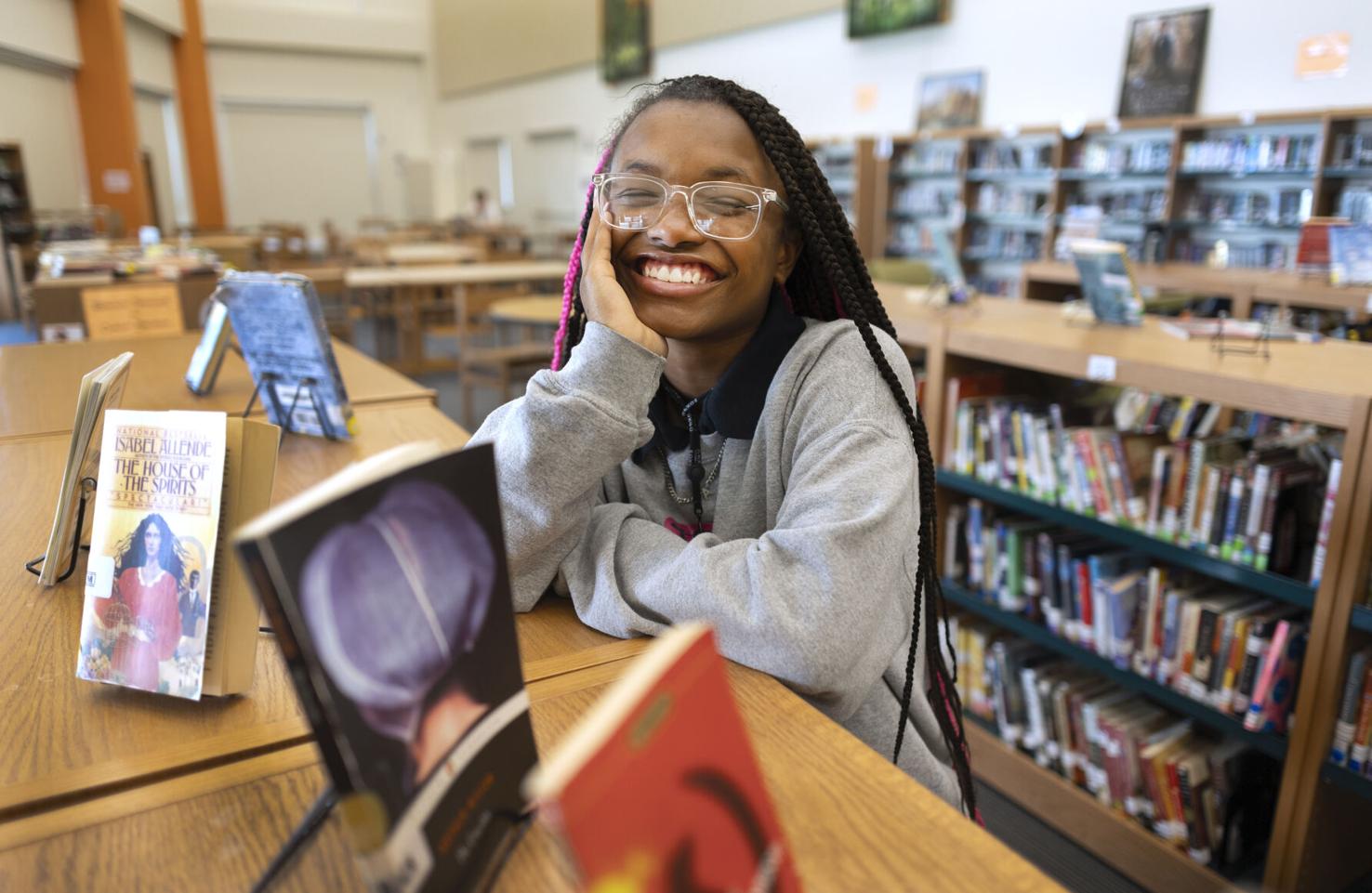
Photo: Chris Granger/Times-Picayune.
New Orleans 12th grader Dejah Grimes was part of a pilot program, soon to be expanded, that gives students $50 per week with no strings attached.

Paying kids to do something they should be doing anyway — for their own sake — does not always have the intended result. But I can see that to keep some teens in school, it might help. And for those who’d stay in school anyway, what a nice bonus!

Marie Fazio writes at the Times-Picayune, “Every Wednesday morning for nearly a year, Dejah Grimes woke up to a $50 deposit in her account, money she was free to spend however she chose.

“Most weeks she gave the card to her mom, who put it towards the water or electric bill. Occasionally she used it to go to the movies or the mall with her friends, or to pay for school expenses, including the recent purchase of a black polo shirt with the G. W. Carver school logo embroidered on the breast, a privilege reserved for seniors.

“ ‘It helped my family a lot,’ Grimes said. ‘It really made life easier.’

“Now, hundreds of other New Orleans teens are set to receive similar assistance as part of a groundbreaking study on the impact of providing young people with a ‘universal basic income,’ or recurring cash payments with no strings attached. 

“After promising preliminary findings and a $1 million investment from the city of New Orleans, a guaranteed income program that began with 20 students at The Rooted School in 2020 will expand this fall to 1,600 high school seniors at schools across the city over the next three years. Deemed the ‘$50 Study,’ the program gives students $50 per week and follows their academic and financial progress. It’s one of the first of its kind to study the impact of universal basic income on youth. 

“Researchers said that high schoolers over the past two years — 386 students from The Rooted School in New Orleans, The Rooted School Indianapolis and G. W. Carver High School — who received payments missed fewer days of school, showed more literacy growth and enjoyed more financial stability than their peers who did not receive money. …

“At the height of the pandemic in 2020, [Jonathan] Johnson, then executive director of Rooted New Orleans, noticed an alarming spike in absenteeism among his students, many of whom had to take on extra shifts at work to help their families make ends meet. 

“Hoping to alleviate some of the financial stress on students, they launched a ‘micropilot’ with 20 Rooted seniors, ten of whom received weekly payments. From 2022 to 2024, they expanded to a randomized control trial with 386 students over two cohorts.

“According to preliminary data, which has not yet been peer reviewed, students who were given the funds attended an average of two more school days per semester and their reading test scores grew by nearly double that of the control group. Researchers also found students who received the money demonstrated better ‘financial capability,’ a term used to refer to financial literacy and real-world application, and scored higher on tests measuring their financial well-being.

“Stacia West, who co-founded the Center for Guaranteed Income Research at University of Pennsylvania and acts as lead researcher for the $50 study, said the program can provide young people with valuable lessons, including how to navigate — or avoid — risky financial instruments such as payday loans and credit cards.

“ ‘The fact that these kids are able to interact with these financial markets so early,’ said West, who is also an associate professor at the University of Tennessee, ‘means they’re going to be better equipped when they get into their 20s to make better financial decisions.’

“Students in phase one of the study, which took place from 2022 to 2023, only used about half of cash assistance. About 47% of the money remains in the students’ bank accounts, suggesting many are saving.

“Of the money they did spend, about 50% went towards food and groceries, 30% to goods and services, 12% to transportation, 3% to healthcare and the rest to other expenses.

“Results from the second phase of the study, which followed 28 students from Rooted Indianapolis, 47 students from Rooted New Orleans and 155 students from G. W. Carver — a Collegiate Academy-run high school — will be published in the spring.

“Grimes, who participated in the second phase, said having the money helped her family with unexpected expenses, like food and travel purchases while out-of-town for her great-grandmother’s funeral. This summer, she used it to pay for Ubers back and forth to work as a camp counselor-in-training at Live Oak Camp. …

“Malik Williams, a junior at G. W. Carver, said he spent money on food and school supplies, including a pair of New Balance sneakers and a pair of headphones.

“New Orleans used to have a guaranteed basic income program aimed at young people ages 18-24 that was part of a national initiative called Mayors for Guaranteed Income. An effort to expand the program in December was not funded by the city council.

“Jeff Schwartz, Director of Economic Development at the City of New Orleans, said in a statement that the agency is ‘thrilled to be an investor’ in the $50 study. …

“West said that the Rooted School’s study is the first to track the impact of guaranteed income on young people. … ‘I think this could be a new way to think about educating and socializing our children financially.’ “

Not to mention relieving some of the stress that interferes with learning, I’d say. Financial literacy shouldn’t be the only goal. Staying in school, learning more, having a better shot at a good future as a result … what about that? I hope to track down the newer study once it’s completed.

More at the Times-Picayune (Nola.com), here.

Read Full Post »

Photo: Mark McGuinness.
Mark McGuinness, a photographer, said the income from Ireland’s government allowed him to devote two days a week to making work for exhibitions.

It’s hard to say which part of the story on Ireland’s experiment with guaranteed income for artists I love most, but “cross-party support” sure feels like heaven.

Alex Marshall reports at the New York Times, “Ian Fay had toiled for years to make it as a comic book artist and illustrator, and last fall, he was ready to call it a day.

“Fay, 32, who lives in Kilkenny in southern Ireland and specializes in drawing muscly superheroes, was only earning enough money to pay his bills, he recalled recently. He couldn’t afford vacations. He was considering boxing up his art supplies and getting a job in a grocery store.

“Then, in September, a lifeline appeared in his email inbox. A message from Ireland’s government said that Fay had been selected for a program guaranteeing 2,000 artists a basic income. For three years, participants — including musicians, novelists and circus performers — would be paid 16,900 euros a year, about $18,200, no strings attached.

“Fay stared at the email in disbelief. The payments — in weekly installments of €325 — would cover his rent, and lower his anxiety about making ends meet, he said. For the first time in years, he added, he would have ‘time to practice and develop my craft.’ …

“The Irish pilot project is the latest sign of growing international interest in universal basic income — when governments pay ‌their citizens, employed or not, a lump sum each month. Proponents of the idea, including antipoverty groups, left-wing politicians and libertarian organizations, say guaranteed income ensures a population’s sustenance and health better than other social welfare policies. Opponents say it’s simply giving the work-shy cash for nothing.

“In early experiments in Finland, California and Germany, people were paid regardless of their profession. But several pilots are now focused on cultural workers, who can spend months, or even years, on unpaid projects. Painters, dancers and musicians often rely on precarious, part-time jobs to fund their passions, and basic incomes are seen as a way to let them focus on artistic pursuits.

“Last year, in the United States, a privately funded initiative called Creatives Rebuild New York began giving 2,400 artists $1,000 a month. Similar programs are underway in San Francisco and Minnesota. But of these artist-focused efforts, Ireland’s stands out because it is government-run and involves rigorous analysis of the recipients’ finances, work patterns and well-being to gauge the handouts’ impact. The recipients’ livelihoods will be compared with those of 1,000 artists in a control group, who are not receiving any payments.

“Catherine Martin, Ireland’s culture minister — a trained singer and former street busker — said in a telephone interview that the idea for the policy emerged three years ago during the coronavirus pandemic. With Ireland’s music venues, theaters and museums shuttered, Martin commissioned a task force to explore how the government could help cultural workers survive. Its main recommendation was a basic income trial. …

The pilot, which has cross-party support, has a budget of €33.8 million a year — and that’s on top of the €130 million that Ireland spends on culture via the Arts Council, its main arts funding body.

“Applications opened last April for people working in the visual arts, theater, literature, music, dance, opera, movies, circuses and architecture. … The applicants had to submit two pieces of evidence to show they were genuine cultural workers, such as membership in a professional body, proof of income from art sales or newspaper reviews. Martin said the government didn’t consider the quality of the applicants’ work.

“More than 9,000 people applied, with 8,200 deemed eligible. From that pool, 2,000 were randomly selected to receive payments and 1,000 for the control group. …

“Lydia Mulvey, 47, a screenwriter, said that she quit her job in a telecommunications firm as soon as she heard she’d made it into the program. Now she spends her time writing pilot scripts for thrillers and sci-fi shows, rather than trying to squeeze that into evenings and weekends. ‘I knew it’d be transformative and give me my life back,’ Mulvey said, although she added that, if she didn’t already own her own home, she’d struggle to live on such a low income, especially in Ireland’s squeezed property market.

“Mark McGuinness, 31, a photographer, said that before receiving the basic income he had spent the whole week seeking commercial photography work to pay his rent and the cost of supplies, and had let his artistic practice slip away. Now, he’d ‘clawed back’ two days a week to make work for exhibitions, he said. …

“Ireland’s government is sending recipients questionnaires every six months that ask about the state of their finances, artistic career and health. … Last year, those taking part received a survey to collect baseline data. It asked if they could adequately heat their homes, replace worn furniture or ‘afford a meal with meat, chicken or fish every second day.’ …

“Aengus Ó Snodaigh, a spokesman on cultural issues for the opposition Sinn Fein party, which supports the program, said he wanted data long before the trial concluded so artists didn’t face a ‘cliff edge’ at the end. He added that he had many questions about the program, including whether payments benefited early-career artists more than established names, and whether the handouts were having unintended consequences, like causing tensions in rock bands if some members were selected, but others weren’t.

“ ‘Maybe the money would be better spent on hardship funds for artists who can prove they can’t afford the mortgage, or can’t rent a studio,’ Ó Snodaigh said.

“Few recipients are taking the windfall for granted. Mulvey, the screenwriter, said she’d recently met television companies about developing shows, and was often working long into the night. ‘I keep reminding myself that three years is a really short time, and we’ve already had six months,’ she said, adding that she wanted to make sure ‘I don’t have to go back to a day job when this stops.’ ”

More at the Times, here.

Read Full Post »

Photo: Pekka Sipola/EPA
Finland is experimenting with a guaranteed income.

Recently I posted about a guaranteed-income pilot program in Kenya that MIT’s rigorously data-driven Abdul Latif Jameel Poverty Action Lab (J-PAL) will be evaluating over the next few years.

Now I see that Finland is testing the concept, too.

Aditya Chakrabortty wrote about Finland’s experiment last month at the Guardian. “In a speck of a village deep in the Finnish countryside, a man gets money for free. Each month, almost €560 [about $660] is dropped into his bank account, with no strings attached. The cash is his to use as he wants. Who is his benefactor? The Helsinki government.”

Juha Järvinen “is a human lab rat in an experiment that could help to shape the future of the west. Last Christmas, Järvinen was selected by the state as one of 2,000 unemployed people for a trial of universal basic income [UBI]. …

“Finland is the first European country to launch a major dry run. It is not the purists’ UBI – which would give everyone, even billionaires, a monthly sum. Nor will Finland publish any results until the two-year pilot is over at the end of 2018. …

“Ask Järvinen what difference money for nothing has made to his life, and you are marched over to his workshop. Inside is film-making equipment, a blackboard on which is scrawled plans for an artists’ version of Airbnb, and an entire little room where he makes shaman drums that sell for up to €900. All this while helping to bring up six children. All those free euros have driven him to work harder than ever.”

Even more than the money, the freedom from the country’s welfare bureaucracy is key.

“In Finland, €560 is less than a fifth of average private-sector income. … [Järvinen’s] liberation came in the lack of conditions attached to the money. If they so wish, Finns on UBI can bank the cash and do nothing else. But, in Järvinen’s case at least, the sum has removed the fear of utter destitution, freeing him to do work he finds meaningful. …

“Social affairs minister Pirkko Mattila … seems genuinely bemused that there could be any political resistance to handing poor people some money to sit at home. ‘I personally believe that in Finland citizens really want to work,’ she says.”

More at the Guardian, here.

Read Full Post »

Photo: Nichole Sobecki for NPR
This Kenyan hamlet is participating in a cash-distribution experiment. The nonprofit GiveDirectly will give $22 a month for 12 years to people in 200 such villages and compare the results with 100 other Kenyan villages.

MIT-based Abdul Latif Jameel Poverty Action Lab (J-PAL) has been working on poverty alleviation for many years now. The nonprofit describes itself as “a network of 145 affiliated professors from 49 universities. Our mission is to reduce poverty by ensuring that policy is informed by scientific evidence.”

A long-term experiment providing Kenyans with a guaranteed income was recently described at National Public Radio. The story caught my attention because my former colleague Erin has been proposing a guaranteed-income approach for years.

NPR’s Nurith Aizenman explains.

“Young guys in dusty polo shirts. New moms holding their babies. Grandmas in bright head wraps. They’ve all gathered in a clearing for one of the village meetings when something remarkable happens. Practically every person’s cellphone starts tinkling.

“It’s a text alert from an American charity called GiveDirectly. Last fall, GiveDirectly announced that it will give every adult in this impoverished village in Kenya an extra $22 each month for the next 12 years — with no strings attached. The money is wired to bank accounts linked to each villager’s phone. The alert is the signal that the latest payment has posted. Everyone starts cheering. Some of the younger women break into song.

“The payouts are part of a grand and unprecedented experiment that is motivated by an equally sweeping question: What if our entire approach to helping the world’s poorest people is fundamentally flawed?

“Today practically all aid is given as ‘in-kind’ donations — whether that’s food, an asset like a cow, job training or schoolbooks. And this means that, in effect, it’s the providers of aid — governments, donor organizations, even private individuals donating to a charity — who decide what poor people need most. But what if you just gave poor people cash with no strings attached? Let them decide how best to use it?

“GiveDirectly has actually been advocating for this kind of cash aid for the past decade. Founded by four grad students in economics who wanted to challenge traditional aid, the charity has already given $65 million to people across Kenya, Rwanda and Uganda, provided by a mix of Silicon Valley foundations and ordinary citizens who contribute through GiveDirectly’s website. And

GiveDirectly has shown through rigorous, independent study that people don’t waste the money.

“Still, those cash grants were relatively modest one-time payouts. With this experiment, GiveDirectly wants to see what happens when you give extremely poor people a much longer runway — a guaranteed ‘basic income’ they can count on for years.

“Michael Faye, the chairman of GiveDirectly, says they’ve chosen to set the payment at $22 because in Kenya $22 per person per month is ‘the food poverty line — the amount of money it would take to afford a basic basket of food for yourself.’

“This hamlet near Lake Victoria — about 400 residents living on less than $2 a day in mud-brick huts with no running water — is just the beginning. [This] fall, GiveDirectly wants to extend the monthly payments to every adult in 200 similar villages across Kenya, then compare them to 100 ‘control’ villages that don’t get the cash. To do this they need $30 million, of which they’ve raised $25 million.

“Some of the world’s foremost researchers of anti-poverty strategies will be doing an independent study of the data that emerges — including Alan Krueger, professor of economics at Princeton University, and Abhijit Banerjee, a professor of economics at MIT and director of the Abdul Latif Jameel Poverty Action Lab. …

” ‘Let them make the choices,’ says [Michael Faye, the chairman of GiveDirectly]. ‘Because the poor are pretty good at making them.’ ”

At NPR, here, there’s a lot more detail, plus interviews with a couple recipients.

Read Full Post »