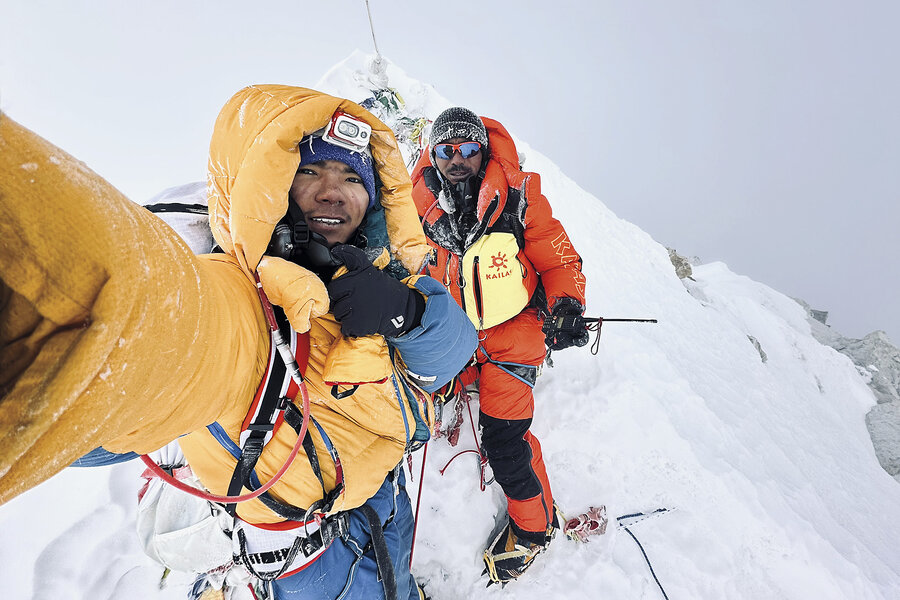
Photo: Nima Rinji Sherpa.
This sherpa “aims to inspire more young people to break away from the Sherpa tradition of serving only as helpers on expeditions,” says the Monitor.
It reassures me about the world when I see young people deciding on new paths and leading the way. In today’s story, we learn about a young Nepalese sherpa who wants to help young people like him to start climbing on their own terms.
Reporting from Kathmandu, the Christian Science Monitor‘s Aakash Hassan, writes, “On a bright afternoon, Nima Rinji Sherpa’s stroll down a crowded Kathmandu street is frequently interrupted by people coming to greet him. Some give him a warm pat on the back. As he joins friends for lunch at a pizzeria, its owner rushes to embrace him, gushing, ‘You are making us proud, Nima.’ …
“In October 2024, at age 18, he became the youngest person to summit the world’s 14 mountains higher than 8,000 meters (26,247 feet). Apart from Nepal, these mountains are in Pakistan, China, and India.
“Mr. Rinji hails from a family of Sherpas, an ethnic Tibetan tribe living in Nepal whose people are pioneers in mountaineering. For generations, they have been highly sought-after guides and porters for international clients making the world’s most difficult climbs. …
“He is seen as a trailblazer who is pursuing climbing as a professional mountaineering athlete and who aims to inspire more young people to break away from the Sherpa tradition of serving only as helpers on expeditions. …
“Mr. Rinji’s father, Tashi Lakpa Sherpa, has summited Mount Everest nine times; at age 19, he became the youngest person to summit Everest without additional oxygen. …
“Mr. Rinji nevertheless showed no interest in climbing in his early teenage days. But in 2020, during the lockdown imposed for the COVID-19 pandemic, he developed an interest in photography and eventually followed his father up mountains with the hope of capturing scenic photos and videos.
“On the first trek, Mr. Rinji says, he surprised his father by matching his pace and kept following him in the coming weeks on more trails, awestruck by the ‘beautiful and overwhelming’ mountains. Soon, Mr. Rinji was part of his father’s training sessions for professional climbers and was determined to summit the Himalayas.
“In September 2022, a few months after Mr. Rinji turned 16 – Nepal’s legal age for climbing – he was part of an expedition to Mount Manaslu, the world’s eighth-highest mountain at 8,163 meters. There Mr. Rinji had firsthand experience of the challenges climbers face and of how tirelessly Sherpas work for their clients.
“Out of 500 people who were at the base camp preparing to summit that season, he says, only about 100 achieved the feat. Twenty people were caught in avalanches and had to be rescued. …
“ ‘I think I was one of the last people to summit. Then it clicked,’ he says with a smile and some pride showing on his face.
“After that, he kept summiting one after another ‘eight-thousanders.’ …
“It was during his 14-peaks expedition spread over the span of two years that Mr. Rinji realized the extraordinary, underrecognized work of Sherpas. …
” ‘It’s our duty to vocalize ourselves, to take credit for who we are.’
“Making his own case as an example, he says he didn’t receive support from any major sponsors for his 14-peaks expedition and had to rely on the resources of his family. …
“Mr. Rinji has been meeting with young Sherpas who work as guides – or aspire to be guides – to motivate them to see themselves as athletes. He visits schools, addresses public events, and posts on social media about the need for young Nepalese to be ‘leaders’ in climbing.
“With the help of his father’s expedition company, he provides free courses, or charges a nominal fee, to train young people who want to become athletes. …
“Mr. Lakpa is proud of his son not only for what he has achieved but also because ‘he is working for himself.’
“Lakpa Temba, a Sherpa who works for an expedition company in Kathmandu, says Mr. Rinji is broadening the employment horizons for Sherpas. ‘Nima is showing us a middle path,’ he says, ‘where you are climbing mountains for yourself, on your own terms.’
“Veteran Sherpas also believe that having more people from Nepal become athletes in climbing will bring new attention and opportunities for Sherpas. And it could attract more people to Nepal, a poor country that relies on tourism.”
More at the Monitor, here.


 Suzanne's Mom's Blog