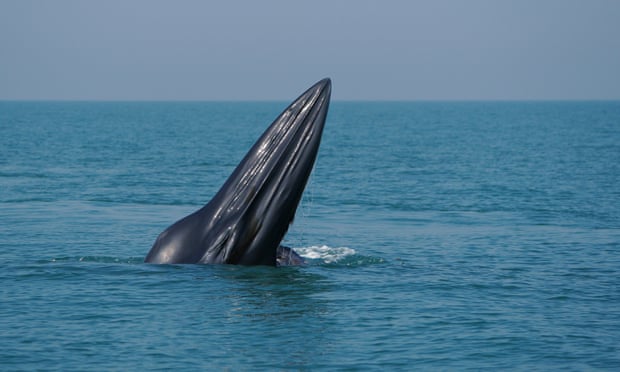
This is a Bryde’s whale, related to the newly described whale species called Rice’s whales. Rice’s whales were previously believed to be a population of Bryde’s but were recently found to be a whole new species.
Lately, I’ve noticed how many mainstream publications reuse stories from other publications, which helps me feel less guilty sharing others’ work at Suzanne’s Mom’s Blog. As a former magazine editor myself, I am pretty scrupulous about providing links and credits and not using the whole original piece.
And if the use of a photo is blocked, I try to find a different photo elsewhere. But I must say that blocking your photo reduces the number of ways people online can find your article.
In an article from Hakai magazine (an online publication about science and society in coastal ecosystems), Joshua Rapp Learn reported on a unique whale. I learned about it from a reprint at the Guardian.
“Genetic analysis and a close examination of the skulls from a group of baleen whales in the north-eastern Gulf of Mexico have revealed that they are a new species.
“ ‘I was surprised that there could be an unrecognized species of whale out there, especially in our backyard,’ says Lynsey Wilcox, a geneticist with the US National Oceanic and Atmospheric Administration who helped uncover the new species. ‘I never imagined I would be describing a new species in my career, so it is a very exciting discovery.’
“The newly described whales weren’t exactly hiding in plain sight. With a population estimated at fewer than 100, the new whales – which researchers have dubbed Rice’s whales after American biologist Dale Rice – aren’t commonly seen even in the corner of the Gulf of Mexico they call home. It doesn’t help that the whales, previously believed to be a population of Bryde’s whales, have a feeding strategy that takes them deep under the water around DeSoto Canyon, about 100km south of Mobile, Alabama.
“Researchers have long known that this group of Bryde’s-like whales in the Gulf of Mexico was different. They seemed to mostly stay put in the north-eastern corner of the gulf, and didn’t mingle with Bryde’s whales, which … typically forage near the surface.
“But it’s difficult even for experts to tell large baleen whales apart in the field – so much so that Bryde’s whales sometimes get confused with fin whales, says John Hildebrand, a biological oceanographer at Scripps Institution of Oceanography at the University of California San Diego who was not involved in the recent study. …
“Wilcox’s colleagues first began collecting tissue samples from Rice’s whales in 2000, eventually collecting samples from 36 different individuals.
Comparing their genes with Bryde’s whales, Wilcox says she and her colleagues ‘noticed that they weren’t quite what was expected.’
“To compare their morphologies, the scientists inspected skeletons held in museums. Then, in January 2019, an 11-meter-long Rice’s whale washed up on a key in the Florida Everglades. Examining the whales’ skulls revealed some differences in the shape and size of the bone material around the blowhole. …
“Rice’s whales are already considered endangered by the United States. They were listed under the Endangered Species Act as a population of Bryde’s whales in April 2019, and the discovery that they are a distinct species is unlikely to change much – other than requiring an update of their name. Living in the Gulf of Mexico, the whales face threats from oil spills, ship strikes, ocean noise and entanglement in fishing gear.
“Hildebrand says the whales are particularly vulnerable to ship strikes because they have the ‘unfortunate habit’ of sleeping at night just under the sea’s surface. … Hildebrand speculates that the whales might once have been more widespread in areas with deeper water, but they are now holing up in an area that sees less ship traffic.
“ ‘They are the most endangered, or nearly the most endangered, baleen whales in US waters,’ Hildebrand says. ‘In terms of the responsibility for the health of the whale, it really does fall on us.’ ”
Read some really wonderful stories about sea life at hakaimagazine.com.


 Suzanne's Mom's Blog