Feeds:
Posts
Comments

Posts Tagged ‘Haitian Creole’

Photo: Suzanne Kreiter/Globe Staff.
Johendy De La Cruz Arias (right), a senior at Margarita Muniz Academy, looked up at his father Jonathan Arias, who he said was the driving force behind his decision to earn the Seal of Biliteracy at Boston Public Schools.

There was a time when US schools try to force students to stop using their native tongue and focus on English. Other countries did the same to push the dominant language.

But how much better to celebrate having two languages! If nothing else, it’s a clearly marketable skill.

‘A new language develops a new cognitive system in your brain,’

Thai Theodoro writes at the Boston Globe, “A record number of Boston students were recognized this year for speaking two or more languages, a milestone that includes both English native speakers learning a second language and immigrant children, mostly Spanish speakers, learning English. ..

“ ‘A new language develops a new cognitive system in your brain,’ said Cecilia Soriano, director of development at the Margarita Muñiz Academy. ‘You’re twice as able to deal with things because you’ve got two systems up in your brain that are able to help you understand the world around you.’

“For Johendy De La Cruz Arias, a senior at Margarita Muñiz Academy, his Dominican father was the driving force behind his decision to earn a Seal of Biliteracy.

“De La Cruz Arias is a second-generation immigrant from the Dominican Republic, and will attend Simmons University, becoming the first in his family to attend college. When he started schooling, he didn’t speak English.

“But I kept learning it, practicing with my dad and my brothers at the house,” he said. ‘[Dad] brought us here for a better future, and I feel proud of myself that I’m making his wish come true.’

“Most recent data, from 2024, shows English learners accounted for 21 percent of Massachusetts seal recipients, according to the 2024 National Seal of Biliteracy Report for 2022-2023 Academic Year.

“To earn a Seal of Biliteracy, students must meet local graduation requirements, demonstrate proficiency in English by meeting state standards on the English Language Arts Massachusetts Comprehensive Assessment System, and satisfy world language proficiency requirements through a state-approved assessment.

“Manicka Fils-Aime, a senior at New Mission High School who was born in Haiti, achieved a seal in Haitian Creole and English.

“ ‘Achieving the seal means that I’m capable of making something good of myself,’ said Fils-Aime.

“The growth in the number of multilingual students also follows Boston Public Schools’ adoption of MassCore in 2021, which established world language coursework as part of the district’s graduation requirements for the class of 2026, and beyond. …

“Spanish accounted for the largest share of Seal of Biliteracy recipients this year, with 327 certified students. Chinese followed with 37 recipients, while Haitian Creole and Portuguese were nearly tied with 30 and 29 recipients, respectively.

“When immigrant children study their home language at school, they feel more connected, perform better academically and are more likely to graduate, said Maria Carreira, executive director of the American Association of Teachers of Spanish and Portuguese.

“ ‘All of this contributes to students who are ultimately better prepared to participate in what is an increasingly diverse society with different people in the United States and across the world,’ Carreira said.

“At New Mission High School in Hyde Park, the majority of the 42 students who earned a Seal of Biliteracy did so in their native, non-English language, said Karen Loughran, the co-head of the school.

“Most of the seals were from students who speak Spanish and Haitian Creole, with some Somali, Portuguese, Vietnamese, French, and Russian.

” ‘Our students are starting to feel pride in themselves every day,’ said Kareem Cutler, co-head of the school. ‘Our community as a whole comes around these students to support them, celebrate them, help them acknowledge the importance of getting the Seal of Biliteracy.’ “

More at the Globe, here. Older people are learning (almost too late) that being bilingual is good for their brains, too. I hope it’s not too late! I’m trying to learn Swedish.
Read Full Post »

Photo: Victoria Onélien/Special to the Christian Science Monitor.
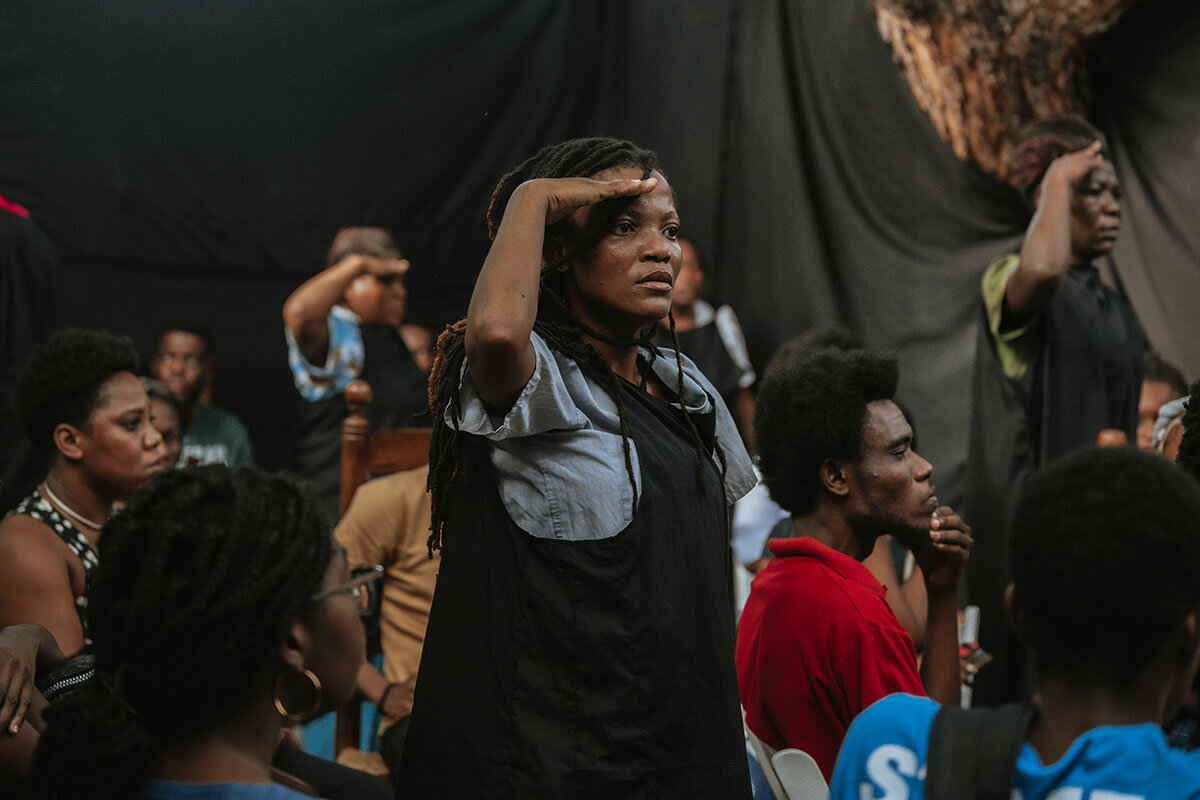
An immersive experience, “Dechouke Lanfè sou Latè” is performed within the audience and features formerly incarcerated women as well as actors to bring home the brutal reality of Haitian prisons. The Quatre Chemins theater festival took place in Port-au-Prince, Haiti, from Nov. 21 to Dec. 3, 2022.

Man, the resilience of the human spirit! Or maybe it’s stubbornness, not resilience. Doesn’t matter. Let us now praise whatever keeps people going in impossible circumstances. In Haiti. for example.

Websder Corneille reports at the Christian Science Monitor, “On a sunny afternoon, some 60 people gather in the small courtyard of Yanvalou Café, the unofficial home of Haiti’s theater scene. It’s the opening of the 19th annual Quatre Chemins (Four Paths) theater festival, but the fact that there’s a full house was never a given.

“For the past three years, Port-au-Prince, Haiti’s capital, has been overrun by criminal gangs. They’ve increasingly terrorized citizens, … blocking freedom of movement since the assassination of President Jovenel Moïse in July 2021. Many citizens have fled their homes in recent months, seeking safety elsewhere – in some cases camping out in public parks because their neighborhoods have become so dangerous.

“ ‘This city is scary these days,’ says Évens Dossous, an educator who came to see the reading of ‘Port-au-Prince et sa Douce Nuit (Port-au-Prince and Its Sweet Night),’ a new play by award-winning Haitian playwright Gaëlle Bien-Aimé. Before leaving home this afternoon, ‘I asked myself, “Is it really worth traveling? Will I be kidnapped?” ‘

“Art, and specifically theater, have a rich history of political resistance in Haiti. Although the unprecedented climate of insecurity has more to do with a vacuum of leadership – there have been no elections since 2016 – than with the overt oppression and censorship that citizens faced under dictatorships in the past, the crowd at Yanvalou today is a reminder that theater remains an act of defiance.

“ ‘You know, life can’t just be about insecurity,’ says Mr. Dossous.

“Colorful murals of well-known artists and thinkers cover the cement walls at Yanvalou, including singer Nina Simone, Haitian dancer Viviane Gauthier, and national anthropologist Jean Price-Mars. The audience at the opening in November makes its way from the courtyard into the restaurant, where chairs are set up facing two lecterns.

“The reading focuses on the lives of two young people, madly in love, in a home in Pacot, a wooded, formerly upscale neighborhood in the heart of Port-au-Prince. It underscores many real-life challenges, like the fragile state of the capital and the difficulty of leaving the house to get food, travel, or go to school or work. But it also dives into bigger questions, such as how to love – oneself and others – when a city is collapsing around you.

“ ‘Theater helps me ask questions about my life,’ says Ms. Bien-Aimé, the playwright, who was the second Haitian in a row to win the prestigious RFI Theatre prize, awarded to emerging Francophone artists. Theater ‘is a living art,’ she says.

“Since the assassination of President Moïse, armed gangs have taken control of some 70% of the capital. … Some 20,000 Haitians are facing starvation, according to the United Nations, the vast majority of whom are located in the capital.

“The insecurity, which includes using sexual violence as a weapon, has led to widespread displacement. Kidnappings increased by nearly 45% in Port-au-Prince in the second quarter of 2022, according to the National Network for the Defense of Human Rights, a Haitian nongovernmental organization. Many believe the gangs are protected by police, politicians, and business elite.

“ ‘The state has agreed to retreat so that armed groups can control the society,’ says Sabine Lamour, a Haitian sociologist at the State University of Haiti, citing research by Haiti’s leading human rights organization, the National Human Rights Defense Network. …

“Micaëlle Charles, the actor reading the lead role of Zily in today’s play, says a lot has changed in Haitian theater over the past three years. She and the entire team putting on today’s show take security precautions she never considered before, such as sleeping over at the rehearsal space. ‘This helps me to hold on, despite the problems in the country or any other problems life might throw my way,’ she says of her passion for the craft. …

“Using theater for social or political commentary isn’t unique to Haiti, but it has a long tradition here. Theater is ‘a weapon of mass awareness that gives the spectator the means to free themselves,’ wrote Félix Morisseau-Leroy in 1955. He was one of the nation’s first writers to create plays in Haitian Creole. Under the Duvalier regime, a father-son dictatorship that ruled Haiti for three decades starting in 1957, Mr. Morisseau-Leroy and others were targeted and exiled for their social commentary and what was perceived as anti-government messages in plays and literature.

“The Duvalier reign was characterized by violence and the suppression of free expression. One of Mr. Morisseau-Leroy’s most prominent works was his Haitian Creole translation of the Greek tragedy ‘Antigone.’ … It was an act of resistance for its message – and its use of the language of the masses. …

“Joubert Satyre, an expert on Haitian theater, told the Christian Science Monitor [that] theater in Haiti plays an important role in social and political struggles. He said, ‘It is this liberating and critical side of the theater that has made it, and that still makes it, suspect in the eyes of autocrats.’ 

“Not that the government is paying much attention to the arts in recent years, says Ms. Bien-Aimé. She’s firmly engaged in a ‘theater of protest,’ she says, but isn’t sure her artwork frightens the government as much as her outright activism. … ‘Today, the state doesn’t even go to the theater,’ she says.”

More at the Monitor, here. No firewall.

Meanwhile, in war-torn Ukraine, theater has gone into living rooms. See a New Yorker story about that.

Read Full Post »