Feeds:
Posts
Comments

Posts Tagged ‘handcraft’

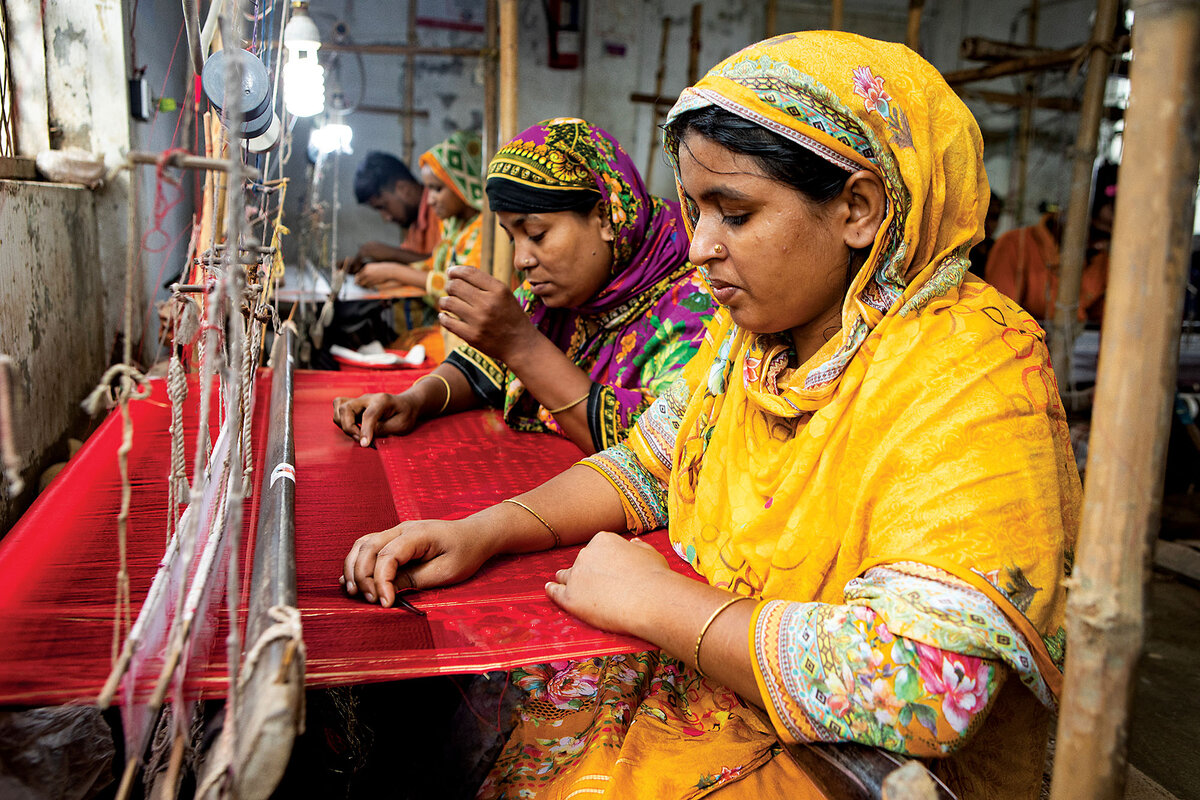
Photo: Melanie Stetson Freeman/CSM Staff.
Artisans do “respectful” work on jamdanis at Abul Kalam Jamdani Weaving Factory in Bangladesh.

Recently I wrote about the the Fuller Craft Museum’s exhibit of the Red Dress, an embroidered garment “worked on by 380 individuals from 51 countries, mostly female, many of whom were vulnerable and living in poverty” — women who felt uplifted by an art project that honored their skills.

Today’s post is also about women’s handcrafts.

Sara Miller Llana reports at the Christian Science Monitor, “Two dozen artisans crouch over hand looms threaded with bright-orange and sky-blue cottons. Their fingers nimbly create a jamdani, an intricately woven sari dating back to the [16th century] Mughal Empire. …

“Made of fine cotton or silk, the jamdani was a pinnacle of fashion centuries ago. But in the 19th century, British colonizers brought in their iteration of fast fashion, and the tradition nearly went extinct. …

“After Bangladesh became an independent nation in 1971, the nongovernmental organization BRAC set out to revitalize the weaving practice. It approached artisan families like that of Anwar Islam, owner of this shop. ‘I didn’t think it was feasible, but I was happy to be part of the solution,’ says Mr. Islam. 

“Today he employs 120 weavers at Abul Kalam Jamdani Weaving Factory. …

“But this is not just a business success story. … The jamdani is seen as a story of cultural success, too. It’s part of the championing and preservation of objects from sealskin parkas in the Arctic to duck decoys and quilts across the United States that otherwise may be forgotten.

” ‘People have been striving to decorate their lives to tell the world who they are for centuries,’ says Chris Gorman, a deputy director of the American Folk Art Museum in New York. … ‘Without people championing the study and preservation of objects like these, and others, there is the possibility that people will simply forget about them, and it is hard to revive them or prove their relevance.’

“About the time the jamdani was being revived, a women’s collective was coming to life at the northernmost tip of Canada, in the town of Taloyoak.  

“Begun in 1972, the group, called Arnaqarvik, garnered a burst of fame in its day with its Inuit parkas, mitts, and boots made from caribou, wolf, and seal and patterned with dyes from tundra lichen and flowers. The collective’s work — including, eventually, duffel-wool ‘packing dolls, or miniature stuffed animals carrying their babies in parkas as the Inuit do — was showcased in New York City and the 1974 Arctic Winter Games in Alaska.

“Yet today, just as the jamdani is enjoying global appeal, the work of Arnaqarvik has been largely forgotten. So the Kitikmeot Heritage Society in Cambridge Bay, in Canada’s Nunavut territory, has set out to restore its memory in a digital archive. 

“And to mark the 50th anniversary of the collective, about 250 items in 2021 were sent back to Taloyoak in an exhibition. It was the first time most in the community found out what Arnaqarvik even was. ‘Everybody was really surprised by what their parents did in those days,’ says Arnaoyok Alookee, Arnaqarvik’s co-founder.

“Brendan Griebel, an Arctic anthropologist and manager of collections and archives for the Kitikmeot Heritage Society, says this reconnection is about far more than just the production of goods. ‘Having that physical contact ignites something in the memory and in the senses,’ he says.

“When Arnaqarvik began, the semi-nomadic Inuit of Taloyoak had only gradually moved into this permanent settlement the decade prior. The collective helped the community bridge a gap — between its Indigenous traditions and the new wage economy into which it was settling. 

“Judy McGrath co-founded the collective with Ms. Alookee when her husband was posted for work in the Arctic community. She says she still recalls the sense of purpose that craft-making gave all of them. They collected flowers with their children in 24-hour sunlight; they’d use the 24-hour darkness of winter to boil their dyes on the stove. ‘I can still feel the confidence that the skills they had mattered, and the excitement over making new things from the old, from the land,’ Ms. McGrath says.

“In Bangladesh, the rise of the jamdani was also driven by economics, to help artisans whose enormous skills couldn’t find the market for livelihoods. BRAC, the country’s largest NGO, created the brand Aarong to distribute their products. …

“Making a jamdani, which derives from the Persian words jam (floral) and dani (vase), is what weaver Mohammed Monir calls a ‘respectful’ job. … ‘When I see someone famous wearing something I made, I feel proud,’ he adds.

“Today jamdani weaving is included on UNESCO’s Representative List of the Intangible Cultural Heritage of Humanity.”

More at the Monitor, here. No firewall. Reasonable subscription. You can also sign up for their free weekend updates.
Read Full Post »

b9d3c5a3-c5af-4fc9-a347-357b11076000

Photo: Anonymous twitter user
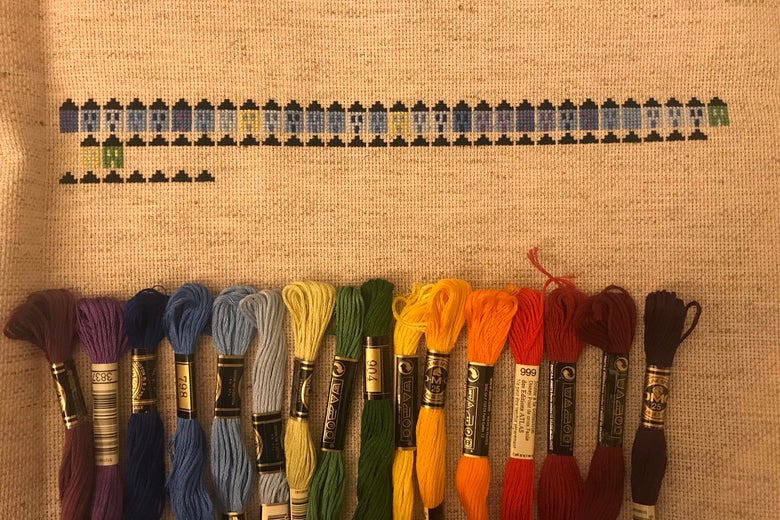
An embroidered “village” of temperatures, inspired by Nathalie Cichon. Handcrafters aren’t about to look away from the reality.

Every day I think about a blogger I know who had to step back from WordPress due to illness in the family. She wrote the most beautiful posts and commented thoughtfully on the posts of others. And because she was a weaver, quilter, and broadminded thinker, among other things, I know she would have liked this story about people using their handcrafts in a cause. Perhaps I will email her the link.

Rebecca Onion writes at “Future Tense,” a feature of Slate magazine, “As January became February, I noticed that green shoots from the daffodils in my front yard in Ohio were already poking above the ground. On Sunday, writer Josie George shared a photo on Twitter of a scarf she had been knitting, with a daily row for the temperature and weather in her town.

‘It felt like a good way to engage with the changing climate and with the changing year,’ she wrote. ‘A way to notice and not look away.’

“In response to George’s viral Tweet, a number of knitters, cross-stitchers, and quilters shared their own projects. The idea of a temperature scarf, it turns out, is at least a half a decade old, and a whole lot of people are trying to chart the ‘new normal’ in yarn.

“In 2015, Joan Sheldon, a marine scientist, knit a scarf depicting global average temperatures from the 1600s to the present. Last year, the St. Paul Star Tribune covered a knit-along called Weather or Knot, conducted by one of the city’s yarn stores, that asked knitters to make a temperature blanket or scarf; that knit-along was inspired by the Tempestry Project, a group founded in Washington state in 2017, that now has chapters across the country. Climate crafting, it seems, has come into its own. …

“The image at the top of this article is the work of a cross-stitcher from France, who is making a little ‘village’ of houses with the low temperature of the day stitched on the door and windows and the high temperature on the walls. She said via email that she started her project after seeing the idea discussed on a Facebook fan group for the French cross-stitch designer Nathalie Cichon. …

‘ I pictured my project as a personal memo of the temperatures of 2020,’ she said over email. ‘However, the further I go the more I can see the impact it can have. I am angry and sad every time I have to stitch a house with a color that shouldn’t be there. …

“I spoke with Fran Sharp, a quilter from Massachusetts who had begun work on a temperature quilt without quite knowing how many other people were carrying out similar projects. … When I shared George’s thread with Sharp, she was full of new ideas. ‘This got me thinking about all the different things one could portray,’ she said. ‘I made a list. Temperature extremes, effects on animal life, food production.’ …

“The knitter, quilter, or cross-stitcher who works on a climate-related design can make interesting design choices that force deep interaction with the data. The Weather or Knot design, for example, featured different colors for absolute temperatures, and varied stitches that reflected whether the day’s temperature was above or below the average. …

“Katharine Schwab pointed out in a Fast Company piece, knitting has long been recognized as conveying mental health benefits. But there’s more to this particular kind of craftivism than self-care. The act of crafting [is], itself, a sort of protest against the industrial world that gave us climate change in the first place. ‘Crafting creates slow space, a speed at odds with the imperative toward hyperproduction,’ Jack Bratich and Heidi Brush write in a history of crafting and activism. …

“These projects also play with the idea of ‘steganography’— the concealment of secret information in plain sight. … The history of fiber and textile art is full of steganography, real, fictional, or anecdotal: Madame Defarge of Dickens’ A Tale of Two Cities, knitting a list of people to be guillotined; the Belgian resistance during WWII, recruiting women whose windows were located over train yards to knit patterns of the trains’ arrivals and departures; enslaved women sewing codes into quilts that helped people navigate the Underground Railroad.” More.

“Future Tense” is a partnership of Slate, New America, and Arizona State University that examines emerging technologies, public policy, and society.

Hat Tip: ArtsJournal

Read Full Post »

Photo: Wikimedia Commons
Sari weaving at Kanchipuram — a city in the Indian state of Tamil Nadu.

One Instagram account I follow is The_Deepaks, which today posted a video about silk weaving that fascinated me. Instagram doesn’t make it easy to share posts, so I hunted around YouTube until I found another video on silk weaving.

The text accompanying the YouTube video is not in perfect English but is worth reprinting. “The saree is an unstitched garment worn by the women India, that reflects the vast aesthetics to suit a women’s need for adornment and cultural identity. It is a traditional wear across India of different styles depending on the region and occasion. Silk sarees (Pattu sarees) are renowned for their intricate work and adds value through Zari work which is considered to be special.

“These are characterized by huge contrast border offers an ethnic look along with appealing color combination, made through the inclusion of checks of varied colors and geometric patterns. Fine stripes as well as checks in both horizontal and vertical manner add to the relish of the fabric. Traditional motifs found are peacock and parrot with colors in mustard, brick red and black.”

Other videos I found bemoaned the dying art of silk weaving. It’s really unfortunate that the sari weavers, inevitably competing with machines, can no longer make a living doing the work by hand.

I wonder if some of them could earn a living teaching Westerners who appreciate handcrafts. I could imagine tour buses full of people coming for courses by skilled craftsmen and craftswomen.

More at Wikipedia, here.

Video: Dsource Ekalpa India


Read Full Post »

My friend and former colleague Mary Ann acquires, edits, and designs lovely craft books for Quarry. Today on Facebook, she linked to this article by one of her authors, Los Angeles Times writer Jeannine Stein.

Jeannine has published two craft books on making your own books: Re-Bound: Creating Handmade Books from Recycled and Repurposed Materials and, this year, Adventures in Bookbinding: Handcrafting Mixed-Media Books. This quote from Stein’s LA Times article gives you an idea of how she thinks about these projects.

“As I learned more complicated traditional bindings, I also gravitated toward unorthodox materials such as 19th century photographs, old quilts, cereal boxes and vintage record albums. My fascination with these materials was really born from books. Reading Laura Ingalls Wilder books made me crazy for worn, faded quilts, calico fabric and rough, unbleached cotton and linen that to this day inform my work. I cannot go to a flea market or thrift store without pawing through every basket of vintage linens, and I have a vast collection of 19th century tin types, carte de visite photographs and cabinet cards that inevitably become book covers or embellishments.”

By chance, my friend Kristina, who is an artist and teaches after-school art classes in her studio, is deep into planning student projects for the coming school year, with a focus on the art of books and bookmaking. I like making connections in general, and in particular, I have been passing leads to Kristina from Mary Ann. And while I was at it, I also promoted Quarry Books to the owner of Dabblers, a craft shop in Concord.

Read Full Post »