Feeds:
Posts
Comments

Posts Tagged ‘hedge fund’

Photo: NiemanLab.
A late private equity bid to disrupt the sale of the Dallas Morning News to Hearst was foiled by a fourth-generation newspaper owner turning down more money.

Some days journalism and free speech seem threatened on every hand. Whether its officials trying to control what is said or hedge funds buying up newspapers to wring them dry, a girl could get depressed.

Today’s story is about how one newspaper escaped disaster at the eleventh hour.

Joshua Benton at NiemanLab gives his views on what happened. As a former employee of the paper he’s writing about, he gets pretty worked up, but his take is interesting. It reminds me that not all shareholders are greedy. It also reminds that usually they are.

“By now, it’s a familiar move to watchers of Alden Global Capital, the ravenous hedge fund with the unusual hobby of sucking the lifeblood out of newspapers.

“See, Alden likes to wait until a newspaper merger or acquisition is juuuuust about consummated. Then, right before the final papers get signed, it swoops in with a late bid that promises the seller a bigger payday. Respectable newspaper owners don’t love the idea of selling to Alden, whose relish for laying off journalists is well known. They’ve sometimes built entire strategies around selling to anyone but Alden. But in the tense final hours of a deal, it can be difficult to explain to shareholders why, exactly, they should turn down a few extra million.

“It’s smart: wait until some other buyer has kicked the tires and run the numbers to come up with a valuation. If Random Newspaper Company thinks it can profitably run a paper at the price of $𝑥 million, surely Alden can run it profitably at $(𝑥 × 1.2) million. All it’ll take is 20% more cuts — and that’s Alden’s specialty.

“Sometimes it works. In 2018, just before a bankruptcy auction for the Boston Herald, Alden announced its intentions to bid, offering more than double the stalking horse bid made by rival GateHouse. Alden got what it wanted. …

“After a few comparatively quiet years, Alden opened up its playbook again six days ago when it announced a bid for the Dallas Morning News, offering $88 million. This came 12 days after the Morning News had taken itself off the market by announcing it would be acquired by Hearst for $75 million. …

“This time Alden won’t get the prize — because of one particular shareholder. This morning, the DallasNews Corporation (formerly A.H. Belo) announced that its board had “reviewed and rejected” Alden’s offer. …

” ‘DallasNews Corporation controlling shareholder Robert W. Decherd, a great-grandson of co-founder George Bannerman Dealey, sent a letter Friday to his former company’s board emphatically stating his complete commitment to the Hearst merger.’ …

“The Morning News was objectively one of the most appealing solo newspapers left for a chain to snare. For one thing, North Texas continues to boom in population. The Metroplex’s population has grown by 2.9 million people since I started there 25 years ago. (For context, that’s equivalent to adding the entire Denver metro area to a place that already had 5.2 million people.)

“But the DMN is also appealing because it hasn’t been gutted as much as most other metro newspapers in its weight class. To be clear: It’s been cut — a lot. When I started there, the newsroom had more than 600 people and bureaus around the world. Today, newsroom headcount is at 157 people. That’s not 600, of course. But 157 is significantly larger than Alden’s (roughly) 70 at the Orange County Register50 at the Denver Post, or 50 at the Orlando Sentinel.

“For a chain thinking for the long term — like still family–controlled Hearst — that relative strength makes the Morning News an asset worth investing in. But it also makes the DMN appealing to a raider like Alden, for a very different reason: Taking over a bigger newsroom means more opportunities for cuts. …

“It’s easy to over-romanticize the days of family ownership of newspapers. The Dealey–Decherd family has been running the Dallas Morning News, in one way or another, since 1885. Over that century-plus, there’s plenty to complain about. … But there’s a simple grace to how that era of stewardship is ending. Robert Decherd turned down several million dollars to keep his family’s newspaper out of Alden’s hands. I’m not sure how many newspaper owners would do that today — but I’m glad the number is at least one.”

More at NiemanLab, here.
Read Full Post »

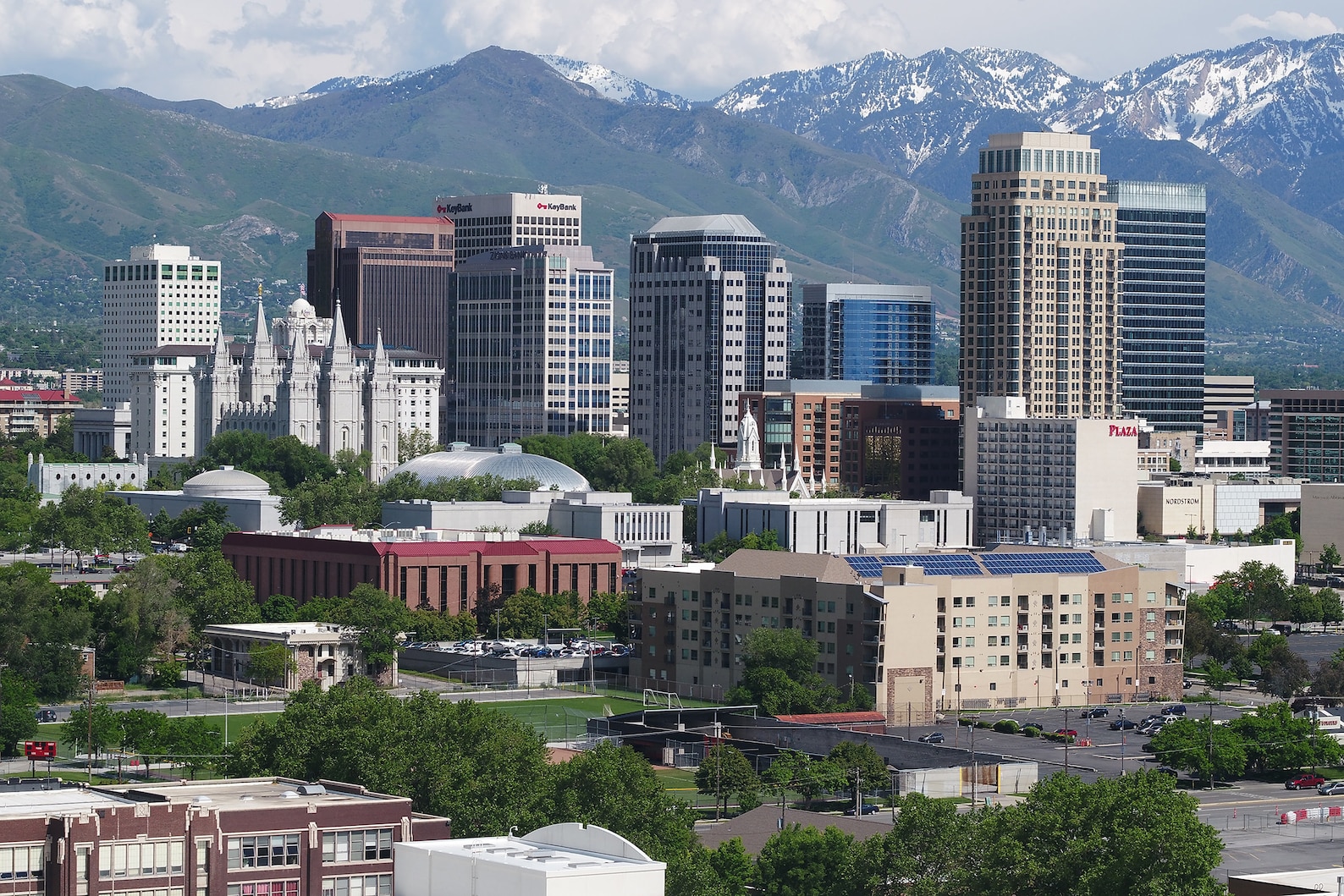
Photo: Capital Canvas Prints.
Salt Lake City, Utah.

Our local paper is owned by a national chain, Gannett, that cares nothing about our town. It prints generic articles from national outlets like USA Today or towns in other parts of New England and doesn’t get around to printing the library’s schedule or candidate letters until the events are over. Once in a while, it covers a controversial meeting or interviews a school coach — exceptions that prove the rule.

So I was not surprised to learn that a group of prominent citizens, including an experienced journalist, is working to establish a nonprofit competitor here. This is not unheard of. Today’s article from NiemanLab describes one successful effort to save local journalism, only in this case, the nonprofit board built on an established newspaper.

As Sarah Scire wrote last November, “The Salt Lake Tribune has plenty to celebrate in 2021. The first (and so far only) major newspaper to become a nonprofit is financially sustainable and, after years of layoffs and cuts, is growing its newsroom. Executive editor Lauren Gustus announced the news in a note to readers in which the relief of escaping hedge fund ownership was palpable.

“ ‘We celebrate 150 years this year and we are healthy,’ Gustus wrote. ‘We are sustainable in 2021, and we have no plans to return to a previously precarious position.’

“It’s been quite the turnaround. Utah’s largest newspaper escaped the clutches of the hedge fund Alden Global Capital in 2016 only to see its local owner, Paul Huntsman, lay off a third of staff two years later in the face of plunging ad revenue. In 2019, the Tribune made history as the first daily newspaper to become a nonprofit. And then amid the height of the pandemic last year, the Tribune ended a 149-year run of printing a daily newspaper and a 68-year-old joint partnership with the Deseret News. …

Gustus pointed out that hundreds of American newspapers are owned by financial institutions with a well-deserved reputation for making every newspaper they touch worse by gutting newsrooms, selling off assets, and jacking up subscription prices for readers.

“Gustus herself joined the Tribune from McClatchy (owned by a hedge fund) and spent years at Gannett (once managed by one hedge fund, and now deeply in debt to a different one). …

“The Salt Lake Tribune’s transition to nonprofit status has been closely watched in the news industry. Does that put additional pressure on Gustus and the rest of the Tribune team? ‘The opportunity for us to prove that this can work is significant and so is the responsibility,’ she said.

“The Tribune grew its newsroom 23% in the last year and will add new reporting roles focused on education, business, solutions journalism, food, and culture in 2022. Gustus also expects to follow the Utah News Collaborative (launched in April to make the Tribune’s reporting available to any news organization in the state) with more multi-newsroom projects centered on saving the Great Salt Lake and the centenary of the Colorado River Compact.

“Other changes include introducing six weeks of paid parental leave and a 401(k) match for employees. In response to readers who said they missed the ‘daily drumbeat‘ amid the weekend edition’s in-depth reporting, the newsroom will publish an e-edition to accompany the Sunday paper. They’re also introducing a second printed edition — delivered by mail, rather than carriers — on Wednesdays at no additional cost to subscribers.

“The Salt Lake Tribune draws revenue chiefly from subscriptions, donations, and advertising. … Subscribers pay for a digital subscription ($80/year), while ‘supporting subscribers’ ($150/year) add a donation on top. In the donations category, members of The First Amendment Society pledge to donate at least $1,000/year for three years while major donors provide one-off gifts and grants.

“The Tribune has about 6,500 supporting subscribers, more than 50 members of its First Amendment Society, and dozens of major donors. (In a bid for transparency, The Tribune forbids donations over $5,000 to be anonymous. You can see the full list here.) Gustus stressed that consistency of support is invaluable.

“ ‘We are so grateful to them [supporting subscribers] because it enables us to plan.’ …

“Gustus says that being ‘relatively lean’ — the newsroom currently stands around 33 reporters, with a handful of open positions — sometimes lends itself to some unusual experiments. The Salt Lake Tribune’s NBA beat writer, Andy Larsen, told his sizable Twitter following he wanted to get 500 new subscribers for the Tribune by the end of the year.

“Larsen had to clarify that this was his own idea and not something his bosses were making him do. … Roughly 24 hours after his first tweet, the thread had earned the Tribune 82 new subscribers. In November, roughly halfway through the self-assigned challenge, Larsen said that number had grown to 294 new subscribers.

“ ‘Andy is a gift to Utah,’ Gustus said, noting that Larsen wrote a popular column that dug into Covid data in the state when professional basketball ground to a halt. ‘He has really taken his curiosity and run with it.’

“Looking ahead to 2022, Gustus was brimming with ideas for the newly-enlarged newsroom. The Tribune will continue to investigate the dark history of Indigenous boarding schools in the state, start a conversation about the long-term impacts of children being educated during the pandemic, address water resource issues, and make sure readers have the information they need to vote in November elections.

“Gustus says The Salt Lake Tribune will also be wrestling with what it means to be a nonprofit news organization, beyond its official 501(c)(3) tax status.

“ ‘2021 has been all about finding stability for the Tribune,’ Gustus said. ‘We are so happy to say we’ve arrived in that spot and we don’t want to go back to where we were.’ “

More at NiemanLab, here, and at the newspaper’s website, here.

Read Full Post »

Photo: Boston Globe
Students at Abaarso, the secondary school that a former hedge fund manager founded in Somaliland. Over the past eight years, the school has placed more than 80 students in international boarding schools or colleges.

Some people in tech start-ups or finance make a lot of money at a young age and then decide to do something for the world. Johnathan Starr is such a person.

James Sullivan has the story at the Boston Globe.

“It was no ordinary test for Mubarik Mohamoud. As the first student from the Abaarso School of Science and Technology to be accepted into an American school, Mubarik could create untold opportunities for his schoolmates with a successful transition to Worcester Academy.

“On the other hand, if he stumbled, his peers’ hopes might be dashed.

“Jonathan Starr, a former hedge fund manager who started Abaarso eight years ago in the breakaway African republic of Somaliland, chuckles as he recalls his demanding expectations for Mubarik. When he learned that his prize student was worried ‘the entire future is on his shoulders,’ he responded, ‘Good! He’s been listening.’

“Starr … has just published a book, ‘It Takes a School: The Extraordinary Story of an American School in the World’s No. 1 Failed State,’ about his rash decision to bring a rigorous education to the former region of Somalia, and the remarkable group of teachers and students who brought that vision to reality.

“By his early 30s, Starr had amassed significant wealth and achievement as a systems savant for Fidelity Investments and later with his own hedge fund, Cambridge-based Flagg Street Capital. But he still felt a nagging desire to do something meaningful with his life. …

“A movie buff, he was drawn to inspirational classroom films like ‘Stand and Deliver,’ the 1988 story of East Los Angeles math teacher Jaime Escalante. And for some time, he writes in his book, he had harbored an idea ‘to start a school for really talented kids who have great potential that will otherwise go wasted.’ …

“When he first arrived in Somaliland, almost all of the republic’s schools had been destroyed or run into the ground by the Somali civil war. Covering grades 7-12, Abaarso, named for the town the school is in, now serves 212 students on its walled, multibuilding campus. Acceptance is competitive. …

“Mubarik graduated from Worcester Academy — Starr’s alma mater — in 2013. This spring, after majoring in electrical engineering and computer science, he’ll graduate from M.I.T. Having specialized in autonomous robotics, he’d like to help engineer driverless cars. It’s an astounding trajectory for a boy who grew up in a world so rural, he mistook the first motor vehicles he saw to be some kind of bizarre domesticated animal.

“ ‘I do not feel exceptional,’ says Mubarik, ‘but I do feel lucky.’ ”

More here.

Read Full Post »