Feeds:
Posts
Comments

Posts Tagged ‘hidden’

Photo: Gabriela Contreras González.
Saint Catherine of Alexandria, patroness of students, teachers, librarians, and lawyers.

Today’s post is about art restoration, a field that always seems brave to me. Imagine charging into some time-honored work and presuming to “fix” it! I guess a good restorer becomes the artist, too — perhaps in the way that a skilled translator of a literary work becomes a coauthor.

This month, with trepidation, my husband and I put a lovely Inuit watercolor into the hands of a conservator. Would she be able to remove all the mildew from life in a damp summer cottage? The results were nothing short of miraculous.

At Artnet, Min Chen writes about a larger work of conservation in Mexico.

“For decades, the interior of the Temple of Our Lady of the Assumption, a church in the town of Santa María Huiramangaro in Mexico, stood stark white, with blue accents. But the parish was not always so bare. A new restoration has revealed a host of resplendent 16th-century religious paintings that once spanned the ceiling of the historic church.

“The project, undertaken by participants including the Ministry of Culture of the Government of Mexico and the National Institute of Anthropology and History (INAH), dispatched a team of professionals to conserve the roof of the church. What they discovered instead were ancient images of saints and martyrs — hagiographic works rarely found in the Michoacán region — which had been painted over during the 1940s.

“The work, said Laura Elena Lelo de Larrea López, expert restorer at the INAH Michoacán Center, in a statement, ‘allowed us to recover an extraordinary work on the horizontal roof of the main altar, and to discover the rich artistic, technical and iconographic evolution that has marked this religious site.’

“The Temple of Our Lady of the Assumption was constructed in the early 16th century, when Santa María Huiramangaro was designated a district head, overseeing the communities of San Juan Tumbio, Zirahuén, and Ajuno. The building reflected the architectural styles of Mudéjar, which featured ornate motifs believed to have been originated by Muslim craftspeople in the 13th century, and Plateresque, a late-Gothic and early Renaissance aesthetic imported by the Franciscans.

“During restoration work, three pictorial layers of religious iconography were uncovered on the church’s ceiling. The oldest, from the 16th century, saw the use of tempera paint, which was applied in thin glazes to depict various characters corresponding to Saints Paul, Peter, Agatha of Cantania, and Catherine of Alexandria, as well as baby Jesus in Franciscan habit. The works were retouched with oil paints in the following century, adding volume and colors to the depicted figures’ clothing.

“When water ran dry in the region in the 17th century, the church fell largely into disrepair, as Santa María Huiramangaro lost its capital status. ‘The misfortune was a blessing in disguise, in terms of conservation,’ said Lelo de Larrea López, ‘since, not having the resources to renew its religious furnishings, the parish priests of the Temple of Santa María preserved its Plateresque ornaments. …

“Still, experts uncovered evidence of a restoration effort in the 20th century. Acrylic paints were deployed to touch up the faces of the saints. …

“During remodeling work in the 1940s, the iconography on the church’s roof was painted over in white, with blue designs. The repainting, noted Lelo de Larrea López, ’caused an alteration in the appearance of the place.’

“The latest conservation removed the repainted layer and restored missing portions of the paintings. Additionally, the ceiling was cleaned of dust and animal droppings, reinforced with joints and wood grafts, and fumigated to deter wood-eating insects. Other roof elements, such as corbels, partitions, and Franciscan cord carvings, were also given a refresh.

“The work marks the latest phase in a major restoration of the Temple of Our Lady of the Assumption, which began a decade ago with a focus on its main altarpiece. Despite a dismantling (undertaken to tackle a collapse in the church’s rear wall), conservators found the artifact in a well-preserved state. Over 2022 and 2023, they addressed damage to its cornices and carvings, and undid a repainting job to reveal its original gold leaf and polychrome.”

I admire the commitment it takes to work on projects of ten years or more like this. Have you ever had a piece of art restored?

More at Artnet, here.
Read Full Post »

Photo: Adinel C. Dincă / Biblioteca Batthyaneum.
Buried for centuries in a Transylvanian church tower, a forgotten medieval library has come to light, offering a glimpse into the intellectual and cultural life of medieval Romania.

By Jove! How many treasure troves are yet to be discovered on Planet Earth? It makes me want to start a limerick using “Jove,” “trove,” “grove” …

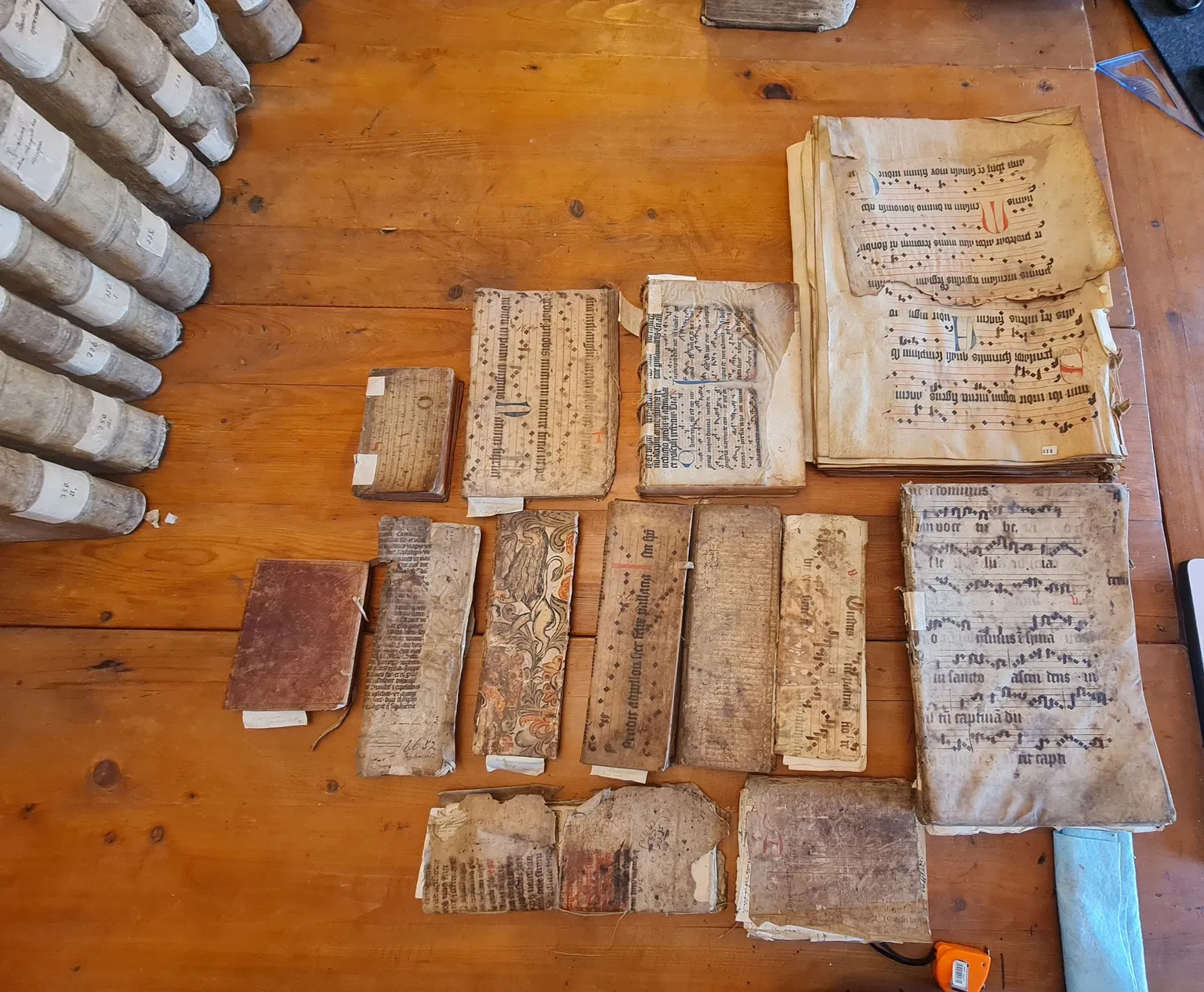
The website Medievalists reports, “Hidden away for centuries in a Transylvanian church tower, a forgotten medieval library has come to light, revealing treasures as old as the 9th century. This extraordinary discovery of manuscripts, books, and documents offers a rare glimpse into the intellectual and cultural life of medieval Romania.

“The discovery was made two years ago in the Church of St. Margaret in Mediaș, a 15th-century Gothic structure built by the Transylvanian Saxons. A team led by Professor Adinel C. Dincă of Babeș-Bolyai University uncovered the collection in the church’s Ropemakers’ Tower, where it had remained hidden for decades, possibly centuries. Biblioteca Batthyaneum, which first announced the find, described it as a scene straight out of an Indiana Jones adventure, complete with a struggle against nesting pigeons to recover the precious volumes. The cache includes:

  • Printed Volumes: Approximately 139 books printed between 1470 and 1600.
  • Manuscript Volumes: Two manuscripts from the early 16th century.
  • Original Documents: Around 60 documents from the 14th to 16th centuries, with a few originals and copies from the 17th century.
  • Administrative Registers: About 10 registers from the 17th–18th centuries, containing fragments of medieval manuscripts. …

“Professor Dincă believes the library was deliberately hidden, possibly during a period of war or religious upheaval. The organization of the books suggests a carefully curated collection rather than a haphazard storage. ‘When I first encountered the books, I immediately noticed the disposition of the volumes according to a certain historical typology: bibles and biblical texts, patristic, theology etc,’ Dincă explained to Medievalists.net. ‘This order doesn’t look like an improvisation. …

“The items found are likely part of a larger collection held by the church. A catalogue from 1864 lists around 7,700 books in the church library, many of which were authored by key Protestant Reformers such as Martin Luther, John Calvin, and Philip Melanchthon. The cache provides researchers with the rare opportunity to match the recovered volumes with the historical records and explore what remains of this once vast repository.

“Among the most intriguing finds are fragments of medieval manuscripts, some dating as far back as the 9th century. These include texts written in Carolingian minuscule, a script commonly associated with the Carolingian Renaissance, as well as liturgical manuscripts from the 14th and 15th centuries. Many of these fragments were found recycled into administrative registers, offering insights into how older texts were reused within the community.

“ ‘One highlight of this historical collection is the large number of original 16th-century bindings, many of them dated,’ Dincă notes. ‘In addition to that, in the series of administrative registers of the parish, there are several fragments of mediaeval manuscripts, among them one copied in Carolingian minuscule, the rest of the “fragments collection” containing the usual liturgical manuscripts from the 14th to 15th century. The closed context of re-use makes it very likely that such recycled pieces of parchment are in fact remnants of a pre-Reformation stock of manuscripts locally used.’

“The discovery has launched a comprehensive research project. … Funded by Germany’s Ministry for Culture and Media, the project focuses on preserving the collection, digitally reconstructing it, and conducting detailed scientific analysis. …

“Researchers are particularly interested in the collection’s role in reflecting the intellectual and cultural life of the Transylvanian Saxons. The books and manuscripts provide unique insights into the circulation of ideas in medieval Europe. …

“Professor Dincă and his team believe the discovery represents more than just a hidden archive — it is a time capsule that offers a rare glimpse into the cultural and religious life of the region during the Middle Ages.”

More at Medievalists, here. No paywall. (Once I started thinking about rhymes for “ove,” I realized once again how weird English is. You can’t use “love” or “shove” with “trove” or “move” either.)

Read Full Post »

Photo: Bargello Museums, Florence.
Drawings believed to be by Michelangelo in the Stanza Segreta, or Secret Room, at the Museum of the Medici Chapels, part of the Bargello Museums and the Basilica of San Lorenzo in Florence.

It’s pretty unusual to find works by a master like Michelangelo centuries after his death, but that’s what happened in Florence in 1975. Now visitors — on a limited basis — are being allowed into the room where Michelangelo once hid out. It seems that even in hiding he couldn’t stop drawing.

Sarah Cascone reports at Artnet, “Guidebooks to the Italian city of Florence have long noted that the Basilica of San Lorenzo is home to a secret room believed to have been decorated by Michelangelo while the famed Renaissance master was in hiding from the pope for two months in 1530. Now the chamber, which is part of the the Museum of the Medici Chapels (itself one of the fives sites of the city’s Bargello Museums), will be open to the public for the first time. …

“The stunning drawings of the Stanza Segreta, or Secret Room, were rediscovered in 1975. That’s when Paolo Dal Poggetto, then director of the Museum of the Medici Chapels, tasked restorer Sabino Giovannoni with trying to clean part of the walls of a narrow chamber beneath the church’s mausoleum, which had been designed by Michelangelo in 1520.

“The corridor, measuring about 32 feet long, 10 feet wide, and eight feet tall, had been used it to store coal, until it had been sealed shut some 20 years prior. It was accessible only by narrow stairway beneath a trap door that had been concealed beneath a wardrobe amid a pile of unused furniture and decor.

“The initial plan was to potentially create a new tourist entry and exit point from the museum. But what Giovannoni found changed everything. Hidden under two layers of plaster, he soon realized, the walls were covered in large-scale charcoal and red chalk sanguine drawings executed with the confidence and ease of a master draftsman.

“ ‘The moment you enter that room you simply are speechless,’ Paola D’Agostino, director of the Bargello Museums, told the New York Times, adding that as your eyes adjust to the low light ‘you start seeing all the different drawings and all the different layers.’

“But why would Michelangelo have been sequestered in this subterranean space, with just a single window letting in light from the street above?

“At the time, the artist’s main patrons, the Medici family, had just returned from exile, having been overthrown by a populist revolt in 1527. Because Michelangelo had worked on behalf of the republican government, supervising the city’s fortifications, Pope Clement VII — a member of the family — had sentenced him to death.

“Hiding beneath the basilica was a way for Michelangelo to lay low until he was back in the pope’s good graces. Fortunately, the Medicis ended up forgiving Michelangelo about two months later, lifting the death sentence and allowing him to leave his (freshly decorated) hiding place to resume work on the family’s tombs at the basilica. …

“Be forewarned that there will still only be limited access to the Secret Room. The museum is making just 100 tickets — priced at €32 ($34), including access to the Medici Chapels — available for each week, with 15 minute slots for groups of four. There is a 45-minute gap between each visit, to limit the works’ exposure to light.” More at Artnet, here.

The Times, here, adds a description of “an imposing nude near the entrance, which has the sketch of a face in profile and looking forward. Experts say it evokes Michelangelo’s ‘Resurrection of Christ.’ [And some] scholars have suggested that Michelangelo could have drawn sketches of a falling man that resemble the central figure of his ‘The Fall of Phaeton.’ Some even think a flexed and disembodied arm on the wall evokes his David statue. What is certain, Ms. D’Agostino said, is that ‘nothing of this kind exists in the world of 16th-century drawings.’ ”

Read Full Post »

Art by Maurice Sendak for the Ruth Krauss book Open House for Butterflies.

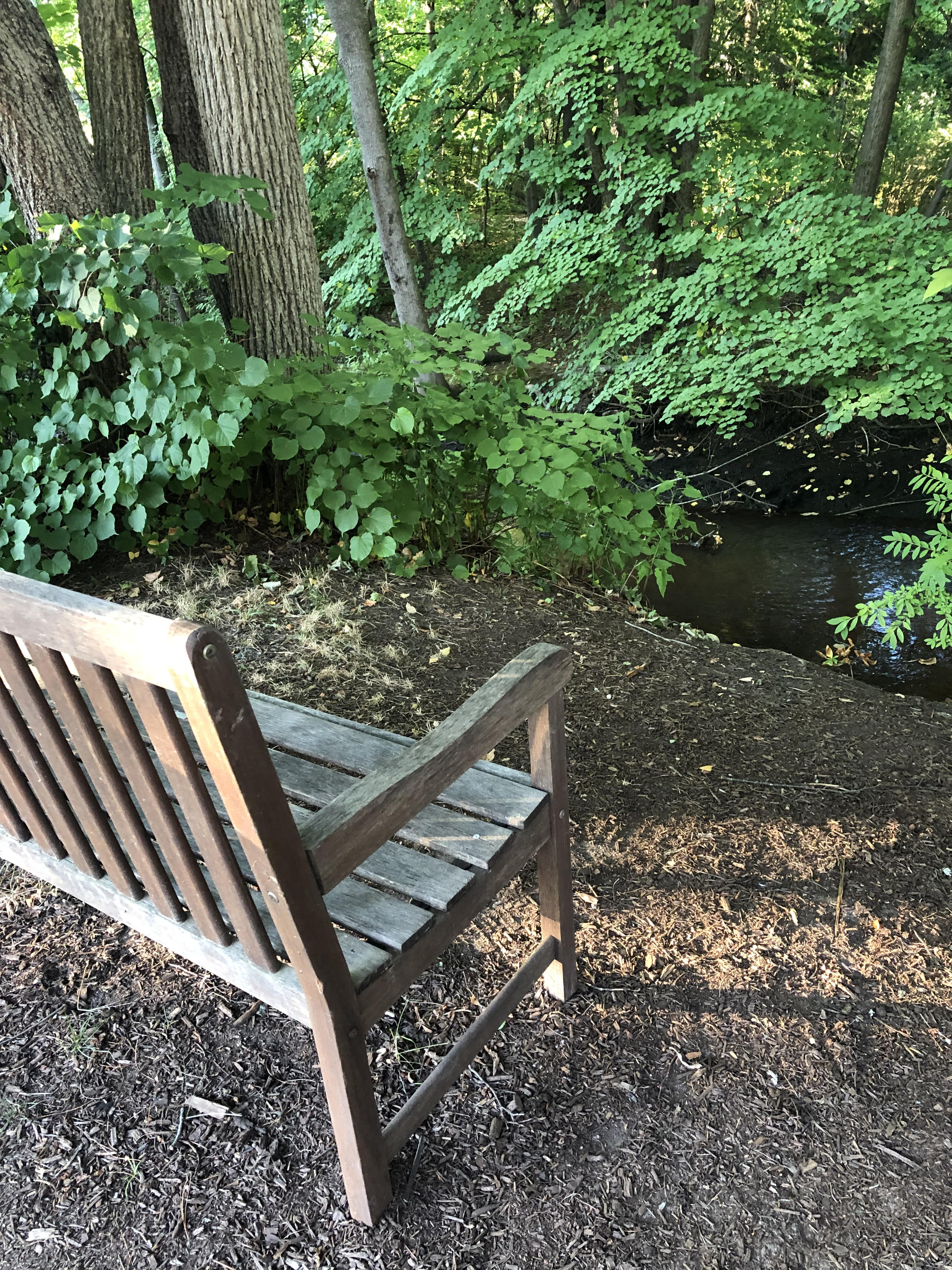
One hot day after dinner, I had an urge to follow Ruth Krauss’s advice, “Everybody should be quiet near a little stream and listen.”

It gave me two challenges. The first challenge was to find a little stream. The second — because if I were to sit on the bank like the child in the Sendak illustration, I might have trouble getting back up — was to find a little stream where there was a bench.

To my surprise, there was in fact a bench facing the Mill Brook behind Main Streets Café. The restaurant had set several benches around for customers waiting at its outdoor eating area, and some inspired worker had turned one toward the stream.

So I sat there a while, and as I sat, I began to wonder if there were other sections of this stream with benches. I also wondered where the stream went.

When I was working at the Boston Fed, I went to a conference about towns like Pawtucket, Rhode Island, getting the idea to “daylight” waterways that had long been hidden in culverts under streets. Towns have been burying assets like that for centuries. Why? Daylighting has really transformed Pawtucket and would be good everywhere.

I’m not sure where the Mill Brook starts, but I can tell you that from a swampy shopping center parking lot, it runs under the pretty pedestrian bridge I’ve shown in other posts, past Main Streets Café, under Main Street, behind several businesses, a theater, an unused bank building (which has a perfect spot for a bench if anyone thought about it), behind private homes, under Heywood Street, and behind the fire station. I know because I went looking.

After the fire and police complex, it went under Walden Street and came out from a culvert near the community gardens, but where it went next, I couldn’t discover. I thought I might find it entering the elementary school grounds, but although I walked up and down there, I couldn’t discern so much as a burble. For me, the stream had vanished behind the homes on Magnolia. It will doubtless show itself when our drought is over and flood season causes it to burst out in a pent-up rage.

I fully intend to investigate the routes of other local streams. You probably need to be retired or a person who likes to walk — or both — to spend time on this activity, but I recommend it. It’s interesting.

Meanwhile, check out what Maria Popova has to say at the Marginalian about Open House for Butterflies and being quiet near a little stream.

Photo: Suzanne and John’s Mom
Bench near a little stream.

Read Full Post »