Art: Asher Durand.
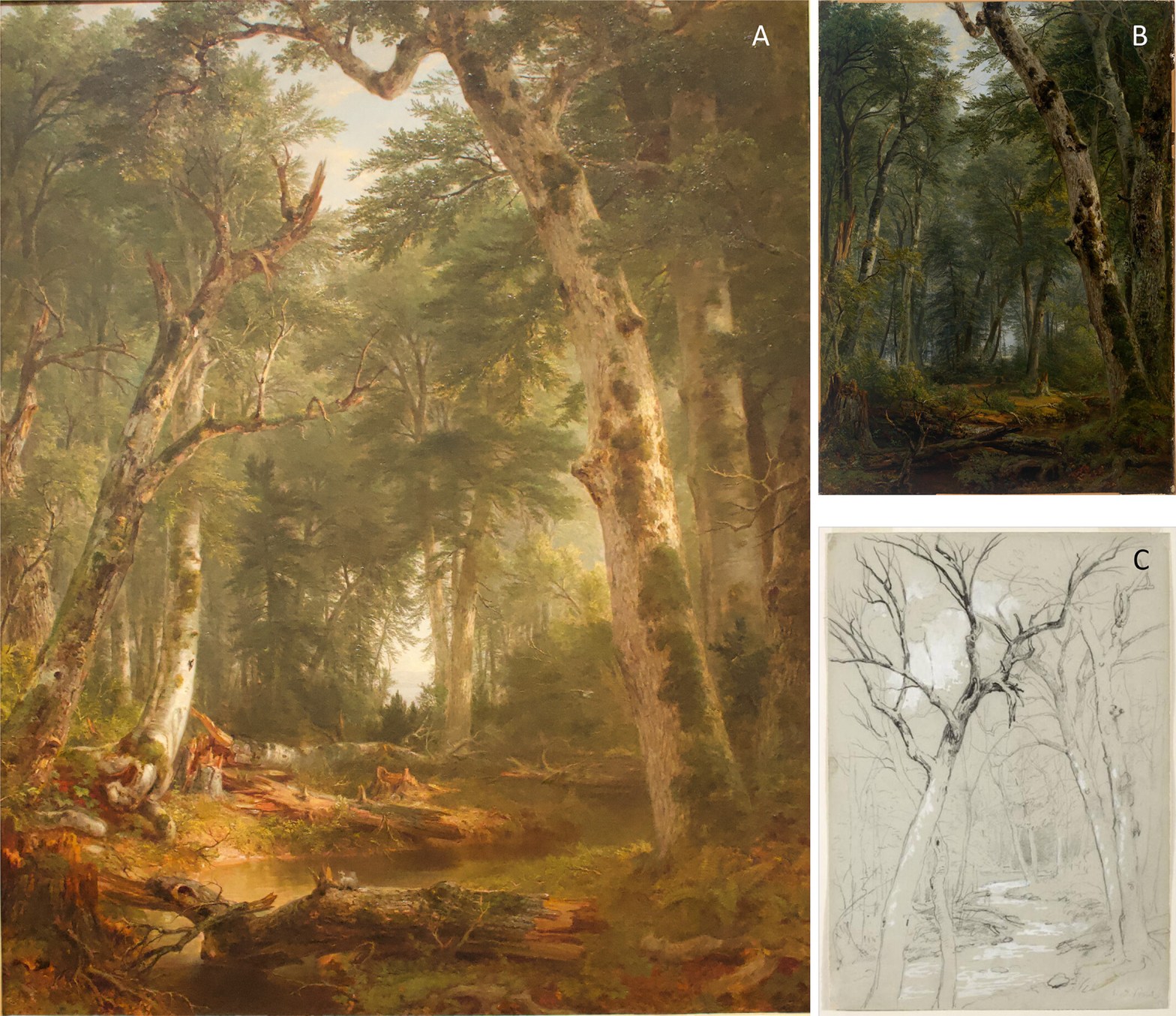
Nineteenth-century paintings of old growth forests are helping ecologists learn about what we have lost. Asher Durand, for example, understood the way that beech trees fit into their forest habitats. A) “In the Woods” (1855); B) “Woodland Interior” (c. 1854), oil on canvas; C) “A Brook in the Woods” (c. 1854), graphite, gouache, and white lead on paper.
Call me retro, but I’ll always love the Hudson River School paintings of a long-gone majestic American wilderness. So do ecologists, as it turns out.
Elaine Velie reports at Hyperallergic on a new study showing that the 19th-century paintings have a value beyond the aesthetic.
“The Hudson River School movement is an enduringly popular slice of 19th-century American art history,” Velie writes, “but as beloved as it is, its paintings of bucolic hills drenched in golden light are not particularly known for their adherence to reality. In a recently published study, a team of ecologists and art historians set out to determine just how true to life these works really were.
“Using onsite sketches and historical writings, the team determined that some of these paintings were true to life. …
Some were so detailed that they could even help scientists today learn about the centuries-old forests that were destroyed before the advent of color photography.
“Dana Warren and Harper Loeb of Oregon State University published their findings last month in the academic journal Ecosphere along with scholars Peter Betjemann, Isabel Munck, William Keeton, David Shaw, and Eleanor Harvey.
“ ‘I have been interested in understanding older forests and old growth forest systems in the Northeast for a while,’ Warren told Hyperallergic. … ‘I was interested in these 19th-century paintings, but I had always thought that issues of artistic license removed the potential for any of these images to be used in a rigorous quantitative way.’ She paired up with art historians to investigate.
“The interdisciplinary team focused on Hudson River School paintings completed between 1830 and 1880, when Northeastern forests were being cleared for farms but more remote regions still remained untouched by European colonizers. Blights and invasive species had yet to arrive, and trees like the chestnut, ash, and elm still shaded the woodland floor. …
“In the early 1800s, American painters began working en plein air. Portable oil paints had come into fashion, and growing infrastructure made it easier to venture upstate. A fascination with ‘wilderness’ in literature and art emerged alongside the dark underpinnings of ‘manifest destiny‘ and colonial expansion.
“As creators emphasized nature, they were acutely aware of the changing landscapes around them.
“ ‘The beauty of [untouched] landscapes is quickly passing away,’ Thomas Cole, the painter credited with founding the Hudson River School movement, wrote in 1836. ‘The ravages of the axe are daily increasing — the most noble scenes are made desolate.’
“While painters like Cole crafted dramatic allegorical renderings of the forests disappearing around them … other artists adhered to observational truth.
“Warren and her team used the interior forest scenes of prominent Hudson River School painter Asher Durand (1796–1886) as a case study, examining his onsite sketches, writings, and oil paintings to establish the veracity of his finished works. …
“Durand explicitly stated his emphasis on depicting the natural world just as he saw it. Like other artists, Durand had been familiarized with the specimen-based botany that had been available in published form since the 1700s.
“The scholars examined an 1855 Durand painting of the Catskills titled ‘In the Woods’ — a calm depiction of a shady stream lined with beech trees. Notably, an 1854 painting of the same scene excludes these plants, but an onsite sketch of a similar setting includes them, signifying that the artist added the trees into his final painting from a real sketch. …
“Warren said her recent study is a ‘proof of concept,’ and that she thinks the team’s exploration of Durand’s paintings can extend to the work of other artists. For now, Hudson River School depictions of microhabitats — groupings of flora like mushrooms on tree trunks and mats of moss on bark — can help ecologists learn about what old growth forests were really like.
“With an interdisciplinary approach to ecology and art history, the scholars think paintings of the American West could help scientists learn about long-melted glaciers and plowed prairie biomes, and artworks showing the coast could help researchers study lost marsh habitats.”
Today we have lots of color photography, but if any of you artists out there want to help the scientists of the future, you know the way.
Check out the art at the Hyperallergic, here. No firewall, but subscriptions solicited.

 Suzanne's Mom's Blog