Feeds:
Posts
Comments

Posts Tagged ‘humpback’

Photo: Nick Ut / AP.
A blue whale, the largest mammal on Earth, surfaces in the Pacific Ocean near Long Beach, California.

Whether we’re talking about Jonah and the whale or Pinocchio or the lobster fisherman’s uncomfortably close encounter in 2021, we humans have always been fascinated by the largest mammals on Earth. And the blue whale is the most massive of them all. But what is going on with Leviathan of late?

Shola Lawal writes at Al Jazeera that it is not singing as much as it used to.

“Unlike our musical sounds, those produced by whales are a complex range of vocalizations that include groans, clicks and whistles and that can sound like anything from the mooing of a cow to the twitter of a bird. These vocalisations can be so powerful that they can be heard as far as 10km (6 miles) away, and can last for half an hour at a time. …

“For researchers, these complex sounds are a window into whale behavior, even if humans don’t yet know exactly how to decode them.

“The frequency of songs and their intensity can signal various things: an abundance of food, for example. In recent studies, however, researchers have been alarmed to find that blue whales, the largest whales and, indeed, the largest mammals on Earth, have stopped singing at specific times.

“Their eerie quietness, scientists say, is a signal that ocean life is changing fundamentally. The most recent study, conducted by scientists from the Monterey Bay Aquarium Research Institute in California in the US and published in February, examined three types of whales. Researchers found that blue whales, in particular, have become more vulnerable to this change.

“Whale songs are critical for communication between males and females when mating and among schools of whales migrating. …

“The first study, conducted in the sea waters between the islands of New Zealand between 2016 and 2018, was led by scientists from the Marine Mammal Institute at Oregon State University in the US. Over that period of time, researchers tracked specific blue whale vocalizations linked to feeding (called D-calls) and mating (called patterned songs).

“Researchers used continuous recordings from underwater devices called hydrophones, which can log sounds over thousands of kilometers, and which were placed in the South Taranaki Bight – a known foraging spot for blue whales off the west coast of New Zealand.

“They discovered that during some periods, particularly in the warmer months of spring and summer when whales usually fatten up, the frequency and intensity of sounds related to feeding activity dropped – suggesting a reduction in food sources. That decline was followed by reduced occurrences of patterned songs, signaling a dip in reproductive activity.

” ‘When there are fewer feeding opportunities, they put less effort into reproduction,’ lead researcher Dawn Barlow told reporters. The results of that study were published in the journal Ecology and Evolution in 2023.

“Then, in a study published in the scientific journal PLOS One in February [2025] researchers tracked baleen whale sounds in the California Current Ecosystem, the area in the North Pacific Ocean stretching from British Columbia to Baja California. Blue whales are a type of baleen whale, and the study focused on them, alongside their cousins, humpback whales and fin whales.

“Over six years starting in 2015, the scientists found distinct patterns. Over the first two years, ‘times were tough for whales,’ lead researcher John Ryan, of the Monterey Bay Aquarium Research Institute in California, noted in a press statement, as the whales, particularly blue whales, were found to be singing less. Over the next three years, however, all three whale species were back to singing more frequently, the study noted.

“Both studies found one main reason for the reduction of whale song: food or, in this case, the lack of it. It turns out that the research, conducted between 2015 and 2020, captured periods of extreme marine heatwave events that killed off krill, the small shrimp-like animals that blue whales feed on.

“Those heatwaves are part of a looming environmental catastrophe … caused by high-emission human activities, chief among them being the burning of fossil fuels. …

“Krill, which blue whales primarily feed on, are highly sensitive to heat and can all but vanish during heatwaves, the studies found. Their movement patterns also change drastically: instead of staying together, as they usually do, krill disperse when it is hot, making them harder for predators like blue whales to find.

“Typically, when foraging, blue whales sing to others to signal that they have found swarms of krill. … Heatwaves can also trigger harmful chemical changes in the oceans that encourage the growth of toxic algae, which causes poisoning and death to mammals in the oceans and sea birds, researchers have previously found, suggesting that blue whales are also at risk of being poisoned.

“In the more recent study in California, researchers found that in the first two years when whales were singing less frequently, there was also a reduction in other fish populations. …

“ ‘Compared to humpback whales, blue whales in the eastern North Pacific may be more vulnerable due to not only a smaller population size but also a less flexible foraging strategy,’ Ryan, the lead author of the California study said in a statement. …

“It is likely, both studies say, that blue whales need to spend more time and energy finding food when it is scarce, instead of singing.”

At Al Jazeera, here, you read about climate change effects on other species, too.
Read Full Post »

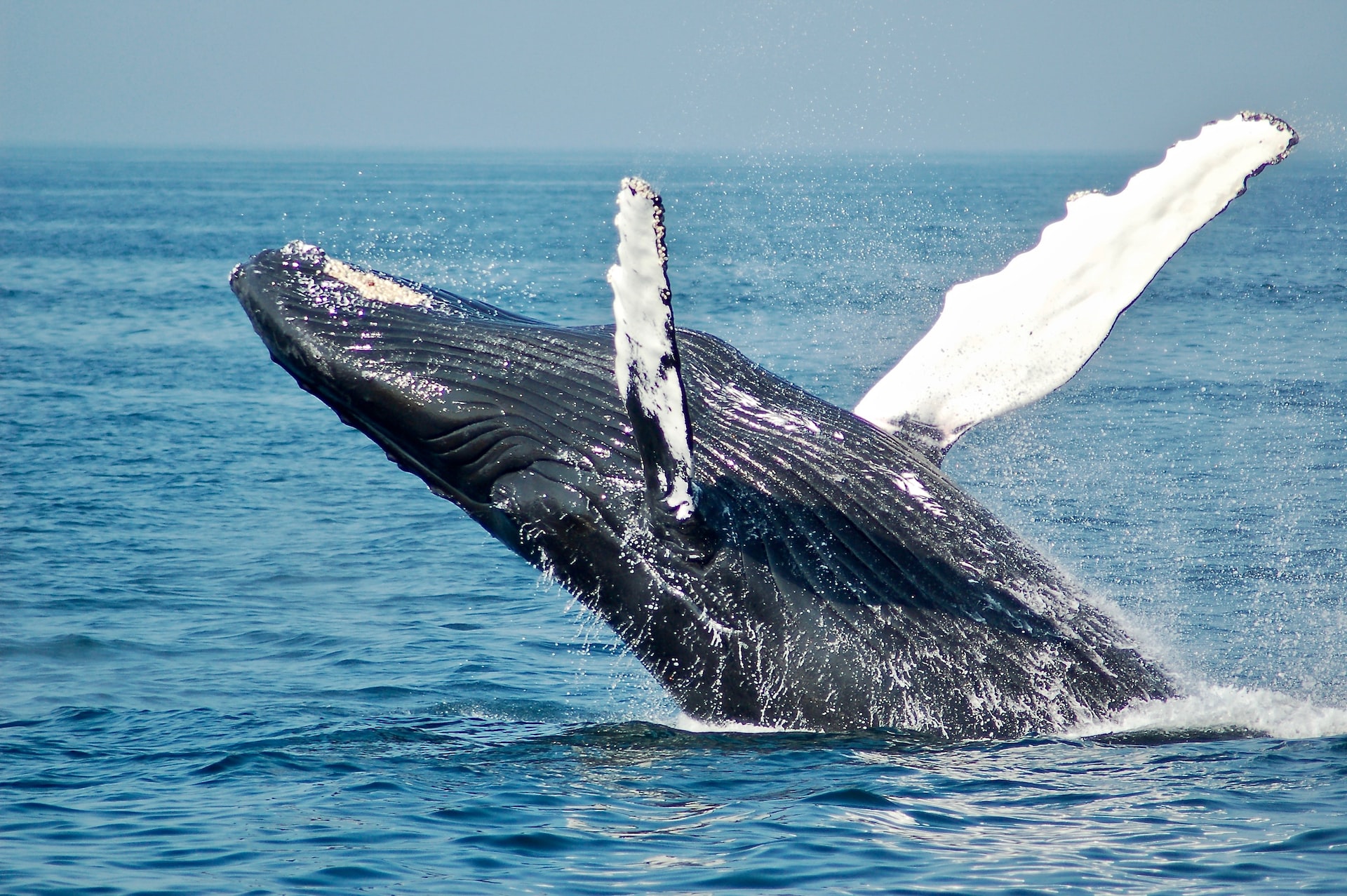
Photo: Todd Cravens via Unsplash.
Some whales “pass their songs across oceans,” says the New York Times. Humpback whales have been studied the most extensively, but other species of whales also sing complex songs.

Although we are surrounded by ocean, I fear that we rarely give much thought to how really extraordinary the ocean is and how many wonders dwell there. Today’s story is about whales that share their song lists around the world.

Carl Zimmer writes at the New York Times, “In a study published [in August], scientists found that humpback songs easily spread from one population to another across the Pacific Ocean. It can take just a couple of years for a song to move several thousand miles.

“Ellen Garland, a marine biologist at the University of St. Andrews in Scotland and an author of the study, said she was shocked to find whales in Australia passing their songs to others in French Polynesia, which in turn gave songs to whales in Ecuador.

“ ‘Half the globe is now vocally connected for whales,’ she said. ‘And that’s insane.’

“It’s even possible that the songs travel around the entire Southern Hemisphere. Preliminary studies by other scientists are revealing whales in the Atlantic Ocean picking up songs from whales in the eastern Pacific.

“Each population of humpback whales spends the winter in the same breeding grounds. The males there sing loud underwater songs that can last up to half an hour. Males in the same breeding ground sing a nearly identical tune. And from one year to the next, the population’s song gradually evolves into a new melody.

“Dr. Garland and other researchers have uncovered a complex, language-like structure in these songs.

The whales combine short sounds, which scientists call units, into phrases. They then combine the phrases into themes. And each song is made of several themes.

“Male humpbacks sometimes change a unit in their song. Sometimes they add a new phrase or chop out a theme. The other males may then copy it. These embellishments cause the population’s song to gradually evolve, resulting in drastically different melodies from one population to the next.

“Michael Noad, a marine biologist at the University of Queensland, discovered that a population’s song can sometimes make a sudden, dramatic change. In 1996, he and his colleagues noticed that a male on the east coast of Australia had given up the local song and was now singing a tune that matched one previously sung on the west coast of the country.

“Within two years, all of the males on the east coast were singing that song. Dr. Noad’s landmark study was the first to discover this kind of cultural revolution in any animal species.

“Dr. Garland … wondered if their songs were spreading farther east across the Pacific. An opportunity to find out arrived when Judith Denkinger and Javier Oña, marine biologists at the University of San Francisco de Quito in Ecuador, offered to collaborate. They study humpback whales that breed on the coast of Ecuador.

“For their new study, Ms. Denkinger and Mr. Oña recorded humpback whales from 2016 to 2018. Over the same period, Michael Poole, a marine biologist at the Marine Mammal Research Program on the French Polynesian island of Moorea, recorded whales there. …

“In 2016 and 2017, the two populations of whales had clearly distinct songs. But in 2018, a revolution happened: The whales in Ecuador were putting French Polynesian themes in their songs. The scientists reported their findings [in] the journal Royal Society Open Science.

“Elena Schall, a postdoctoral researcher at the Alfred Wegener Institute in Bremerhaven, Germany, who was not involved in the study, said that she is seeing some similar patterns in the Atlantic Ocean. Humpback whales off the coast of Brazil and South Africa are picking up themes previously recorded off the coast of Ecuador.

“It is conceivable, Dr. Schall said, that songs flow all the way around the Southern Hemisphere. ‘It’s possible, but there’s a data gap in the Indian Ocean,’ she said. ‘I think that will definitely be the next step, if we can find enough data.’ “

More at the Times, here. Amazing to think that whales in one part of the world can “cover” the songs of whales thousands of miles away.

Read Full Post »

I wish Pete Seeger were around for this story. The folksinger spent many years sailing his sloop the “Clearwater” up and down the Hudson River to draw attention to pollution. Today the river is in good enough shape to attract a whale chasing its dinner.

Recently, New York Times reporter Katie Rogers interviewed Dr. Rachel Dubroff, whose apartment overlooks the Hudson. She writes that the first time Dubroff spotted a whale swimming outside her living room window, “she didn’t quite believe the sighting was real,” but news reports in November confirmed that “the Hudson River has a resident humpback.”

Continues Rogers, “The Hudson, as scenic as it is, does not scream ‘whale habitat.’ But experts say cleanup and conservation efforts have led to cleaner waters and an abundance of fish. …

“A whale appearing in the Hudson is very rare, [Paul Sieswerda, the president of Gotham Whale, an organization that tracks marine life around the city] said, which is why he thinks this one is a solo traveler. But the whale still faces significant danger because it is swimming in traffic-laden waters. …

“ ‘When you have whales chasing the bunker [menhaden], and fishermen chasing the stripers that chase the bunker, accidental interactions between whales and vessels can occur,’ Jeff Ray, a deputy special agent with NOAA’s law enforcement division,” added.

I hope everyone using the river will watch out for whales and try to coexist. It would be great if the whale came back after the usual typical retreat to warmer breeding grounds in winter.

More at the New York Times, here.

Art: Amy Hamilton
A humpback whale like the one spotted in New York’s Hudson River in November 2016.

Read Full Post »