Feeds:
Posts
Comments

Posts Tagged ‘hunt’

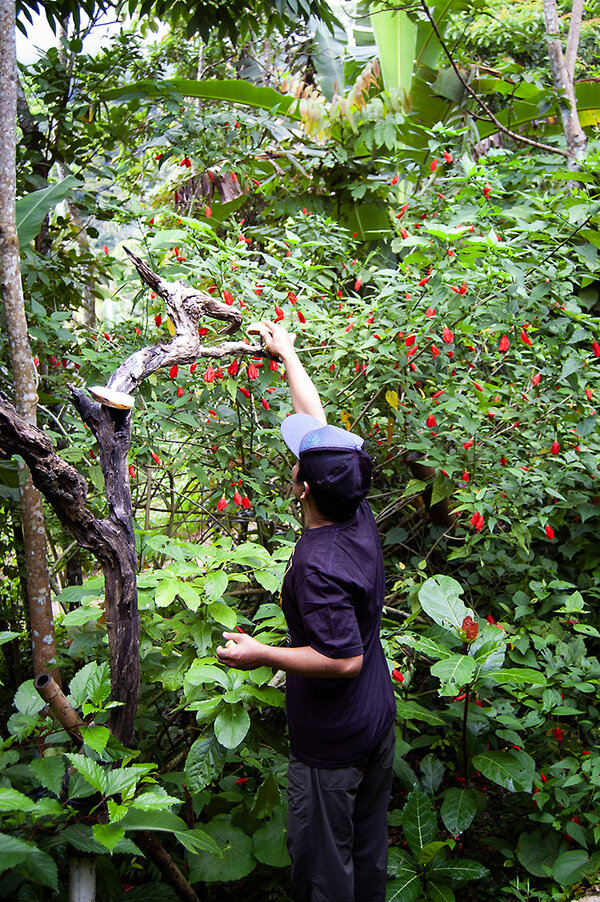
Photo: Lindsey McGinnis/The Christian Science Monitor.
Kelik Suparno, a bird-hunter-turned-nature-guide, begins his day by loading fruit onto trees to attract birds to a viewing area near his home in Jatimulyo, Indonesia, March 1, 2025.

As I started to work on this post, I had an uneasy feeling that I’d written before about the birdsong competitions that are mentioned. Alas, yes. Click here to enjoy the charming side of today’s topic. Continue reading for the other side.

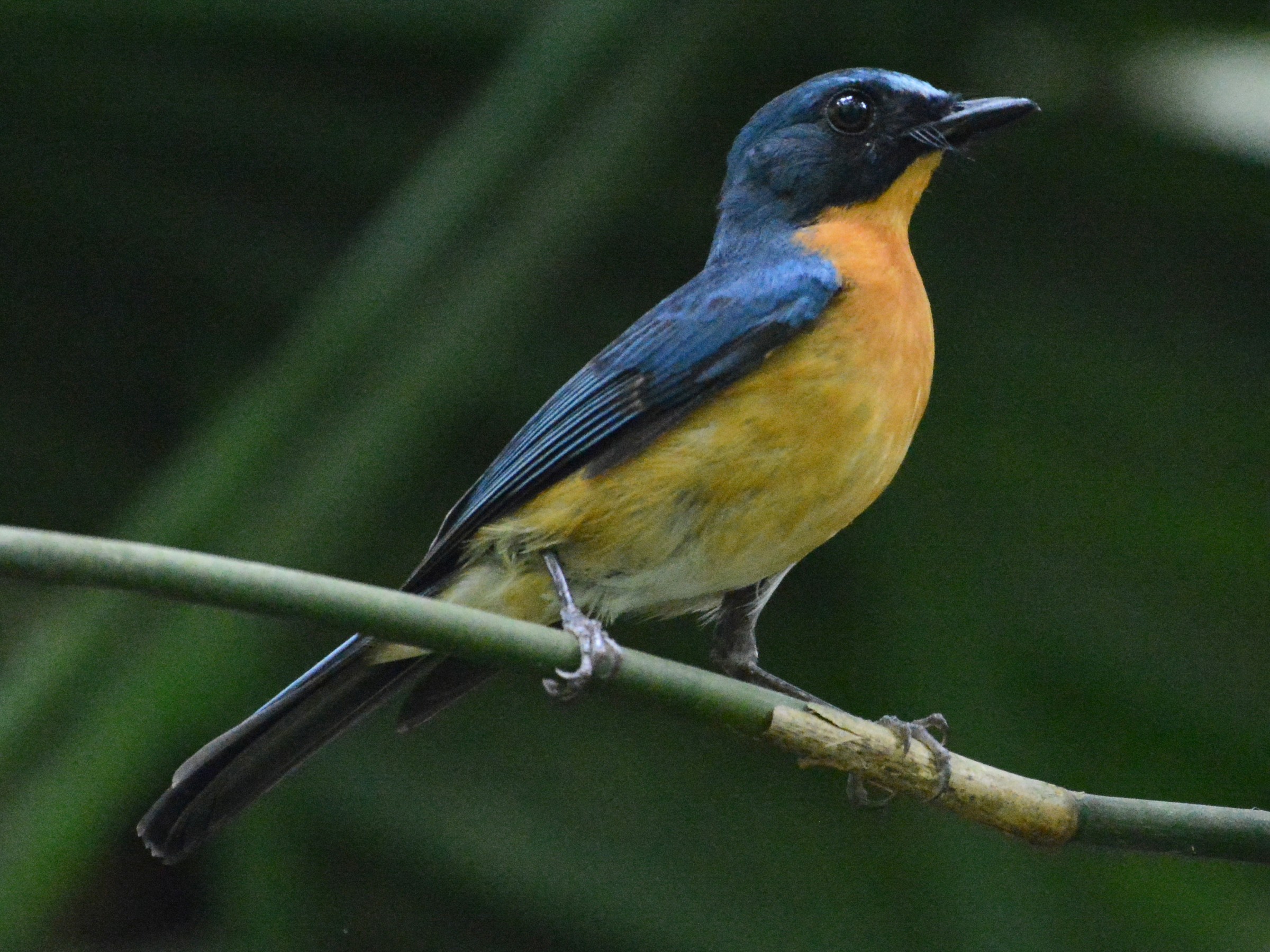
Lyndsey McGinnis writes at the Christian Science Monitor, “A decade ago, when Kelik Suparno heard the Javan blue flycatcher’s melodic whistle, he perked up at the promise of a payday. Knowing a single bird could earn him two months’ salary at one of Indonesia’s bustling bird markets, he set off to capture the critically endangered creature.

“Now, when he hears its distinct, high-pitched ‘twee-twoo sounds, he perks up for a different reason. It means he gets to introduce a group of outsiders – researchers, photographers, tourists – to his favorite species.

Photo: Ari Noviyono via eBird.

“Like many other men in the mountain village of Jatimulyo, Mr. Suparno made the switch from bird hunter to nature guide shortly after the village banned poaching. And now, as increasingly popular birdsong competitions across Asia threaten the country’s wildlife, Jatimulyo could set an example for other communities.

“Indonesia is the epicenter of what ecologists describe as the Asian songbird crisis: the rampant, illegal trade of rare and endemic birds to the devastation of their wild populations. The crisis affects at least 26 threatened species within Indonesia, where it’s fueled by the rising popularity of high-stakes birdsong competitions. Everyone wants these species to thrive. The love of native songbirds runs deep, especially here on the island of Java, and many hope to pass that love on to younger generations. But protecting both the country’s biodiversity and its songbird culture will require balance.

“ ‘In Indonesia, all kinds of birds are being hunted, everywhere,’ says Mr. Suparno. ‘The competition accelerates the rate of bird extinction.’

“The practice of keeping caged songbirds originated centuries ago in Java, and among general collectors, competitors, and breeders, up to 84 million caged birds are believed to be kept on this island today.

“Six belong to Emmannuel Tantyo, head of a neighborhood in the heart of Yogykarta – a city about 20 miles away from Jatimulyo, and often described as Java’s cultural ‘soul.’ Here, in the mazelike streets surrounding the city’s historic palace, a kind of perkutut, or zebra dove, reigns supreme.

“For Javanese men, it’s a symbol of prosperity, Mr. Tantyo explains, and a source of calm.

“ ‘When I wake up from sleep and hear the “too too too too” …’ he says, pausing to find the right word to describe the feeling. He taps his fingers to his heart. ‘Peaceful.’

“After Indonesia gained independence in 1945, the Javanese passion for bird keeping spread, spurred further by the introduction of birdsong competitions in the 1970s.

“As the popularity of competitions steadily grew, so did the industry around them – bird markets cropped up in every major city, a network of birder associations flourished, and cash prizes ballooned. Today, Indonesia holds hundreds of competitions annually, drawing thousands of competitors from all walks of life, all hoping to win money and prestige with their champion crooners.

“The competitions help uplift the entire economy, says Susri, a Yogyakarta-based perkutut breeder who, like many Indonesians, goes by one name. …

“He didn’t snag these doves from the forests of central Java. ‘Even a bird like the perkutut has its own role in the ecosystem,’ he says, and that’s where he believes wild birds should stay.

“Competition coordinators generally agree. They are trying to phase out the use of wild-caught birds by requiring competitors to prove the origins of their flock, usually through special bands that are installed by breeders like Susri onto a bird’s leg when they’re young.

“Phasing out wild songbirds would mark a seismic shift. A survey of 24 different songbird markets found that 71.5% of the birds were believed to have been taken from the wild, according to a preliminary study by Birdlife International and the international wildlife regulation group CITES. The study, presented during a 2023 workshop, found that only 2.2% of the birds were believed to be bred in captivity. Conservationists say that lax law enforcement and consumer preferences for wild-caught songbirds (which are often cheaper and, some collectors believe, sing better) help buoy the wildlife trade.

“Ultimately, says Susri, it’s up to all sectors of society to preserve Indonesia’s wildlife. ‘We are all responsible,’ he says.”

More at the Monitor, here.

Read Full Post »

Photo: Eduardo Sampaio and Simon Gingins.
An Octopus cyanea, center, hunts with a blacktip grouper on one side and a blue goatfish on the other.

There are trends, I think, in which animals are popular and get the most news coverage. Lately, octopuses seem to be “in.” That is probably because the people who know them best, like naturalist Sy Montgomery, have demonstrated how intelligent octopuses are.

Now we learn that some octopuses hunt with partners from other species and may make the group decisions.

Evan Bush writes at NBC News, “A new study shows that some members of the species Octopus cyanea maraud around the seafloor in hunting groups with fish, which sometimes include several fish species at once.

“The research, published in the journal [Nature], even suggests that the famously intelligent animals organized the hunting groups’ decisions, including what they should prey upon.

“What’s more, the researchers witnessed the cephalopod species — often called the big blue or day octopus — punching companion fish, apparently to keep them on task and contributing to the collective effort.

“Octopuses have often been thought to avoid other members of their species and prowl solo using camouflage. But the study [is] an indication that at least one octopus species has characteristics and markers of intelligence that scientists once considered common only in vertebrates. …

“Said Eduardo Sampaio, a postdoctoral researcher at the Max Planck Institute of Animal Behavior and the lead author of the research, ‘We are very similar to these animals.’ …

“To understand the inner details of octopus lives, researchers dived for about a month at a reef off the coast of Eilat, Israel, and tracked 13 octopuses for a total of 120 hours using several cameras. The team followed the octopuses for 13 hunts, during which they observed groups of between two and 10 fish working with each octopus.

“These hunting groups typically included several species of reef fish, such as grouper and goatfish. The octopuses did not appear to lead the groups, but they did punch at fish to enforce social order — most often at blacktip groupers.

“ ‘The ones that get more punched are the main exploiters of the group. These are the ambush predators, the ones that don’t move, don’t look for prey,’ Sampaio said. …

“ ‘If the group is very still and everyone is around the octopus, it starts punching, but if the group is moving along the habitat, this means that they’re looking for prey, so the octopus is happy. It doesn’t punch anyone, Sampaio said.

“The researchers think fish benefit from such hunting groups because an octopus can reach into crevices where prey hides and root out lunch. The octopus benefits, they believe, because it can simply follow the fish to food, rather than perform what the researchers call speculative hunting. …

“After shooting their video, the researchers fed all of their hunting scenes into software that creates a three-dimensional representation, then used another program to track each animal and log its position in relation to others. The data allowed the researcher to measure how close the creatures remained to one another and which creatures anchored or pulled the group in one direction or another.

“The data showed that a particular fish species, the blue goatfish, would roam off and lead the hunting groups in that direction, but the group of fish would linger if the octopus didn’t immediately follow.

“The goatfish ‘are the ones exploring the environment and finding prey,’ Sampaio explained. ‘The octopus is the decider of the group.’

“The researchers did not see evidence that the creatures shared prey. All the species involved are generalists that eat crustaceans, fish and mollusks, but whoever was able to catch the prey got a meal. Questions remain, however, including whether certain octopuses recognize or prefer to hunt with a favorite fish companion. … It’s also not clear if this social hunting behavior is something octopuses learn or if it’s innate.

“ ‘In my intuition, I think it’s something they learn, because the smaller octopuses seem to have a higher difficulty to collaborate with fish than the large ones,’ Sampaio said.

“Jonathan Birch, a professor of philosophy at the London School of Economics who studies animal sentience but was not involved in the new research, said he … appreciated that the study’s observations were made outside a laboratory setting, where a lot of animal cognition research takes place. Octopuses can be difficult to study outside their natural setting. …

“ ‘Octopuses were seen as a problem case because they are intelligent and yet solitary, it was assumed, so researchers puzzled for a long time about what’s going on there,’ Birch said. ‘[This study shows that] For at least one species of octopus, there is quite a rich social life.’ “

More at NBC, here. No paywall.

Read Full Post »

Photo: Decca
British songwriter Bill Fay in 1970, when a Decca imprint released his debut album. After the release of ‘Time of the Last Persecution’ a year later, he seemed to disappear.

Who doesn’t love a mystery? Thanks to mystery fiction, I’ve waded deep into topics and places I would never have known anything about. Nonfiction mysteries can be even more fun. Today’s story is about a songwriter who really wanted to know why the musician behind an obscure album his father loved disappeared from the music scene after the album came out.

Grayson Haver Currin at the New York Times reported on the quest in January: “Joshua Henry never understood why his father owned ‘Time of the Last Persecution,’ an obscure 1971 psychedelic-folk album by the British songwriter Bill Fay.

“Henry, a 40-year-old songwriter and producer devoted to old-school analog technology, grew up in the woods at the edge of California’s Sierra Nevada. His father, Jamie, wasn’t a record collector: He reluctantly served in Vietnam before becoming an antiwar activist, then spent his final four decades as a hardscrabble logger. ‘Last Persecution’ was never issued in the United States, and barely caused a blip in England’s very crowded singer-songwriter scene of the early ’70s. After its release, Fay vanished from music.

“All his life, Henry remained curious about the Fay LP, with a portrait of a disheveled singer on its stark black cover. When he was caring for his father, who was battling cancer, the album became a lifeline between the two men. They’d listen to Fay, dissecting his peculiar mix of apocalyptic vision and hopeful grit. After his father’s [death], Henry began trying to make good on a fantasy they had shared: to find Fay and help him make his first record since 1971.

“[In January, Fay released] ‘Countless Branches,’ his third album in the 10 years since Henry tracked him down and urged him to return to the studio. Fay — now 76 and married, almost all he’ll allow about his personal life — has made as many studio albums this decade as in the previous six combined. …

‘When Joshua told me about his dad and that he’d grown up listening to my music, it was real and profound,’ Fay said by phone from his North London home. …

“Fay stumbled into music in the ’60s. As a college student in Wales, he began to forsake his electronics curriculum for writing songs featuring piano and harmonium. … His self-titled 1970 debut featured idealistic odes to friendship, nature and peace swaddled in swooping strings and cascading horns. But only a year later, he’d turned to thorny rock for ‘Time of the Last Persecution.’

“Fueled by the horrors of the Vietnam War and the violence of the Jim Crow South, Fay railed against social corruption for 14 fractured songs, framing life as a revolving door of chances to get right with God. Dense and challenging, the album flopped. …

“Labels rejected subsequent demos and his father died from an aneurysm, leaving Fay as his mother’s longtime caretaker. During the next four decades, he raised a family and worked as a groundskeeper in a London park and a fish packer in a supermarket. Still, in a quiet corner of his home, he slowly built a meager recording rig with a cheap eight-track and a little keyboard, shaping full-band arrangements of songs he never intended for anyone to hear.

“ ‘I was disappointed,’ Fay said, ‘but music was never my living. And I wasn’t like other people, who had become part of a scene. I went back to what I had always done, which is the gift and blessing of working on music in its own right.’ …

“Jim O’Rourke found Fay’s music while researching Ray Russell, the electrifying guitarist on both Decca albums. … When a small British label reissued both albums on one CD in 1998, O’Rourke began telling his friends. As O’Rourke worked on Wilco’s ‘Yankee Hotel Foxtrot,’ he played Fay’s debut for Jeff Tweedy.

‘I was astonished: How have I not heard this? How is this not something that is part of our DNA?’ [Wilco’s] Tweedy said of the first time he listened to Fay. … ‘It’s music that sounds like it was designed in a laboratory for me to fall in love with.’ …

“O’Rourke also sent ‘Last Persecution’ to David Tibet, … Despite rumors that Fay had absconded to a Christian cult, Tibet began looking for him; within a week, a British journalist connected him with a guitarist who had once played with Fay and became their intermediary. The two became fast friends.

“In 2005, Tibet released ‘Tomorrow Tomorrow and Tomorrow.’ …  In early 2010, Tibet also issued a two-disc sampler called ‘Still Some Light,’ culled from decades of Fay’s home recordings.

“A year after its release, the liner notes in that set finally gave Henry the lead he needed.”

Read what happened next at the New York Times, here.

Read Full Post »

5565

Photo: Universal History Archive/UIG via Getty Images
Shakespeare’s birthplace in Stratford-Upon-Avon, England, from 1890. A new book describes one man’s hunt for Shakespeare’s library.

There are people I’m sure you know who get a bee in their bonnet about some topic, often to the point of wearing out their friends and relatives with a barrage of random facts. But although their enthusiasm can be wearing, there’s no doubt that their research provides benefits to many of us, whether their obsession is about an ancestor of ours or someone we all claim as our own, like Shakespeare.

This report is for Laurie, who is likely to appreciate the enthusiam of Shakespeare hound Stuart Kells.

Alison Flood writes at the Guardian, “In an autumn in which scholars have unearthed Milton’s copy of Shakespeare in Philadelphia and parchment fragments from the 13th-century epic Le Roman de la Rose in Worcester [UK], Stuart Kells, author of the forthcoming Shakespeare’s Library, would like to be clear: he has not uncovered the Bard’s book collection, despite what the title might suggest.

“ ‘But I have confirmed its existence, clarified its scale and scope, and documented what happened to it,’ says the author, who has spent 20 years on the trail of Shakespeare’s personal library, and lays out his search in his new book. ‘It would be a very different book if I had gone out and discovered his library. No one has done that. It isn’t in one spot.’ …

“Kells is by no means the first person to have embark on a quest to find Shakespeare’s library during the last 400 years. As he writes, “for every species of book person, the idea of Shakespeare’s library – his personal collection of manuscripts, books, letters and other papers – is enticing, totemic, a subject of wonder.’ …

“Those not sold on his death, or destroyed or lost, ‘are sitting quietly, in cabinets and on shelves, in public and private collections around the world,’ he speculates. …

“ ‘There are things out there still being found and that’s part of the fun. … People are still finding chests of early letters, and there are volumes of multiple plays all bound together.

‘Play scripts were thought of as low literature for some time – they were slightly disreputable and weren’t taken seriously.’ …

“One of his tantalising findings is the potential former owner of a theologicial work by Agostino Tornielli. The book was published in Milan in 1610 and shipped to England, where it was bound in brown calfskin in 1615, the year before Shakespeare’s death. The cover panels on the book include an image of Pyramus and Thisbe, and the edges of the text block are decorated with elaborate patterning.

“The owner of the four bindings is not known, but there are a few hints.. … Writes Kells. ‘In tiny letters, the cover image is signed “I. S.” No one knows whether the initials are those of the block-maker, the bookbinder, the bookseller, the book’s owner, a patron or a dedicatee.’ … But the initials match those of Iohannes Shakespeare, William’s father, who dealt in leather hides – ‘no doubt some of them for bookbinding,’ Kells writes.

“Kells believes that one of the reasons for the disappearance of Shakespeare’s library is that the playwright was not an ‘avid inscriber of books,’ or much of a letter writer. ‘Practically minded and commercial, he does not seem to have been driven by abstract ideas of fame and posterity,’ Kells writes. …

“ ‘I’m quietly confident things are going to turn up,’ he says. “We now see the quarto editions as some of the greatest literary treasures in the world but, up until the 19th century, they were thought of in a different way. They are slight documents, little pamphlets, so it’s very probable they’re out there. We now have clearer eyes to search for these things and different ways of analysing them and dating things. We’re in a golden era of discovery right now.’ ”

More at the Guardian, here. I must say, it takes imagination to interpret the initials of Shakespeare’s father on a piece of leather this way, but it is surely imagination that will find and assemble the lost library.

Read Full Post »

flowering-tree-BostonlEven though it was a bit chilly early on, the flowering trees and sunshine suggested that spring isn’t going back on us.

After church, we had a lively, chaotic Easter egg hunt and marching band with grandkids who are 1, 2, and 4 and very funny.

Then came a leisurely brunch with a beautiful fruit salad from my daughter-in-law, and new recipe for egg strata that turned out very well.

My husband and I got a little bonus time with Suzanne and Erik as the three of us tried to tire out the two-year-old in the playground before his car ride back home.

Suzanne is always up for an Easter egg hunt. In fact, Liz, her roommate, used to do the honors for her back in college. Liz sent Suzanne a text this year to make sure that everyone’s Easter was being taken care of.

Easter-at-churchdyed-eggsWhatever you celebrate, I hope you had a sunny weekend.

Read Full Post »