Feeds:
Posts
Comments

Posts Tagged ‘hurricane’

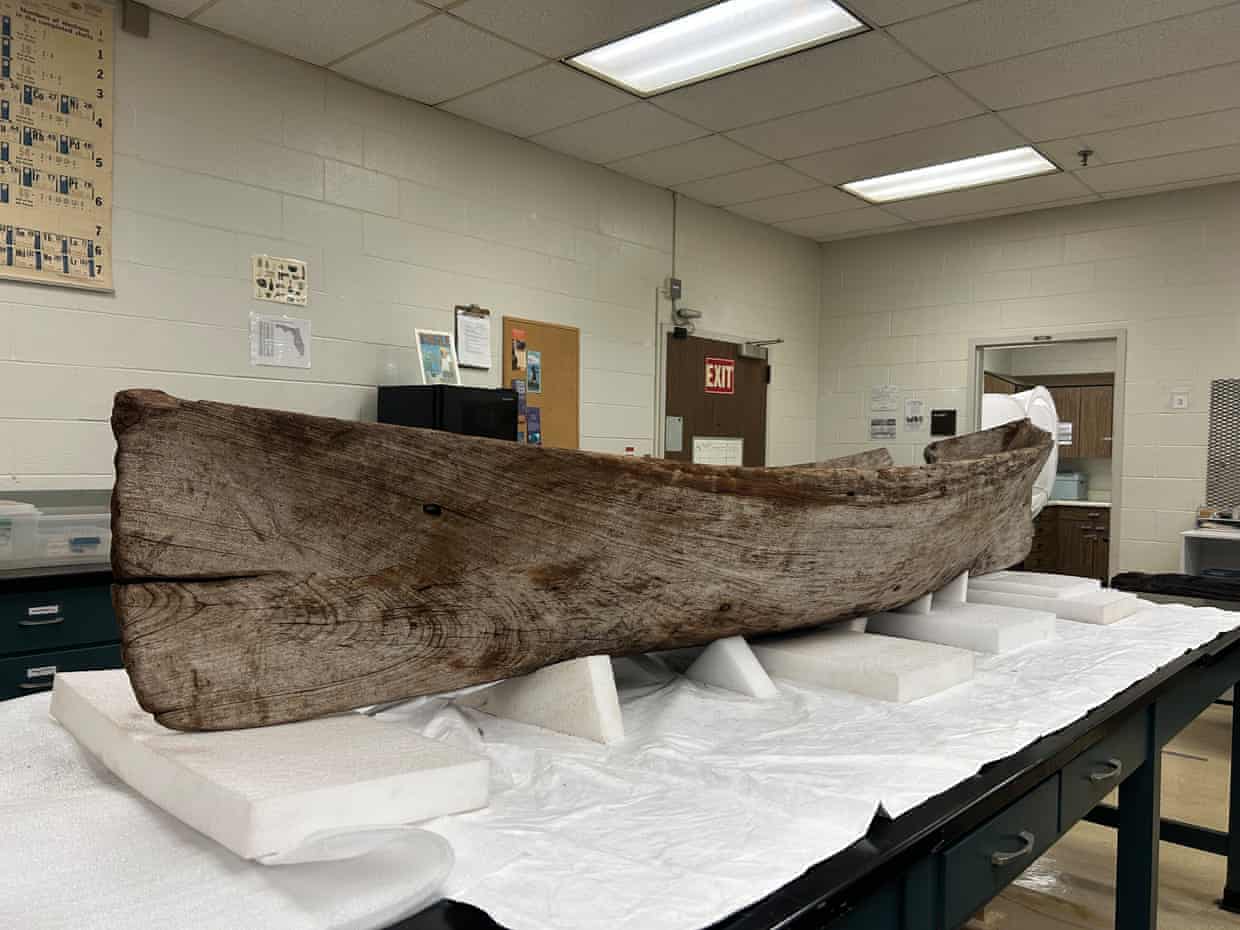
Photo: Florida Division of Historical Resources.
A 16th century canoe was discovered by a resident of Fort Myers, Florida, when Hurricane Ian made landfall in 2022. 

When I was a kid on Fire Island, a big storm always meant there would be treasures on the sand the next day. We would hurry up the sidewalk to the ocean to see how the beach had reshaped itself and what flotsam and jetsam had washed up. Often the shore was littered with shells, jellyfish, or starfish.

Not that we wish for hurricanes, but extra big storms like that can uncover even larger surprises than starfish.

Richard Luscombe notes at the Guardian, “Florida already claims to be the world capital of golf, shark bites and lightning strikes. Now a remarkable discovery following a devastating hurricane has enhanced its position as a global leader in another distinctive field: ancient canoes – some even prehistoric.

“State archeologists have just completed a painstaking preservation of an ancient wooden canoe discovered by a resident of Fort Myers during the cleanup from Hurricane Ian in 2022.

“It joins 450 other log boats or canoes dating back thousands of years recorded or preserved by the Florida division of historical resources. But this one is unusual, officials say, because it is the first they have seen made of mahogany, and probably the first to originate outside Florida, possibly in the Caribbean.

“The age of the fragile 9ft canoe is under analysis through carbon dating and other scientific processes. Investigators are pursuing a theory that it might be a dugout cayuco crafted by Spanish invaders who settled in the region during the 16th century.

“ ‘We compared it to canoes that we have in our collection and previously recorded, and it’s a very unusual form, so that was the first hint it was not necessarily from Florida,’ said Sam Wilford, Florida’s deputy state archeologist. ‘On the surface there’s tool marks made by iron tools, and we know that that is a historical date because that’s when the Europeans introduced iron tools into the Americas.’ …

“ ‘The tree may have died much earlier than when the canoe was constructed from it. It might have been driftwood, or stored somehow before it was made as a canoe.’

Hurricane Ian caused ‘catastrophic’ damage when it slammed into south-west Florida in September 2022 with 150mph winds and a storm surge of 18ft. The canoe is believed to have been pulled from a riverbed and ended up in the yard of a Fort Myers resident, who discovered it as he cleaned up after the storm and alerted state officials.

“ ‘It had been clearly submerged in water; there’s lots of stain marks on it, [but] it was dry when we received it,’ Wilford said, adding that it was then lightly vacuumed and cleaned with soft brushes, and that each stage of its careful conservation was photographed.

“Florida has had more discoveries of old canoes than any other place in the western hemisphere, and more than 200 separate sites have been recorded, officials said. Many of the canoes were made and used by Native American tribes, including the Miccosukee and Seminole tribes, who inhabited large swathes of the state, particularly the wetlands of the Florida Everglades.

“The oldest, Wilford said, is a canoe discovered near Orlando, estimated to come from the middle Archaic period up to 7,000 years ago.

With about one-fifth of Florida covered by water, the prolific use of canoes by its residents throughout history is unsurprising.

“ ‘It’s because of the environment,’ Wilford said. ‘Native Americans and then later on Europeans needed canoes to get around, and then the wet environment also led to preservation.’

“Canoes collected in the state’s historical resources division are stored in what Wilford said was a central archeological collections facility that is not open to the public. But the department operates an artifact loan program, with 26 canoes currently on display at museums across the US.

“ ‘It’s incredibly exciting,’ Wilford said. ‘Every canoe, and every fragment of a canoe, tells a story, and each one is unique.’ ”

More at the Guardian, here. (Although the Guardian has no paywall, I just upped my random donations to an actual subscription as independent journalism seems especially important in these trying times. Even tiny donations are welcome there.)

Read Full Post »

Photo: Melanie Stetson Freeman/CSM.
One Man Swamp Band street musician Brian Belknap performing in the French Quarter of New Orleans in April.

Here’s a story of resilience, 20 years after the devastation of Hurricane Katrina in New Orleans, Louisiana.

Patrik Jonsson writes at the Christian Science Monitor, “When Hurricane Katrina careened into Mississippi and Louisiana 20 years ago this week … the overtopping of New Orleans’ levees caught local, state, and federal officials flat-footed in the days after the storm’s Aug. 29, 2005, landfall just east of New Orleans, near the Pearl River. …

“As I head back to New Orleans ahead of the 20th anniversary of that historic storm, looking to chronicle the growth that has taken place since that disaster threatened to wash away the soul of this vibrant city, I’m following some of the paths I took when covering the aftermath of Hurricane Katrina, remembering that time, those scenes.

“Twenty years after that catastrophe, New Orleans’ larger recovery has been a complicated story of progress, ongoing challenges, and missed opportunities.

“It was still a lawless city when I arrived in 2005. As dark descended and I settled into my van for the night, so did fear. Rumors abounded – most outrageous, but some not far from the truth about the human toll. About 1,800 people are believed to have perished during Katrina and its aftermath, most from the storm surge in Mississippi and catastrophic flooding in New Orleans. The most expensive natural disaster in United States history, it caused over $200 billion in damage. …

“Communities reemerge, but they reemerge differently. People search for what once was – a piece of flatware, a boat transom, a bent-up old .22 rifle. Or an old guitar. They drag the past from the wreckage and use it to imagine the future.

This year, I’ve brought my Guild A-20 dreadnought guitar, my road companion. I’m realizing that this reporting trip is also to build a connection across the decades – maybe one as rickety and rusty as that old Huey Long – and to see the effects on communities and people, including myself, and how they recover. …

“This time I am staying in a rental, a shotgun-style short-term place near the Tremé, the city’s iconic music district.

“I go to a nearby coffeehouse the next morning, where schoolkids in uniforms are already plinking away standards on a well-tuned upright piano. Wrens are cajoling amid the Magnolia grandiflora. I sip chicory-infused coffee and chat with the shop owner about a day that’s dawning with surprising coolness.

“Afterward, I find a great, steep stoop from where I can less watch but rather consider the city. I grab my Guild and sit down, strum some cowboy chords in B major, and noodle some lines from my reporter’s notebook: ‘She’s an angel, even when she’s falling down / She’s an angel, in the wrong part of town.’ …

“Brian Belknap traded a guitar for a life in New Orleans.

“The Chicago native arrived a decade ago, well after the ravages of Katrina. Like so many before him, he fell for the languid city’s slow charms. With little money, he lived on the streets for a while, busking for change. But then he traded his 1942 Martin D-18 for a battered shotgun shack in St. Roch. …

“Every day, Mr. Belknap walks into the French Quarter in the early, cooler parts of the day, setting up the instruments that now make up his One Man Swamp Band on Royal Street.

“ ‘There’s still desperation here,’ Mr. Belknap says. ‘But out here it’s an intimate experience. The people are close. The music is everywhere. Even in hard times, the sense of joy is unmistakable.’

“To punctuate that point, he grabs an accordion, gives a kick on a high hat pedal, and rolls into an original song about folks stomping the varnish off a dance floor.

“Though he’s not a native, in some ways Mr. Belknap’s presence here is a small part of New Orleans’ recovery. The city lost a third of its population after the hurricane. But it has been bouncing back – though not to what it was before Katrina.

“There’s a new $15 billion system of levees, floodgates, and drainage canals built to better withstand storms like Katrina. The public school system, among the worst in the country before 2005, has been revamped. Today, graduation rates have risen significantly, and more New Orleans high schoolers are going straight to college than before.

“But the city continues to grapple with the lasting impacts of the initial federally funded rebuilding plan, called Road Home. Over $9 billion in federal funds was allocated for residents to rebuild – but within a tangle of Byzantine application procedures. Disbursements, too, were based on property values before Katrina struck. This left mostly Black, low-income residents with far less to rebuild, and long-standing racial disparities continue today.

“ ‘Katrina in many ways reshaped the way we think about vulnerability in disasters,’ says Jeannette Sutton, a sociologist who studies emergency preparedness at the State University of New York at Albany. Road Home and other programs, she says, have proved that ‘If you were poor before a disaster, the [disaster response] is not going to improve your well-being’. If you were barely getting by before, you’re not going to be better off with the funding in the aftermath. But those who could ‘afford’ a disaster are probably going to recover pretty well.’ …

“Gentrification has also changed the flavor of New Orleans in many ways. The city continues to debate limiting short-term and highly profitable tourist rentals – like the one I’m staying in – which create a demand for housing and cause other rents to rise. The checkerboard of empty lots in the hard-hit Lower Ninth Ward, too, still defines many of the failures of the federal rebuilding plan. …

“Liz LeFrere was 8 years old, living in New Orleans East, when Katrina struck. She thought she’d miss a day or two of school. Four months later, the family returned to live in the broken city, since her father was a police officer.

“Ten years ago, when she was a student at Tulane, the campus flooded on Aug. 29 – the Katrina anniversary. Ms. LeFrere broke down in uncontrollable tears. ‘It came out of nowhere,’ she says. ‘It’s definitely part of a communal trauma.’

“Yet the storm’s indelible impact also created a new life for her. Today, Ms. LeFrere is part of an artist collective dedicated to understanding Katrina and its aftermath through art – including massive portrait murals that now dot and define the city.

“Artists like Ms. LeFrere are committed to telling a tangibly redemptive story. ‘The art is where expression can be a catalyst for change,’ she says. The murals ‘help create a sense of people seeing themselves reflected in the face of the city. The narrative of New Orleans expanded.’ ”

There’s a lot more at the Monitor, here. Impressive photos. No paywall, but subscriptions keep responsible news coming. Reasonable prices.

Read Full Post »

Photo: Erin Brethauer.
Marquee hosted more than 300 artists and small business owners in Asheville, North Carolina, before Hurricane Helene, a devastating storm in 2024.

When Hurricane Helene washed through Asheville, North Carolina, last year, my childhood friend Ursula was one of the many who lost out. Her basement washed out, not only forcing her to stay at a neighbor’s but damaging many of her father’s artworks and the materials for her own weaving. At the same time, Asheville lost its whole arts district.

Now Ursula is rebuilding, and so is Asheville.

Jonathan Abrams writes at the new York Times, “Jeffrey Burroughs strolled among crooked trees and clumsily leaning chain-link fences on a recent Thursday afternoon in Asheville’s lower River Arts District. Nearby, heaps of flood-damaged antiques dotted the ground outside gaptoothed buildings that had previously housed hundreds of working artists.

“ ‘It’s nice that at least it’s green,’ Burroughs, president of the River Arts District Artists, said of the bent trees. ‘It was really depressing through the winter and the fall.’

“Burroughs, who uses they/them pronouns, is not joking when they say they have taken just two days off in the more than 10 months since Hurricane Helene, the deadliest hurricane to strike the mainland United States since Katrina in 2005, ravaged wide swaths of the Southeast, leaving at least 250 people dead.

“The storm overwhelmed Asheville’s French Broad River, submerging much of the once robust River Arts District in as much of 24 feet of water, caking it in layers of mud and destroying the life’s work and financial pipeline of hundreds of artists. …

“ ‘People were prepared because this area has flooded’ in the past, Burroughs said. ‘They moved everything up. Nobody anticipated second floors would flood. That’s not something you even conceive.

‘All of a sudden, it was like a lake opened in the middle of our town.’ …

“Over the past few decades, the River Arts District blossomed into that sprawling artistic epicenter as antiquated buildings transformed into bustling studios, classrooms, galleries and showrooms. The district’s recovery is seen as a crucial step in regaining a steadiness of income and the sense of normalcy for the many who lost so much in the storm.

“ ‘The business owners in the River Arts District have been working their tails off to rebuild since Hurricane Helene struck and I am making sure the state works with that same urgency to support their recovery,’ said Gov. Josh [Stein] who recently toured the district on a bike.

“The River Arts District housed nearly 750 artists before the hurricane. ‘You’re just immersed in art,’ said Davis Perrott, a woodworker who recalled waking up from the storm to a sound like someone forcefully slamming themselves against his window. ‘I’m sure there are other areas like it, but I haven’t seen it.’

“The upper portion of the district, which houses Burroughs’s jewelry store, returned fully in January. A few spaces have reopened in the lower portion of the district, which is closer to the river and suffered the most flooding.

“About 350 of the displaced artists are working again in the district. Some are actively involved in the continuing recovery process, waiting to return to the home that welcomed them.

“Others have decided not to return. For them, the risk of another storm outweighed anything else.

“Riverview Station was a major hub in the district, once hosting hundreds of artists, including the 14,000-square-foot ceramics space, the Village Potters Clay Center. That was before ’26 feet of water went through and wiped us out,’ said Sarah Wells Rolland, its founder. …

“The center was home to studios, showrooms, a gallery and classrooms where workshops were held. Wells Rolland said that $500,000 worth of equipment was lost in the flooding.

“ ‘I never even entertained going back,’ she said. … ‘I believe it’ll all wash away again.’

“Instead, Wells Rolland opened a new center near the arts district. While her business has returned, she is still searching for her creative spark.

“ ‘I’ve lost a lot of people. … Just numb is what I felt. I didn’t have any ideas. Still, almost a year out, I’m a highly creative person, but I still don’t feel like I have that creative energy yet.’

“As the district returns in fits and bursts, it could provide a blueprint for how other communities ravaged by increasingly destructive natural disasters can recuperate their livelihoods. Those affected have been depending much more on smaller networks of supporters and volunteers than on any government channels. …

“Marquee, an art gallery that hosted more than 300 artists, [anticipated] a September reopening, with other businesses in the lower district.

“ ‘We’re able to tweak the things that we wished we’d have done the first time before we opened and now we’re getting to get it all right,’ said Robert Nicholas, the building’s owner.

“Despite the devastation it caused, the storm reinforced what had drawn many to the district in the first place, heightening their sense of community.” More at the Times, here.

Read Full Post »

Photo: Ken Ruinard/USA Today.
Asheville, North Carolina, after Hurricane Helene.

Asheville, NC. “I’m safe, but my house is structurally damaged and I’ve just dealt with FEMA and they’re very good and my insurance is being a pain in the neck so … ugh. Anyway, I don’t have power or water and I’m living in a neighbor’s house right now. Thank you for thinking of me. I’m safe and a little stranded feeling. I’ll try and reach out when I’ve got more definite news.”

I got that voicemail on October 7. Hurricane Helene struck my childhood friend’s home September 24. She didn’t answer email. I didn’t have her mobile phone number. But when the US mail delivered my letter to her, we connected.

Patrik Jonsson goes in depth at the Monitor about hurricane-tossed North Carolinians pulling together to help one another.

“Eric Gillespie put his sandals on, walked outside his house, and stood in awe at the sight of Clear Creek – usually a gurgling rivulet – rushing like a dark torrent.

“Then he heard the screams for help. Down a steep bank lay a row of cookie-cutter houses, now up to their eaves in muddy water. Friends and neighbors – some infirm – remained in their homes as nearly 30 feet of water rushed down the French Broad River system, rising in a matter of minutes, trapping a dozen neighbors unable to scramble to higher ground.

“ ‘That’s when things got crazy,’ says the owner of the Wakey Monkey coffee shop in nearby Saluda. ‘There was no way to prepare for what happened.’

“In a rescue scene replicated over 6,000 times across Appalachia as remnants of Hurricane Helene crashed into the steep terrain, neighbors and first responders rushed to action, using everything from sofa cushions and paddleboards to mules and Chinook helicopters in order to ferry friends and strangers to safety. Over 230 people died in the storm, the bulk of them in Appalachia. The toll includes 11 members of one family in the Asheville suburbs.

“ ‘There was both beauty and tragedy in the response,’ says Nathan Smith, a pilot from Charlotte, North Carolina, who surveyed the damage as he flew his 1979 Cessna 180 Skywagon on multiple missions into hard-hit county airports. …

“There were slip-ups and mistakes. But to many on the front lines here, the very worst that nature could conjure was met by the very best America had to give. …

“What promises to be a long recovery is now top of mind for residents of Greater Appalachia, many of them exhausted and still in shock at the discombobulation not only of their lives, but also of the geography of their valleys. …

“In Saluda, North Carolina, a railroad stop that became an adventure destination, the tone of the first meeting of the local business association after the storm was subdued at best.

“The Green River, a world-renowned kayaking destination, could remain impassable for months, if not years, some association members said. With major roads blocked and tourist towns like Bat Cave and Chimney Rock leveled, would anyone show up for leaf-peeping season?

“ ‘What happened was scary,’ says Emily Lamar, co-owner of The Purple Onion restaurant in Saluda. ‘What happens next is scary, too.’

“Access issues for rescue crews tell that story. There is little way to get from South Carolina to Tennessee as parts of Interstate 40 are washed out. The famous Blue Ridge Parkway is undrivable, covered with trees and washouts. Large parts of Asheville’s quirky River Arts District are smashed. {See photo.] Much of what was the iconic village of Chimney Rock is now wreckage situated downstream in Lake Lure. …

“One analogue is the city of New Orleans, which lost more than a quarter of its population [after Hurricane Katrina] 2005 and 2011. But just as New Orleans used that experience to strengthen its levees, many here hope these Carolina communities can build back stronger. Hard-hit Asheville, for one, has long debated better flood controls for its vulnerable River Arts District.

“ ‘This recovery, it’s going to be weeks, months, years, decades, if it’s ever complete,’ says Aaron Clark-Ginsberg, professor of policy analysis at the Pardee Rand Graduate School in Santa Monica, California. ‘Some of this trauma is going to be incorporated into the structure of the community.’ “

More at the Monitor, here. No paywall. Excellent pictures.

Read Full Post »

Photo: Panoramic Studio/Landprocess.
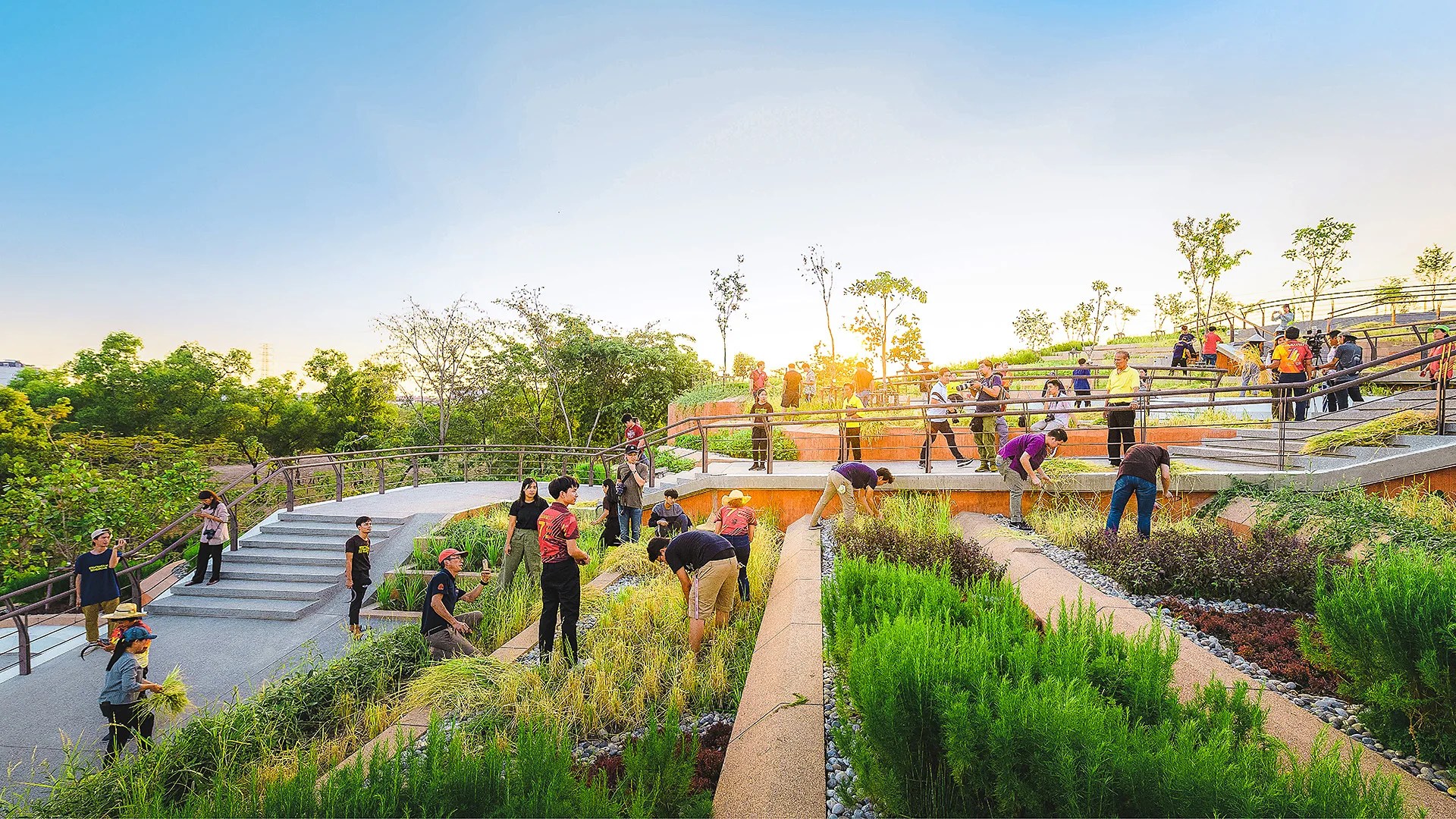
Thammasat University’s rooftop farm features cascades of rice paddy-style terraces used to grow organic crops.

Here in the US, we are all preoccupied with floods because we’re in the midst of an extreme hurricane season. So it seems strange to think of places where a certain amount of flooding is desired — rice paddies.

Xiaoying You at the BBC writes about what can be learned from ancient techniques for controlling rice-paddy flooding.

“One of Kotchakorn Voraakhom’s most memorable moments growing up in Bangkok in the 1980s was playing in floodwaters in a small boat built by her father in front of her home.

” ‘I was so happy that I didn’t need to go to school because we didn’t know how to get to it,’ recalls Voraakhom, a landscape architect based in the Thai capital.

“But nearly 30 years later, flooding turned from a fun childhood recollection to a devastating experience. In 2011, Voraakhom and her family – along with millions of others in Bangkok – found themselves ‘displaced and homeless‘ when floods plowed through swathes of Thailand and poured into the metropolis. …

“The disaster deeply shook Voraakhom, who believed it was time to use her expertise to do something for her hometown. She founded her own landscape architecture firm, Landprocess, which over the past decade has designed parks, rooftop gardens and public spaces in and around the low-lying city to help its people increase their resilience to flooding.

“Perhaps her most intriguing design so far has been an enormous nature-laden university roof inspired by rice terraces, a traditional form of agriculture that has been practiced in Asia for some 5,000 years. …

“The university roof designed by Voraakhom is part of a wider trend in Asia that is seeing architects seek inspiration from the region’s rice terraces and other agricultural heritages to help urban communities reduce waterlogging and flooding. …

‘The answers to the future of climate change, many of them are actually in the past,’ says Voraakhom.

“At Thammasat University, north of Bangkok, tiers of small paddy fields cascade down from the top of the building along Voraakhom’s green roof, allowing the campus to collect rainwater and grow food.

“There are four ponds around the building to catch and hold the water flowing down. On dry days, this water is pumped back up using the clean energy generated by the solar panels on the roof and used to irrigate the rooftop paddy fields. …

“Compared to a design made of concrete, the green roof can slow down runoff – excess rainwater that flows to the ground, a big problem for Bangkok – by about 20 times, according to estimates from Voraakhom. It can also lower the temperature inside the building by 2-4C (3.6-5.4F) during Bangkok’s notoriously hot summer, she says.

“Rice terraces are layer upon layer of paddy fields usually created by smallholder farmers along the sides of hills and mountains to maximize the use of land. They can be found in many Asian countries. …

“While their shapes and sizes may vary, all rice terraces are built to follow natural contor lines, which means each layer has equal elevation above sea level. This feat enables them to collect and hold rain and use it to nurture the soil and crops. Some rice terraces, such as those of the Hani people in southern China, overlook rivers, allowing the tiered soil to reduce, decelerate and purify excess rainwater washing down from the top of the mountain before it flows into the valley.

“Such indigenous know-how, passed down by generations of small-scale farmers, can hugely benefit Asian cities when it comes to handling rainstorms, according to Yu Kongjian, a professor of landscape architecture at Peking University in Beijing and the brains behind China’s ‘sponge city’ concept

“Chinese cities – as well as many others in Asia – have a monsoon climate, which is characterized by rainy summers and drier winters. … Huge downpours mean their flood-control measures need to be based on localized ways of adaptation tested and proven over thousands of years, he argues.

“Rice terraces are one of the pillars of Yu’s spongy city theory, which urges cities to turn to soil and greenery – not steel or cement – to solve flooding and excess rainfall problems. According to him, rainwater should be absorbed and retained at the source, slowed down in its flow and then adapted to where it ends up. Rice terraces deal with mitigating floods at the source, Yu says. …

“The Yanweizhou park, for example, completed in 2014 in Jinhua, Yu’s hometown, has a rice-terrace-like bank planted with grasses that can adapt to an underwater environment. The spongy feature is capable of reducing the park’s yearly maximum flood level by up to 63%, compared with a concrete one, a 2019 paper found.

“Such designs can also filter floodwater, which is often contaminated by sewage, chemicals and other pollutants. Another of Yu’s projects, Shanghai Houtan Park, is situated on a piece of once highly polluted land that used to house a landfill site for industrial waste. Since its establishment in 2009, each hectare of the park, which also features Yu’s terracing element, is capable of purifying 800 tons of heavily polluted water per day.”

Read about related flooding projects at the BBC, here. Fascinating photos.

Read Full Post »

Photo: Stephanie Hanes/The Christian Science Monitor.
A jogger runs on a path in Babcock Ranch, Florida, on Nov. 3, 2022. Babcock Ranch, which calls itself America’s first solar-powered town, survived Hurricane Ian with little to no damage.

When does the bottom line get in the way of building something to last? Too often.

But there are always outliers. At the Christian Science Monitor, I learned recently about housing developers in Florida who give “careful consideration of how the built environment will respond to an increasingly harsh climate.”

Stephanie Hanes writes, “As Hurricane Ian moved toward Florida’s west coast in late September, Amy Wicks drove around this rapidly growing community, trying to figure out what she hadn’t thought of yet. She checked for any debris that might be blocking water runoff paths; she took note of the restored wetlands; she hoped that no alligators had taken up residence in the drain pipes.

“Eventually, she returned to her own home here, hunkered down with her husband and three children, and listened as freight train winds moved over Babcock Ranch, a 4-year-old planned community some 20 miles inland from Fort Myers. At that point, she says, she could only hope that the unique storm water system she had designed and monitored over the past decade would be up for the task. …

“The storm sat overhead for nearly 10 hours, dumping more than a foot of rain on this swath of old Florida cattle ranches and newly built cul-de-sacs.

“By the time it subsided, it was clear that something extraordinary had taken place in Babcock Ranch. Created as a sort of laboratory for green development in Florida, and intentionally designed to survive extreme weather, the town proved remarkably resilient in the face of a Category 4 hurricane.

“Unlike surrounding areas, it did not flood, in large part because of Ms. Wicks’ years of planning and her unique stormwater management design that mimicked natural systems rather than fighting them. It did not lose power, thanks not only to its 700,000-panel solar grid and battery backup system, but also to the power line hardening developers undertook with their utility provider, Florida Power and Light. And because Babcock Ranch owns and operates its own water plant, which also survived the storm, it was the only town in Charlotte County that did not go under a boil-water alert. …

“Across the state, there is a small but growing effort to build more resilient communities in Florida – an effort to shift a yearslong pattern of rapid development that many here say exacerbates water shortages and other environmental risks. …

“With a constant flow of new homebuyers – an average of nearly 1,000 people move to Florida each day, according to oft-repeated state statistics – developers have tried to acquire as much land as possible, and as quickly as possible. That often means buying up faded ranches or long-ignored swaths of swamps and forest – green-covered lands that must be flattened and cleared to make way for housing developments and roads and shopping centers.

“Indeed, to meet building codes that require homes to be graded above street level, developers will typically bulldoze the landscape, dig storm ponds, and then use the fill from those holes to prep building sites, explains Timothee Sallin, co-CEO of Cherrylake, a landscape company working across the Southeast that has become a leader in sustainable design.

“Traditionally, developers would replant that denuded landscape with the types of species that outsiders tend to think about when they imagine Florida – green St. Augustine grass, colorful azaleas, draping bougainvillea. The problem, Mr. Sallin says, is that these plants aren’t native to the state, so they require a lot of inputs to stay healthy, such as water, fertilizer, and pesticides. They also struggle to thrive in soil devoid of organic material and nutrients.

“ ‘The developers have to mass grade a site to build efficiently and economically,’ he says. ‘The most efficient thing to do is to raze it and bring in fill. But that creates soils that are difficult to work with.’

“Meanwhile, because the natural topography of the land has been erased, and the natural water collection systems of wetlands and marshes eliminated, the man-made drainage system becomes the only way to capture water. This can be a problem in some storms – particularly those with unusually heavy rains thanks to climate change.

“All of this, says [Jennison Kipp, a resource economist with the University of Florida and the state coordinator for Sustainable Floridians] creates a system without resilience, suffering from both too much and too little water. ‘The landscapes are on life support,’ she says. …

“According to the state’s central water authority, the region will face a 235 million gallon a day shortfall by 2035 unless demand and usage patterns change. This is one of the reasons why when 27,000 acres of ranch land came up for development just south of Orlando – part of a 300,000 acre swath owned by the Church of Jesus Christ of Latter-Day Saints – executives at the development company Tavistock decided to approach the project differently. …

“To plan Sunbridge, which is about two-thirds the size of Washington, D.C., [Clint Beaty, senior vice president of operations for Tavistock and the lead on the Sunbridge project] and others at Tavistock coordinated with representatives from the University of Florida’s Institute of Food and Agricultural Sciences, the Sustainable Floridians, and other groups. They came up with a plan to use native landscaping – even eschewing the popular St. Augustine grass for the more drought and heat resilient (although occasionally browner) Bahia grass. They are saving and relocating some of the old live oak trees on the property. All of the new homes will be wired for solar panels and electric vehicle plug-ins, and one model house version boasts Tesla solar shingles and a battery backup system.

“Meanwhile, to help move away from fertilizers, scientists have built a living laboratory along a walking path at the development’s community center, called Basecamp, where they are testing the viability of different species of native plants as well as different sorts of compost amendments to soil and the impact on pollinator species. Mr. Beaty is also working to figure out how to arrange for large scale composting and food-waste recycling for the community.”

More at the Monitor, here. No firewall. Subscriptions welcome.

Read Full Post »

Photo: Moira Donovan.
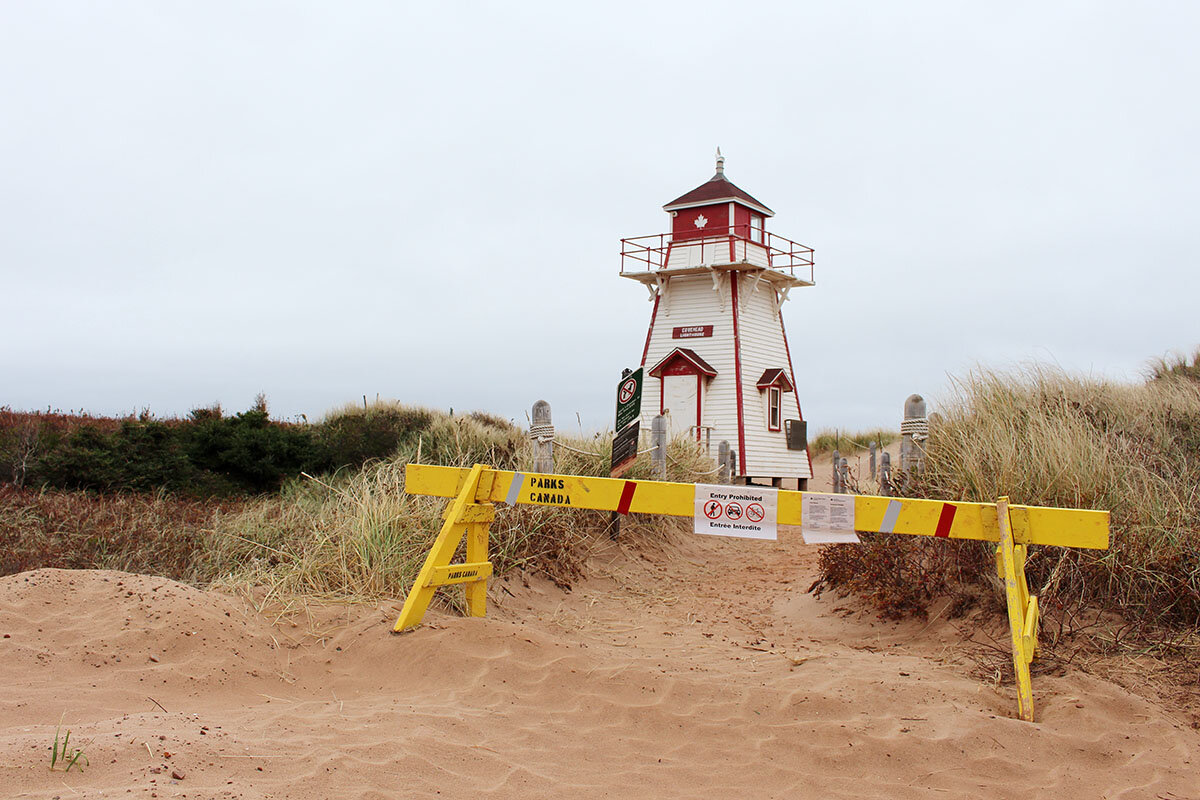
“Hurricane Fiona carved out sections of coastline,” says the
Monitor, “and caused dunes to disappear on Prince Edward Island, where beaches like this one remained closed weeks later.”

There’s nothing like a new experience to make you see things differently. At the Christian Science Monitor, Moira Donovan reports that the severity of a recent hurricane on Canada’s Prince Edward Island is forcing people “to grapple with how climate change is rewriting people’s relationship with the sea.”

She writes, “Robbie Moore spent a week preparing his oyster farm as Hurricane Fiona barreled toward Prince Edward Island in late September. But that didn’t spare it from the impact.

“On Sept. 24, Fiona roared across Atlantic Canada, leaving catastrophe in its wake, including two deaths. Prince Edward Island recorded 92 mph winds, and on the North Shore, where Mr. Moore’s farm is located, the storm ripped up trees, reduced wharves to splinters, and flooded structures. By the time he could get to his farm to assess the damage several days later, he found some sections had vanished, and this year’s oyster crop had been tossed into the treeline, 30 feet from the high-water mark.

“Still, he counts himself relatively fortunate. Some people lost everything, and as much as people had prepared, there was no way to prepare for the damage Fiona caused. ‘There’s a lot of people very discouraged right now,’ he says.

“The recovery is expected to take years. But given what Fiona has shown about the growing threat posed by hurricanes, the more transformative effect could be still to come. As hurricanes become a more regular, immediate danger up and down North America’s Eastern Seaboard, Atlantic Canada – like regions from the Gulf Coast to Florida to New England – is beginning to grapple with how climate change is rewriting people’s relationship with the sea.

“While Atlantic Canada is no stranger to volatile weather, Fiona marked a departure.

Past storms, such as Hurricane Dorian in 2019, had weakened before they made landfall. But Fiona retained much of its strength, making it the most powerful storm to ever hit Canada.

“University of Prince Edward Island climatologist Adam Fenech says that while Fiona was unprecedented, the storm was not unanticipated, given projections of stronger storms in the Atlantic hurricane season. ‘All the things that we’ve been talking about for 30 years are all coming true,’ he says.

“Despite that consensus, Dr. Fenech has spent years playing Cassandra to an at-times skeptical public. Half a dozen years ago, when Dr. Fenech was invited to give a talk about coastal erosion at a cottage development on Prince Edward Island’s North Shore, he warned that many of the properties could disappear in a big storm. Residents were unconvinced. …

“When Fiona hit, 12 cottages in that development were swept off their footings; several were swallowed wholesale by the ocean. In other places, people’s year-round homes were destroyed.

“But in a region where communities have deep ties to the coast, housing isn’t the only concern. Atlantic Canada is the site of Canada’s most lucrative fisheries, operating out of nearly 200 small harbors dotting the coastline – nearly three-quarters of which were affected by Fiona in some way.

“For many harbors, the destruction caused by Fiona will mean an expensive rebuild. But some people are saying the reconstruction should look different.

“When Fiona hit Newfoundland’s southwest coast, Shawn Bath was a day’s drive away; as the scale of the damage came to light, he loaded his truck, hitched his boat, and headed across the province.

“There, he found … shorelines littered with debris. In many places, wharves and fishing stages had been smashed like toothpicks, scattering fishing gear into the water. Mr. Bath and his crew – who run a marine debris cleanup project called the Clean Harbours Initiative – made their way to a small community called Burnt Islands, and got to work. …

” ‘It’s overwhelming,’ says Mr. Bath. ‘Pictures don’t do it justice.’ And he’s worried that there are more than a thousand fishing nets drifting along the bottom of affected harbors. … In the long term, Mr. Bath says the way harbors are laid out needs to be rethought. Fishing infrastructure has traditionally been placed close to the water because that’s where it made the most sense to be. But that calculus has changed.

“ ‘There’s no point in rebuilding and filling all these stages with nets again, if two years down the road the same thing happens,’ he says. ‘Keeping fishing gear on the water’s edge is no longer a reasonable thing to do.’ …

“For Prince Edward Island musician Tara MacLean, who grew up playing in the dunes, the shock of seeing a beloved landscape suddenly vanish was indescribable. …

“Ms. MacLean says the sorrow for what’s been lost should serve as a wake-up call on the risk that climate change poses to the region. But it’s that emotional connection to the water that could also make changing the relationship to it difficult, and when things return to normal, the allure of living close to the water may return, too.”

More at the Monitor, here. No firewall.

Read Full Post »

Photos: Valaurian Waller.
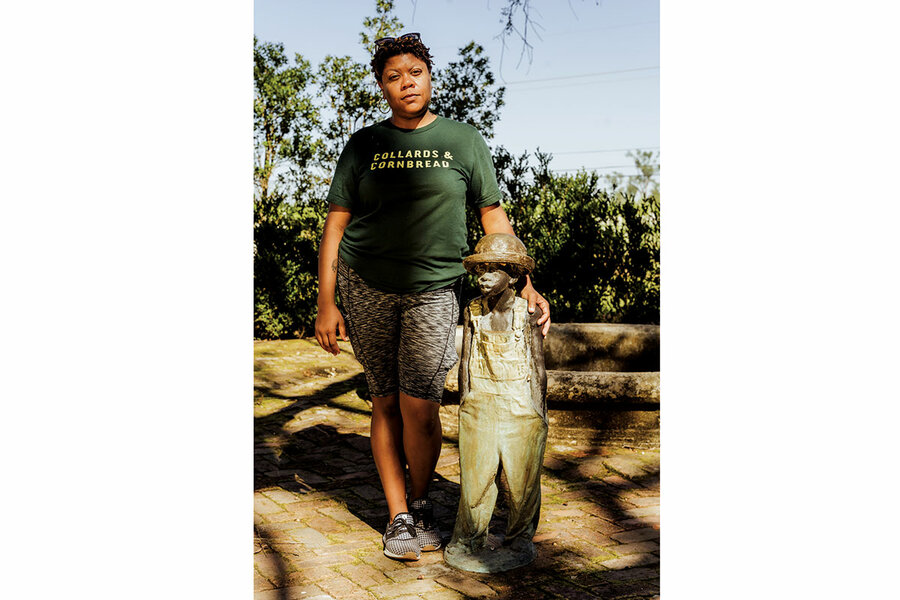
Ederique Goudia is a chef who came through for her community after Hurricane Ida. She is seen here with a statue commemorating child slaves on the Whitney Plantation — the only museum in Louisiana with an exclusive focus on the lives of enslaved people.

Have you been following the efforts of Chef José Andrés and World Central Kitchen as they serve the displaced people of Ukraine? Inspirational. Today I have a related story. It’s also about chefs who help desperate people by giving what they know best.

Xander Peters has the story at the Christian Science Monitor. “Ederique Goudia isn’t the type who stops moving. From November through February, her life was like a hurricane’s gust, tossing her about the country between the community that raised her and the place she now calls home.

“In early November, Ms. Goudia and an entourage of chefs made their way from Detroit to her childhood hometown of Wallace, Louisiana, a community of nearly 600 about 50 miles outside New Orleans that had been pummeled by Hurricane Ida’s Category 4 strength last summer. Her foodways colleagues Raphael Wright and Jermond Booze, among a host of others from their home in Detroit, rallied around her and organized a day of service for the community, followed by their group’s inaugural diaspora dinner. …

“The day after they arrived back in Detroit, Ms. Goudia and company made a beeline back to the kitchen, where they began working alongside colleagues to prepare 50 family-sized Thanksgiving meals for their food-insecure community members. The meals were prepared through the food security group Make Food Not Waste, of which Ms. Goudia is the lead chef. 

“Food relief is about more than physical sustenance for Ms. Goudia and the many chefs who volunteer alongside her. It is a rung on the ladder to stability. And it can be the glue that holds communities together. ‘It creates a shared song amongst people, of a reset,’ says Detroit chef Kwaku Osei-Bonsu, founder of ​​BlackMetroEats and one of the volunteers who traveled to Wallace with Ms. Goudia. …

“After Ida hit southeast Louisiana, [friends from the nonprofit Taste the Diaspora] were among the first to ask how her family fared, and they were well aware that it wasn’t feasible to get to Louisiana to help right away, as disaster recovery dragged on for weeks after the storm. They then suggested hosting local pop-up fundraisers. Before long, they had gathered a group of 15 or so members of the Detroit food community interested in traveling to Wallace. …

“[Ms. Goudia] knows small towns like hers don’t often receive disaster relief quickly while efforts concentrate on metro areas like New Orleans and Baton Rouge first. Wallace sits in the middle of a petrochemical corridor and has long struggled with environmental justice issues.

“Ida made landfall on Aug. 29. As Ms. Goudia checked on her family, the Detroit food scene leaped into action. … In total they raised $8,500 and they distributed it to Wallace residents through the Descendants Project, an advocacy group for descendants of formerly enslaved people in Louisiana’s river parishes. … 

“By the time Ms. Goudia and her colleagues were ready to head to Wallace themselves, word had spread through the Detroit area. Soon sponsorships began rolling in: The Kresge Foundation, which expands opportunities for low-income individuals nationwide, was the first major group to chip in. Then ProsperUS Detroit, an economic development initiative, pitched in. Turning Tables NOLA caught wind of their efforts soon after and offered to help as well. …

“The Detroit food community’s support for Ms. Goudia and her hometown was, in some ways, as emotionally overwhelming as watching Ida hit her family. At the same time, it wasn’t surprising. It’s what Ms. Goudia has come to know as the heart of Detroit.

“ ‘The hospitality that lives in Detroit, it isn’t a one-off,’ says Ms. Goudia. ‘It isn’t surprising at all, because there is this Southern hospitality that’s here, that’s unmatched.’

“On the day of the Wallace dinner, as always, Ms. Goudia didn’t stop moving. She and her volunteers worked through the afternoon to prepare an evening meal of a beet-based African dish, mirliton dressing, baked spaghetti, cornbread tea cakes, and pralines.

“As he leaned against a picnic table out front, opening cans of corn, Mr. Osei-Bonsu of BlackMetroEats reflected on his and others’ trip down South so far, and what he hoped the meal would mean for the community.

“Healing a community’s emotional wounds through food ‘is definitely something that’s impactful,’ Mr. Osei-Bonsu says. ‘Today will be about so much more than just the consumption of food. It’ll also be a dialogue.’ …

“Ms. Goudia says from her home in Detroit several weeks later [that the point is] to use ‘food in a way that breathes life into people, that gives them what they didn’t think they needed at the time.’ She stops and reflects for a moment. ‘I think we were successful in that. … Everybody that came on the trip is now family. Not only with me, but with the residents of Wallace. I was blessed to be able to provide that for them.’ ”

More at the Monitor, here.

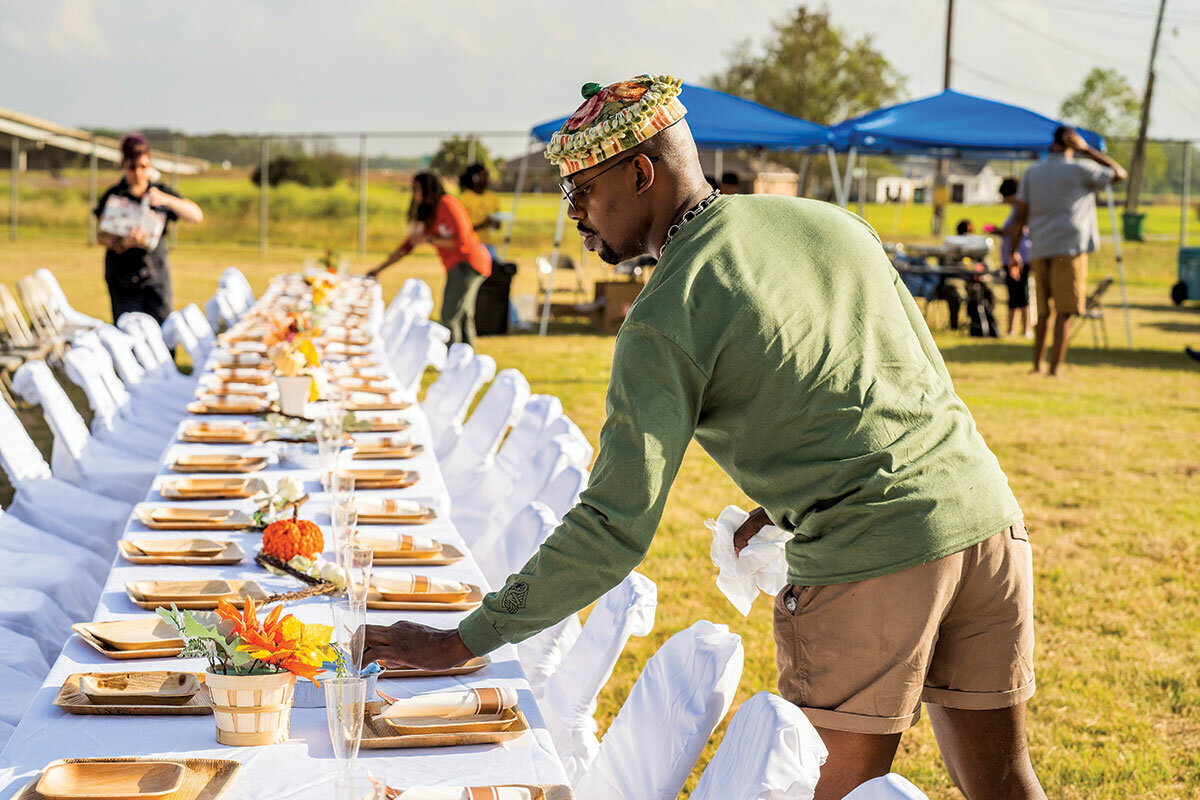
Kwaku Osei-Bonsu, Detroit-based chef and founder of BlackMetroEats, sets the table for a 100-person Taste the Diaspora community dinner in Wallace, Louisiana, Nov. 21, 2021.

Read Full Post »

I’ve been reading a compelling fantasy novel about travel to different worlds that, like other fantasies I’ve read recently, underscores something important about the real world. We are destroying it.

A New York Times article by Catrin Einhorn and Christopher Flavelle focuses on a group in Mexico saving one beautiful piece of our planet, using a different way of funding the work. It’s controversial, but see what you think.

“When Hurricane Delta hit Puerto Morelos, Mexico, in October, a team known as the Brigade waited anxiously for the sea to quiet. The group, an assortment of tour guides, diving instructors, park rangers, fishermen and researchers, needed to get in the water as soon as possible. The coral reef that protects their town — an undersea forest of living limestone branches that blunted the storm’s destructive power — had taken a beating. Now it was their turn to help the reef, and they didn’t have much time.

“ ‘We’re like paramedics,’ said María del Carmen García Rivas, director of the national park that manages the reef and a leader of the Brigade. When broken corals roll around and get buried in the sand, they soon die. But pieces can be saved if they are fastened back onto the reef. …

“The race to repair the reef is more than an ecological fight; it’s also a radical experiment in finance. The reef could be the first natural structure in the world with its own insurance policy, according to environmental groups and insurance companies. And Hurricane Delta’s force triggered the first payout — about $850,000 to be used for the reef’s repairs. …

“When the Brigade laid eyes on their reef, which runs 28 kilometers south of Cancún and is home to critically endangered elkhorn coral, it looked ransacked. Structures the size of bathtubs were flipped upside down. Coral stalks lay like felled trees. Countless smaller fragments of broken coral coated the seafloor.

“On the boat, cement mixers prepared a special paste that snorkelers ferried down to divers who spent hours underwater carefully fastening pieces back on the reef. They used inflatable bags to turn over large formations rolled by the storm and collected fragments to seed new colonies. …

“Back in 2015, Kathy Baughman McLeod, who was then director of climate risk and resilience at the Nature Conservancy, asked a profound question: Could you design an insurance policy for a coral reef?

“On its face, the idea might have seemed absurd. For starters, nobody owns a reef, so who would even buy the policy? And it’s not easy assessing the damage to something that’s underwater.

“But Ms. Baughman McLeod, along with Alex Kaplan, then a senior executive at Swiss Re, a leading insurance company, came up with workarounds. First, the policy could be purchased by those who benefit from the reef — in this case, the state of Quintana Roo, which is also home to Cancún and Tulum and has a tourism economy estimated at more than $9 billion. …

“Second, rather than basing the payout on reef damage, it could be triggered by something far easier to measure: The storm’s wind speed. The stronger the wind, the worse the assumed damage to the reef.

“The idea of putting a dollar value on a reef or ecosystem by identifying a ‘service’ that it provides has become increasingly popular. For example, coastal salt marshes protect from flooding — offering economic benefits on top of environmental ones. Peat bogs store vast amounts of carbon, keeping it out of the atmosphere where it would worsen global warming. And coral reefs reduce the energy of waves by 97 percent, protecting coastal properties.

“But this notion of ‘ecosystem services’ is controversial in some circles.

“ ‘It’s a popular concept because it commodifies nature and it allows people to put a dollar value on nature,’ said Terry Hughes, who directs a center for coral reef studies at James Cook University in Australia. ‘But it’s very anthropocentric and it’s certainly not about protecting nature for nature’s worth. It’s almost kind of selfish.’

If you look at it from the reef’s perspective, Dr. Hughes said, hurricanes are the least of its problems. Climate change, coastal pollution and overfishing are far greater threats.

“But given the scale of the planet’s intertwined environmental emergencies — not only climate change but the collapse in biodiversity — conservationists say they must be pragmatic. More than a million species are at risk of extinction, including many coral species.

“And in Puerto Morelos, monetizing the reef had the almost ironic consequence of helping some in the community understand that it is actually invaluable. ‘My experience with the Brigade has changed my thinking so much,’ said Alejandro Chan, who takes tourists sport fishing and snorkeling. ‘I have to help the reef.’ …

“ ‘If the insurance money had been available in a timely manner,’ said Claudia Padilla, a researcher at the National Fisheries and Aquaculture Institute in Mexico, which developed the Brigade’s hurricane response protocols and trained its members, ‘the results of the rescue effort could have been greatly multiplied.’

“Still, the money will be put to its intended purpose of restoration, funding longer-term projects like seeding of new colonies and replenishment of reef biodiversity. And Mr. Secaira of the Nature Conservancy believes that the rest of the world will use Quintana Roo as proof of concept.

“Indeed, as the Brigade was at work in Puerto Morelos, a bill in Guam’s Legislature sought to evaluate insuring a reef there. Training is underway in other locations in Mexico, Belize and Honduras.”

Hat tip: Hannah. More at the New York Times, here.

Read Full Post »

img_2122-edit-572ac53c931c7a2f01777cd9d56a9beb080e9036-s600-c85

Photo: Greg Allen/NPR
Francisco Valentin, a store owner in Mameyes, Puero Rico, helped parts of his town convert to solar energy after Hurricane Maria.

As Puerto Rico deals with another hurricane, Dorian, it’s worth remembering that even the extreme devastation of Hurricane Maria two years ago could not dampen the ability of a resourceful people to rebound.

In this story, we see how the months without electricity in 2017 led to innovations in renewable power.

Marisa Peñaloza and Greg Allen at National Public Radio’s All Things Considered report, “Mameyes is a small community of about 1,000 people high in Puerto Rico’s central mountains. But in its own way, it is one of the leaders of Puerto Rico’s energy future.

“Francisco Valentin grew up in Mameyes, where he runs a small store. Even before Maria he had big ambitions for his town. After Maria, he knew he wanted his community to run on solar power. And with the help of foundations, charities and the University of Puerto Rico — not the government — he has done that, converting the town’s school, health clinic and several other buildings.

“The move to solar was important, Valentine says, because after Maria it took months before power was restored to the area. This makes Mameyes self-sufficient and able to respond to residents’ needs in future disasters. …

“Across the island, individuals, communities and businesses are installing solar panels and battery systems. At the Community Foundation of Puerto Rico, Javier Rivera is working on solar systems with 50 mostly rural, underserved communities. His goal is to wire 250 communities for solar over the next few years.

“Rivera says that especially after the hurricane, people realized they couldn’t depend on Puerto Rico’s Electric Power Authority. … [PREPA] had severe problems long before Hurricane Maria. After decades of mismanagement, a several-billion-dollar debt drove the authority into bankruptcy. …

“PREPA officials say they are ready to make big changes. The authority has prepared a detailed plan to rebuild its power grid into a more resilient system. It includes hardening transmission towers and lines, burying some underground. It also envisions splitting the system into eight minigrids, each with its own power generation. That is intended to prevent another extended islandwide power failure.

“The first phase will cost $1.4 billion. … ‘This is a key part of what an energy sector should look like,’ [Fernando Padilla, one of PREPA’s top executives] says.

“Just a small portion of the utility’s energy currently comes from renewable energy sources. Some of that renewable energy will come from communities and business with solar panels. PREPA also envisions building large solar farms.

“And that’s in line with a new law in Puerto Rico that sets an ambitious timetable for the shift to renewables, including solar. It calls for the island to receive half of its power from renewable sources by 2035. …

” ‘There’s a gap there between what the government is saying it wants to do and what it’s actually presenting to the regulators,’ says Sergio Marxuach, with the Center for the New Economy, a research group in San Juan.

“While PREPA talks about building solar farms and other renewable sources eventually, in the short term it is investing heavily in natural gas. … Marxuach says PREPA is doing it backward and that the company should ‘do as much in renewables as you can right now. Have batteries for backup. And then have as a third line of defense, if you will, the new natural gas.’ …

“Others in Puerto Rico aren’t waiting. A new study estimates that over the next five years, businesses, individuals and communities in Puerto Rico will spend more than $400 million to convert to solar energy.” More here.


Read Full Post »

091720nc20boats

Photo: Patrik Jonsson/Christian Science Monitor
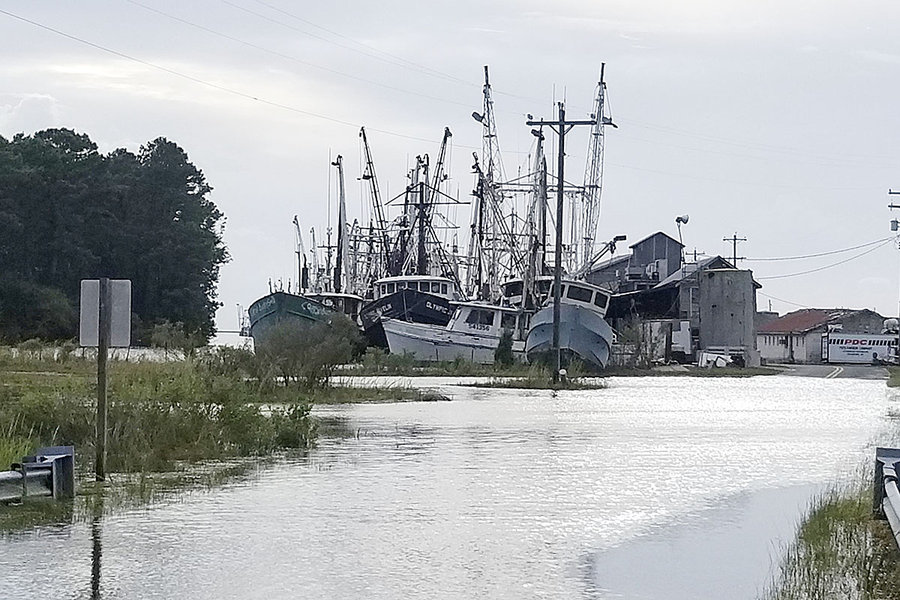
At Swan Quarter, North Carolina, shrimp boats cluster on the shore ahead of hurricane Florence in September. The town’s protective dike represents cooperation among practical people, who put aside politics to solve a serious problem.

Even when people believe global warming is only a cyclical blip, they can find common cause with others to solve a problem that affects everyone. Residents of a small town in North Carolina did just that after years of dangerous floods.

From the Christian Science Monitor: “As staff writer Patrik Jonsson began traveling the Carolinas after hurricane Florence, he came across a town that put aside its differences over politics and global warming to find a solution to chronic flooding. …

“Neighbors J.W. Raburn and Henry Williams are political polar opposites. … But the two lifelong friends – along with about 300 or so other North Carolinians who call Swan Quarter home – stood united [in September] against hurricane Florence.

“Nearby Oriental, New Bern, and large parts of central North Carolina were devastated when up to 40 inches of rain fell. … Tens of thousands of residents were displaced, and at least 23 people died.

” ‘There is no doubt that dike has saved us. It gives us a little bit of hope,’ says Raburn. His friend nods.

“The dike, completed in 2010, is a piece of political pragmatism that has gained stature as it held up well against during hurricanes Irene and Matthew, superstorm Sandy. …

“There is also growing evidence that mounting property losses, declines in property values, and threatened historical landmarks are wearing away resistance to preparedness. That common purpose might sometimes be hard to see on the national stage. But locally, people are putting aside politics in favor of practical solutions.

” ‘Working in Swan Quarter, flooding is not an ideological issue there. It is a way of life. Same with sea level rise. People have watched it happen within that lived environment. If you watch forests turn to marshland and the roads flood, the politics fade away,’ says Jason Evans, an environmentalist from Stetson University in DeLand, Fla., who worked on the dike project.

“Raburn and Williams, former bandmates, show the human side of the debate. Raburn believes that finding solutions to manmade climate change is vital. Williams, a farmer and volunteer firefighter, does not believe that humans are altering the temperature of the planet, calling it ‘a phase we are going through.’ But he is the one who cares for and maintains the dike – a job he takes very seriously. …

“In Swan Quarter, local taxes are likely to go up. The county needs to purchase pumps to help clear water that seeps through the dike. Across the sound on Ocracoke Island, county leaders are working on bolstering dunes. …

“At the same time, the dike played a role in the county investing millions in a new courthouse and fire station. The state credit union has felt confident enough in the dike to build a new branch. A critical ferry service runs from the docks to the Ocracoke Island. Inside the local gas station, a line drawn at head level shows the height of Isabel’s surge. Thus far, Florence has left no mark at all.

“The size of the town and the lean budgets mean, ‘the kind of interventions that can be done there and how we think about it is much different than thinking about New York City or Miami,’ says Evans. ‘Hyde County is a hardscrabble place trying to build a dike. Nothing solves anything forever. … But it clearly has helped with certain floods. I wouldn’t want to be in Swan Quarter during a big hurricane event without that dike being there. …

‘Whatever legislators want to do, whatever presidents want to do, it’s in the end not relevant in terms of trying to work through the facts. We have scientific understanding that can apply to all these places,’ says Evans. ‘But I have also seen over and over again – whether in the Florida Keys or in Swan Quarter – that within areas facing substantial problems, all the political stuff that we all get drawn into fades away.’ ”

Speaking of political stuff fading away, I want to do a post sometime on the fact that the divisions among us may make lively and urgent headlines but aren’t always replicated on the ground. Don’t we all interact regularly with people whose politics we know differ from ours? Would love to hear your examples to add to my own.

More at the Christian Science Monitor, here.

Read Full Post »

prcorals_grupo_vidas

Photo: Bobby Bascomb
The Grupo Vidas crew taking a break from their coral restoration work in Puerto Rico.

Perhaps inadvertently, media stories lead one to believe that all Puerto Ricans are passively waiting for the Mounties to rescue them from the destruction of Hurricane Maria. The Mounties surely better get their act together, but residents of the island are not counting on them. They’re taking matters into their own hands. I plan to post soon about the women who are rebuilding the island’s farming industry, but today the topic is restoring damaged coral reefs.

The National Public Radio (NPR) show Living on Earth has the story.

“Roughly 10 percent of Puerto Rico’s corals were broken and damaged by Hurricane Maria in 2017. Corals are a first line of defense against storm surges and a critical habitat for juvenile fish but face an uphill battle against warming seas, ocean acidification and ship groundings. As Host Bobby Bascomb reports, Puerto Ricans are finding ways to give corals a fighting chance by reattaching healthy fragments. …

“BASCOMB: Chunks of coral were broken off by rough seas and ocean swells. But on a recent trip to Puerto Rico, I discovered there’s still hope for thousands of battered bits of coral lying around the sea floor.

“I’m standing on a tall dune near Vega Baja on Puerto Rico’s north coast. The ocean stretches out in shades of dark blue, turquoise, and pale aquamarine. But interspersed among the usual colors of a tropical ocean are patches of brownish orange – elkhorn coral.

“Salvador Loreano is a worker with the environmental NGO Grupo V.I.D.A.S. Their main task is coral restoration.

“S. LOREANO: Our goal right now is to plant coral fragments here because you know that Maria, Hurricane Maria, came here and devastated the island. This caused great damage to the coral reef because the first time we went to there after Maria, the reef was like destroyed, like we see big coral colonies upside down and a lot of dead coral.

“BASCOMB: As long as they remain submerged under water, these coral, which are colonies of tiny invertebrate animals, have a 20 percent chance of survival. But that increases to more than 90 percent if they are attached to a larger structure, not getting banged around by the surf or smothered with sand.

If a piece of coral is at least 2 inches long and 80 percent healthy, it can actually be reattached to an existing reef. …

“MARIOLA LOREANO: [Here’s] a slate where we write our tallies, basically, which is all of the fragments that we’ve successfully planted, a bag for any trash that we find inside the ocean, and a buoy so it floats. …

“BASCOMB: We put on our mask, snorkel, and fins and walk backwards into the bath-warm water, stepping over the sharp black sea urchins. … A rainbow of fish greets us – green fish with florescent blue heads, black fish with yellow stripes, green fish with pink stripes. They’re all juvenile fish, and the reef is a critical habitat for them. …

“A worker named Ernesto is already hard at work. He uses a wire brush to scrape algae off a piece of coral the size of a ping pong paddle and does the same to a suitable spot on the reef. Just like gluing two objects together, you need to start with a clean surface on both sides. Then he pulls a plastic zip tie out of his sleeve and uses it to attach the coral in place.

“He uses pliers with a florescent pink handle to pull the zip tie tight and cut off the excess plastic, which he sticks in his other sleeve. This piece of coral is now one of hundreds just like it pinned to the reef with zip ties. And in two to three weeks, it will grow onto the reef enough to stay put on its own. …

“BASCOMB: If hurricane damage was the only issue, this work wouldn’t be necessary. But much like the world’s coral reefs in general, this reef has a lot of challenges. Grupo V.I.D.A.S. worker Ernesto says one of the biggest problems is algae blooms from sewage runoff. In many places the coral is essentially smothered, leaving it a ghostly gray color. …

“E. VÉLEZ GANDÍA: It’s like Day of the Dead but under the water.

“BASCOMB: There is a very large dead coral at the entrance to the reef in the shallowest, warmest water. Ernesto believes that one died not from algae blooms but from stress of a warming ocean. … Ernesto talks about the death of that coral as one might talk about a member of the family passing away.

“VÉLEZ GANDÍA: And we got a lot of love for him. We saw him alive, very alive. He is one of the oldest in our reef, but he start dying. We saw the process of his death. So, we just admire him and remember him. It’s very sentimental, I don’t know, but it’s deep in the heart.”

More at Living on Earth, here. And you can read another article about ways to save reefs at Earther, here.

Photo: Sean Nash
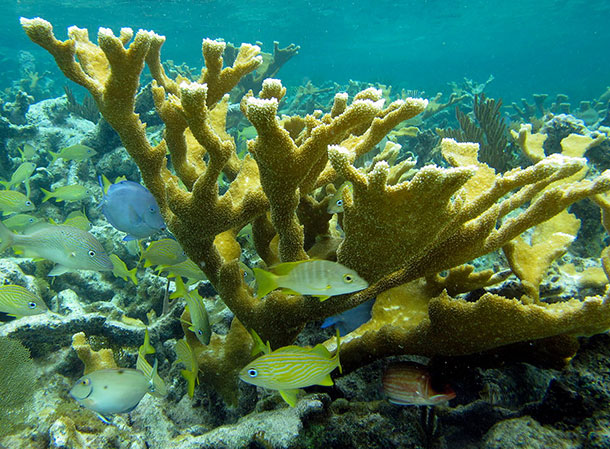
Elk horn coral are part of a vital reef ecosystem that provide habitat for fish. In Puerto Rico, many were damaged after Hurricane Maria.

prcorals_elk_horn_coral

Read Full Post »

vvzodywnvei6rlikbya67or4yePhoto: Charlotte Kesl/For The Washington Post
Leroy Wilson outside his home in Marianna, Florida, a day after Hurricane Michael hit the panhandle.

I believe that when a hurricane is coming and you’re told to evacuate, you should evacuate. But this story about a homeowner who refused to leave is pretty great anyway.

Like the wolf in the “Three Little Pigs,” Hurricane Michael huffed and puffed, but the homeowner’s brick house not only stood strong, it welcomed neighbors whose houses were not so strong.

Read what Patricia Sullivan and Frances Stead Sellers wrote at the Washington Post about why the Marianna, Florida, native couldn’t bear to leave his house. It adds a whole other level to the story.

“The modest one-story brick house on Old U.S. Road,” they report, “meant more to Leroy Wilson and his family than a roof over their heads.

“Their ancestors lived on this land as slaves before Wilson’s grandfather acquired five acres here in 1874, right after emancipation. … So as Hurricane Michael ripped the top off a 50-year-old dwelling next door, brought a tree down on Leroy’s daughter’s home and snapped nearby pine trees like pencils, the Wilsons stayed put in their brick house on Wednesday, opening the doors to neighbors whose homes were succumbing under Michael’s powerful winds.

“ ‘I wasn’t going anywhere,’ said Wilson, 74. …

“Sixty miles from the coast in Jackson County, this city of about 10,000 rarely suffers through hurricanes. Known as ‘The City of Southern Charm,’ Marianna has experienced storms that have taken down trees and power lines, but it has been largely spared the devastation regularly wrought in coastal towns. Hurricane Michael was different.

“ ‘It hit everybody hard,’ said Annell Wilson, Leroy’s wife. ‘We prayed a lot.’

“[Leroy’s son] Lamar, an assistant professor at the University of Alabama in Tuscaloosa, said he dismissed class around 5 p.m. Wednesday after getting a text from his sister describing the devastation in his hometown and he began making frantic telephone calls to his relatives. He knew they would not leave their land.

“ ‘To be able to own several homes you built with your hands, to protect the home your mother built, that your grandfather toiled for, it’s noble,’ Lamar said.

“And in this case, dangerously noble. His sister lost her home; his brother’s house is barely habitable.

“But the little brick house protected the Wilsons and the people they took in. It lost its water pump and its shutters, and the wind drove water in under the window panes. But the structure stayed intact — and by the end of the evening, more than a dozen members of five families were seeking shelter there.

“ ‘That’s what we do. We all help each other,’ said Annell Wilson, 73, Lamar’s mother, describing how she settled her unexpected visitors and got them fed, and then stuffed towels along the windows to mop up the water that seeped in.”

More at the Washington Post, here. No word on a wolf coming down the chimney or the canny homeowner setting a boiling pot in the fireplace to welcome him, but I wouldn’t have been surprised.

Don’t you love it when life imitates art? (Having said that, I still urge you, “Don’t sit out a hurricane when told to evacuate.”)

Read Full Post »

Photo: AP
Hurricane Marie, as seen from the International Space Station last year.

To understand more about how tropical storms evolve and become hurricanes, two Penn State professors from very different fields are joining forces.

Mark Ballora, professor of music technology, and Jenni Evans, professor of meteorology, report on their research at the Conversation.

“During the 2017 hurricane season, major storms in the North Atlantic devastated communities in and around Houston, Florida, Puerto Rico and the wider Caribbean. The destruction shows how important it is to understand and communicate the serious threats that these storms pose. …

“Since 2014, we have been working together to sonify the dynamics of tropical storms. In other words, we turn environmental data into music. …

“Most of us are familiar with data visualization: charts, graphs, maps and animations that represent complex series of numbers. Sonification is an emerging field that creates graphs with sound.

“As a simple example, a sonified graph might consist of a rising and falling melody, instead of a rising and falling line on a page.

“Sonification offers a few benefits over traditional data visualization. One is accessibility: People with visual or cognitive disabilities may be better able to engage with sound-based media.

“Sonification is also good for discovery. Our eyes are good at detecting static properties, like color, size and texture. But our ears are better at sensing properties that change and fluctuate. Qualities such as pitch or rhythm may change very subtly, but still be sensed quite easily. The ears are also better than the eyes at following multiple patterns simultaneously, which is what we do when we appreciate the interlocking parts in a complex piece of music. …

“We distilled the changing characteristics of a hurricane into four features measured every six hours: air pressure, latitude, longitude and asymmetry, a measure of the pattern of the winds blowing around the storm’s center. …

“In our recordings, air pressure is conveyed by a swirling, windy sound reflecting pressure changes. More intense hurricanes have lower values of air pressure at sea level. The winds near the ground are also stronger in intense storms.

“As pressure lowers, the speed of the swirling in our sonic recordings increases, the volume increases and the windy sound becomes brighter.

“The longitude of the storm center is reflected in stereo pan, the position of a sound source between the left and right speaker channels.

“Latitude is reflected in the pitch of the swirling sound, as well as in a higher, pulsing sound. As a storm moves away from the equator toward one of the poles, the pitch drops to reflect the drop in temperatures outside the tropics.

“A more circular storm is typically more intense. Symmetry values are reflected in the brightness of a low, underlying sound. When the storm has an oblong or oval shape, the sound is brighter.

“So far, we have sonified 11 storms, as well as mapped global storm activity from the year 2005. …

“Even for experts in meteorology, it can be easier to get a sense of interrelated storm dynamics by hearing them as simultaneous musical parts than by relying on graphics alone. For example, while a storm’s shape is typically tied to air pressure, there are times when storms change shape without changing in air pressure. While this difference can be difficult to see in a visual graph, it’s easily heard in the sonified data.”

More here.

Read Full Post »

Did you see the Kenneth Chang story about Hawaii’s wild chickens? Tourists love them. Scientists study them. And the guy in the picture below has the job of rehabilitating the ones that are injured or orphaned. (I need to remember Orphaned-Chicken Rehabilitator next time I make a list of unusual jobs.)

“On the island of Kauai, chickens have not just crossed the road,” writes Chang. “They are also crowing in parking lots, hanging out at beaches and flocking in forests.

“ ‘They’re absolutely everywhere,’ said Eben J. Gering, an evolutionary biologist at Michigan State University who has been studying these truly free-range birds. …

“In a paper published last month in the journal Molecular Ecology, Dr. Gering and his colleagues tried to untangle the genetic history of the Kauai feral chickens, which turn out to be not only a curiosity for tourists, but also a window into how humans domesticated wild animals. …

“Local lore is that many of the Kauai chickens are descendants of birds that escaped when Hurricane Iwa in 1982 and then Hurricane Iniki in 1992 blew open coops. (Feral chickens are found on other Hawaiian islands, but not in overwhelming numbers. Some speculate that Kauai is overrun because mongooses, which like to eat eggs, were never released there. Dr. Gering said another reason could be that the two hurricanes only sideswiped the other islands.) …

“In follow-up research, the scientists would like to observe more of the characteristics of the feral chickens — How many eggs do they lay? How often? Do they grow quickly like the farm breeds? — and then try to connect the genes responsible for the evolution of the hybrids. Dr. Wright is mating chickens and red junglefowl to precisely study how traits and behaviors are passed on.

“Dr. Gering speculated that until recent decades, the Kauai chickens were largely like the ones that the Polynesians brought long ago, living in small parts of the island and modest in number. Then they began mating with the escaped farm chickens or their descendants, with greater fecundity and a wider range of habitats.

“ ‘We think that’s why we’re seeing them now at Walmart and all over the place,’ Dr. Gering said.”

More at the NY Times.

Photo: Hob Osterlund for The New York Times
Stuart Hollinger, right, rehabilitates injured and orphaned wild chickens on Kauai. 

Read Full Post »

Older Posts »