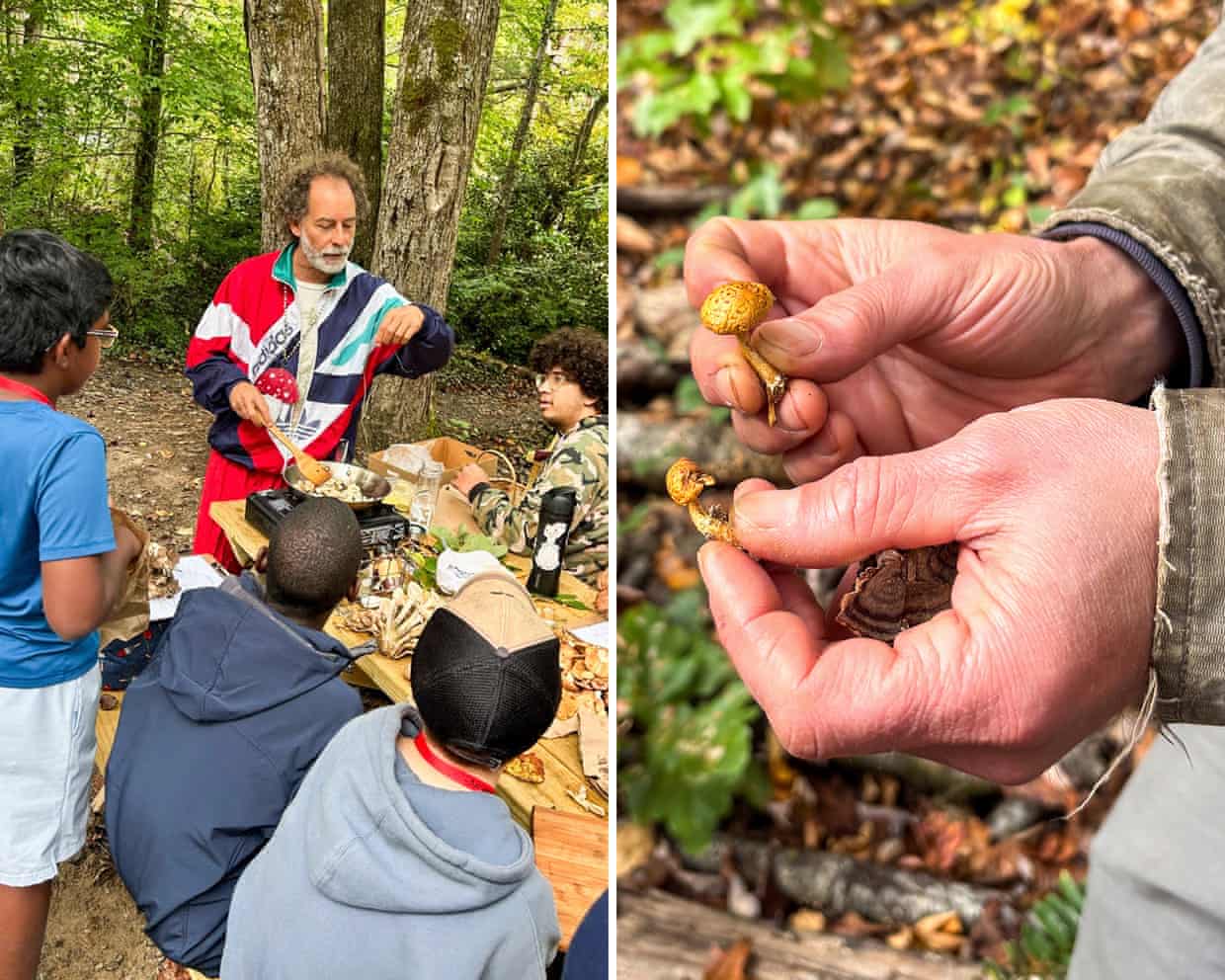
Composite photo: No Taste Like Home/Emily Cataneo.
Alan Muskat teaches North Carolina kids about foraging as part of his afterschool program in fall 2025. Tour guide Dimitri Magiasis shows off some mushrooms he foraged.
My childhood friend Ursula seems to have mostly recovered from the devastation of 2024’s Hurricane Helene in North Carolina. She has gone back to teaching weaving, for example, but I’m still waiting to see the promised photo of her home’s restoration.
Life goes on if you survive disaster, and most people make adjustments to how they were living before. We need to keep learning.
An experienced forager has begun teaching young learners in Asheville about a side of nature that’s more benign than hurricanes. Emily Cataneo has report at the Guardian.
“Juniper Stewart just turned 12. She … knows how to identify a Pilobolus mushroom, which grows on ‘cow poop,’ according to Juniper. She can confidently harvest plantain leaf, a ubiquitous wild plant that’s tasty in salads and sautées, and useful as a poultice on stings and poison ivy. She has paper bags full of sourwood leaves drying at home to make tea, and she’s delighted by the fact that when you touch jewelweed seed pods, they explode.
“Juniper’s deep knowledge of the wild plants around her home in western North Carolina stems from her involvement in an after-school program that taught kids in Asheville and surrounding towns how to forage. For three days a week [last] fall, foraging guides brought groups of students ages five to 12 from City Mountain Public Montessori out to forests and fields to learn about the plentiful berries, mushrooms, leafy greens and even flavorful sticks in their own backyard.
“The program is the brainchild of Alan Muskat, a ‘philosoforager’ who runs No Taste Like Home, an educational company that for the past 30 years has taught locals and tourists alike how to plumb the bounty of the southern Appalachians, one of the most biodiverse areas in the world. …
“Muskat hatched his idea to teach kids in the aftermath of Hurricane Helene, the storm that devastated Asheville in September 2024 [to] serve as a ‘different kind of hurricane relief.’
“Muskat has built his life philosophy on the idea that many of society’s ills stem from our fear of the natural world, our tendency to live in opposition to it rather than in harmony with it. After the hurricane, he wanted to impart those lessons on young people who lived through the storm. …
“ ‘It felt a little to me when the hurricane happened that we were in a dress rehearsal for what could happen with [future] natural disasters,’ [Juniper’s mother] said. ‘The grocery store shelves were completely bare and people were eating government-rationed food, which is not as healthy as making a big chickweed [salad].’ …
“During the after-school program, a bus brought the kids from school to an educational site outside Asheville. Led by a No Taste Like Home guide, the kids would ‘run around and find things, and ask if they were edible,’ according to Jemma Ferrington, nine, whose house was destroyed in the hurricane and who participated in the program. She added: ‘I’d identify lots of things, like some mushrooms that had gills, and some that had a sponge at the bottom.’ …
“The program has faced some setbacks. … A staff member questioned Muskat after he let kids eat white milk cap mushrooms, which in large quantities can irritate the stomach, and pushed him to remind kids that not all white mushrooms are safe to eat (‘he was right’ about the second complaint, Muscat acknowledged in an email, adding that one of the ‘golden rules of foraging is, don’t overgeneralize’).
“In addition to the after-school program, No Taste Like Home has run two foraging field trips, with plenty of chaperones to keep an eye on kids, which they hope to repeat in 2026. …
“[Guide Dimitri] Magiasis, who discovered the world of foraging while studying to be a naturopath in Seattle, has worked for Muskat for nine years, leading a couple tours per week. …
“[Recently] Magiasis gathered the group near a rushing brook to explain that they’d be ‘meeting’ plants such as cool-weather greens, herbs and spices, and mushrooms, although this fall has brought a drought to the region that’s rendered the mushroom population sparse.
“That’s just a part of foraging, said Magiasis. The practice forces you to redefine the way you think about food availability. ‘You go into the grocery store and find onions, apples, lettuce 365 days per year,’ he said. ‘Nature doesn’t work that way. She’s going to provide what she’s going to provide.’ …
“On the tour, Magiasis is strict about safety. When we’re looking for chickweed, he points out the plant’s chief identifying features: the leaf edges are smooth, not serrated. They’re shaped like spades, or hearts, and furry on only one side. He checks each person’s leaf before they’re allowed to eat it, then counts one, two, three before we pop them into our mouths.
“For many, safety is a big question around foraging, especially for kids. Ten to 12 mushroom species in western North Carolina are deadly, for example, and a couple hundred more will make you extremely sick. But guides and parents alike stressed that knowledge is power and that for them, it’s actually more dangerous not to teach their kids how to forage.”
More at the Guardian, here.


 Suzanne's Mom's Blog