Feeds:
Posts
Comments

Posts Tagged ‘idol’

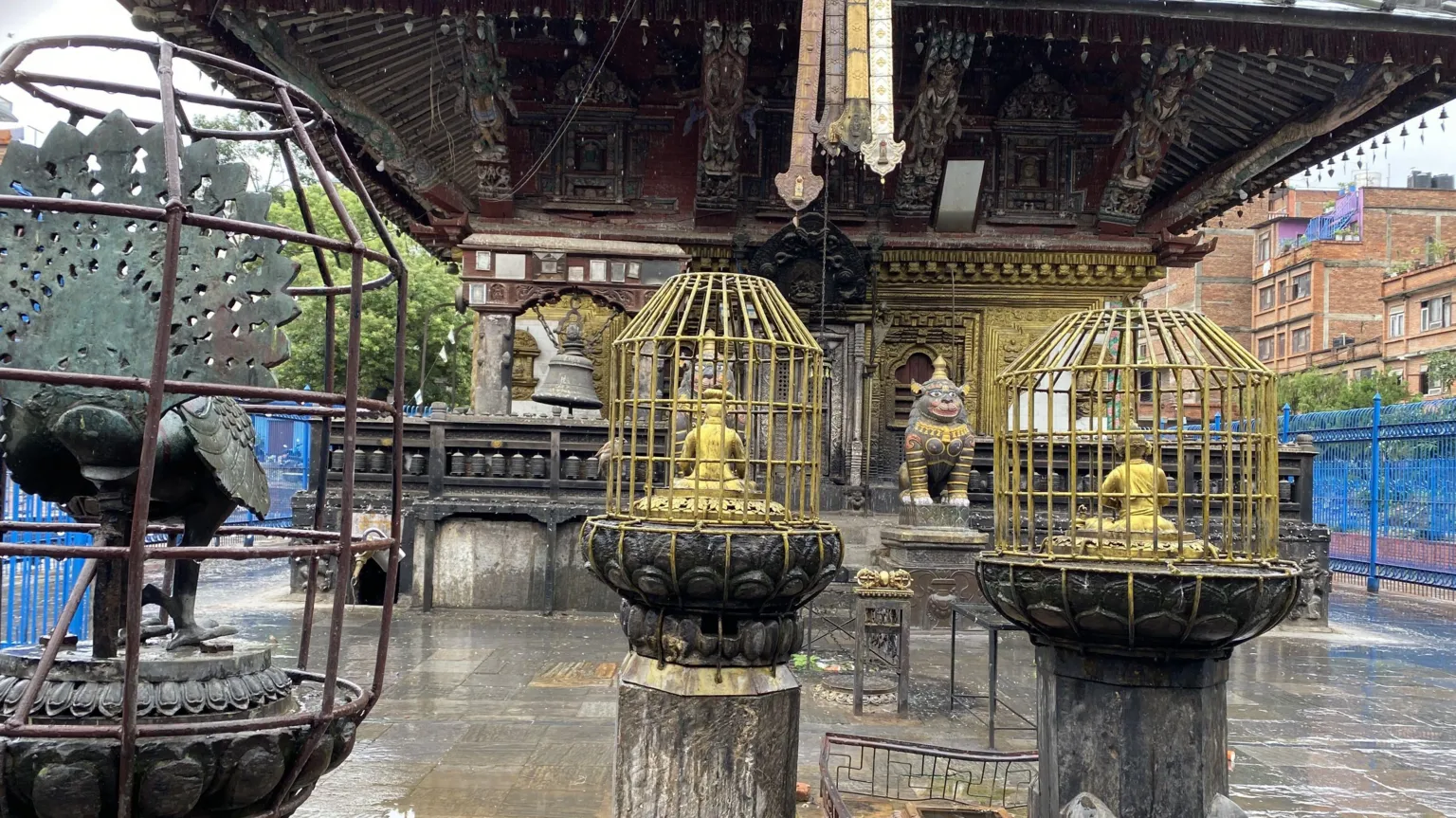
Photo: Sanjaya Dhakal/BBC Nepali.
In Nepal, some communities have put their recovered idols in iron cages for security.

Who does art belong to? For centuries, looters have justified their thefts by asserting that they aim to protect the stolen art for posterity. That no longer holds up, and now art is getting returned to the plundered countries.

And if you play nice and return Nepali idols, you may be given an accurate replica.

Sanjaya Dhakal writes at The Guardian, “Along a small street in Nepal’s Bhaktapur city stands an unassuming building with a strange name — the Museum of Stolen Art. Inside it are rooms filled with statues of Nepal’s sacred gods and goddesses.

“Among them is the Saraswati sculpture. Sitting atop a lotus, the Hindu goddess of wisdom holds a book, prayer beads and a classical instrument called a veena in her four hands.

“But like all the other sculptures in the room, the statue is a fake. The Saraswati is one of 45 replicas in the museum, which will have an official site in Panauti, set to open to the public in 2026.

“The museum is the brainchild of Nepalese conservationist Rabindra Puri, who is spearheading a mission to secure the return of dozens of Nepal’s stolen artifacts, many of which are scattered across museums, auction houses or private collections in countries like the US, UK and France.

“In the past five years, he has hired half a dozen craftsmen to create replicas of these statues, each taking between three months and a year to finish. The museum has not received any government funding. His mission is to secure the return of these stolen artifacts – in exchange for the replicas he has created.

“In Nepal, such statues reside in temples all across the country and are regarded as part of the country’s ‘living culture,’ rather than mere showpieces, says Sanjay Adhikari, the secretary of the Nepal Heritage Recovery Campaign. Many are worshipped by locals every day, with some followers offering food and flowers to the gods. …

“It is also common for followers to touch these statues for blessings — meaning they are also rarely guarded — leaving them wide open for thieves.

“Nepal has categorized more than 400 artifacts missing from temples and monasteries across the country, but the number is highly likely to be an underestimate, says Saubhagya Pradhananga, who heads the official Department of Archaeology.

“From the 1960s to the 1980s, hundreds of artifacts were looted from Nepal as the isolated country was opening up to the outside world. Many of the country’s most powerful administrators back then were believed to have been behind some of these thefts — responsible for smuggling them abroad to art collectors and pocketing the proceeds.

“For decades, Nepalis were largely unaware about their missing art and where it had gone, but that has been changing, especially since the founding of the National Heritage Recovery Campaign in 2021 – a movement led by citizen activists to reclaim lost treasures. …

“There are many hurdles. The Taleju Necklace, dating back to the 17th century, is a case in point. …

“It’s still unclear how it might have been stolen and many in Nepal had no idea where it might have gone until three years ago, when it was seen in an unlikely place – the Art Institute of Chicago.

“It was spotted by Dr Sweta Gyanu Baniya, a Nepali academic based in the US who said she fell to her knees and started to cry when she saw the necklace.

“According to the Art Institute of Chicago, the necklace is a gift from the Alsdorf Foundation — a private US foundation. The museum told the BBC it has communicated with the Nepali government and is awaiting additional information.

“It’s not just a necklace, it’s a part of our goddess who we worship. I felt like it shouldn’t be here. It’s sacred,” she told the US university Virginia Tech. …

“But [Saubhagya Pradhananga, who heads the official Department of Archaeology] said Nepal’s Department of Archaeology had provided enough evidence, including archival records. On top of that, an inscription on the necklace says it was specifically made for the Goddess of Taleju by King Pratap Malla.

“It’s these ‘tactics of delay’ that often ‘wear down campaigners,’ says one activist, Kanak Mani Dixit. ‘They like to use the word “provenance” whereby they ask for evidence from us. The onus is put on us to prove that it belongs to Nepal, rather than on themselves on how they got hold of them.’ …

“Many worshippers are now a lot more paranoid — putting these idols in iron cages to protect them from going missing.

“Mr Puri however hopes his museum will eventually have its shelves wiped bare.”

More at the BBC, here. No paywall.
Read Full Post »

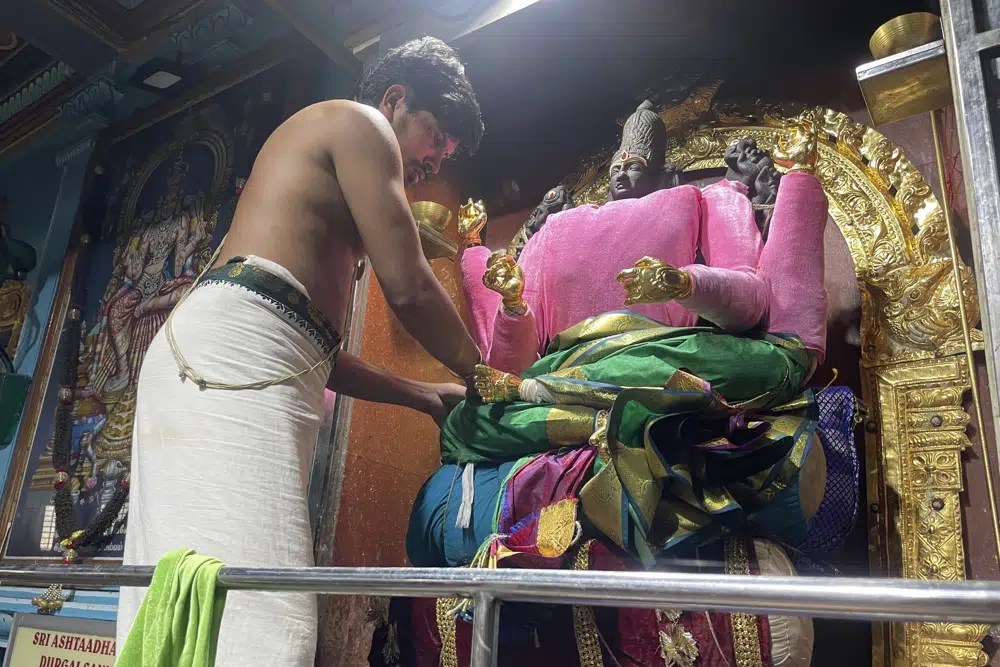
Photo: Deepa Bharath/AP.
Deity decorator S. Goutham is seen at the altar of the goddess Durga at the Anantha Padmanabha Swamy Temple in Chennai, India, on Nov. 29, 2022. Goutham is a fifth-generation practitioner of this millennia-old spiritual art of decorating temple deities.

Isn’t it amazing how many kinds of jobs there are in the world? Today’s story from the Associated Press (AP) is about a young man whose family has had the job of decorating statues of local deities for five generations!

Deepa Bharath reports, “On a recent afternoon, 33-year-old S. Goutham was perched on a ladder at the altar of the goddess Durga at the Anantha Padmanabha Swamy Temple in Chennai, India. Goutham — his hand moving steadily — was pleating a green silk sari to adorn the deity. …

“A computer science graduate, Goutham quit his job nearly a decade ago to pursue his calling. He has since followed in the footsteps of his ancestors as a fifth-generation decorator of temple deities.

“In Hindu temples, idols are mostly made of materials such as black granite, white marble or five-metal alloys that have sacred significance. These deities are worshipped as physical, tangible representations of god (Brahman) who is believed to be infinite, omnipresent and beyond comprehension. Worship in a Hindu temple includes bathing these deities in milk, decorating them with colorful clothes, flowers, perfumes such as sandalwood, jewelry, and even weapons such as swords, clubs and tridents. Oil lamps are lit at the altar, and sacred chants and foods are offered to the gods.

Decorating the deities is a millennia-old practice that is described in the Hindu epic Ramayana, and Goutham has been learning the art since he was a toddler. He crafted his first formal decoration when he was 13. …

“Goutham said he became interested in decorating deities as a child because of his father.

“ ‘When you are little, your father is your hero,’ he said. ‘I wanted to be just like him.’ The first lesson Goutham got from his dad was about the weapons each god would hold. He heard stories about the power of each weapon and how gods would wield them.

“ ‘The personality of the deity and the story of the god or goddess could change depending on their weapons, the clothes they wear, the expression on their face or the position in which they are sitting or standing,’ he said. …

“There are rules about the types of materials that can be used on deities.

“ ‘The human body is made up of earth, water, fire, air and space, and everything you see naturally occurring on Earth is made of these elements,’ Goutham said. ‘To show this, we decorate deities using things that occur in nature and are a representation of these elements, like copper, cloth, coconut fibers and so on.’

“He says decorating a deity combines elements from art, dance and yoga, in terms of the hand gestures and postures the deities assume. Man-made materials such as plastic are prohibited. Goutham says he uses little pins to hold fabric together, but makes sure the pins don’t directly touch the idol. …

“[He] dreams of establishing an institution to train artists who can maintain the sacred tradition. While most deity decorators are men, he sees no reason why women cannot learn and practice it. ‘Everyone is equal under god,’ he said.

“Storytelling is an important part of what he does. One of his favorite installations depicts the friendship between Lord Krishna, an incarnation of Vishnu, and Kuchela.

“ ‘It shows Krishna washing the feet of Kuchela, a poor man, conveying the message that humility is a virtue — whether you are a human being or god,’ Goutham said.

“The term ‘idol worship’ may have negative connotations in some faiths. But for Hindus, deities — which are kept in temples, homes, shops and offices — serve as focal points ‘for to us channel our devotions, our actions and serve as a reminder of all the positive values that are associated with those deities,’ said Suhag Shukla, executive director of the Hindu American Foundation.

“Shukla says this form of worship is a way for her to connect with her ancestors. ‘As a second-generation Hindu American, I didn’t grow up with all these things around me where I could absorb through osmosis,’ she said. ‘But just knowing that I’m part of a tradition that has been passed down from generation to generation is personally powerful for me.’

“In U.S. Hindu temples, community members come together to help create the costumes for the deities, and it is an act of devotion, Shukla said.

“ ‘No one has to sit there and embroider a skirt or sari for a goddess, but they do it as a display of love,’ she said. ‘It’s humbling and empowering.’ ”

More at AP, here. No firewall.

Read Full Post »