Feeds:
Posts
Comments

Posts Tagged ‘imagination’

Photo: Carlos Magno/Unsplash.
Remember when we weren’t so hyper about Covid germs? My kids loved this.

I tend to pounce on articles about the importance of creative play for children (in this 2020 post, for example). I have seen the value of play in my own life and in the lives of my former students, my children, and my grandchildren.

Also, I read Dickens, who was a leader in encouraging imagination and who wrote about its value often — not just in his education novel Hard Times, where he calls for “Queen Mab’s chariot among the steam engines.”

Jackie Mader writes at the Hechinger Report about a study on “guided” play, which has the advantages of free play and a bit more.

What happens when you stop teaching young children via direct instruction and instead set up purposeful opportunities to play? They could learn just as much — or more — when it comes to literacy, numeracy and executive function skills critical to early academic success, according to a new review of 17 studies of play.

“Researchers looked at 39 studies of play and included 17 in a meta-analysis that found when children ages three to eight engage in guided play, they can learn just as much in some domains of literacy and executive function as children who receive direct instruction from a teacher or adult. …

“Guided play [means] there is a learning goal set by an adult and children are ‘gently steered’ to explore. The study found children also learned slightly more in some areas of numeracy, like knowledge of shapes, and showed a greater mastery of some behavioral skills, like being able to switch tasks.

“These findings, which were published in the journal Child Development, add to a growing body of research that has found play is not simply a carefree tangent to learning, but rather an effective way to teach important early skills.

“ ‘Children often struggle with mathematical concepts because they are abstract,’ said Elizabeth Byrne, a co-author of the study and a research associate at the University of Cambridge, in a statement. That’s why the hands-on nature of play may be helpful. Those concepts ‘become easier to understand if you are actually using them in an imaginary game or playful context.’ …

“Last year, a report by the LEGO Foundation that looked at 26 studies of play from 18 countries found play is so powerful it can reduce inequality and close achievement gaps between children ages 3 to 6. Those studies, which also looked at free play in addition to guided play, found children progressed in several domains of learning, including language and literacy, math and social-emotional skills.

“While direct instruction gets information across quickly and is effective for certain skills or lessons in a classroom, ‘real learning’ occurs when children are active and engaged, said Kathy Hirsh-Pasek, a professor of psychology at Temple University and a senior fellow at the Brookings Institution. That’s why play can be so effective. … ‘What it’s really about here is can we teach human brains in the way human brains learn,’ Hirsh-Pasek said.

“An added benefit is kids enjoy play more than sitting and listening to an adult talk at them. ‘The kids are happier, the teachers are happier. It’s teaching them more about how to collaborate and communicate,’ she added.

“In the years prior to the pandemic, some states and districts were bringing more play into schools by creating play-based kindergarten classrooms. It was an attempt to move away from the rigorous, academic-focused kindergarten classrooms that emerged in a nation concerned about low reading scores and meeting the Common Core standards.

One top pre-K researcher recently called for more play in pre-K amidst concerns that state-funded pre-K programs involve too much direct instruction and not enough time spent outside. …

“Ideally, guided play involves forethought in setting up play opportunities based on a learning goal, but it doesn’t necessarily require extensive adult interaction. For example, if a climbing structure is painted to show units of measurement, children may take notice and talk about how high they’re climbing. Or if kids are trying to learn addition and subtraction during lesson, throwing a giant number line on the ground and letting children jump forward or backward becomes a guided play activity.

“Teachers or parents ‘become guides on the side,’ Hirsh-Pasek said. ‘When we interact too much and become helicopter parents, the kids check out,’ she added.”

More at the Hechinger Report, here.

Read Full Post »

On Shadows

Photo of Magritte art: Thomas Hawk.
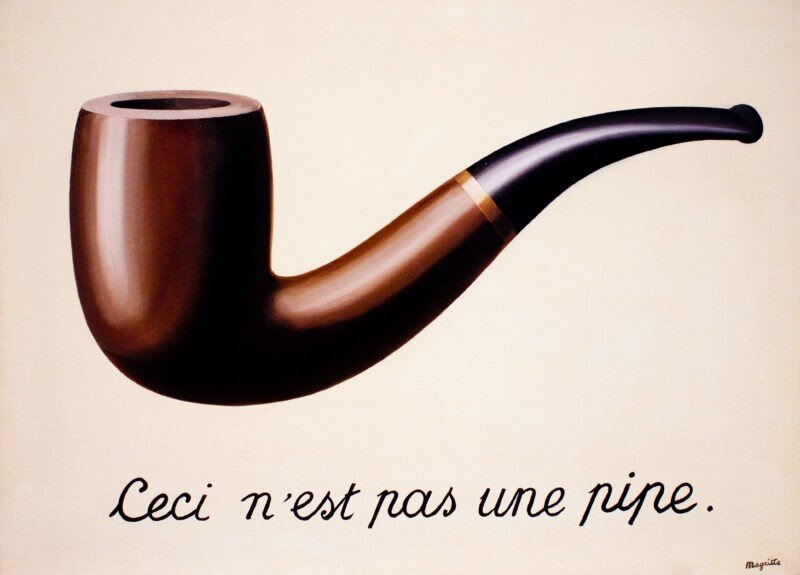
René Magritte’s “La Trahison des Images” (“The Treachery of Images”) (1928-9) or “Ceci n’est pas une pipe” (“This is not a pipe”). The work is now owned by and exhibited at LACMA.

The first time I saw the Magritte work called in English “This is not a pipe,” I thought, “What do you mean? Yes, it is.” It took me a long time to consider that it’s only a picture of a pipe, not the pipe itself. My pipe-smoking father wouldn’t have been able to put tobacco in it and smoke it.

I mention this because it relates to one of the reasons I’m fascinated by shadows.

Peter Pan’s shadow goes off on its own for a while, but it wouldn’t exist without Peter Pan. The shades in the Greeks’ Underworld are both the real people and not the real people. In “A Midsummer Night’s Dream,” when Puck says to the audience, “If we shadows have offended,” he’s describing actors as shadows of characters, and characters as shadows of people. He recommends thinking about the play as a dream — another kind of meaningful shadow.

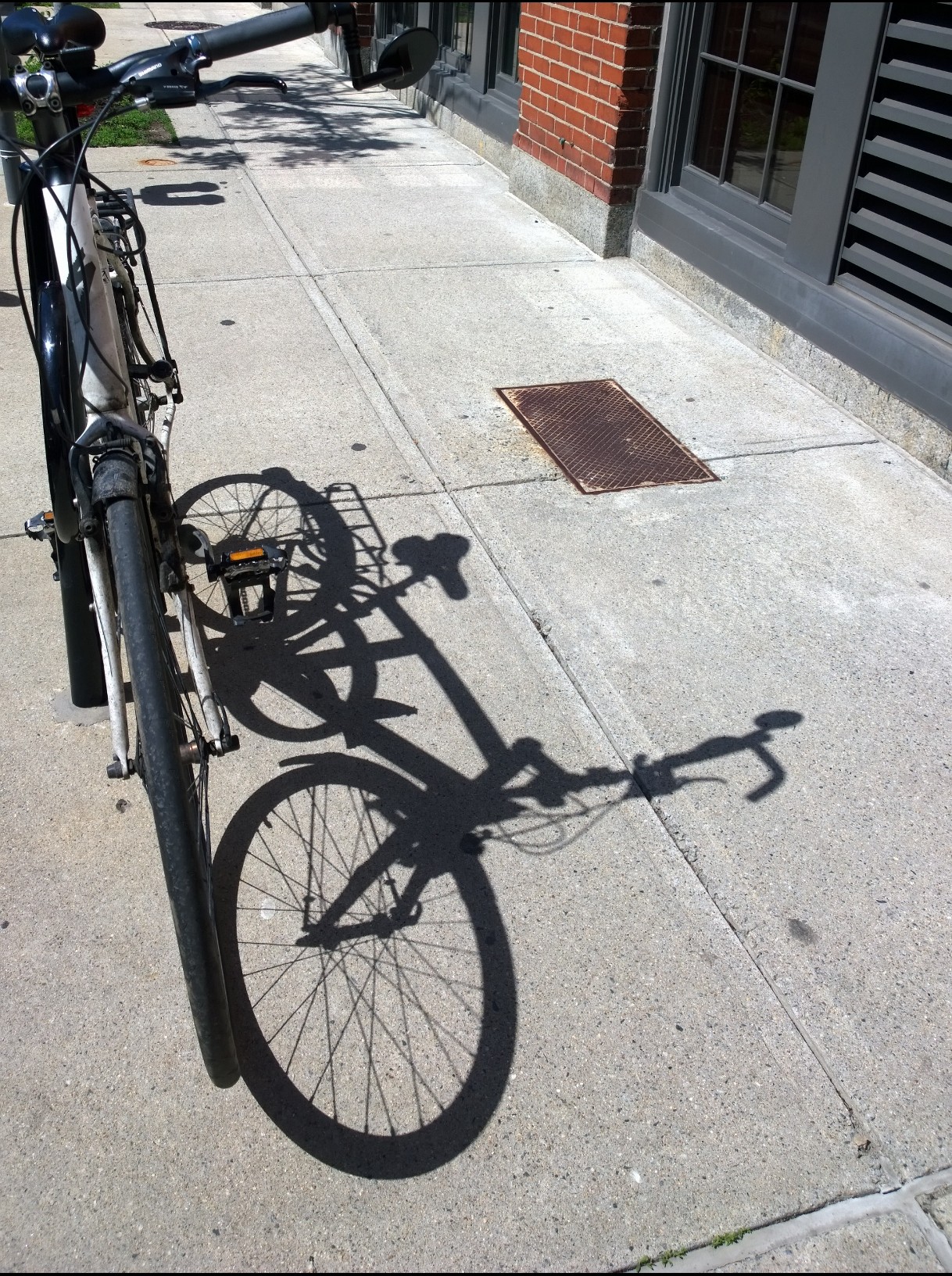
This is not a bicycle.

A shadow is the thing and not the thing, a distorted version of the thing that may lead to interesting or useful thoughts. Perhaps Orpheus will come and ride that bicycle into Hades and try bringing Eurydice home on the back. In the myth, though, he turned around despite dire warnings not to because he couldn’t hear her footsteps. I fear he will make the same mistake with the bicycle as he won’t be able to feel her sitting behind him.

Shadows are a way of thinking about things unseen that can stimulate the imagination and provide extra insight into the everyday world we experience. Since first reading The Princess and the Goblin, I’ve sensed that fiction and fantasy may provide the best ways to understand the “real.” It’s why I enjoy, for example, Francesca Forrest’s other world in Lagoon Fire, here, and blogger Laurie Graves’s fantasy series about the Great Library and her podcast, here.

There are so many things in our lives that are hard to fathom, and sometimes the imagination helps to get a grip on them. Some years ago, I read about a woman in Guatemala who was trying to explain why her neighborhood volcano erupted and killed so many people. She said it was because of her husband’s misdeeds. It was just her way to get her head around something too enormous to comprehend.

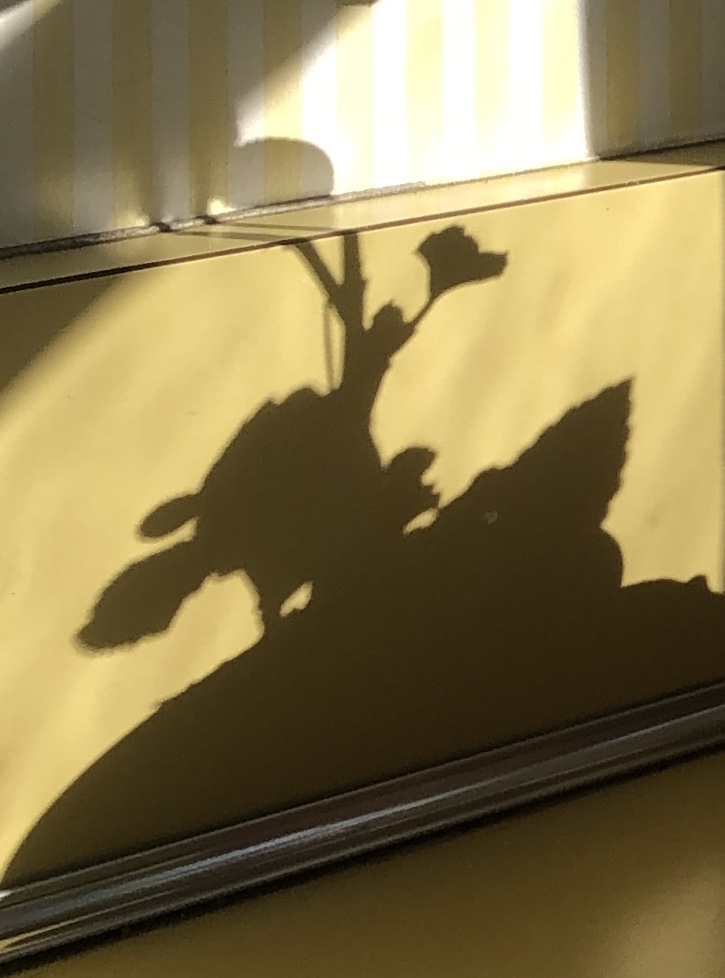
This is not a planter Suzanne made as a child. No plants here.

This is a planter Suzanne made as a child. Or is it?

Read Full Post »

New research in the UK is providing confirmation of my belief that boredom is not always a destructive thing but often a path to creativity. Other people have had the same impression. After all, the site with some of the most creative links on the web calls itself Bored Panda.

Recently, my husband sent along a relevant article by the BBC’s David Robson, who caught my interest at once with his claim that boredom was first mentioned in Bleak House, by Charles Dickens. (I’ve read that novel enough times to know that Robson spelled Lady Dedlock’s name wrong, though.)

For his report, Robson interviewed Sandi Mann, coauthor with Rebekah Cadman of a University of Central Lancashire study on boredom.

He begins, “I’ve met lots of people with a talent to bore in my time, but Sandi Mann is one of the few to have honed it as a craft. Eager volunteers visiting her lab may be asked to carry out less-than-thrilling chores like copying out lengthy lists of telephone numbers. They mostly tolerate the task politely, she says, but their shuffling bottoms and regular yawns prove they are hardly relishing the experience. …

“Mann has found that their ennui boosted their performance on standard tests of creativity – such as finding innovative uses for everyday objects. She suspects the tedium encouraged their minds to wander, which leads to more associative and creative ways of thinking. ‘If we don’t find stimulation externally, we look internally – going to different places in our minds,’ she says. ‘It allows us to make leaps of imagination. We can get out of the box and think in different ways.’ Without the capacity for boredom, then, we humans may have never achieved our artistic and technological heights. …

“Given this benefit, Mann thinks we should try not to fear boredom when it hits us. ‘We should embrace it,’ she says – a philosophy that she has now taken into her own life. ‘Instead of saying I’m bored when I’m stuck in traffic, I’ll put music on and allow my mind to wander – knowing that it’s good for me. And I let my kids be bored too – because it’s good for their creativity.’ ”

My own approach to being stuck at the end of a long line is to recite the poems I know. I also carry in my bag a few other poems in case I run out.

More here, at the BBC, which also covers the darker side of boredom.

Photo: Socialphy
Yawning.

Read Full Post »

I remember many days with Carole on the playground at recess playing house and gathering “grain,” which we pulled off a common weed and sometimes pretended to eat and sometimes buried — in case we might need extra food someday. Carole was a great kid to play with.

Asakiyume, whom I met in adulthood, is the kind of person I would have wanted to play with in childhood. She has a wild imagination that seems to fire on all burners 24/7. And now that she is old enough to carry out some wishes from age 10 or so, she is going right ahead with them.

For example: acorn cake. At Asakiyume’s blog, followers watched her leach the tannin out of her acorns over a period of days, changing the water repeatedly. We kept tabs as she next roasted the acorns, made acorn flour, and finally baked a cake.

“Today I baked an acorn cake,” she wrote on Nov. 3. “I used my ground-up, leached acorns, and a recipe from Hank Shaw (posted here). The body of this cake is equal parts acorn flour and wheat flour.

“And–it tastes fabulous. It has a flavor like molasses with a hint of ginger, and your tongue tingles a little afterward, like when you eat something peppery. …

“It’s a tiny childhood dream come true–feasting on the abundance of acorns! (Okay, helped by honey, oil, and eggs, not to mention that wheat flour, but still.)”

Read more here.

Photo: Asakiyume
Acorn cake with sugar outlining an oak leaf.

Read Full Post »

I moved from Rochester, New York, more than 30 years ago, so it was only when I went back for a visit that I got to see the storied collections of Margaret Woodbury Strong in a museum built to house them.

When one recovers from the enormity of her obsession, one feels deeply grateful for all the toys and dolls of one’s childhood so beautifully preserved.

The offerings and outreach of the museum have grown like topsy in 30 years. And today another new partnership was announced.

“The great minds of the toy industry will be honored alongside their famous creations when the Toy Industry Hall of Fame combines with the National Toy Hall of Fame under a partnership announced Tuesday.

“The 5,000-square-foot National Toy Hall of Fame gallery at the Strong museum in Rochester will undergo $4 million in renovations, with the goal of opening the combined hall in the fall of 2015.

“The Toy Industry Hall of Fame, whose inductees have included Milton Bradley, Frederick August Otto Schwarz, Walt Disney and George Lucas, has been without a physical presence for about eight years following the closure of the International Toy Center in New York City.

“Leaders of both halls have been talking for some time about combining the two as a way to raise their visibility and exposure and to promote their educational missions. …

” ‘The Strong is an ideal home for this homage to both the toys that have influenced generations of children and the innovative minds that brought them to life,’ Carter Keithley, president of the Toy Industry Association, said at a news conference at the Strong museum, where items like alphabet blocks, roller skates, the Frisbee, Lincoln Logs and the stick occupy places of honor.”

Read more at Yahoo, here. Click “like” if you believe in toys.

Photo: The Strong Museum
“The Strong’s founder, Margaret Woodbury Strong, had a particular interest in dolls and amassed one of the largest collections in the world. The National Museum of Play® at The Strong continues to refine and develop her collection, making it increasingly comprehensive and inclusive. It now includes more than 12,000 dolls and 2,800 paper dolls.”

Read Full Post »