Feeds:
Posts
Comments

Posts Tagged ‘impressionist’

Photo: Joanna Hawkins/BBC.
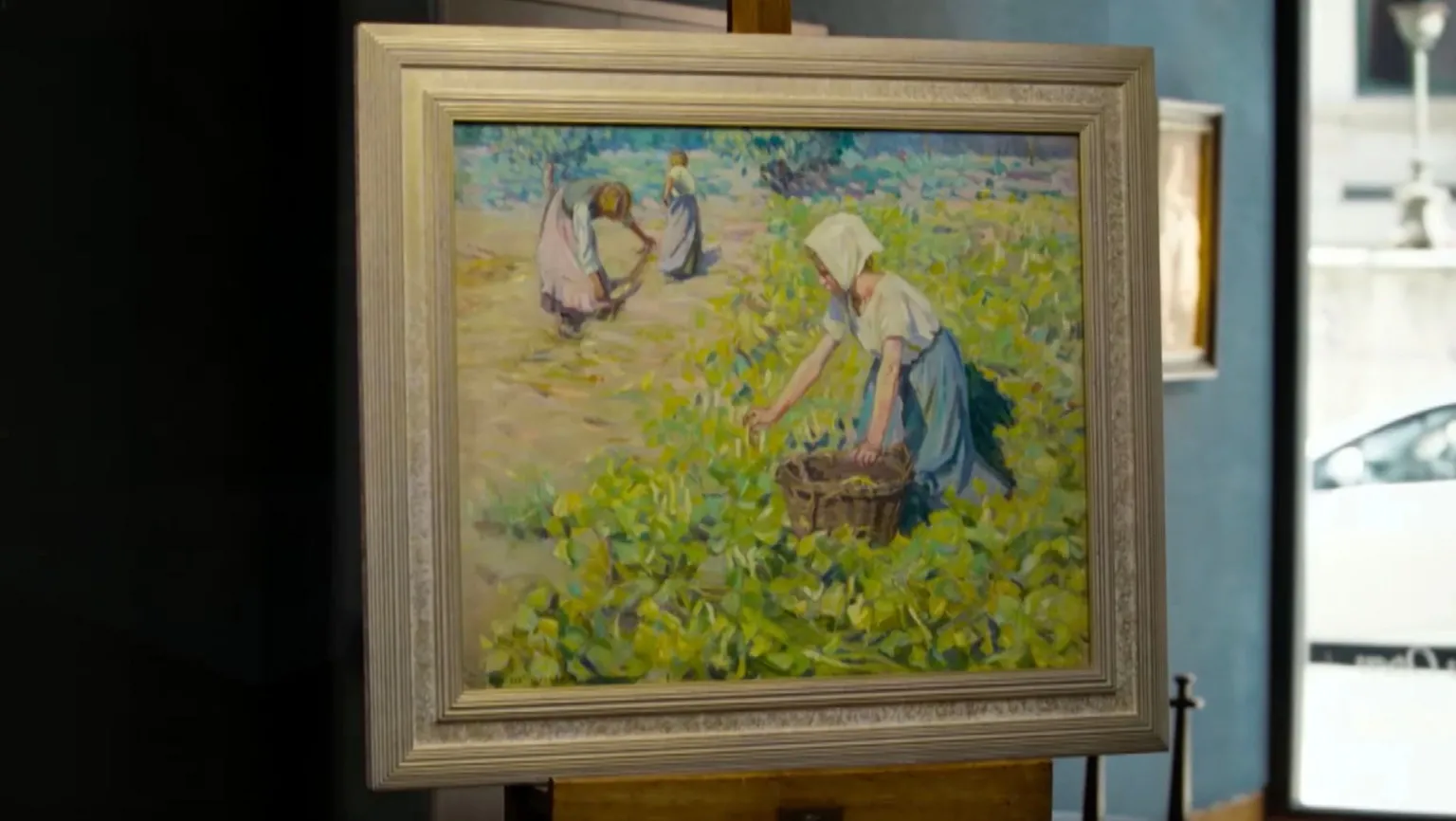
Artist David Taylor spotted this early 20th Century by Canadian impressionist Helen McNicoll at a UK auction house. It is valued at 150 times what it cost.

Let’s start 2025 with another fun story of a rediscovered treasure. The person who found it wasn’t just some guy. He was an artist who knew quality when he saw it and was willing to pay a large amount for it — just not as large an amount as it turned out to be worth.

David McKenna writes at the BBC, “A painting bought for just over £2,000 [~$2500] has been authenticated as a long-lost masterpiece worth £300,000 [~$374,000].

“The buyer, [Lincolnshire] artist David Taylor, said he had been ‘bowled over’ by the artwork while browsing a sale at a regional auction house.

“Experts on the BBC’s Fake of Fortune? were able to prove the painting, known as ‘The Bean Harvest’ and depicting a scene of women in a field, was a piece from the early 20th Century by Canadian impressionist Helen McNicoll. …

“McNicoll is one of Canada’s most celebrated female artists, achieving considerable international success during her career.

“Deaf from the age of two, McNicoll was known for her impressionist representations of rural landscapes.

“In 1915, her career was cut short when she developed complications from diabetes and died at the age of 35.

“It was revealed [in an October 2024] episode of Fake or Fortune? that the artwork had been exhibited in Canada five times between 1912 and 1913, but its whereabouts had since been unknown.

“During the episode, the show’s team — including presenters Fiona Bruce and Philip Mould — helped Mr Taylor to prove its authenticity.

” ‘I’d not heard of Helen McNicoll before we started investigating this painting,’ Bruce said. ‘But what a pioneer she was — a woman at that time, the early 20th Century, traveling abroad with her easel while profoundly deaf. I’m so glad we’ve been able to bring her name to wider attention.’ …

“Co-host Mould described the find as a ‘once-in-a-lifetime discovery,’ adding there was a massive desire on both sides of the Atlantic for the work of high-quality women artists.

“Canadian philanthropist Pierre Lassonde, a major collector of McNicoll’s work, flew over to London to see the painting in person. During the show, he said: ‘For a painting that has been missing for 110 years, I think it’s fantastic… I wouldn’t mind adding one more piece to my collection.’

“Mr Taylor described the experience as ‘an absolute adventure.’ “

More at the BBC, here. Find out more about the artist at Sotheby’s, where her painting was offered for sale in November.

Read Full Post »

Image: arthénon
A postcard called  “Rue Daubigny, Auvers-sur-Oise” is superimposed with parts of the painting “Tree Roots” (1890) by Vincent van Gogh, revealing new insights on the artist’s last hours.

One doesn’t need to go to Mars or the Himalayas or Sedona to make discoveries. One doesn’t need to skydive or eat insects or tag sharks to have new experiences. Not that people shouldn’t seek out adventure, but the truth is, there’s always quite a lot to discover right where you are — maybe just deepening your understanding of what makes an old friend tick.

I loved this story of a discovery about the great Impressionist painter Vincent van Gogh, a discovery made just by studying an old postcard and thinking.

Jasmine Weber writes at the arts website Hyperallergic, “In one of the most captivating artistic discoveries made amid the COVID-19 pandemic, a researcher has pinpointed the likely location of Vincent van Gogh’s final painting, ‘Tree Roots’ (1890).

“Wouter van der Veen, the scientific director of the Institut van Gogh, noticed the oil painting’s clear resemblance to a portion of a postcard from the French town of Auvers-sur-Oise, where the Dutch painter took his life in 1890. Dated between 1900-1910, the postcard shows mangled tree roots growing out of the hillside; when superimposed onto the photograph, the painting seems to be a perfect match.

When France lifted its COVID-19 lockdown this May, Van der Veen was able to visit the spot and found the large trunk still looked as it had over a century ago.

“Van der Veen submitted his findings to two senior researchers at the Van Gogh Museum in Amsterdam, Louis van Tilborgh and Teio Meedendorp. The pair believes there is a ‘high plausibility’ that the the hillside in the town where van Gogh spent the last 70 days of his life, was the same as the motif in ‘Tree Trunks,’ which belongs to the museum’s collection. …

“ ‘On closer observation, the overgrowth on the postcard shows very clear similarities to the shape of the roots on Van Gogh’s painting,’ [Meedendorp] said in a press release. …

“ ‘The site is also consistent with Van Gogh’s habit of painting motifs from his immediate surroundings,’ said van Der Veen. He adds that the ‘sunlight painted by Van Gogh indicates that the last brush strokes were painted towards the end of the afternoon,’ contributing further information about van Gogh’s last hours.

“The Institut van Gogh has since worked with local authorities to build a protective wooden structure around the site.” More.

In one more example of the benefits of having plenty of time to think, the BBC adds that Mr Van der Veen “had the revelation at his home in Strasbourg, France, during lockdown. … [and] visited the site to verify his theory in May 2020, once coronavirus restrictions had been lifted in France.

“A ceremony was held in Auvers-sur-Oise, a few miles north of Paris, [in July] to mark the discovery of the apparent location. Emilie Gordenker, the general director of the Van Gogh Museum, and Willem van Gogh, the great-grandson of Vincent’s brother Theo, were in attendance to unveil a commemorative plaque at the site.” More at the BBC.

Read Full Post »

Art: Van Gogh
Moulin d’Alphonse, painted in Arles in southern France.

Once again, a master’s work has been rediscovered. This time the master is Van Gogh, and the work’s identification is all thanks to a sister-in-law who knew a great artist when she saw one.

Dalya Alberge at the Guardian has the story. “A landscape by Vincent van Gogh is to be exhibited for the first time in more than 100 years following the discovery of crucial evidence that firmly traces back its history directly to the artist.

“The significance of two handwritten numbers scribbled almost imperceptibly on the back had been overlooked until now. They have been found to correspond precisely with those on two separate lists of Van Gogh’s works drawn up by Johanna, wife of the artist’s brother, Theo.

“Johanna, who was widowed in 1891 – months after Vincent’s death – singlehandedly generated interest in his art. She brought it to the attention of critics and dealers, organising exhibitions, although she obviously could never have envisaged the millions that his works would fetch today.

“Le Moulin d’Alphonse Daudet à Fontvieille, which depicts vivid green grapevines leading up to a windmill with broken wings in the distance, is a work on paper that he created with graphite, reed pen and ink and watercolour shortly after he reached Arles, in the south of France. It dates from 1888, two years before his untimely death.” More here.

When I was sixteen, I passed through Arles on a kind of tour. I am sorry to say the only thing I remember clearly is that the teacher said you had to translate “to Arles” as “en Arles” instead of “à Arles,” as you would say for other cities. Only guess what! A quick Google search informs me “en Arles” is only for people stuck in the 19th century.

On me pose très souvent la question de savoir si je me suis trompé en disant à Arles (vs. en Arles). Et bien non, à part si vous êtes resté au IXème siècle …

David Larlet is the source, and I have no idea if he is an expert. I assure you I wasn’t 16 in the 19th century, but my teacher was rather old fashioned.

Read Full Post »

Another good lead from the voracious reader of magazines in my household.

This Smithsonian story shows how a relatively simple invention made it possible for the Impressionists to do much more painting outdoors, en plein air.

Perry Hurt writes, “The French Impressionists disdained laborious academic sketches and tastefully muted paintings in favor of stunning colors and textures that conveyed the immediacy of life pulsating around them. Yet the breakthroughs of Monet, Pissarro, Renoir and others would not have been possible if it hadn’t been for an ingenious but little-known American portrait painter, John G. Rand.

“Like many artists, Rand, a Charleston native living in London in 1841, struggled to keep his oil paints from drying out before he could use them. At the time, the best paint storage was a pig’s bladder sealed with string; an artist would prick the bladder with a tack to get at the paint. But there was no way to completely plug the hole afterward. And bladders didn’t travel well, frequently bursting open.

“Rand’s brush with greatness came in the form of a revolutionary invention: the paint tube. Made from tin and sealed with a screw cap, Rand’s collapsible tube gave paint a long shelf life, didn’t leak and could be repeatedly opened and closed.

“The eminently portable paint tube was slow to be accepted by many French artists (it added considerably to the price of paint), but when it caught on it was exactly what the Impressionists needed to abet their escape from the confines of the studio, to take their inspiration directly from the world around them and commit it to canvas, particularly the effect of natural light.

“For the first time in history, it was practical to produce a finished oil painting on-site, whether in a garden, a café or in the countryside.” More.

Dear artist friends, I can picture what it would have been like for you traveling by train after an outing to some scenic spot before this invention. “Oh, Madame, I am so terribly sorry. I’m afraid my cobalt pig’s bladder burst!”

Photo: Chrysler Museum of Art
The tin tube, below, was more resilient than its predecessor (the pig bladder), enabling painters to leave their studios.

Read Full Post »