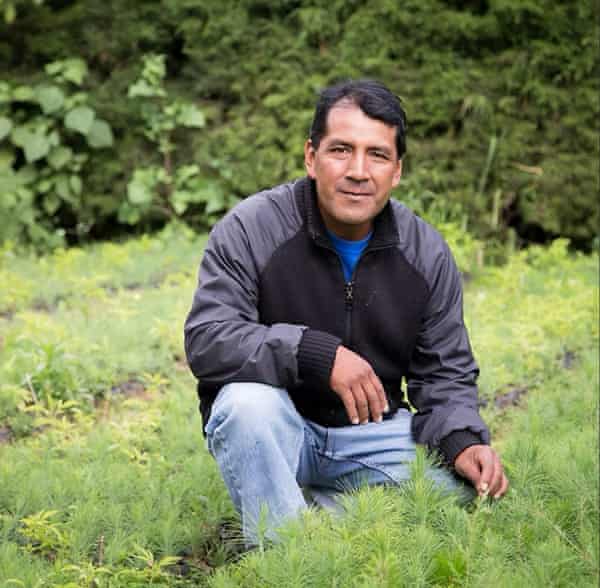
Photo: Zach Mordan.
Armando López Pocol, who set up Guatemala’s Chico Mendes Reforestation Project in 1999.
Sometimes I am just overwhelmed at the power of one person to make the world better. It may be the man who starts a regreening project on ruined land. It may be the woman who draws cheery pictures on patients’ insurance bills. It may be you when, after getting a long run-around on a robotic telephone chain, you are kind to the poor schlemiel who is the first human you talk to.
Let’s start with the artist in the billing department. Steve Hartman at CBS, recounts what happened to a patient called Melody Morrow.
“A few years ago, Melody Morrow of New York City hurt her foot and needed physical therapy. However, she said what really made her feel better was paying the bill.
” ‘On the envelope, on the front of the envelope, it had these little music notes,’ Morrow told CBS News of the billing statement she received in the mail, a play on her name, ‘Melody.’ …
” ‘This was a stranger,’ Morrow said. ‘And she was doing that just for me. And that’s the beauty of it.’ ” More at CBS, here.
Now let’s turn to Armando López Pocol in Guatemala. Suzanne Bearne has an in-depth report at the Guardian on what he started.
It begins, “Armando López Pocol is showing off some of the thousands of trees he has planted in Pachaj, his village in the highlands of western Guatemala, when he suddenly halts his white pickup truck. Alongside an American volunteer, Lyndon Hauge, he gazes out over a charred field. Clouds of smoke are still billowing from the ground.
“As he walks through the ash-covered field, his optimistic speech turns to sadness and he pauses in silence to take in the barren landscape.
“Before the fire, this 2-hectare (5-acre) plot of land in the mountains of Cantel was home to 2,000 trees, all planted through Pocol’s reforestation project.
“Over a quarter of a century, he and his small team of volunteers and community members have planted thousands of trees, regenerating the landscape of Guatemala’s highlands and mitigating the impacts of the climate crisis, while also generating revenue for local communities.
“Pocol initiated the Chico Mendes Reforestation Project in Pachaj – located 2,400 metres (7,900ft) above sea level and about 6 miles (10km) from the town of Quetzaltenango, known as Xela – in 1999. At that time, the region had suffered extensive deforestation over several decades.
“The organization was named after the Brazilian environmentalist Chico Mendes, who fought to preserve the rainforest and for Indigenous rights until he was murdered by a cattle rancher in 1988.
“ ‘The struggles he went through in Brazil are similar to the ones we go through in Guatemala,’ Pocol says.
“ ‘From the 1960s to the 1990s, there was a lot of deforestation in Cantel, as the wood was used extensively for building houses and as firewood for families,’ he says. ‘I started Chico Mendes to stop the deforestation, as I was worried about climate change and environmental problems in Guatemala, with mining companies destroying the community forests of Indigenous people.’
“He says deforestation is now largely caused by fires during the dry season, and attributes the latest one – the third in his fields so far this year – to an arson attack.
“ ‘We’re losing many tree plantations,’ he says, adding that the region lost more than 100,000 trees to fires in 2023 alone.
‘What keeps my spirit alive are the workers and volunteers showing their support and not giving up.’
“Since he embarked on his tree-planting mission, Pocol has become resigned to the fact that he cannot stop fires. ‘We just don’t have enough staff,’ he admits. ‘It’s expensive to have people out here watching all this land.’
“While he believes some of the fires are due to foul play, he says they have tried to reduce the number by creating fire corridors in the forests. …
“Pocol says his organization has not received any money. ‘We don’t receive funds from the government as we are against mining projects and environmental injustices in Guatemala, and we know that all the funds the government manages come from transnational companies.’ …
“Without a regular income, the Chico Mendes project depends on donations and a ‘volunteering fee’ (equivalent to about [$20] a day), which covers a homestay and three meals. Volunteers gather seeds, source decomposed leaves, fill bags with soil, and plant trees.
“Donations and the volunteering fee are crucial for Chico Mendes, as Pocol sees his initiative as much more than a reforestation project. The organization also supports the community through ecotourism, with funds circulating through the local economy via homestays and treks, as well as volunteers spending money in the village. …
“[Dr René Zamora-Cristales, outgoing director of the Latin American restoration initiative 20×20 at the World Resources Institute] praises Pocol’s work and says Guatemala needs more people like him. ‘Deforestation has always been an issue, but different efforts, such as the one from Armando, have reduced the overall deforestation in the country. We certainly need more local leaders committed to improving the livelihoods of local communities by restoring nature,’ he says.
“Pocol, who works on his project every day without a break, including weekends, and tops up his income in the evenings as an Uber driver, admits he is exhausted.
“ ‘I wake up in the night and wonder what the future is going to be for the project as there’s been a lot of difficult times. But I’ve never given up, and it always lifts my spirits when volunteers come.’ ”
More at the Guardian, here.

 Suzanne's Mom's Blog