Feeds:
Posts
Comments

Posts Tagged ‘intelligence’

Photo: JSTOR.
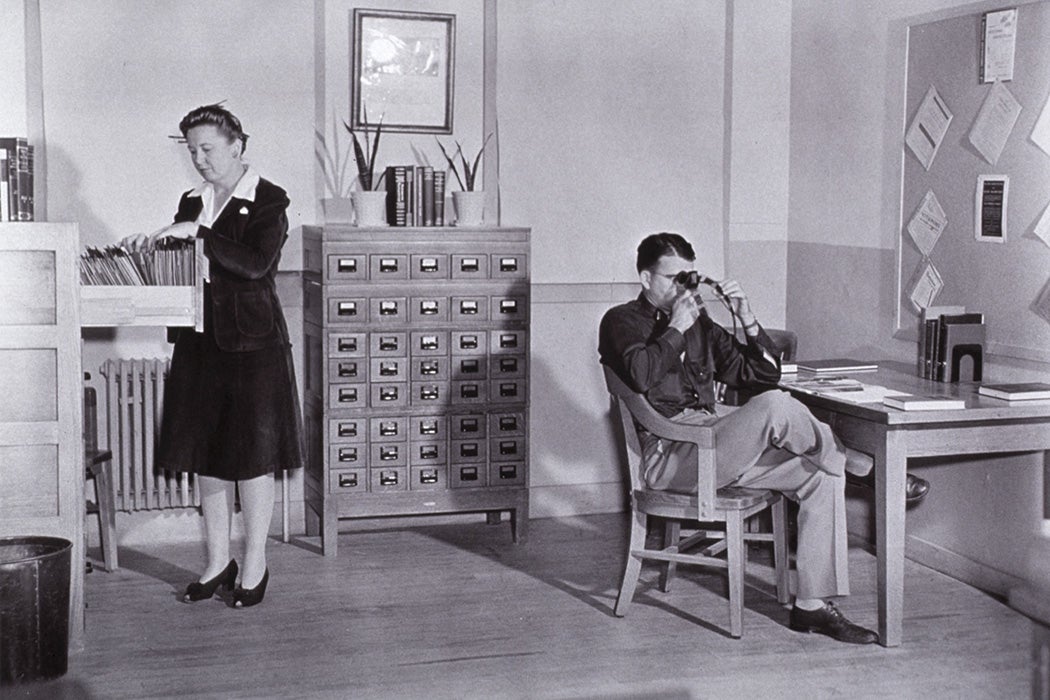
A librarian at the San Antonio Aviation Cadet Center and a patron examining microfilm. US librarians and the invention of microfilm were important to the war effort in the 1940s.

The enduring appeal of fictional detectives like Miss Marple has something to do with the idea that they are very unlikely sleuths. The “mild-mannered” (like Superman’s alter ego Clark Kent) are always undercover, and criminals never notice they are being casually but carefully observed.

Librarians, too, often described as “unassuming,” are not exactly James Bond material. But as we learn in today’s true story, they may provide vital intelligence in wartime.

Katie McBride Moench at JSTOR Daily writes, “In war, as in everything, information is power. And for the United States and its allies in World War II, an epic battle from an analog age, that meant obtaining and transmitting by hand useful intel. ….

“Enter the librarians, tapped by US government officials to help in this effort. These librarians adopted technology from other fields to photograph an array of documents, including those that were rare and/or archival, and found means of sending them across continents. They used both microfilm and microphotography — technologies that came to play a key role in the wars of the twentieth century.

“To the librarians of the World War II-era, microforms were a revelation; microfilm, for instance, was revolutionizing universities. Before its adoption, scholars generally traveled to sites housing materials they wanted or hired locals to do research on their behalf. Microfilm, the product of scaling text or graphics down into miniature forms, made it possible to streamline this process and ship scans anywhere. All that was needed was a microfilm reader on the receiving end to enlarge a scan to the point of readability. This innovation vastly broadened the scope of information researchers around the world could now access.

“It became clear to President Franklin Roosevelt in the months before the US entered the war in 1941 that there was a lag in intelligence gathering. To rectify this, Roosevelt tapped William ‘Wild Bill’ Donovan, a veteran and lawyer, to develop the Office of Strategic Services (OSS) — the precursor to the Central Intelligence Agency. Donovan worked with Archibald MacLeish, a Librarian of Congress who saw the potential for librarians to serve as valuable assets. …

“Under the auspice of the Interdepartmental Committee for the Acquisition of Foreign Publications (IDC), co-created by Donovan and Roosevelt, he enlisted the help of librarians and researchers from across the US.

Adele Kibre, the daughter of a connected Hollywood family, was one such recruit, working out of the IDC’s Stockholm office. Kibre attended the University of California, Berkeley; thereafter she went to the University of Chicago for graduate school, getting a PhD in medieval linguistics in 1930. Like many women of her day, she was denied a career in academia and instead conducted research for other scholars. On one such assignment, she visited the heavily restricted Vatican archives to photograph rare manuscripts; there she saw fellow researchers using microphotography.

“ ‘I acquired the habit of visiting the photographic studio in order to observe philologists, paleographers, and art historians rapidly filming their research materials with miniature cameras,’ Kibre is reported to have said, according to Kathy Peiss’s Information Hunters. Kibre followed suit with a microfilm-producing micro-camera and sent the films back to her employers. …

“Of course, microfilm was only part of the puzzle of increasing the information the US government gathered. … Kibre and IDC staff cultivated relationships with members of resistance movements and Allied sympathizers, creating a pipeline of scientific information leading to the US. Kibre was celebrated for the volume of sources she assembled. She relied on her experience talking her way into archives, museums, and rare books storerooms and on her knack for building relationships with the guardians of these institutions. She cultivated ties with government agencies, librarians, and booksellers sympathetic, or at least agnostic, to the Allied cause. …

“In total, the Stockholm station delivered more than 3,000 books and documents to the US during the war. … The IDC likewise established a station in Lisbon, where its work represented a collaboration between Ralph Carruthers and Reuben Peiss [uncle of author Kathy Peiss] of the OSS and Manuel Sanchez of the Library of Congress. 

“Arriving in Portugal in early 1943, Sanchez spent his first few days shaking the undercover agents trailing him. Once he evaded them, he began buying printed matter he believed would be of value to the Library of Congress. He also cultivated a partnership with the Andrade brothers; they owned a bookstore and were Allied sympathizers.

“The three men habitually crossed into Franco-controlled Spain to elude suspicion during book-buying expeditions. Meanwhile, Carruthers, an expert on microfilm, photographed thousands of pages of text, and Peiss, a librarian, developed systems of information classification and retrieval for the mass of intel collected. So extensive was their work that staff members worked ’round-the-clock shifts to photograph obtained documents, using micro-cameras to create microfilms that would be shipped on a Pan Am Clipper.”

More at JSTOR Daily, here. No firewall.
Read Full Post »

Photo: Candace Croney.
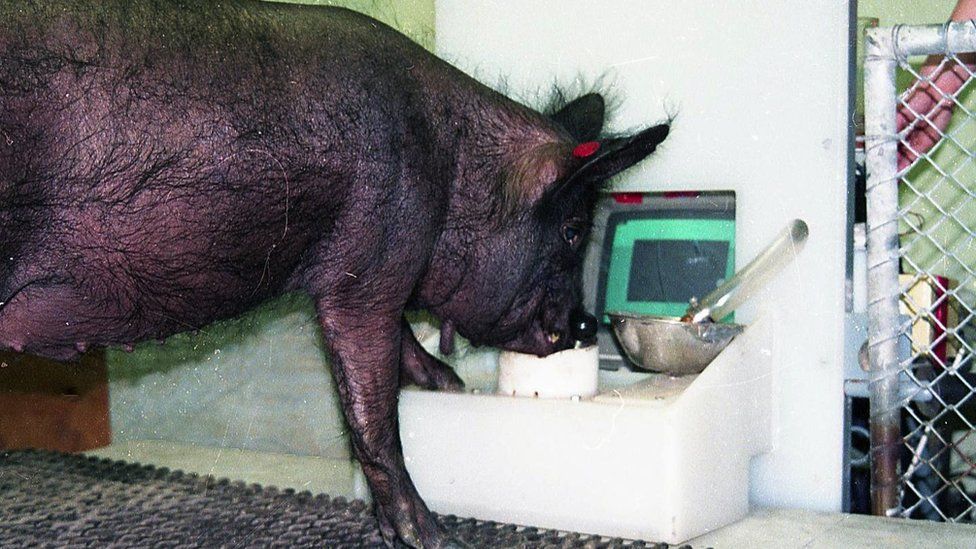
Pigs can play video games, scientists have found. Here, the pig Ebony operates a joystick.

In the same way that most of us are just beginning to understand the deep wisdom of indigenous tribes, we have barely scratched the surface of what animals can do. Fortunately, scientists never stop investigating.

BBC News reports, “Four pigs — Hamlet, Omelette, Ebony and Ivory — were trained to use an arcade-style joystick to steer an on-screen cursor into walls.

“Researchers said the fact that the pigs understood the connection between the stick and the game ‘is no small feat.’ And the pigs even continued playing when the food reward dispenser broke — apparently for the social contact.

“Usually, the pigs would be given a food pellet for ‘winning’ the game level. But during testing, it broke — and they kept clearing the game levels when encouraged by some of the researchers’ kind words. …

“The research team also thought that the fact the pigs could play video games at all — since they are far-sighted animals with no hands or thumbs – was -remarkable.’

“But it was not easy for them. Out of the two Yorkshire pigs, Hamlet, was better at the game than Omelette, but both struggled when it got harder — hitting the single target just under half the time. The Panepinto micro pigs had a bigger gamer skill gap — while Ivory was able to hit one-wall targets 76% of the time, Ebony could only do it 34% of the time.

“But the researchers were still satisfied that the attempts were deliberate and focused, rather than random — what they called ‘above chance.’ That means that ‘to some extent, all acquired the association between the joystick and cursor movement.’

“Kate Daniels, from Willow Farm in Worcestershire, told BBC Radio 4’s Today programme that while the scientists might have been impressed, ‘I don’t think this will come as a surprise to anyone that works with pigs. … They’re not playing Minecraft — but that they can manipulate a situation to get a reward is no surprise at all.’ ” More at the BBC, here.

The research paper was published in the journal Frontiers in Psychology.

For more on the intelligence of pigs, check out naturalist Sy Montgomery’s book The Good Good Pig.

Montgomery’s website says in part, “The Good Good Pig celebrates Christopher Hogwood in all his glory, from his inauspicious infancy to hog heaven in rural New Hampshire, where his boundless zest for life and his large, loving heart made him absolute monarch over a (mostly) peaceable kingdom. At first his domain included only Sy’s cosseted hens and her beautiful border collie, Tess. Then the neighbors began fetching Christopher home from his unauthorized jaunts, the little girls next door started giving him warm, soapy baths, and the villagers brought him delicious leftovers. His intelligence and fame increased along with his gift, and he was eventually featured in USA Today and on several National Public Radio environmental programs. One election day, some voters even wrote in Christopher on their ballots.”

Read Full Post »

I was charmed by Sy Montgomery’s recent article in the Boston Globe on the intelligence of octopi (she says “octopuses”).

The author of The Soul of an Octopus: A Surprising Exploration into the Wonder of Consciousness, Montgomery describes getting to know a clever and apparently affectionate octopus called Octavia.

“Everyone wanted to pet Octavia,” she writes. “And no wonder. She was beautiful, graceful, and affectionate. The fact that she was boneless, slimy, and living in painfully cold, 47-degree water deterred none of us.

“What thrilled us — me, New England Aquarium volunteer Wilson Menashi, and four visitors from the environmental radio show Living on Earth was the surprising fact that Octavia, who clearly wanted to be petted, was a giant Pacific octopus.

“When her keeper, Bill Murphy, opened the top of her exhibit, Octavia recognized Menashi and me immediately; we’d been working with her for several weeks. Turning red with excitement, she flowed over toward us from the far side of her tank. When we put our hands in the water, her arms rose to meet ours, embracing us with dozens of her strong, sensitive, white suckers. Occasionally Wilson handed her a fish from the plastic bucket perched on the edge of her tank. …

“Then, as Menashi reached for another capelin to feed her, we realized the bucket of fish was gone. While no fewer than six people were watching, and three of us had our arms in her tank, Octavia had stolen the bucket right out from under us.

“ ‘Octopuses are phenomenally smart,’ Menashi says. And he should know: He has worked with them for 20 years, and is expert in keeping these intelligent invertebrates occupied. Otherwise, they become bored. Aquariums design elaborate escape-proof lids for their octopus tanks, and still they are often thwarted. Octopuses not infrequently slip out of their exhibits and turn up in other tanks to eat the inhabitants.

“Many aquariums give their octopuses Legos to dismantle, jars with lids to unscrew, and Mr. Potato Head to play with. Menashi, a retired inventor, designed a series of nesting Plexiglas cubes, each with a different lock, which Boston’s octopuses quickly learned to open to get at a tasty crab inside. And just this spring, New Zealand Sea Life aquarists teamed up with Sony engineers to teach a female octopus named Rambo to press the red shutter button on a waterproof camera to take photos of visitors, which the aquarium sells for $2 each to benefit its conservation programs. Rambo learned in three attempts.”

What a different perspective on the scary beast in the film 20,000 Leagues Under the Sea, which I saw as a child.

I’d love to copy the whole intriguing article, but I’m afraid that would not be “fair use.” So read it all here.

Photo: Tia Strombeck
Sy Montgomery pets Octavia, an octopus at the New England Aquarium in Boston.

Read Full Post »