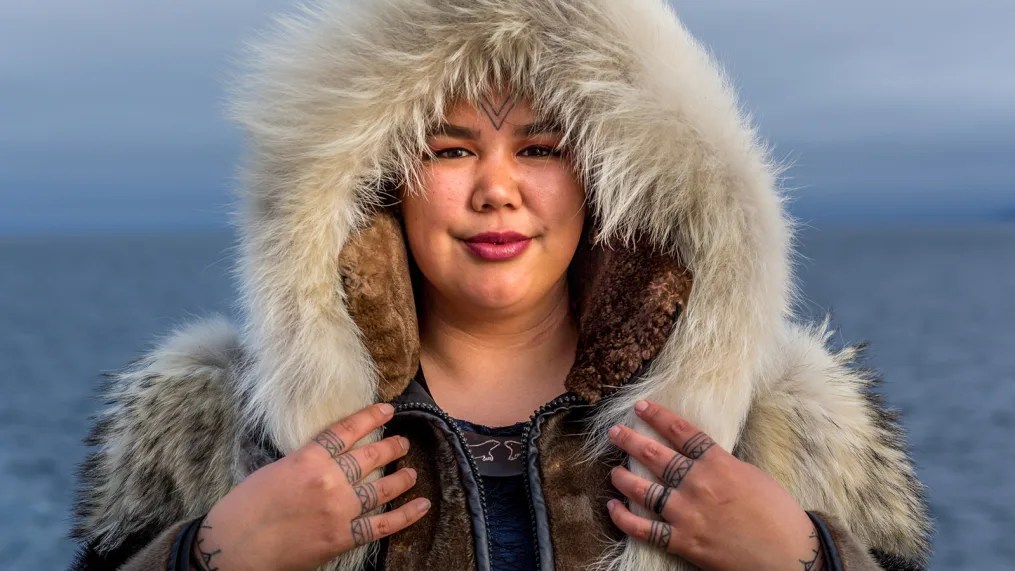
Photo: Adeline Heymann/One Ocean Expeditions.
Candice Pedersen, a guide for One Ocean Expeditions in the Arctic, tells passengers that Inuit women feel empowered reclaiming traditional tattoos for themselves.
I love the radio show called The World because of the international focus. It always has a deeper take on mainstream media stories, and you can hear music you’re unlikely to be exposed to anywhere else. Recently, Joshua Coelda, Sejersdal Dreiager, and Shirsha Chakraborty reported about a tradition that is coming back from the brink: Inuit tattoo art.
“Najannguac Dalgård Christensen, 35, pulled back her sleeve on one forearm to reveal a pair of tattoos shaped like train tracks across her wrists. …
“These are traditional Inuit tattoo patterns that speak to her Indigenous Inuit heritage. The markings, she said, represent Sila, a word that carries many meanings, including ‘breath,’ ‘sky,’ ‘spirit’ and ‘universe.’
“To Christensen, who got the tattoo several years ago, it also means ‘the Greenlandic belief that we should be aware of who we are and what we can be, and that is attached to each other.’
“In precolonial times, Inuit women of Greenland, and across much of the Arctic, would have tattoos on both their bodies and faces, holding important pre-Christian spiritual meaning. Today, some Greenlandic Inuit like Christensen are reclaiming their identity through this long-lost art.
“She said that she didn’t always embrace her Greenlander identity — because it is often associated with negative stereotypes about the Inuit diaspora living in Denmark, who colonized the North American island three centuries ago.
“ ‘I felt empowered by getting the tattoos because it was like there was some kind of relief that I didn’t have to be embarrassed about being a Greenlander anymore,’ Christensen said. …
“The custom itself is far from new, but tattoos were some of the first traditions to be discouraged when Danish-Norwegian missionaries started colonizing the island at the beginning of the 18th century. The missionaries found tattooing incompatible with Christian faith, [Randi Sørensen Johansen, intangible cultural heritage curator at the Greenland National Museum and Archives] said. …
“As the custom disappeared, so did much of the knowledge about the tattoos’ meaning. ‘We didn’t have that tradition of writing down,’ Johansen said — Inuit passed knowledge through oral storytelling. …
“Inuit would use amulets to protect them from ‘unwelcome spirits,’ but also to help certain attributes or ensure a successful childbirth, among other things. It is likely, Johansen said, that Inuit tattoos were seen as a kind of amulet, giving strength, help or protection to the women or — in rarer cases — men who had gotten them.
“The tattoos were most often made as linear patterns across the brow and vertical lines on the chin made by using both a puncture or dot technique and a sewing technique. The latter technique consisted of pulling sinew dipped in soot under the skin with a needle made of animal bone, curator Johansen said.
“Maya Sialuk Jacobsen is one of about a dozen Inuit tattoo artists across the globe reviving this traditional art. … It was she who created Christensen’s tattoos. For over six years, she’s been helping Inuit like Christensen who live in Denmark connect with their culture through ink. Like Christensen, she is of both Danish and Greenlandic Inuit descent — a group she describes as an emerging ‘third culture’ in the Scandinavian country.
“The community is fairly small in Denmark and not well-defined demographically. According to StatBank Greenland, there are a little under 17,000 people born in Greenland currently living in Denmark. But community leaders, including from the Greenlandic House of Aalborg, aren’t even sure about the exact number of Inuit in Denmark. The number of self-identifying Inuit could be even higher, due to the presence of third-culture community members, who are partially Inuit. …
“Sialuk Jacobsen said, ‘It’s basically identity work all the time.’ Many come to her with a feeling of sadness, in search of a sense of belonging, she said. ‘They need to talk about these things, and to learn about the culture, they just want to learn.’ …
“While Sialuk Jacobsen said she uses inks and needles approved for tattooing on clients in Denmark, her research into the traditional techniques has included experimental tattooing on herself, and using her own right leg as her test area to reconstruct authentic methods of inking up.
“But in Denmark, finger, hand and face tattoos are prohibited (though it’s not illegal in Greenland). So, Sialuk Jacobsen is limited to tattooing the rest of the body. …
“The legacies of colonialism hang heavy over the community living in Denmark. Greenlanders are overrepresented among Denmark’s homeless population — accounting for 7% of people experiencing homelessness, according to VIVE.
“In recent years, Denmark’s colonial past came under public scrutiny. For her master’s degree, Christensen looked into a form of ‘modern boarding schools.’ She found that Inuit children in Denmark are more likely than Danish children to be taken away from their families and placed in foster homes, which are almost always Danish families.
“ ‘They learn to speak Danish, and there isn’t any focus on the Greenlandic language, so they lose their Greenlandic language. And when the parents only speak Greenlandic, they can’t talk to each other without an interpreter.’
“Christensen, who has become an activist through her research, believes the government should make it at least mandatory for Inuit children living in foster care to have lessons on Greenlandic.”

 Suzanne's Mom's Blog