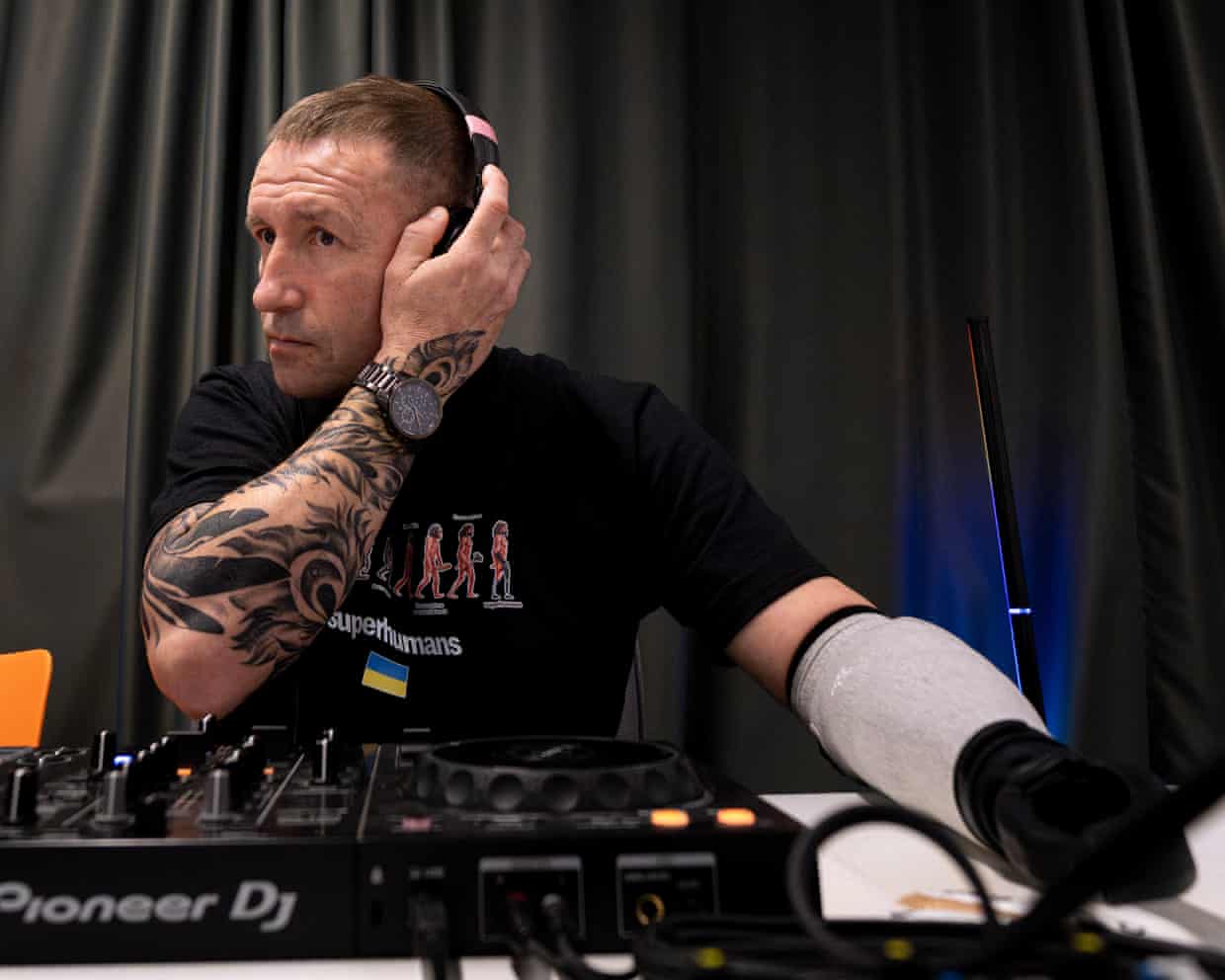
Photo: Bohdan Lozytsky.
Ukraine was veteran Dmytro Melnik works with the EnterDJ system, as part of rehabilitation from trauma.
Several of us who for a few months helped out Ukrainian journalists with social media in English befriended Vitali, who lives with his wife and little girl in Rivne and does charitable work for displaced Ukrainian women and children. We were always relieved that Vitali had not yet been called up by the army.
That changed in December, not long after Rivne, too, began suffering from Russian bombing. We worry about him because of the obvious dangers of conflict — and the PTSD some soldiers experience when they get home. I hope he never needs an intervention like the one in today’s article.
Darcie Imbert tells Guardian readers about a worthy music therapy program — EnterDJ at the Superhumans center near Lviv.
“In Ukraine, sound carries a different weight: the cautionary blurt of sirens, Shahed drones humming overhead, the concussive thwack of air defense interception and the subsequent explosion. But as well as the sounds of war, which continue three and a half years into Russia’s full-scale invasion, music still plays, clubs remain open during the day (closing well before the midnight curfew), and electronic dance music remains an intrinsic part of many Ukrainian lives. …
“The rehabilitative power of dance music is most evident at the Superhumans center, near Lviv in the west of Ukraine. Here, the most critically war-wounded are treated with prosthetics and reconstructive surgery, and psychological support is given to children and adults affected by the war. And within the range of treatment is music therapy.
“Howard Buffett, the son of Warren Buffett and one of the center’s chief funders, suggested forming a Superhumans band, so the center teamed up with music charity Victory Beats, which was set up one year into the war to provide veterans with relaxation and a nonverbal outlet for emotional expression.
“ ‘We were working with a 25-year-old soldier with severe brain damage and limited use of his hand,’ the charity’s founder, Volodymyr Nedohoda, remembers. ‘We started with a [sound-based] relaxation session designed to calm the nervous system, but stopped almost immediately because the low frequency triggered pain. When he started to feel better, he asked for a DJ console.’
“Having witnessed the efficacy of electronic music as therapy firsthand, Nedohoda and Vlad Fisun – a DJ and former editor-in-chief of Playboy Ukraine – partnered to create the EnterDJ program, which teaches veterans the basics of mixing. All that users require is a laptop, headphones and an internet connection; some tune in from home, others show up to a dedicated space in the Superhumans center. …
“Speaking with the same stoicism that underpins most of my conversations with Ukrainians, another veteran, Oleksandr, tells me about the incident that led him to Superhumans and EnterDJ. ‘I was serving in Poltava when a missile destroyed my leg,’ he says. ‘I remember everything about it. The blast, phoning my commander to say I was alive, realizing I’d have to drive an automatic car, worrying about the blood in my car after the evacuation.’ He laughs at the absurdity, and continues. ‘In hospital, I lost nearly all my blood and had to be resuscitated. I woke up knowing my leg was gone, but thankful the rest of my body and brain were OK. That’s most important.’
“For Oleksandr, EnterDJ became a daily routine, ‘to get some good moments if the day was hard, or to celebrate if I gained something in rehabilitation.’ Within six months, he was performing alongside the Lviv Philharmonic Orchestra, using a Midi controller to layer sounds over a composition written with British composer Nigel Osborne.
“Oleksandr had started off using singing bowls in a sound therapy session. … Before being fitted with a prosthetic leg, EnterDJ ‘helped distract me from the trauma and rehabbing,’ he says, holding his kind gaze steady. … ‘We have composed ambient music for therapeutic purposes; I added electronic effects to live classical instruments. The audience relaxed deeply; some even fell asleep. So we met our goal!’ …
“Roman Cherkas, who served in the Third Tank brigade in eastern Ukraine, has gravitated towards drum’n’bass. He joined the EnterDJ program after months of surgeries, prosthetics and rehabilitation at the centre, after losing both of his lower limbs in a mortar strike. He speaks to me on a call from his home, ready with a drum’n’bass mix. ‘Right now, I still don’t feel mobile, I can’t move around normally. Music has become energy for me, life energy,’ he says. …
“After six months in the program, Roman performed in Lviv at a showcase by one of the world’s leading drum’n’bass labels, Hospital Records. He speaks slowly and thoughtfully about how music shifts his headspace. He becomes completely absorbed by it, sometimes sitting in his chair mixing for six-hour stretches. ‘I tried working with psychologists but it didn’t work for me. You have to consciously switch your brain on and imagine lifting your legs, which is very difficult. With music, it’s the opposite, it switches my mind automatically and makes me feel better.’ ”
More at the Guardian, here.

 Suzanne's Mom's Blog