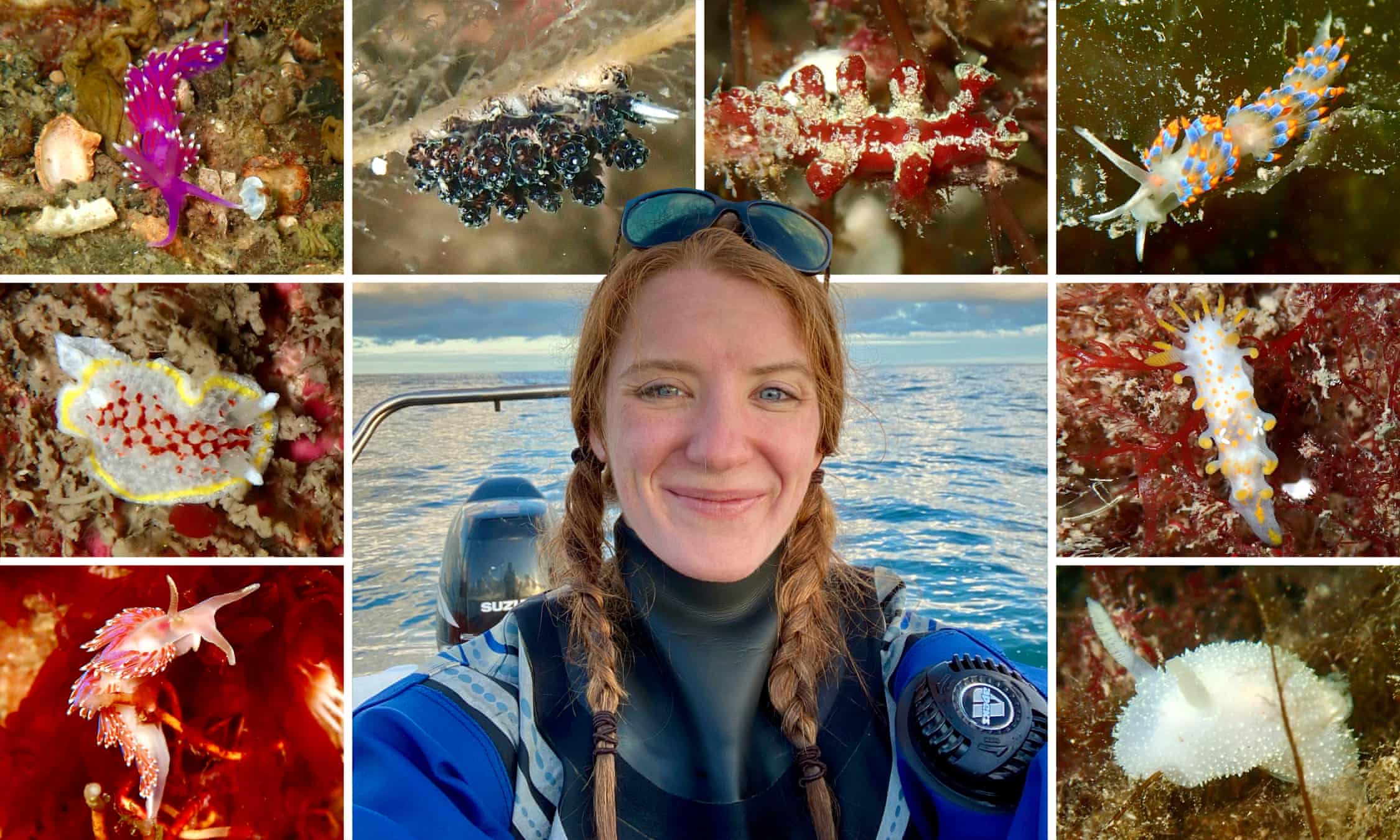
Photos: Libby Keatley.
Libby Keatley and some of the “inherently charismatic” sea slugs she has encountered.
After blogging singer Will McMillan told us more than we ever imagined about sea snails once used for a royal purple dye, I remembered that the Guardian had an equally fascinating story on sea slugs. It turns out some young people are huge fans of the critters and are helping scientists keep track of them.
Helen Scales writes, “Two years ago, Libby Keatley was diving off the coast of County Antrim in Northern Ireland when she spotted something unusual. It was a sea slug – or nudibranch – whose transparent body had orange lines running through it and twiggy projections arranged along its back. ‘It was quite distinctive and not like anything I’d seen before,’ she says.
“Keatley called over her diving buddy, Bernard Picton, a local marine biologist and pioneer in UK sea slug studies. He scooped it up in a plastic bag and, back at his lab, confirmed it was a newly discovered species. He named it in Keatley’s honour: Dendronotus keatleyae.
“ ‘Three years ago, I didn’t really know what a nudibranch was or I thought they only lived in tropical countries,’ says Keatley.
‘It just shows you can learn – you don’t have to be somebody who’s been in a lab for 20 years to know that something looks a bit funny or different.’
“For a niche but growing group of amateur naturalists, sea slugs have become an ideal subject: as stunning as butterflies but with the good grace to sit still while you peer in close and take a photograph. Distant relatives of the slimy, drab land-dwellers that live in gardens, sea slugs are an altogether more endearing bunch. Many are daubed in jewel-like colors that warn off predators. Others take on hues to blend in with their surroundings, often gaudy seaweeds and sponges. There are also plenty of sea slugs to discover in UK waters, with about 150 known species across the north Atlantic. …
“To show me why the hobby has attracted a worldwide community of scuba divers and amateur photographers – and how it makes important contributions to scientists’ understanding of how our oceans are changing – Keatley takes me diving in Strangford Lough. An hour’s drive south of Belfast, it is one of Europe’s largest sea inlets and a renowned wildlife spot, home to seabirds, seals and recently a pair of bottlenose dolphins.
“There’s even more going on beneath the waterline. At high tide, the Irish Sea brings in a soup of particles and nutrients which feeds a rich mix of underwater species – and a host of other creatures that feed on them. …
“We are joined on the dive by Keatley’s partner and fellow enthusiast, Phil Wilkinson, and Picton, who recently updated a guidebook to sea slugs of the north Atlantic with Christine Morrow. …
“We find more sea slugs than I’ve ever seen, even in tropical seas: neon pink ones and transparent ones covered with finger-like projections with shiny turquoise tips; another is white with yellow specks and a pair of bunny ears that are for smelling not hearing. We encounter a gathering of sea slugs that look like miniature fried eggs splashed in chili sauce, and Keatley points out a peach-colored specimen hitching a ride on a hermit crab. It feeds on minute hydroids – stinging relatives of jellyfish – that grow on the crab’s shell.
“For Keatley, sea slug spotting was part of an unexpected reawakening of a childhood interest in nature. In January 2019, she learned to scuba dive and was an instant convert to the underwater world. ‘I couldn’t get enough,’ she says. ‘The more I saw, the more I wanted to learn, and then the more I was seeing. So it just snowballed a wee bit.’ ”
Don’t you love the variety of things that people get interested in? At the Guardian, here, you can read about the importance of citizen scientists in the slug world. No firewall. Donations encouraged.

 Suzanne's Mom's Blog