Feeds:
Posts
Comments

Posts Tagged ‘italy’

Photo: Roberto Salomone/The Guardian.
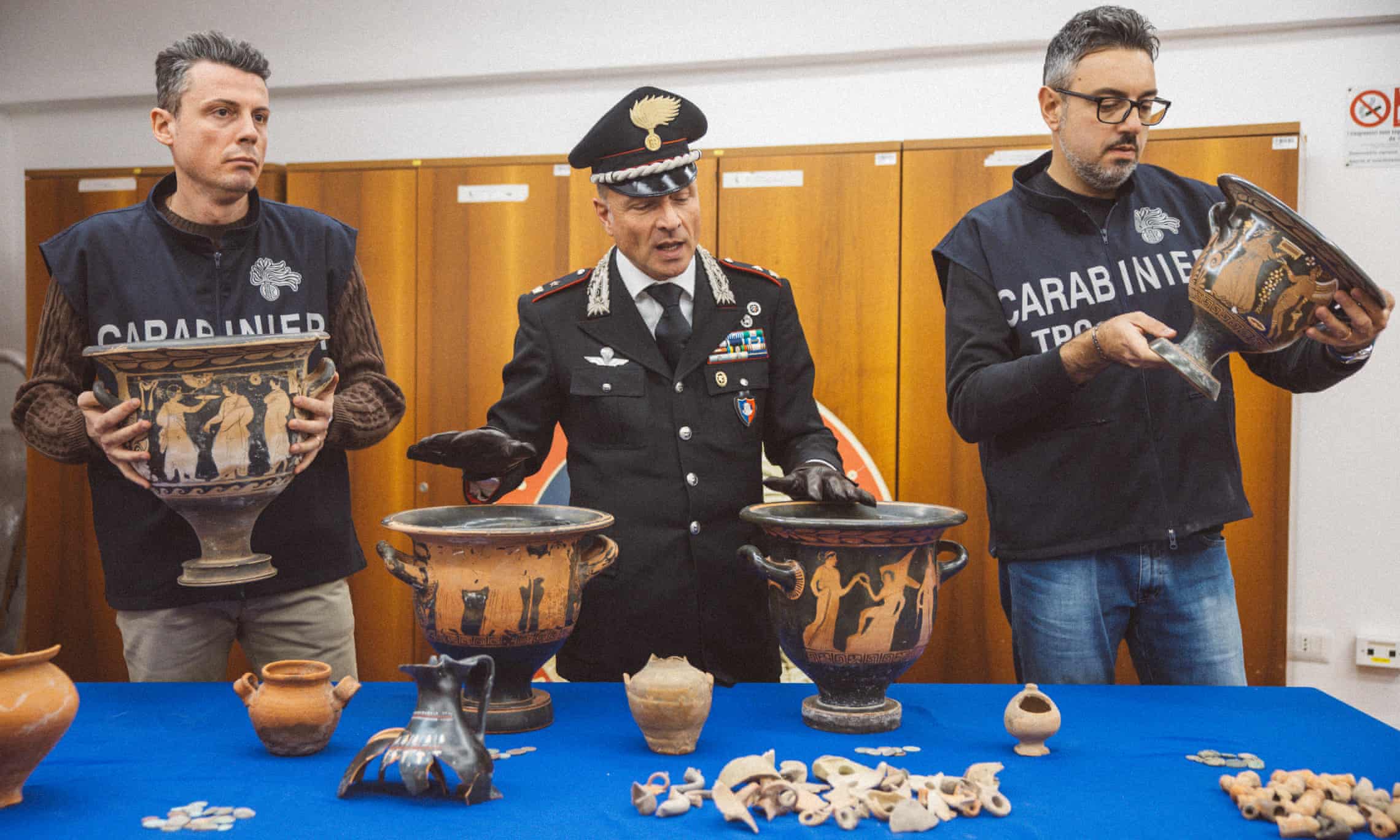
Italy’s Carabinieri cultural heritage protection squad at work. The force recently uncovered a clandestine dig in the middle of Naples
.

Every morning on the social network Mastodon, German archaeologist Nina Willburger (@ninawillburger) posts a beautiful, or at least curious, artifact from a dig. The history of archaeology suggests that not all of them were unearthed in legal ways, but they are in museums.

Nowadays there are strict laws around digging. Which is why Italy needs its cultural heritage protection squad.

At the Guardian, Angela Giuffrida wrote about the team’s latest success.

“Looking towards the semicircular apse with a frescoed image of a partially identifiable Christ on a throne staring back at them, the archaeologists crouching in the small space deep beneath a residential building in Naples were left speechless. They were amid the remains of an 11th-century church.

“The archaeologists, however, could not take the credit: the historic jewel, which had just been seized by police, was dug up by tombaroli, or tomb-raiders, illicit gangs who for decades have been plundering Italian cultural sites, in turn fueling the global market for stolen art and antiquities.

“Investigators believe the group’s leader was a local entrepreneur, currently under investigation, who owns two apartments in the building above. His cellar was turned into a well-organized excavation site, from where the tomb-raiders dug a warren of tunnels leading them about 8 metres [~26 feet] down into ancient Naples, where they unearthed medieval art. …

“But impressive though their workmanship was – they even installed concrete pillars to prevent the structure from collapsing – officers from the Naples unit of Italy’s Carabinieri cultural heritage protection squad unmasked the gang and confiscated the church after a covert investigation.

“The force also recovered 10,000 fragments of Roman and medieval pottery from the alleged gangmasters’ homes and 453 intact artifacts, including vases, terracotta lamps and coins. …

“The gangs commonly work by marking out clandestine excavation spots close to known archaeological sites, which in the Campania region surrounding Naples can include Pompeii, Herculaneum, Paestum or areas where there were Roman settlements. So uncovering a clandestine dig in the middle of the city took the specialist squad by surprise.

“ ‘When you think of Pompeii, for example, you know a dig can lead to a wealthy domus where prestigious objects can be found,’ says Massimo Esposito, the chief of the squad’s unit in Naples. ‘But it’s rare to find one in the heart of Naples.’

“The group’s alleged leader is believed to have had an inkling that there might be something beneath his home when construction works nearby on the city’s metro were interrupted and the site cordoned off after a small part of the remains of another, albeit less historically interesting, church emerged.

“The group worked for several months, carrying out their noisiest activity during the day, but not loud enough to attract complaints from the building’s residents. Little did the gang know that their comings and goings were being observed by Esposito’s team, with the squad staking out the building and wiretapping its alleged leader’s phone. Suspicions were especially aroused after seeing him carrying boxes filled with materials. …

“The Carabinieri’s cultural heritage protection squad was established in 1969 with the task of protecting Italy’s priceless cultural assets. Since then, more than 3m stolen artworks and relics have been retrieved, including those that ended up on display in some of the world’s biggest museums, such as the Getty in Los Angeles.

“Art and relics thieves in Campania especially thrived in the 1980s, taking advantage of a devastating earthquake at the beginning of that decade to ransack churches of paintings. The long-lost La Desposizione, a 2-metre high masterpiece painted by Angelo Solimena in 1664 depicting the crucifixion, was recently returned to Campania only after it was spotted on display in a museum in the Marche region. …

“Esposito met the Guardian in his unit’s office located in Castel Sant’Elmo, a medieval fortress overlooking Naples. He was surrounded by relics … including a wine amphora and a house-shaped sarcophagus believed to have contained the remains of a child, and various other funerary objects dating back to the fourth century AD. The artifacts are usually kept there pending the conclusion of judicial cases, before being either returned to their origin or entrusted to museums. …

“Data in recent years indicates a gradual decrease in crimes against cultural heritage. Laws for crimes against cultural heritage have been tightened, and work intensified to return stolen assets from abroad. … Use of social media, especially over the past decade, has also made it easier for the squad to identify thieves. A trove of funerary treasures, believed to have belonged to Etruscan princesses and illegally excavated from an underground tomb in Umbria, was retrieved in November after police came across a photo of the bungling thieves posing on Facebook as they attempted to sell it online.

“ ‘Despite the risk, there is sometimes this egotistical element: they want to boast about the beautiful items they’ve found,’ says Esposito.”

Check out the treasures at the Guardian, here. No paywall. Donations are important to the Guardian‘s journalism.
Read Full Post »

Photo: ItalianNotes.
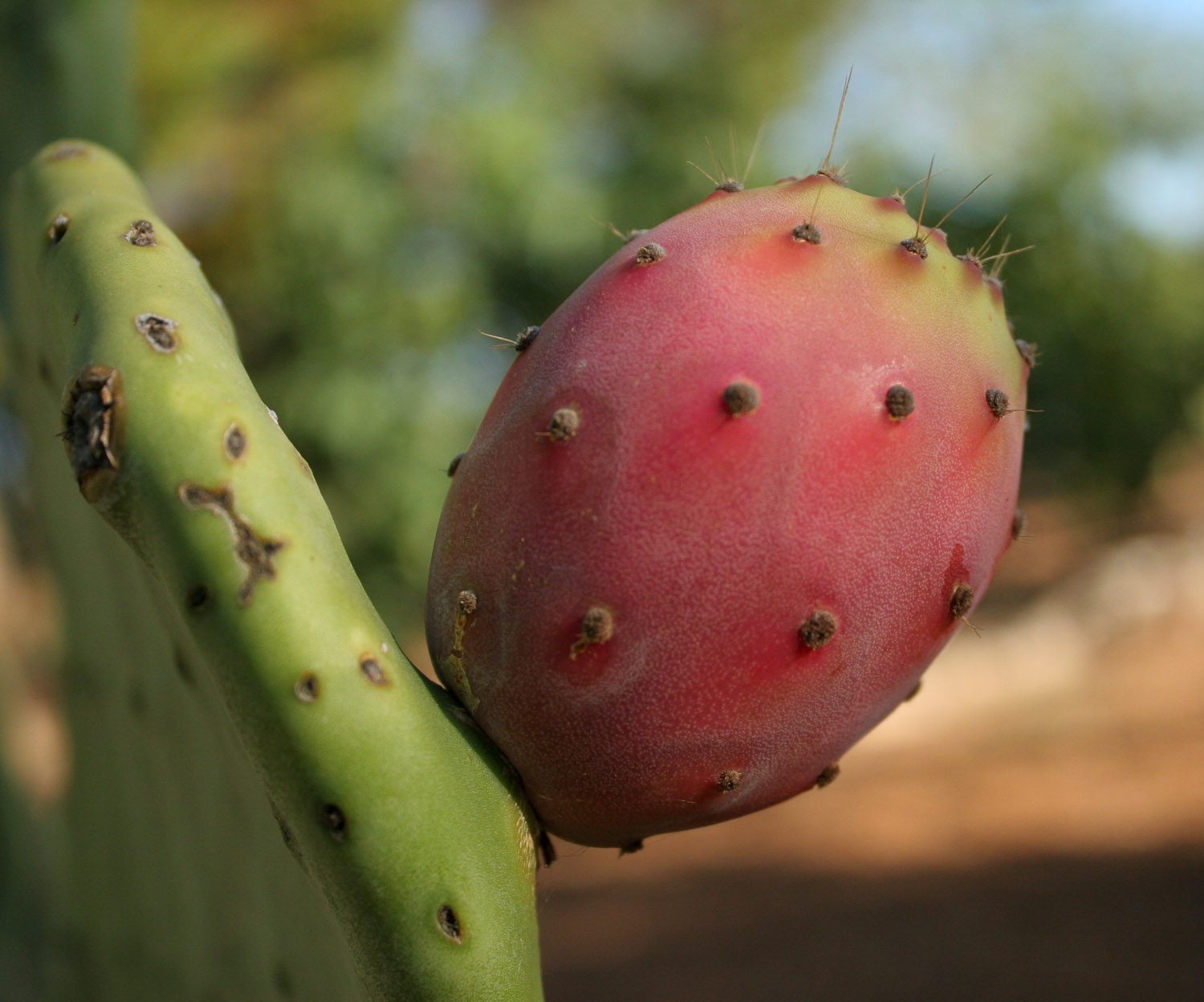
Prickly pear, or cactus pear. When Italy suffers from drought, some people turn to an edible cactus.

A while ago I posted photos I’d taken in New England and was surprised to see a cactus this far north. Hannah called it “prickly pear” and told me it was known for its versatility. It’s apparently the same cactus that Italy is looking to as a reliable food source.

Stefano Bernabei and Gavin Jones write at Reuters, “Global warming, drought and plant disease pose a growing threat to agriculture in Italy’s arid south, but a startup founded by a former telecoms manager believes it has found a solution: Opuntia Ficus, better known as the cactus pear.

“Andrea Ortenzi saw the plant’s potential 20 years ago when working for Telecom Italia in Brazil, where it is widely used as animal feed. On returning to Italy he began looking at ways to turn his intuition into a business opportunity.

“He and four friends founded their company, called Wakonda, in 2021, and began buying land to plant the crop in the southern Puglia region where the traditionally dominant olive trees had been ravaged by an insect-borne disease called Xylella.

“The damage from the plant disease has been compounded by recurring droughts and extreme weather in the last few years all over Italy’s southern mainland and islands, hitting crops from grapes to citrus fruits.

“Ortenzi is convinced the hardy and versatile cactus pear, otherwise called the prickly pear or, in Italy, the Indian fig, can be a highly profitable solution yielding a raft of products such as soft drinks, flour, animal feed and biofuel. …

” ‘As an industry, cactus pear production is growing rather quickly, especially for fodder use and as a source of biofuel,’ said Makiko Taguchi, agricultural officer at the United Nations’ Food and Agriculture Organization headquartered in Rome.

“The cactus produces a tasty fruit eaten in much of Latin America and the Mediterranean, while in Mexico the flat green pads that form the arms of the cactus, are used in cooking. In Tunisia, where it covers around 12% of cultivated land, second only to olive trees, the cactus pear is a major source of income for thousands, particularly women who harvest and sell the fruit.

“In Brazil, which has the world’s largest production, it is mainly cultivated in the north-east for fodder, while Peru and Chile use it to extract a red dye known as Cochineal, used in food and cosmetic production.

Sportswear group Adidas and carmaker Toyota have recently shown interest in using the cactus to produce plant-based leather sourced mainly from Mexico.

“The cactus pear is not yet included in the FAO’s agricultural output statistics, but Taguchi cited the rapid expansion of CactusNet, a contact network of cactus researchers and businesses worldwide which she coordinates. …

“The plant, native to desert areas of south and north America, thrives in the increasingly arid conditions of Italy’s south, and needs ten times less water than maize, a comparable crop whose byproducts also include animal feed and methane. …

“Of the roughly 100,000 hectares of olive trees destroyed by Xylella in southern Puglia, only 30,000 will be replanted in the same way, [Ortenzi] told Reuters in an interview. ‘Potentially 70,000 could be planted with prickly pears,’ he said. …

“Wakonda’s business model discards the fruit and focuses instead on the prickly pads, which are pressed to yield a juice used for a highly nutritious, low-calorie energy drink. The dried out pads are then processed to produce a light flour for the food industry or a high-protein animal feed.

“Wakonda’s circular, ecological production system also includes ‘biodigester’ tanks in which the waste from the output cycle is transformed into methane gas used as a bio-fuel either on site or sold. …

“Under Ortenzi’s business plan, rather than buying up land to plant the cactus, Wakonda aims to persuade farmers of its potential and then license out to them, in return for royalties, all the equipment and know-how required to exploit it.

” ‘The land remains yours, you convert it to prickly pears and I guarantee to buy all your output for at least 15 years,’ Ortenzi said.”

Hmmm. I have two issues. Throwing out the fruit seems super wasteful. And methane may be a biofuel, but it’s no better for the environment than fossil fuel. What do you think?

More at Reuters, here. No firewall.

Read Full Post »

Photo:Sasha Arutyunova/New York Times.
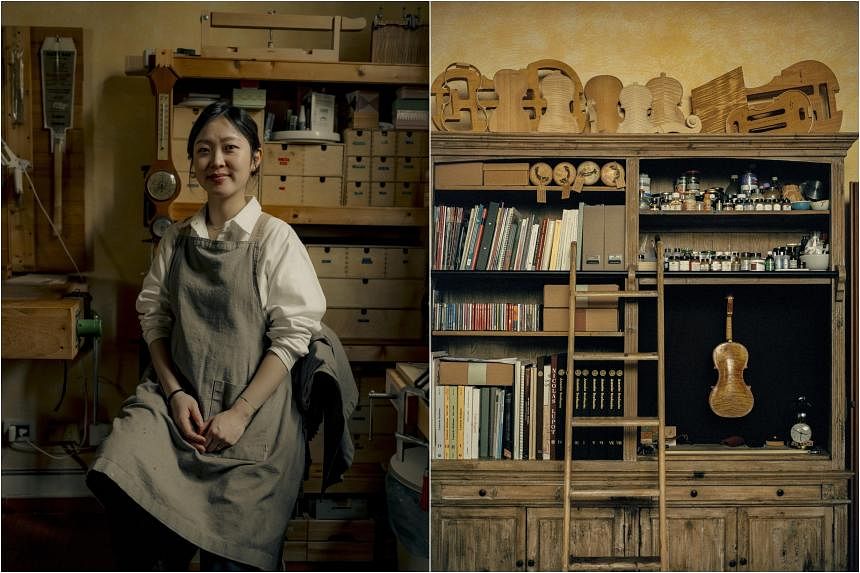
South Korean violin maker Ayoung An at her studio in Cremona, Italy. 

It’s a mystery how some children get a passion for an activity at a very young age and never let it go. You can probably think of someone you know who was like that.

At the New York Times, Valeriya Safronova writes about a little girl in Korea who slept with her violin and who later learned to make violins in the Italian tradition.

When Ayoung An was 8,” Safronova writes, “her parents bought her a violin. She slept with the instrument on the pillow next to her every night. Two years later, a shop selling musical instruments opened in Pyeongtaek, South Korea, her hometown, and An became a fixture there, pelting the owner with questions. ‘I think I bothered him a lot,’ An, now 32, said.

“As a teenager, she decided she would become a violin maker. Eventually, a journey with twists and turns took her to Cremona in northern Italy — a famed hub for violin makers, including masters like Antonio Stradivari, since the 16th century. There, An, a rising star in the violin-making world with international awards under her belt, runs her own workshop. …

“On a recent Monday, An was hunched over a thick 20-inch piece of wood held in place by two metal clamps. Pressing her body down for leverage, she scraped the wood with a gouge, removing layers, her hands steady and firm. She was forming a curving neck called a ‘scroll,’ one of the later steps of making a violin or cello. On this day, the violin maker was immersed on a commission for a cello, which shares a similar crafting process.

“Violins like An’s, made in the tradition of Stradivari and Giuseppe Guarneri, require about two months of work and sell for about 16,000 to 17,000 euros, or $17,500 to $18,500. …

“An was 17 when she hatched her plan to learn the craft: She would move in with an American family in a Chicago suburb so that she could attend a local high school, master English and eventually study at the Chicago School of Violin Making. There were no such schools in Korea at the time. Her parents, distraught about her moving so far away to pursue an uncertain career path, tried to stop her. …

“ ‘When I said goodbye to my parents at the airport, they were crying,’ she said. ‘I wasn’t. I was too excited.’

“Two years after moving to Illinois, she discovered that one of the best known schools for violin makers, the International School of Violin Making, was actually in Cremona. So in 2011, at age 20, she moved to a new country again.

“Cremona was home to some of history’s most famous luthiers, makers of stringed instruments: Stradivari; Andrea Amati, considered ‘the father of the violin’; and the Guarneri family. For the 160 to 200 violin makers in Cremona today, the sound quality of the masters remains the ultimate goal. …

“Around the studio, small pots of pigment, for varnishing, sat on shelves and tables alongside jars of powders — ground glass and minerals — for polishing. On a wall were dozens of knives, chisels and saws. Also present: dentist’s tools to scratch the instrument for a more antique look.

“An is the youngest member of a consortium in Cremona dedicated to upholding violin-making traditions. She is so immersed in the Cremonese method of violin making that, at the suggestion of a mentor, she created an artist’s name, Anna Arietti, to better fit in with Italian culture.

“An important moment is when luthiers place their label inside the instrument, called a ‘baptism.’ To make her label, An stamps her ink signature onto a small piece of paper — a browned page from a secondhand book, giving the impression of age. Then, using a traditional homemade mixture of melted bovine skin and rabbit skin as a long-lasting adhesive, she glues the label inside one half of the instrument. She also burns the signature of her Korean name into the instrument with a tiny heated brand.

“Afterward, the two halves are sealed together, completing the main body of the instrument. Her Italian artist’s name remains inside, intact as long as the violin is.”

More at the Times, here.

Read Full Post »

Photo: Rafael Viñoly Architects.
This airport in Italy will incorporate “multi-modal transport” links as well as … a vineyard.

No matter how innovative and complicated an architectural design is, it’s the quirkiest little thing that captures the attention of the public. As a member of the public, I am really hoping that the plans for a working vineyard on the roof of an airport in Florence will work out.

Lizzie Crook writes at Dezeen, “US studio Rafael Viñoly Architects has unveiled its plans for an international terminal at Florence Airport in Italy that will be crowned by a 7.7-hectare [19 acre] vineyard.

“The airport terminal will encompass 50,000 square meters [538,196 square feet] and is expected to be used by more than 5.9 million passengers annually. …

“The terminal’s main feature will be a vast sloping roof, which will be lined with skylights and 38 rows of usable vineyards.

“According to Rafael Viñoly Architects, this is a nod to Florence’s reputation as ‘the heart of Italy’s renowned wine country. … A leading vintner from the region will cultivate the vineyards, and the wine will be crafted and aged in specialized cellars beneath the terminal’s roof.’

“Inside, the terminal will feature a large piazza-like space at its centre, which will be flanked by the arrivals and departures areas on opposite sides. This central space will be linked to transport, parking and retail spaces open to both passengers and local people, and is hoped to streamline circulation for the terminal.

“Other key elements of the proposal include the reorientation of Florence Airport’s, formerly Aeroporto Amerigo Vespucci, existing runway by 90 degrees. This move will turn the runway away from the surrounding hills and lengthen it to better suit modern aircraft.

“The plans will also improve the airport’s links to the city and wider region through ‘multi-modal transport options including a new light rail system,’ the studio said. [The] construction of the airport terminal will be carried out in two phases, with the first slated for completion in 2026 and the second in 2035.”

The architects’ website adds this: “Linear structures of precast concrete contain the soil and irrigation to sustain the vineyard and are held aloft by a network of branching columns that preserve layout flexibility for the terminal’s internal components. …

“Between each of these sloping, elevated structures [are] insulated skylights that flood the interior with natural light. The structures’ trapezoidal section (narrower on the bottom than the top) increases the view angle of the sky from below. In all there are 38 rows of productive vineyards that will grow on the building’s roof while providing excellent thermal insulating characteristics that contribute to the building’s targeted LEED Platinum sustainability rating. …

“The wine will be crafted and aged on-site in specialized cellars below the area where the ground begins to slope up to become the terminal’s roof. This enormous surface, which hides the airport terminal when viewed from Brunelleschi’s Duomo and other prominent vantage points in the city, will not only serve as a new landmark for the city’s sustainable future, but also as a symbol of the traditions, history and innovative spirit that continue to drive the Italian economy into the 21st Century.” More here.

More at Dezeen, here.

Read Full Post »

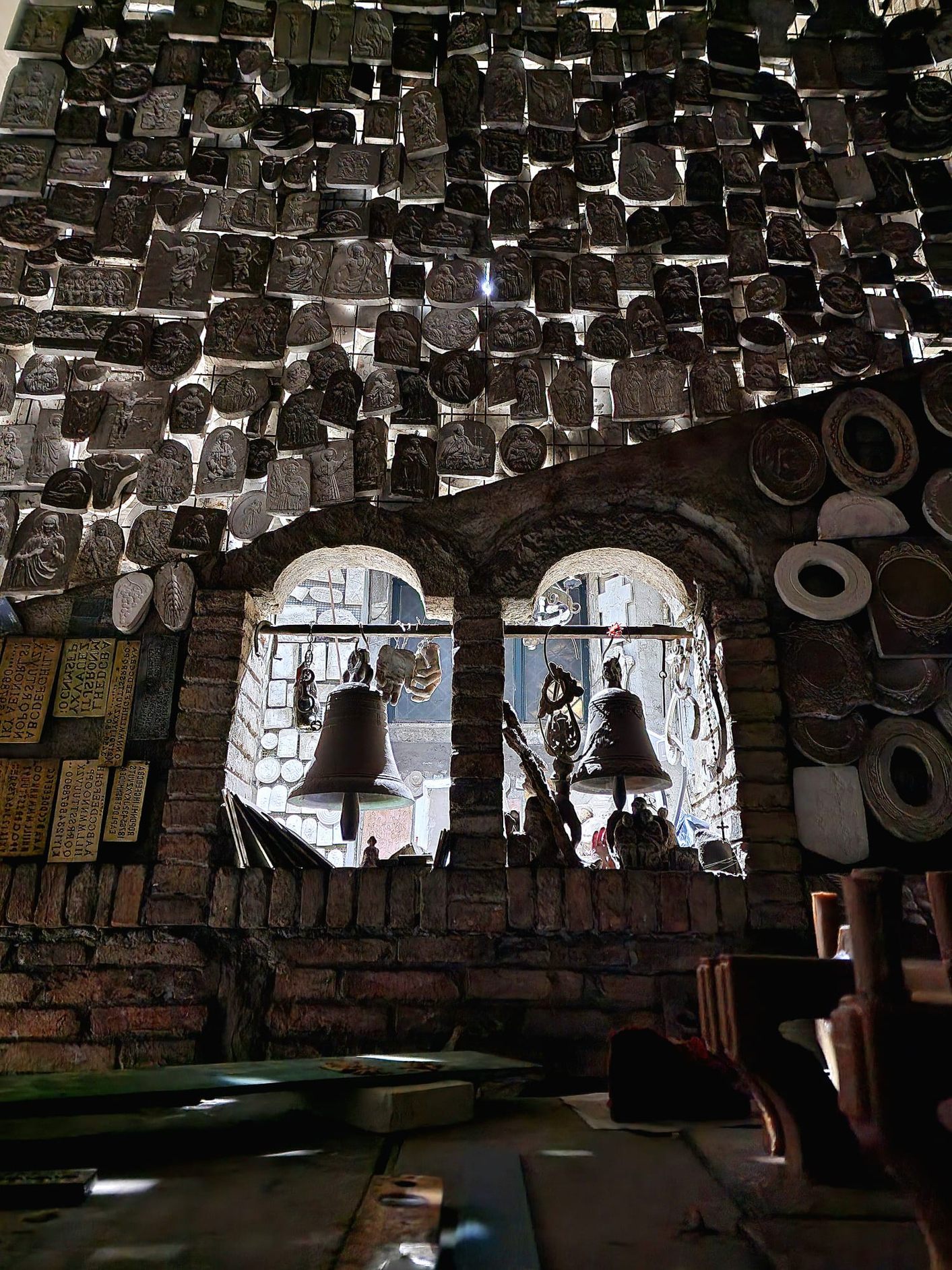
Photo: Pontifical Marinelli Bell Foundry.
One family has been making bronze bells for over 1,000 years in the Molise region of southern Italy. The bells can be seen in the Marinelli Bell Museum. 

My brother the business writer has made a study of companies in America with impressive longevity. For example, the Hollingsworths of Hollingsworth Vose were granted a patent to manufacture paper from manila fibers in 1843, but my brother says they go back to the time of George III.

Be that as it may, the Italian family in today’s story has been in business even longer.

Asia London Palomba writes at Atlas Obscura that Pasquale Marinelli is “a bell artisan in Italy. Pasquale and his brother Armando are the 26th generation of a family who has been crafting handmade bells since the middle ages. Pouring scalding-hot liquid metal into carefully designed molds, the two sweat over glowing embers, working with 10 centuries worth of knowledge in order to spread a medieval chime around the world.

“Naturally, such historical work is done in an ancient town called Agnone. Located in Italy’s isolated and rugged southern region of Molise, the quiet stone village lies squarely in a mountainous valley, where green hills roll into each other like waves and hay barrels freckle the land like drops of gold. It’s here, teetering at the top of a rocky outcrop, where you’ll find the two brothers working in the Pontifical Marinelli Bell Foundry, which, appropriately, is the oldest family-run business in Italy and among the oldest in the world.

“The Marinellis have been handcrafting bronze bells since at least the 11th century, although archaeological findings at nearby Benedictine monasteries suggest the Marinellis’ craft could date as far back as the 9th century.

“ ‘The same techniques and models, everything from A to Z, have been the same for the last 1,000 years,’ notes Armando. ‘Deviating from these methods that have been passed down throughout the generations means shutting the door on 1,000 years of history.’ …

“Their ancestor Nicodemo Marinelli, for whom they have historical documents … is documented to have been crafting bells in an era when the sonorous instrument had a greater, even primary role in society. ‘Bells were the first mass media. They heralded the salient moments of the day: to call people to work, for lunch, to return home from work. They were a way of telling time, of warning people,’ notes Pasquale.

“For almost its entire history, the foundry and its artisans were mobile, moving around to forge bells wherever there was demand. ‘We were like nomads,’ explains Armando, ‘living away from home for months alongside the tratturi, which were like the highways of antiquity.’ …

During World War II, Nazi troops seized many of the family’s historic bells and melted them down to create cannonballs.

“The brothers’ grandfather managed to bury some of the business’ most important bells underground, which were eventually recovered after the war, although Armando suspects there still may be a handful forgotten beneath the town’s earth. …

“A Marinelli bell is made with three cups stacked within each other — think of them as Russian nesting dolls. The first cup, called the ‘soul,’ is the internal part of the bell and is created by laying brick fragments upon each other and wrapping them together with iron string. This is slathered in a thick layer of clay, then wax, and then even more clay to create the second cup, named the ‘false bell,’ which will eventually be destroyed to make way for the bronze product. Smoldering coals are poured inside these two structures to bake the clay and melt the wax from the inside out.

“Hand-drawn wax molds are then cast onto the exterior of the false bell. ‘This is a very important step, because once its realized in bronze, it’ll live on for centuries in a church or a community,’ explains Armando. While almost everyone in the family partakes in the decoration process, this work falls primarily on Ettore Marinelli, Armando’s 31-year-old son and part of the 27th generation of artisans. Also a talented bronze sculptor, he works mainly in the artist’s hall. … ‘I was practically born in the foundry. I was already molding clay at the age of three,’ says Ettore.

“The soul and decorated false bell are then covered in more clay to create the third and final cup, called the ‘mantle.’ Once dry, the mantle, with the wax designs embossed into it, is lifted and the false bell is destroyed by hand with a hammer. A bronze alloy, spiced with a smattering of tin, is heated to 1,200 degrees Celsius (roughly 2,192 Fahrenheit) and poured into the bell mold, now consisting only of the mantle and the soul, while a priest blesses the process with a sprinkling of holy water. When the alloy hardens, the mantle is broken apart with a hammer to release the bronze bell, which is then polished until it shines.”

More at Atlas Obscura, here. No paywall. Lovely photos.

Read Full Post »

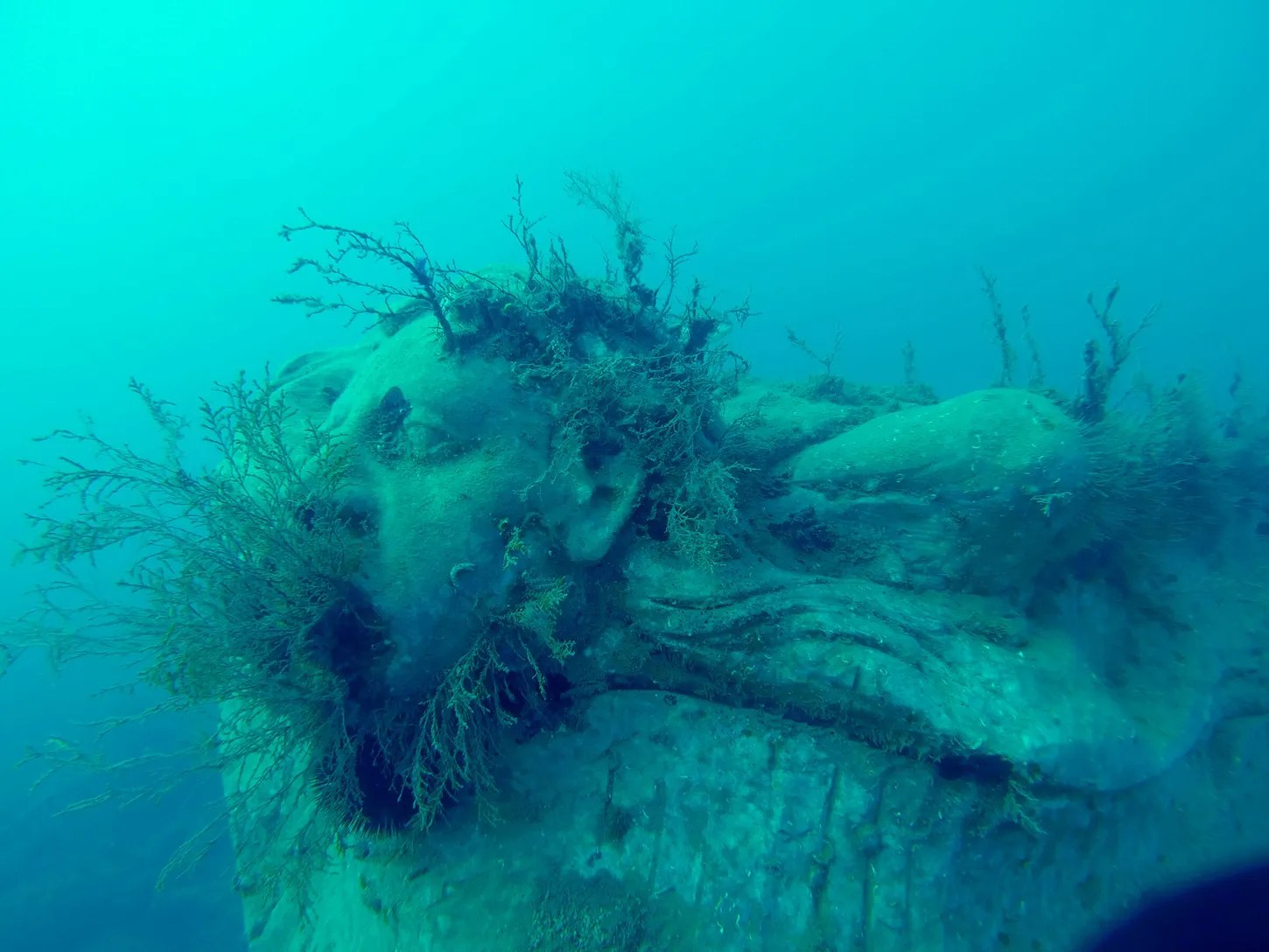
Photo: Casa Dei Pesci.
A sculpture named ‘Acqua’ by Giorgio Butini is one of 39 underwater sculptures helping to deter illegal fishing off the coast of an Italian port.  

Here’s a creative idea to thwart illegal activity: attract enough sightseers to make it too public to pursue. Today’s story shows how environmentalists, artists, and a fishing community in Italy are collaborating on shared goals.

Veronique Mistiaen writes at National Geographic, ” ‘The stone is asking me to give it the right face: it is thoughtful, quiet,’ says British stone sculptor Emily Young. She carves boldly, clad in a thick jacket, leather hat, sturdy boots, face mask and ear plugs, but no gloves because ‘you need to feel what’s happening with the stone through the tool.’ …

“Young, who has been called ‘Britain’s greatest living stone sculptor,’ has work exhibited and collected around the world, but it is the first time that one of her creations reposes at the bottom of the sea.

“Young’s 18-tonne Weeping Guardian and two other colossal faces (The Gentle Guardian and the Young Guardian), which she carved in Carrara marble with the help of two associates over five days, were lowered down on the sea bed off the coast of Tuscany at Talamone, a town between Florence and Rome, in 2015. There, her massive stone guardians are protecting marine life against gangs trawling illegally at night.

“Young’s unusual work is part of an on-going project by local fisherman Paolo Fanciulli and his non-profit Casa dei Pesci to try to protect the sea in a creative way. There are now 39 underwater sculptures and marble blocks at Talamone, placed in 2015 and 2020, and another 12 are ready to join them as soon as necessary funds can be raised.

“Bottom trawlers drag their heavy-weighted nets multiple times over the sea floor, scraping it bare and destroying the Posidonia (Posidonia oceanica), known as Neptune grass, a flowering seagrass endemic to the Mediterranean, which forms large underwater meadows and acts as a nursery and sanctuary for all marine life.

The Posidonia also soaks up 15 times more carbon dioxide annually than a similar sized piece of the Amazon rainforest.

“For these reasons, the Posidonia is a protected species included in the EU’s Habitats Directive and the Marine Strategy Framework Directive, and bottom trawling is illegal within three nautical miles from the coast in Italy. But because it is very profitable, and impossible to police the 8000km of Italian coastline, boats carry on at night regardless. 

“Now in his 60s, Fanciulli has been fishing around Talamone since he was a teenager.  In the 1980s, he started noticing the devastation caused by bottom trawlers and the impact it had on his and other local fishermen’s catch and livelihood. He has been trying to fight them ever since.

“In 2006, he joined force with the municipality of Talamone and a few environmental organizations to drop big concrete bollards on the bottom of the Mediterranean to ‘serve as secret agents under the sea.’ The action received media attention and he became a national hero – but it wasn’t enough to deter the trawlers. The local mafia also retaliated by making sure he couldn’t sell his fish at the market, and threatening him.

“He needed to find another way. ‘He thought: “This is Italy. We do art. If we could put art and conservation together, we might have more impact,” ‘ explains Ippolito Turco, a friend of Fanciulli and president of the non-profit Casa dei Pesci, which they created together for that purpose with the support of several cultural and environmental associations.

“They asked nearby Carrara quarries if they could donate a few stones. Franco Barattini, the president of one of Carrara’s best-known quarries – Michelangelo cave, the very place where the eponymous artist came at the turn of the 16th century to select stones for his iconic David and Pietà statues – promised to donate not a few, but 100 huge blocks of marble.

“Young, along with Italian artists Giorgio Butini and Massimo Lippi, and other artists from four countries, was asked to carve the marble blocks. ‘We all donated our time. I thought it was a brilliant project: it would attract more attention to the problem,’ says Young. …

“The sculptures were placed in a circle, four metres apart around a central obelisk, carved by Massimo Catalani, another Italian artist. A bit further sleeps a mermaid, a collaboration by sculptor Lea Monetti and young artist Aurora Vantaggiato, and a reclining figure by Butini, among other works.

“The marble sculptures create both a physical barrier for the trawlers’ nets and a unique underwater museum, open to anyone either through arranged scuba diving tours or their own dive. “It’s really beautiful and it’s amazing to see how easy it is for nature to recover. …

“The scheme has completely stopped illegal trawling within three miles off shore in front of Talamone as far south as the mouth of the Ombrone river, Turco says. ‘But now the pirate boats have moved north of the Ombrone. Casa dei Pesci plans to protect this stretch of sea as well.’ “

More at the Geographic, here. Needless to say, the photos are wonderful. No firewall.

Read Full Post »

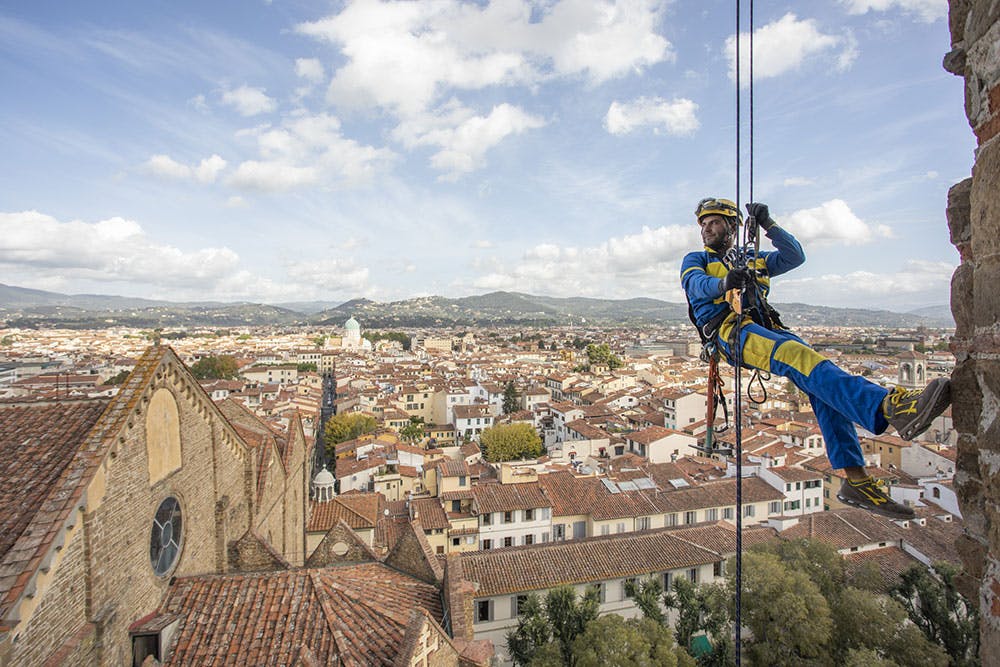
Photo: EdiliziAcrobatica.
A construction worker has a great view from Santa Croce in Florence.

So many different kinds of jobs in the world! Today’s story is about construction workers with specialized talents that might just as easily have gotten them hired by the circus.

Rebecca Ann Hughes has the story at Apollo. “Beneath the celestial vistas of Parma Cathedral’s frescoed dome, two men swing like trapeze artists from ropes crisscrossing under the roof as though in a circus tent. They seem to be attempting to join the swirling vortex of angelic limbs in Correggio’s scene of the Virgin’s Assumption above them. But they are actually members of EdiliziAcrobatica, an Italian construction company specializing in rope access building interventions. On this occasion, the company has been drafted in to repair a bell in the cathedral.

“EdiliziAcrobatica’s team has rock-climbed up and abseiled down some of Italy’s most significant historic monuments. The company has worked on the Ponte Vecchio in Florence, Siena Cathedral, and the Roman Forum, to name a few. It has also intervened in banks, apartment blocks and various other public and private buildings. Suspended from ropes, the acrobatic technicians can perform a whole range of tasks, from the waterproofing of roofing to welding – all the necessary tools in bags and buckets attached to their harnesses. To watch the team at work is a breathtaking and nail-biting experience. From street level, they are minute figures poised on the roof of Parma’s dome to replace copper panels damaged by rain or casually dangling above the waters of the Arno to repair a leaking fountain on the Ponte Vecchio. …

“The building company didn’t choose to specialize in these acrobatic techniques just for the spectacle. Rope access, a construction work-at-height technique that started to become popular in the 1980s, comes with a multitude of advantages over traditional scaffolding, as Riccardo Iovino – who founded EdiliziAcrobatica in 1994 – explains via email.

“At the forefront is safety. Workers are attached by two ropes, one for safety, and ropes can also relay equipment. Although founder Iovino was, as a skipper, at home shimmying up and down rigging – and was thus inspired to adopt the technique professionally – EdiliziAcrobatica’s workers are not expected to have a mountaineering or caving background. The company assists the construction workers – who are overseen by specialist surveyors – with training and obtaining the required permit for rope access work. Thus, suspended from the side of a building, EdiliziAcrobatica’s technicians can carry out restoration work, paint walls, clean windows, replace gutters and repair unsafe elements of a building in total safety.

“That’s not to say that these strict safety procedures dampen the thrill of the work. Enzo Spitale, who began as an acrobatic builder and now acts as coordinator overseeing the team in Italy, returned from his interview 10 years ago thinking it was all completely mad. But he now says his employment at EdiliziAcrobatica was a life-changing opportunity. Dangling from a Renaissance dome or a medieval bridge, ‘you feel one step away from the sky,’ Spitale says. ‘It is unique and unimaginable for those with their feet on the ground.’

“This aspect of the job comes with its own risks. ‘It is always important, as I remind the new company recruits, never to lose concentration at work,’ says Spitale. ‘We are suspended from ropes several metres off the ground, we have to pay attention to what we are doing and not get distracted by the clouds!’ “

More at Apollo, here.

Read Full Post »

rtx79fmi-e1584114422319

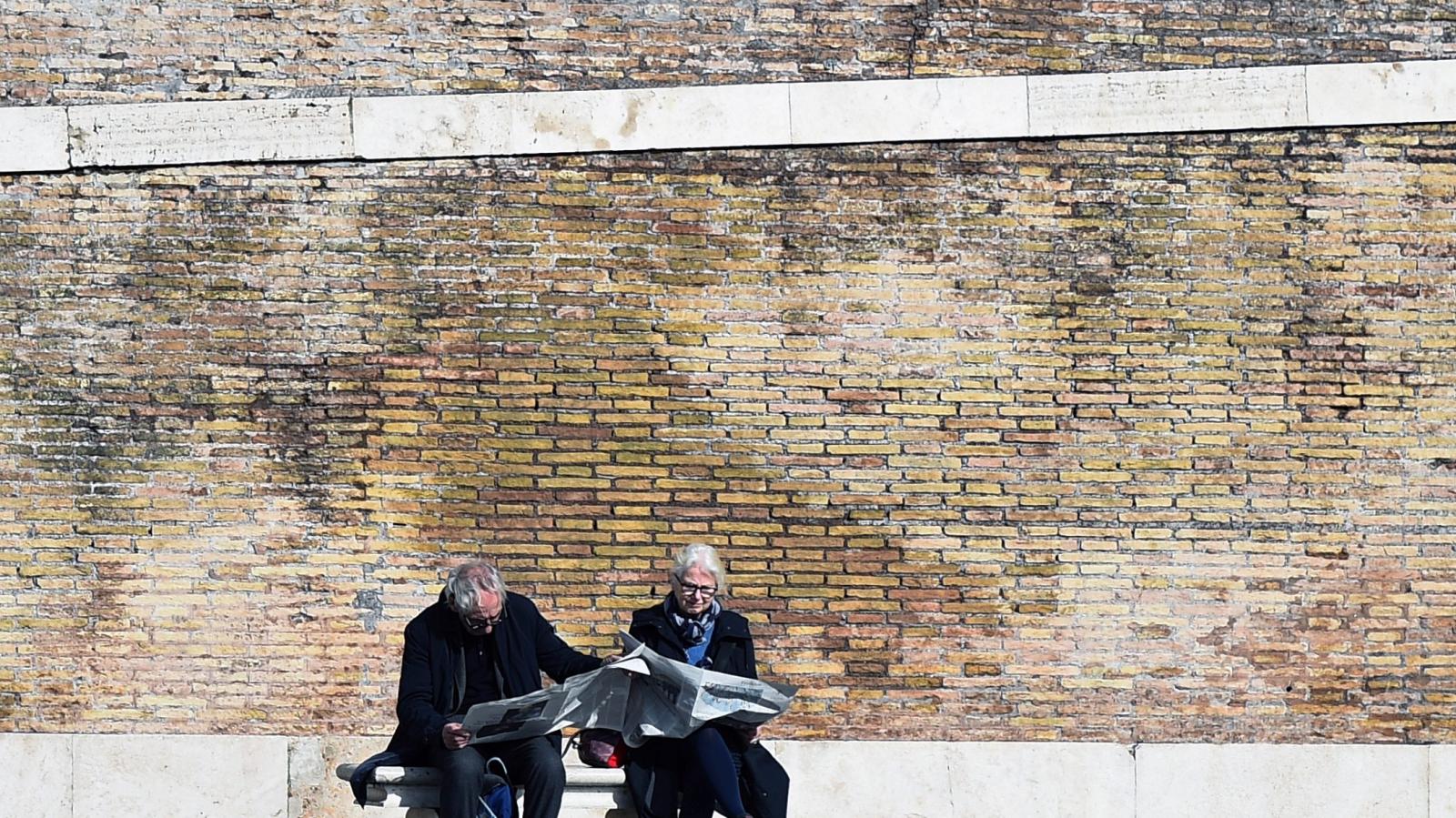
Photo: Reuters/Guglielmo Mangiapane
Italy formally recognizes that newspapers are essential services.

The demise of newsprint has been exaggerated. Newspapers are still needed. Not only did one in Australia — partly as a joke — print some blank pages with dotted lines for making your own toilet paper, but in Italy newspapers have now been characterized as “essential” services.

Luiz Romero reports at Quartz: “As it became increasingly clear earlier this week that the Italian government would announce even more stringent measures to combat coronavirus, in a country that already faces extraordinary restrictions, a debate began to brew over what should be left open and what should be forced to closed. Places that sell food and medicine would have to keep functioning, but what about the edicole—the small shops that sell newspapers and magazines, and that still exist in the thousands in Italy?

“On Wednesday (March 11), Carlo Verdelli, the director of Repubblica, one of the two largest newspapers in the country, alongside Corriere, published a note arguing that newsstands should be added to the list of essential services that was being prepared by the government. …

“Here, like everywhere else, newsstands are disappearing. They went from 18,400 to 14,300 during the 2010s—a number that  includes those that also sell souvenirs for tourists. Excluding them, the real number of newsstands in Italy is estimated to be around 5,000. Still, Italians like to read newspapers. Almost a third of the population gets its daily news in print. …

“After some debate, and as the number of cases continued to spike, the government finally took a decision. Everything had to close except what it deemed essential services—food stores, pharmacies, hardware stores, and factories. … Newsstands were also allowed to keep going. …

“In Milan, newspaper vendors are proud of what they do. Rosi Varezza, who operates a small but busy newsstand, explained that papers are essential for elderly readers, who are most at risk from the outbreak. Clients buy newspapers for habit, but also to get information they deem more trustworthy; to go deep into subjects they consider important; and to hear the news delivered from specific voices—columnists that have informed them for decades. …

“Newsstands are even registering a small bump in sales. That was clear in Milan. In a busier newsstand, near a major shopping street here, I had to wait to pay for the newspaper. And when my turn came, I had to ask my questions quickly. The newsagent was impatient, answering with short sentences, and insistently looking over my shoulder. A line was forming.” More at Quartz, here.

In my own case, I have always read articles more deeply if they are in print. And in my semi-isolation, I look forward to the paper delivery every day and read more sections than usual. You?

Read Full Post »

merlin_170474973_91ef72aa-3ae2-42f9-bafc-b67945f958b8-jumbo

Photo: Alessandro Grassani for the New York Times
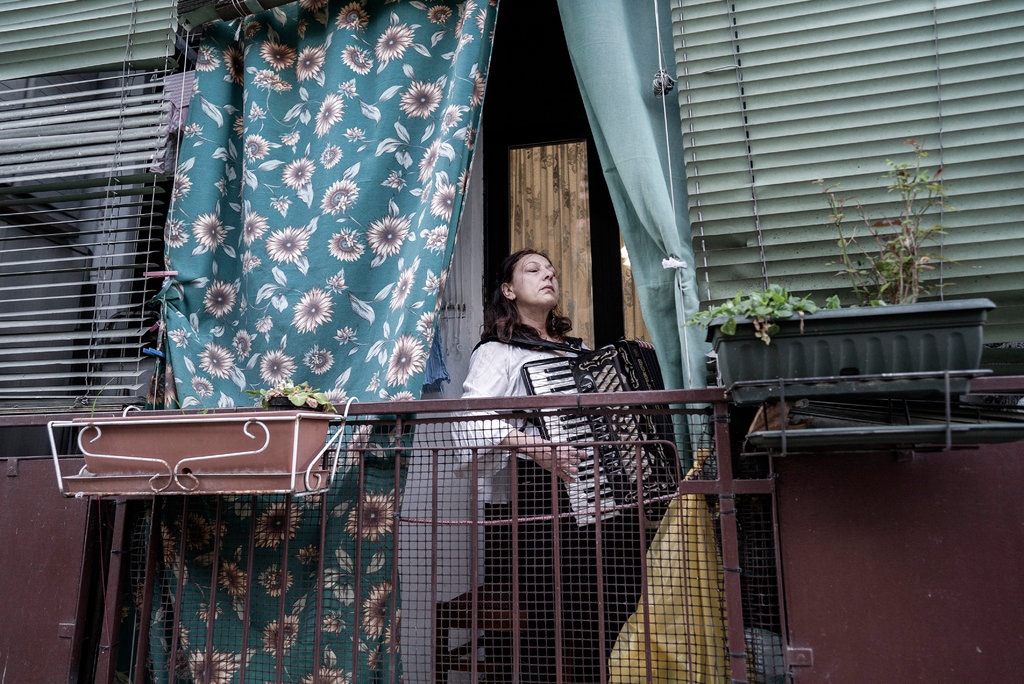
This woman in Milan is part of Italy’s spontaneous self-isolation music scene. I love the look on her face. For all I know she may be thinking about making dinner or washing the bathtub, but it sure looks like she’s conscious of performing a sacrament.

If you’re on social media or following the news in some other way — and who isn’t? — you probably already know about this lovely aspect of the Italian spirit, but I thought the piece by Jason Horowitz at the New York Times was especially good.

“It started with the national anthem. Then came the piano chords, trumpet blasts, violin serenades and even the clanging of pots and pans — all of it spilling from people’s homes, out of windows and from balconies, and rippling across rooftops.

“Finally, on Saturday afternoon, a nationwide round of applause broke out for the doctors on the medical front lines fighting the spread of Europe’s worst coronavirus outbreak. …

“Italians remain essentially under house arrest as the nation, the European front in the global fight against the coronavirus, has ordered extraordinary restrictions on their movement to prevent contagions. … But the cacophony erupting over the streets, from people stuck in their homes, reflects the spirit, resilience and humor of a nation facing its worst national emergency since the Second World War.

“Like any national crisis, the virus has exposed the flaws of those countries it has struck the hardest, whether it be the reflex for secrecy in China, the downplaying of the crisis in Iran or the initial confusion and fragmentation in the Italian response.

“But to the extent that this is a virus that tries people’s souls, it has also demonstrated the strengths of those national characters.

In China, patriotic truck drivers risked infection to bring desperately needed food to the people of Wuhan, the epicenter of the outbreak. In Iran, videos show doctors in full scrubs and masks dancing to keep spirits up.

“And in Italy, the gestures of gratitude and music ring out above the country’s vacated streets, while social media feeds fill with encouraging, sentimental and humorous web videos.

“On Friday evening, at the exact hour that health officials normally update the daily numbers of the country’s increasing infected and dead, Italians from the southern islands to the Alps sang the national anthem and played instruments. … On Saturday, one image circulating widely showed a nurse cradling the Italian peninsula in her arms. …

“The duress also seemed to stir patriotism in a country that has a deep suspicion of nationalism. The Italian media reported a spike in sales of the Italian flag. The national anthem, usually limited to the start of soccer matches, reverberated off palazzo walls at 6 p.m. on Friday. …

“At noon in Verona on Saturday, the peal of church bells gave way to the clapping of hands as Cristina Del Fabbro, 53, stood on her balcony applauding with her daughter Elisa, 21.

“ ‘We want to thank doctors and nurses,’ she said. ‘They can’t stay safe at home as we do, they are tired and worried but they stay there, for those who get sick and need them.’ …

“A reporter working at home in the Chinatown section of Milan for the online newspaper Il Post, stuck his head out the window on Friday and added to the concert with refrains from ‘Nessun Dorma.’ He considered the sudden symphony ‘a small brick in nation building.’

‘We showed that in this hard time we can stick together,’ he said. ‘We were a community, not just a bunch of individuals.’

Lots of other lovely examples at the New York Times, here.

PS. Don’t you find that your perceptions of how you should behave change on a daily, almost hourly, basis? When I woke up Thursday, I thought I’d be going for my annual physical Friday — on the subway. Nope. Rescheduled. Now I don’t even meet my grandchildren unless it’s outdoors. And I’m ordering home delivery of milk in bottles from a dairy. It won’t be delivered by horse, but it’s still kind of cool.

Read Full Post »

img_5840_slide-ff1c3b28ab10fe2abcf7dd215aafd3846b326aee-s700-c85

Photo: Chris Livesay for NPR
A security guard blocks off the recording area outside the Violin Museum in Cremona, Italy, for a project to preserve every note of the Stradivarius violin.

When a whole town — or almost a whole town — gets on board to support an artistic project, the results can be impressive. I imagine that the key is to tap what matters to people. In this case, violins.

Christopher Livesay reported about the unusual preservation project at National Public Radio (NPR) in February.

“Inside the concert hall of the Violin Museum in Cremona, Italy, Antonio de Lorenzi plays the prelude from Bach’s Partita No. 3 on a Stradivarius violin. Cremona is the town where master luthier Antonio Stradivari crafted his storied instruments three centuries ago.

“But there’s no guarantee that his instrument’s inimitable sound will survive for centuries more, says Fausto Cacciatori, the museum’s chief conservator.

” ‘What will these instruments sound like in 200 years? I hope they can still be played,’ he says. ‘But you never know. All it takes is one unfortunate event. An earthquake, for instance. Think about what happened to so much art during World War II.’

“Cacciatori says Stradivarius instruments need a 21st century failsafe — and someone who understands music as well as technology to pull it off. Enter deejay Leonardo Tedeschi. …

“When he’s not spinning records, Tedeschi runs Audiozone, a northern Italian sound engineering firm. And he had an idea: ‘To bring the sound of Stradivari and make it accessible around the world,’ he says.

“The idea came to him in 2014, when he wanted to mix the analog sounds of Stradivarius violins in some of his own electronic recordings, but discovered the elements he needed were lacking. That’s when he reached out to the Violin Museum in Cremona, just a 45-minute drive from his native Piacenza, with a proposal.

“First, they would need to record Stradivarius instruments, and while they were at it, those of other master luthiers. Then they would have to save the recordings in a database that future composers could use to make their own music electronically.

“The Violin Museum, which was already concerned about preserving these sounds for future generations, agreed. … They would have to painstakingly record every possible note that can be played on each instrument.

” ‘Every possible note, and even more difficult, every note transition,’ explains Tedeschi. ‘From one note to all the other ones in the same string.’ …

“In the concert hall, Lorenzi, who is with the Italian Symphony Orchestra and has performed in the world’s top concert halls, plucks the notes C, D, E, F, G, A, B and C — ‘do, re, mi, fa, sol, la, ti, do’ — on the Stradivarius violin. Then down the scale, until the engineers say they’ve got it. …

“He says, ‘It takes a lot of mental and physical concentration. It’s one of the most demanding things I’ve ever done.’

“But that meditative concentration is hard-won. Outside the museum, Tedeschi points out the thorn in his side.

“A rumble passes as a woman drags a suitcase across cobblestones. Then, the hiss of a street-sweeper machine. It’s what you’d expect in a city of 70,000 people, with a bustling open-air market and a population of typically boisterous Italians. …

” ‘Every time we hear this sound, the sound will mix with the frequency of our instruments, so we cannot use that sound in our product,’ Tedeschi laments.

“At the end of December, just before recording was set to begin, he went to the mayor of Cremona, Gianluca Galimberti, and asked for help. … The mayor asked the people of Cremona to please keep it down, and blocked traffic around the concert hall during recordings from Jan. 7 to Feb. 9.”

Did it work? Read more here.

Read Full Post »

Photo: Diego Rinaldi/Casa di riposo per musicisti, Fondazione Giuseppe Verdi
The exterior of Casa Verdi, founded by famed Italian composer Giuseppe Verdi in the late 1890s.

Facebook has decided I like stories about kind people because I linger over some with spooling captions. It keeps showing me items that are “Similar to Posts You’ve Interacted With.” It may be that I like such stories, but I never click on Facebook’s suggested links because I definitely don’t want Facebook knowing anything about what I like. (OK, I admit that’s a lost cause.) If the site weren’t the best way for me to connect with Carole, who I have known since nursery school and who has Parkinson’s now, I don’t think I’d be there at all.

The following post on the kindness of Giuseppe Verdi didn’t come from Facebook. It came from a site that gives me loads of other ideas for blog posts, ArtsJournal.com.

It’s where I learned about Rebecca Rosman’s National Public Radio [NPR] report on “Casa Verdi, a retirement home for opera singers and musicians founded by the famed Italian composer Giuseppe Verdi more than 100 years ago.

“Soprano Lina Vasta spent her career performing in Italian operas around the world. Twenty years ago, she settled at Casa Verdi. The tiny singer, who uses a cane to get around, won’t reveal her age (through a translator she admits to being ‘over 65’), but she still enjoys singing bits of The Barber of Seville around the home.

“Vasta came to Casa Verdi with her husband when they both retired from singing. Since he died, this is all she has. But with ‘a beautiful house, a piano, a very nice garden, nothing is missing here — it’s perfect. Grazie, Verdi,’ she says. …

” ‘In Italy, Verdi isn’t considered only a composer, only a musician, but kind of a national hero,’ [Biancamaria Longoni, the assistant director of Casa Verdi], says. ‘He used his operas to give voice to people — to humble people, to modest people, to poor people.’

“Many of Verdi’s own former colleagues found themselves living in poverty toward the end of their lives. At that time, there were no pensions for musicians in Italy. …

“Using his own fortune, Verdi built the retirement home for opera singers and musicians, a neo-Gothic structure that opened in 1899. The composer died less than two years later, but he made sure the profits from his music copyrights kept the home running until the early 1960s, when they expired. Today guests pay a portion of their monthly pension to cover basic costs – food and lodging — while the rest comes from donations. …

“Casa Verdi has an extra 20 rooms set aside for conservatory students aged 18 to 24. … Armando Ariostini, a baritone in his early 60s, comes to Casa Verdi every Wednesday to visit the guests, some of whom are his former colleagues. And while Ariostini himself is still several years away from retirement, he says he knows exactly where he’ll be hanging up his hat once he leaves the opera stage for good.”

More at NPR, here.

Read Full Post »

http3a2f2fcdn-cnn-com2fcnnnext2fdam2fassets2f180910100856-03-roman-gold-coins

Photo: Ministry of Cultural Heritage and Activities
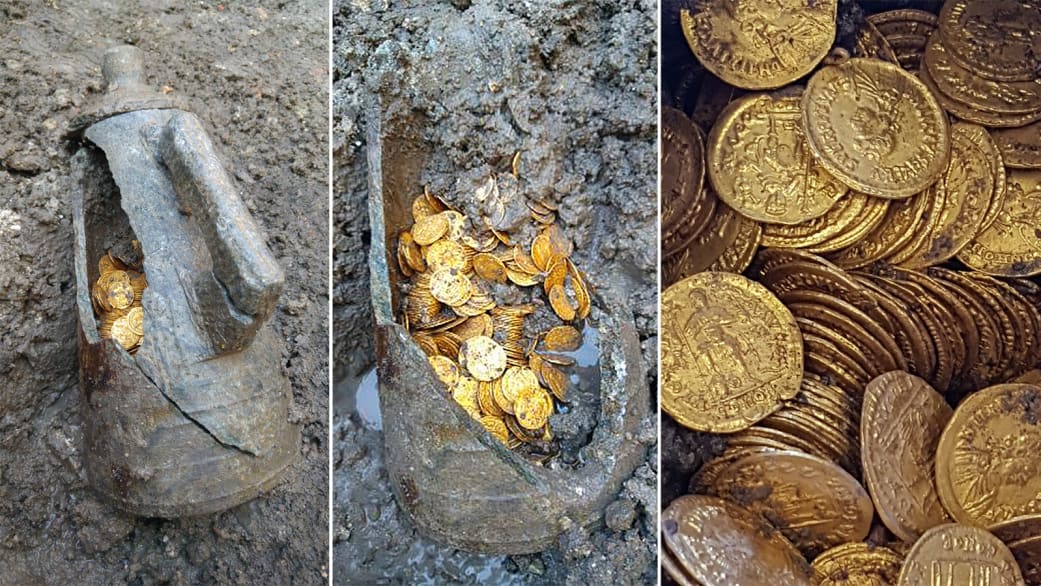
A trove of ancient gold coins hidden in a soapstone jar was recently unearthed in Como, Italy.

When you were a kid, you believed in the possibility of finding buried treasure. I, for one, believed so thoroughly, I could be easily taken in. My neighbor Kenneth Jukes was a great one for tall tales, and I remember distinctly being persuaded by him that some charcoal refuse in a stream was actually gold. I took it to my parents who were annoyingly skeptical. My grandmother said to my father, “But what if it is … ?” Kenneth looked sheepish.

Nevertheless, people do find gold in unexpected places. Kids may know things grownups have forgotten.

As Amanda Jackson and Gianluca Mezzofiore report at CNN, “Archaeologists are studying a valuable trove of old Roman coins found on the site of a former theater in northern Italy. The coins, at least 300 of them, date back to the late Roman imperial era and were found in a soapstone jar unearthed in the basement of the Cressoni Theater in Como, north of Milan.

” ‘We do not yet know in detail the historical and cultural significance of the find,’ said Culture Minister Alberto Bonisoli in a press release. ‘But that area is proving to be a real treasure for our archeology. A discovery that fills me with pride.’

“Whoever placed the jar in that place ‘buried it in such a way that in case of danger they could go and retrieve it,’ said Maria Grazia Facchinetti, a numismatist. … ‘They were stacked in rolls similar to those seen in the bank today. … They don’t go beyond 474 AD.’ …

“The ministry did not place a value on the coins. But reports in the Italian media suggest they could be worth millions of dollars.

“The historic Cressoni Theater opened in 1807 before transitioning into a cinema and eventually closing in 1997. The site is not far from the Novum Comum forum area, where other important Roman artifacts were discovered, according to the ministry.”

More at CNN.

Read Full Post »

Photo: Elisa Coltro/Facebook
Nonna Irma, of Noventa Vicentian, Italy, poses with some of the children in the Kenyan orphanage she supports.

News outlets around the world reposted this story about a 93-year-old’s outreach work as described by her granddaughter on Facebook. But I found that BrightSide dug for additional details.

The website reports, “This charming woman from Noventa Vicentina, Italy is Irma, and she is 93 years old. Despite her age, she’s full of energy and desire to change the world for the better. She decided to fly to Kenya to help children in the orphanage there. Her granddaughter shared her grandma’s photos on her Facebook page, which took over the Internet. …

” ‘Irma has always loved life and was never stopped by life’s obstacles,’ her granddaughter [Elisa Coltro] wrote. She knows what difficulties are like and has always tried to help others. Irma lost her husband at 26 and later one of her three children. Her life has not been easy, and she has always relied on her own strength to make it through.

“Many years ago she met Father Remigio, a [missionary] who has spent his life helping the people of Kenya. Irma has supported him for many years. Once she heard that Father Remigio was hospitalized, she made a decision to visit him and all the places he had built during his lifetime, such as hospitals, orphanages and kindergartens.

“Now being in Kenya, Irma helps children as much as she can. She teaches English and Math in the school of Malindi. … Her age never stops her from taking motorcycle rides. Despite all the difficulties she’s faced, she continues to enjoy life. Irma plans to stay in Africa for a few weeks, but there is a possibility that she will want to stay there for good.

“She has always taught her children and grandchildren to help others. Her granddaughter Elisa did volunteer work in refugee camps in Greece in 2016 and 2017.” More here.

One of the things I like best about the story is the sense of a network of fellow travelers. Irma’s daughter went to Kenya with her. Her granddaughter volunteers. And zillions of people loved what Irma is doing enough to share the news on social media. One and one and 50 …

Photo: Elisa Coltro / facebook   

Read Full Post »


Photo: Sara Miller Llana/Christian Science Monitor
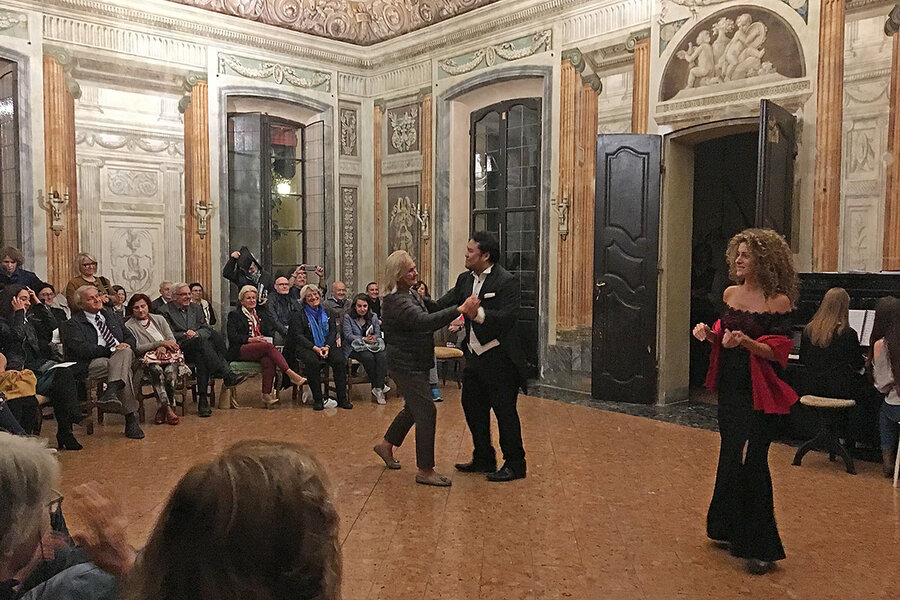
The annual Festival Verdi in Parma, Italy, brings opera to the people by performing in private homes. Just like the old days.

I love the idea of having arts performances in one’s living room, whether it’s a cabaret duo, jazz, opera, drama, or anything similar. It’s partly because I used to write and perform plays as a kid, especially at Christmas in the living room.

Sara Miller Llana has a cool story about living-room concerts at the Christian Science Monitor, a really interesting newspaper with an international focus, in case you’re interested.

She writes, “A young tenor’s voice, in his rendition of ‘La donna e mobile,’ fills the palatial living room with one of Giuseppe Verdi’s most famous canzones from ‘Rigoletto.’

“It’s a late Thursday afternoon and the sun is setting, as guests seated around the piano begin to clap. The hostess is suddenly in the center of the circle for a short waltz.

“For a moment, it feels as though we are transported back to the 19th century, when Verdi, among the world’s most famous composers, created 27 operas, some of them the most-loved in the world.

“But it’s 2017, and this is the sidelines of the month-long Festival Verdi held each year in Parma, Italy. If any region can call itself a heartland of opera, it’s this one.

“The festival … aims to bring opera off the stages into the community in a series of events – from Verdi sung in rap, to the staging of ‘Nabucco’ by inmates at the local jail, to these living room performances for aspiring opera stars. And at least with the latter, the festival brings an ancient custom of private home performances that started in mid-18th century Europe to 21st century Italy.

“Accompanist Claudia Zucconi, who is studying for her masters and wants to specialize in opera, says that playing these antique keys in such a living room ‘was very emotional.’

“ ‘The piano was very ancient, so it was special for a pianist to play it. I felt like it was another epoch, in another time, like I could be dressed liked a princess playing in a room like this.’

“Opera – and specifically local hero Verdi – are so central to the town’s identity and culture that people debate it at locales the way they might discuss the latest soccer match. …

“The director general of Parma’s Teatro Regio, Anna Maria Meo, says the responsibility she feels is nothing short of enormous. Only a few nights ago, after a performance that had only one intermission, theatergoers stopped her on her way down from her office and asked why there weren’t two. She replied that the opera was already long. ‘ “But you can’t cut the space for us to discuss what we are watching, we need at least two,” they said,’ she recounts over a cappuccino in the theater’s baroque café.”

More here.

Read Full Post »

Art: Albrecht Dürer
“Virgin and Child With Pear,” at the Uffizi Gallery in Florence.  Heritage fruit archaeologist Isabella Dalla Ragione says it’s not a pear.

I loved reading about this side effect of an Italian woman’s work to preserve heritage fruits: she discovered that a fruit in a famous painting was mislabeled.

Elisabetta Povoledo writes at the NY Times, “On her farm, Isabella Dalla Ragione pursues a personal mission — saving ancient fruit trees from extinction — with a strong sense of urgency. Rescuing vanishing varieties is a race, she says, ‘and lots of times we arrived late.’ …

“To find and collect their forgotten varieties, for decades she and her father chatted up farmers and motley locals in the Umbrian and Tuscan countryside. They gathered branches, and with them the traditions and chronicles tied to the fruits. …

“But because fruit was not always described in detail in written records, she also began to examine the works of Renaissance and Baroque painters working in Umbria and Tuscany at a time when ‘artists had close relations to agriculture’ and were sensitive to the seasons and local varieties, she said. …

“A closer look at Albrecht Dürer’s ‘Virgin and Child With Pear,’ at the Uffizi Gallery in Florence, for example, reveals a clear misnomer, Ms. Dalla Ragione said.

“ ‘If it were a pear, it would show a stalk on top,’ she said. ‘Mary is clearly holding a muso di bue apple.’ …

“Ms. Dalla Ragione created a nonprofit foundation, the Arboreal Archaeology Foundation, in 2014 ‘because it made it easier to give a future to all this,’ she said.”

Read more about her quixotic but intriguing work here.

Photo: Francesco Lastrucci for The New York Times
Isabella Dalla Ragione picking apples on her farmstead in San Lorenzo di Lerchi, Italy.

Read Full Post »

Older Posts »