Feeds:
Posts
Comments

Posts Tagged ‘kabuki’

Photo: Sayuri Suzuki/GKIDS.
Ryo Yoshizawa and Ryusei Yokohama as Kikuo and Shunsuke, rival kabuki actors in Japanese Oscar submission Kokuho.

A popular new movie is reviving interest in an ancient Japanese art form, and those who know how to practice it are wondering how that will affect their future.

Thomas Page reports at CNN, “In the movie Kokuho, a three-hour epic spanning half a century in the life of a fictional kabuki actor, we see the traditional art form slowly retreat from Japanese popular culture. What was once a national interest — albeit, a relatively middle class one — recedes into a niche, performed by an aging cohort artistically frozen in time.

“In art, so in life. Kabuki is struggling in Japan. The 400-year-old UNESCO-inscribed classical theater is battling to attract an audience. Data shared by the Japan Arts Council shows attendance at National Theatre venues has dropped significantly, and has not returned to pre-pandemic levels.

“Kabuki is also failing to attract apprentices, the de facto route for pursuing a career in the art. Historically, acting dynasties have produced a healthy stable of performers, but in recent decades the state has picked up the slack. Courses at the National Theatre Training School have trained a third of kabuki performers working today, but the school received just two applicants for its latest two-year acting course.

“Enter Kokuho. Based on Shuichi Yoshida’s bestselling novel of the same name, the movie, directed by Lee Sang-il (Pachinko) and starring Ryo Yoshizawa, has captivated audiences after debuting at the Cannes Film Festival in May. …

“The film has been the talk of the town among Tokyo’s kabuki performers, according to local reports. But more than that, it could be drawing people to the performing art. …

“When kabuki performer Nakamura Ganjiro IV (who appears in the film and also instructed other actors on their performance) made an appearance at the National Theatre alongside director Lee in September, 2,200 people applied for 100 seats, said the [Japan] Arts Council.

“Looking to seize the moment, the Arts Council has distributed flyers for its January 2026 program outside cinemas showing the film, launched a tie-in social media campaign, and put on introductory performances of kabuki masterpieces with more affordable seating to encourage newcomers. …

Kokuho translates as ‘national treasure,’ a reference to ‘ningen kokuhō,’ or ‘living national treasure,’ a title designated to masters of their art.

“The film opens in the 1960s and follows the orphaned son of a yakuza boss, Kikuo, on his journey into the upper echelons of kabuki. At age 15, he’s old for an apprentice … though he has the tutelage of Ken Watanabe’s seasoned pro Hanjiro, and the competition of Hanjiro’s son Shunsuke (Ryusei Yokohama) spurring him on.

“Kikuo performs as an ‘onnagata’— a male actor specializing in female roles — a custom that began in the 17th century. That comes with its own dictates, including posture, walk and dance moves. …

“ ‘The more I did the dancing, the more I saw how difficult it was going to be to reach the level of actual kabuki actors,’ [the actor said]. …

“In the movie, Kikuo’s smooth ascent from outsider to stardom is tempered by his affairs and the jealousy he inspires in others. But these points of friction rarely eclipse the heightened drama on stage.

“The screenplay draws on kabuki’s established repertoire, featuring stories of love rivalries, transfiguration and suicide, often deployed to parallel character narratives and reflect their inner state. Kokuho provides helpful on-screen synopses for the uninitiated. …

“The director and cast had to negotiate the pitfalls of shooting stage acting for screen; crafting performances made to be seen by the cheap seats in a back of a kabuki theater, captured by the close-up camerawork of cinematographer Sofian El Fani. …

“ ‘I was told by Director Lee that this wasn’t about doing a beautiful dance on stage, but really showing who Kikuo is as he’s performing,’ said Yoshizawa. “Focusing on things like a trembling finger in a certain moment to show his mental situation, to really concentrate his whole life and show that on stage.’ …

“The epic concludes in 2014, with Yoshizawa aged up and Kikuo forced to confront the damage and hurt he has caused on his path to greatness.

“For the actor, it was not the usual case of playing old. ‘There’s a difference between a person who plays the onnagata in kabuki growing old, versus a regular man growing old,’ he explained. ‘I noticed in the reference material they would stay young and beautiful … I’d seen they keep their great posture.’ ”

More at CNN, here.
Read Full Post »

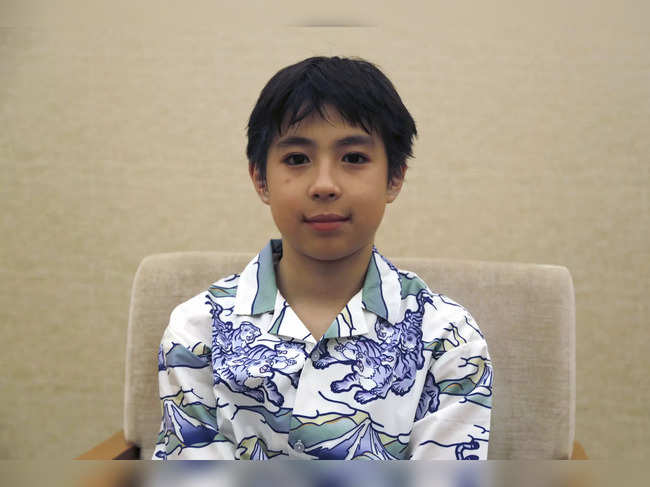
Photo: AP/Yuri Kageyama via Economic Times.
Ten-year-old Maholo is an emerging star in Japan’s 420 year-old Kabuki theater. And he happens to be French.

Having once been turned down for a New Shoreham committee because I was not a year-round resident, I love hearing about famously hidebound organizations that decide to open up. Today’s story is features Kabuki theater opening up.

Yuri Kageyama writes at the Associated Press (AP), “Ten-year-old Maholo Terajima Ghnassia loves watching anime and playing baseball. … And he’s breaking conventions in Japan’s 420-year-old Kabuki theater tradition.

“In Kabuki, all the roles are played by men, including beautiful princesses — a role Maholo accomplishes stunningly in his official stage debut as Maholo Onoe at the Kabuki Theater in downtown Tokyo. … He starts out disguised as a woman, dancing gracefully, before transforming into sword-wielding warrior Iwami Jutaro. He then makes a quick costume change right there on the stage, all while delivering singsong lines in a clear resonating voice unaided by a microphone.

“Out to avenge his father’s death, striking spectacular poses, Maholo performs swashbuckling fight scenes and slays a furry baboon.

” ‘I like “tachimawari” (fight scenes). It feels good, and people who are watching it think it’s cool,’ said Maholo. …

“Maholo’s grandfather, Kikugoro Onoe, appears as the God of War. He praises Maholo’s character, Iwami, and tells him to keep at his art, promising to always be at his side and help him attain his goals.

“Kabuki is typically passed from father to son, the art form largely limited to Japanese men. But Kikugoro Onoe is Maholo’s maternal grandfather; the young Kabuki performer’s father, Laurent Ghnassia, is French. …

“The huge curtain for the stage, which also works as advertising space, is speckled with fluttering dots of purple and orange, designed by French artist Xavier Veilhan of fashion house Chanel. This was Ghnassia’s idea — as an art director, he designs venues, installations, shops and events to market fashion brands, contemporary art and film ventures. …

“Maholo himself isn’t sure yet if he will stick with the strict, demanding art form and someday adopt his grandfather’s stage name, Kikugoro — a prized name in Kabuki passed down through generations of Onoe men.

“Child Kabuki actors go through a difficult transitional period when their voices change with puberty but they aren’t yet mature enough to take adult roles. Only the truly determined ones pull through that stretch to succeed.

“ ‘Unless he is recognized and in demand, he won’t get any roles. He must have the passion. It’s not easy. It’s up to him,’ said Maholo’s mother, renowned actor Shinobu Terajima. She won the Silver Bear for Best Actress at the Berlin International Film Festival for her poignant performance in the 2010 film Caterpillar.

‘It’s not easy, but choosing the harder path makes life more worthwhile. The more hurdles there are, the climb becomes worth it,’ Terajima said.

“Although Japan has been known for discriminatory attitudes toward foreigners and outsiders, Terajima hopes her son’s French cultural background will give Maholo a unique edge in the world of Kabuki. But he may become a film actor like herself, Terajima said.

“ ‘It must be felt. It’s not just the lines you speak,’ she said. ‘I want him to act by digesting within what’s received from the other, and then return that, changing one’s heart with that received energy. That’s fundamental to acting.’ “

More at AP, here. No firewall.

Read Full Post »

Photo: All Nippon Airways
In addition to the male Kabuki performers, there’s an onnagata (man in female role) in the in-flight safety video of a Japanese airline.

After seeing one too many airline safety videos about how to buckle a seat belt, passengers tend to tune out. That is, unless the video is really entertaining. Consider this safety video using Kabuki dancers. I know that would make me pay attention.

Andrew Bender wrote about it at Forbes. “Let’s call it like it is: those airline safety presentations have always felt a little like a kabuki dance, no? Now Japan’s largest airline, All Nippon Airways, has taken that literally, with actual kabuki performers in its newest in-flight safety video. I, for one, can’t stop watching it. …

“Supervised by a kabuki performer, the four-minute-plus production opens with an ANA flight attendant wearing a red-and-white striped kabuki mask, before the striped curtain behind her (in the traditional kabuki colors of black, deep-green and the orange-red the Japanese call persimmon) slides to reveal an airplane cabin set.

“Kabuki actors stow their elegantly lacquered bamboo boxes in the overhead bins and under the seats (not in the aisles, thank you), fasten seat belts over their elaborate kimono and dutifully turn off electronic devices displaying scenes from classic ukiyo-e woodblock prints on their screens. The same style is used to show how high heels, in this case chunky wooden geta sandals, can tear the evacuation slide.

“In another section, an actor wearing an oversized wig and robe and fearsome makeup tries on the oxygen mask, and a child in the classic pure white face makeup demonstrates the ‘brace for impact’ position. And it’s quite a sight to see an onnagata (male performer in a female role, a longstanding kabuki tradition) perform the life vest demonstration.

“Kabuki theater traces its roots to 1603, the early Edo Period, and is on the UNESCO list of the world’s Intangible Cultural Heritage. Among its unique features are stunning costumes, stylized dialogue and poses (immortalized in ukiyoe woodblock prints, kind of like iconic modern-day movie posters; see 1:38 in the video), a revolving stage and musicians who sit onstage and animate the action with music and narration. Many of the leading performers have family lineage in kabuki going back more than a dozen generations.

“At various times the safety video shows another feature of kabuki, on-stage assistants covered head to toe like ninjas. Called kurogo, they’re typically dressed in black implying that they’re not visible onstage, but in this video they’re instead in ANA’s signature blue and white. …

“ANA’s safety video debuted late last year and went worldwide on flights this January. As a bonus, a behind-the-scenes video of the production plays during deplaning.”

More at Forbes.

Read Full Post »