Feeds:
Posts
Comments

Posts Tagged ‘land trust’

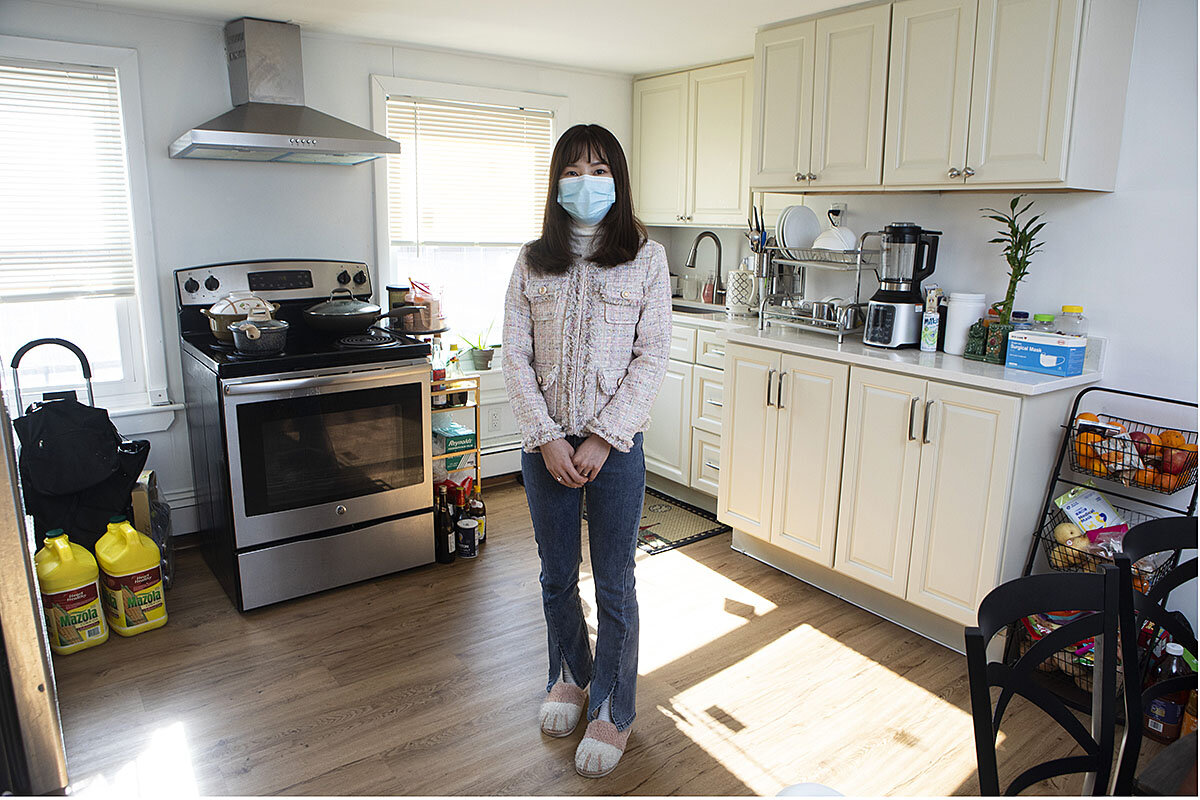
Photo: Melanie Stetson Freeman/CSM.
Meidan “Abby” Lin poses in her apartment in Boston’s Chinatown. She and her husband bought the unit with help from the Chinatown Community Land Trust, which aims to stabilize the community through affordable housing, ownership of land, control of public lands like parks, and the preservation of cultural and historical sites.

One of the biggest challenges for America in these times is housing. Housing can help people with addictions get clean. It can reduce the need for long, polluting commutes to jobs in expensive urban areas, it can give people breathing space to pursue their interests and make better lives for their children.

One of the current experiments in providing housing that people can afford involves community land trusts.

Jocelyn Yang and Alexander Thompson write at the Christian Science Monitor, ‘In March 2016, [Meidan ‘Abby’] Lin; her husband, Yin Zheng; their young son, Yuchen; and Mr. Zheng’s mother left Fuzhou, Chin, … for another port half a world away on the Charles River in Boston.

“They shared their first apartment in Boston’s Chinatown with another family. During nights in that cramped space, Ms. Lin started dreaming of a place she could call her own. But Boston’s soaring real estate prices seemed to put that dream out of reach. Mr. Zheng works at a restaurant. Ms. Lin works at home.

“Then a friend told Ms. Lin about the Chinatown Community Land Trust. … The group was selling apartments at discount prices, and Ms. Lin jumped on the waitlist. But there was only one apartment big enough for her family. ‘I didn’t think we were able to get it,’ she says. All she could do was hope.

“Community land trusts [are] buying their own properties to preserve them as affordable housing in perpetuity and give residents more say over what happens in quickly changing neighborhoods. 

“That mission has gained new urgency over the past year as homeowners reap the rewards of a red-hot real estate market while renters are hit with steep rent hikes, deepening the divide between the housing haves and have-nots. …

“ ‘As neighborhoods change and gentrify really fast, the idea of having community control and having more say about how neighborhoods are changing and who’s going to be able to live in the neighborhood over time, from an affordability perspective, I think becomes really important,’ says Beth Sorce, who works with community land trusts nationwide at the Grounded Solutions Network, an affordable housing advocacy group. …

“Land trusts raise money from donations, grants, and government funds to buy property. Then they lease the house or apartment to a buyer well below market value, but the trust retains ownership of the land.

“This way, occupants typically get an ownership stake in their homes. They build equity over time, but at a rate that is often capped at 1% or 2% a year. The trust, which is governed democratically by residents and neighbors, can decide to whom the dwelling can be sold and at what price, usually through a covenant in the lease. This ensures the property remains affordable.

“The land trust idea was imported to the United States by civil rights activist Charles Sherrod in the early 1970s from the kibbutzim of Israel. Mr. Sherrod saw land trusts as a way for Black Americans to buy agricultural land in the South. …

“Andre Perry, a housing policy expert at the Brookings Institution [has shown] that an ‘intrinsic value of whiteness’ persists at almost every step of home buying from the appraisal to the sale. Minorities, but especially Black people, must pay more and get less. 

“By taking property out of the traditional market, land trusts reduce the discrimination baked into that system and empower communities to actively fight it, Dr. Perry says. …

“In California, justice is what drives Jacqueline Rivera and her fellow housing activists in San Jose. In the heart of Silicon Valley, where even high-paid tech employees struggle to find housing, development was pushing out vibrant Black, Hispanic, and immigrant neighborhoods.

“In community conversations Ms. Rivera and her colleagues held around the city in 2018, land trusts kept coming up. Ms. Rivera grabbed hold of the idea, and by 2020 she was heading up the South Bay Community Land Trust.

“Success has not come easily, though.  By definition, land trusts do not make profits, and fundraising is the biggest challenge they face. To buy their first property, a fourplex in downtown San Jose, they need to fundraise at least $1 million, on top of the half million dollars they need to pay professional staff and make the organization run. Speed is a problem, too. Developers snap up properties with cash in a matter of days, while the land trust moves ‘at the pace of community,’ Ms. Rivera says. 

“Yet, in order to disrupt traditional real estate, land trusts ‘still have to play in the real estate game,’ she adds.

“Advocates stress that land trusts are just one tool in a broader approach to the affordability crisis, but it could be a more effective one with government help. Ms. Sorce, of Grounded Solutions, says state and local governments should invest money in land trusts and change appraisal policies so land trust properties aren’t paying taxes based on their speculative value. With or without such help, land trusts must innovate to succeed.

“ ‘When we think about community land trusts, so many times we think about just the homeownership level,’ says Sheldon Clark, who recently served as president of the board of the Douglass Community Land Trust in Washington, D.C. ‘And that really just doesn’t cover the housing needs that we have.’

“Douglass has units it’s maintaining as permanently affordable rentals and other properties set up as cooperatives. They’ve also helped tenants take advantage of a District of Columbia law that entitles them to buy their unit if their landlord plans to sell.

“Really, land trust leaders say, homeownership is just one aspect of their focus on what Mr. Clark calls the ‘big C’ in community land trusts: the community.

“Douglass organized food drives during the pandemic and helps connect residents to credit unions, as many are unbanked. In Boston’s Chinatown, the land trust helped save a local park.”

Find other examples of how land trusts strengthen communities at the Monitor, here. No firewall; nice photos.
Read Full Post »

capable_2_2_pyramid_900x600

Photo: Capable (Community Aging in Place — Advancing Better Living for Elders)
The Community Aging in Place — Advancing Better Living for Elders program sends a nurse, an occupational therapist, and a handyman to modify and improve the home environment of low-income seniors.

Many people I know are thinking about downsizing or signing up for an assisted-living arrangement that could be tapped when needed. It’s tricky though. Most places require a checkup to show you’re healthy when you arrive, but you may not want to use the service until you are routinely forgetting to turn off the oven or until the local building inspector is demanding expensive repairs on your property.

That is why so many new models are emerging.

Amanda Abrams writes at Shelterforce, “Three years ago, Lisa was in trouble. The Minneapolis homeowner had fallen victim to several recent misfortunes, including a divorce and diagnosis of a chronic illness. But it was the attention of a particularly punitive city housing inspections department that almost did her in. …

“Lisa was required to paint the trim around her own house, add handrails to the front steps, and fix the roof. Later, the city also pointed out that two elm trees in her yard were diseased and had to be cut down. The fines she was assessed had a steep interest rate and the total grew rapidly; within a few years, she owed $24,000; plus, she needed another $4,000 to cut down the elm trees.

“Lisa, then 65, didn’t have that kind of money, so the amount was added to her property taxes, putting her ownership of the house at risk. The home, a two-story duplex in an ethnically diverse North Side neighborhood, was paid off, but Lisa was unable to refinance it or otherwise raise the funds. …

“Lisa’s story sounds dramatic, but it’s not a particularly unusual one for low- and moderate-income seniors around the country. According to experts, the United States is about to face a giant wave of aging baby boomers who are hoping to remain in their houses as they age, but who are often one outstanding tax bill, major repair, or medical crisis away from losing their homes altogether.

“The statistics are daunting. According to LeadingAge, a national association of not-for-profit aging services organizations, in a little over 10 years, one in five Americans will be older than 65, and over half of them will need some sort of paid long-term care services. The organization recently released the results of a poll showing that at least 60 percent of seniors hope to remain at home as they age, even if they have a physical disability.

“But elderly Americans tend to have low incomes, as their life spans outstrip their savings. Roughly 20 million senior households pay over 30 percent of their incomes for housing, according to the AARP Foundation; almost 10 million pay over 50 percent. …

“ ‘For younger baby boomers, their economic situation is much worse than the older ones — they got hit in ’08 [by the financial crisis] and were unable to recover. There’s a growing number of baby boomers retiring with mortgages, so they don’t own their houses outright,’ says Robyn Stone, co-director of the LeadingAge LTSS Center @ UMass Boston. …

“Dan Soliman, director of housing impact at the AARP Foundation, agrees with Stone that a crisis is looming, but he’s more optimistic about the options for addressing it. ‘It’s a really, really big math problem.’ …

“There are definitely innovative programs out there, Soliman says. One is the Community Aging in Place — Advancing Better Living for Elders (CAPABLE) initiative run by the Johns Hopkins School of Nursing. The program sends a nurse, an occupational therapist, and a handyman to modify and improve the home environment of low-income seniors who want to age in place. Initially piloted in Baltimore, it’s a modest program that can have a real impact — and save money for Medicare and Medicaid.

“ ‘They get that if we’re able to keep an older adult in their home rather than a facility, there’s significant savings,’ says Soliman. The program is now being expanded to several states.

“AARP Foundation itself has developed a new program called Property Tax-Aide to help older homeowners gain better access to property tax refund and credit programs; currently only about 8 percent of low-income seniors benefit from these initiatives. …

“And many cities have programs that help elderly residents retrofit their houses to make them more user-friendly. Washington, D.C., for example, offers grants of up to $10,000 to low- and moderate-income homeowners and renters for home modifications that reduce the risk of falls and improve mobility.

“But those programs don’t get at some of the bigger issues, like out-of-control tax bills that can eventually lead to foreclosure, major repairs costing tens of thousands of dollars, or medical crisis that interrupt mortgage or tax payments.

“There is a small program currently being implemented in Minneapolis that addresses just about all of the key problems, and then some. It funds housing retrofits and pays off outstanding bills so that seniors can age in place, and could cover some services as well. And it keeps the homes affordable to low- and moderate-income buyers in perpetuity, so that when seniors no longer live there, the houses don’t fall into the hands of investors or negligent landlords.

“The program, called Project Sustained Legacy, was created by Minneapolis’ City of Lakes Community Land Trust. It takes advantage of the land trust model — but tweaks it slightly. Rather than buying the land underneath a house in order to lower the initial purchase price for a new buyer — the traditional CLT approach — the organization takes over the deed to the land belonging to an existing homeowner. In return, City of Lakes addresses outstanding tax liens, mortgage payments, and deferred maintenance.”

There are, of course, challenges to implementing a program like this. You can read about that and about what parts of the country are tackling a land-trust model here.

Read Full Post »

Good news for Letterbox Farm Collective in New York State! The environmental nonprofit Scenic Hudson’s interest in protecting a Hudson River tributary has enabled the young farmers to purchase land.

Scenic Hudson’s Jay Burgess writes, “Scenic Hudson has acquired a conservation easement protecting 62 acres of productive farm fields and watershed lands in Greenport, just south of the City of Hudson. The easement’s purchase enabled a group of young farmers who had been leasing the property to purchase it, securing the future of their farm operations.

“Known as the Letterbox Farm Collective, the farm partners supply specialty vegetables, herbs, pork, poultry, rabbits and eggs to a variety of regional and New York City markets — local bakeries and food trucks, many restaurants (including New York City’s renowned Momofuku restaurants) and two farmers’ markets. In the spring the farmers will launch a diversified Community Supported Agriculture (CSA) operation. …

“ ‘Achieving the goal of Scenic Hudson’s Foodshed Conservation Plan — meeting the growing demand for fresh, local food in the Hudson Valley and New York City — depends on successful partnerships like this, which provides a stable base of operations for the dedicated young farmers in the Letterbox Farm Collective. We also thank these farmers for enabling a future public access point to our protected lands along South Bay Creek, which present exciting opportunities for Hudson residents and visitors to enjoy the outdoors,’ said Steve Rosenberg, executive director of The Scenic Hudson Land Trust. …

“ ‘We were lucky to have Scenic Hudson with us while we gathered our financing and at the closing table when the moment came and we were able to buy our land,” said Letterbox’s Faith Gilbert.” More here.

Thanks to Sandy and Pat for letting me know and congrats to their niece for being successfully launched in farming.

Photo: Nathaniel Nardi-Cyrus

Read Full Post »