Feeds:
Posts
Comments

Posts Tagged ‘landscape architect’

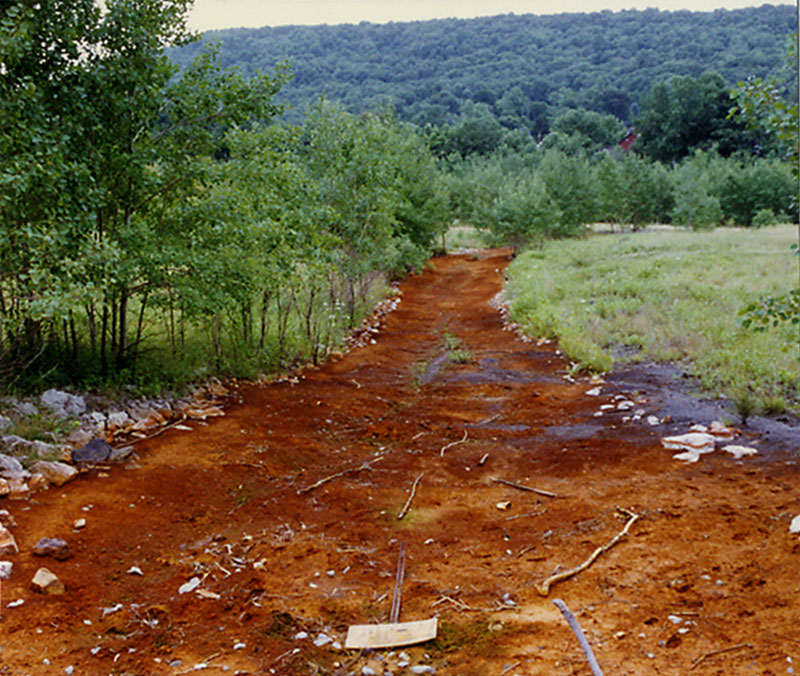
Photo: D.I.R.T. Studio.
Vintondale Reclamation Park, Vintondale, Pennsylvania. Landscape architect Julie Bargmann’s “work to revitalize toxic sites and reconnect them to their communities has earned her the nicknames ‘Toxic Avenger’ and ‘Queen of Slag,’ ” says the
Times.

Have you ever looked at a polluting site, maybe fire from a smokestack or rusting steam engines, and seen a kind of artistic beauty — that is, something that would be beautiful if the poisonous fangs were removed?

Today’s story is about a landscape architect with that way of seeing and the skills to reclaim what had been lost.

Tanya Mohn reports at the New York Times, “For more than 30 years, Julie Bargmann, a landscape architect and founder of D.I.R.T. Studio (Dump It Right There) in Charlottesville, Va., has focused on contaminated and forgotten urban and postindustrial sites, dedicating her practice to addressing social and environmental justice. …

Her projects include an abandoned pump house and reservoirs in Dallas transformed into an art-filled residential garden; the derelict parking lot of a 19th-century fire station in Detroit converted into an urban woodland; historic shipyards that became welcome centers and corporate campuses; and former coal mines, quarries and foundries recast as community parks and public spaces.

In an essay titled ‘Justice from the Ground Up,‘ Ms. Bargmann wrote that there is a disturbing overlap between maps showing where poor people and ethnic minorities live and where contaminated soils exist in the United States. …

“In October 2021 she was named the inaugural winner of the Cornelia Hahn Oberlander International Landscape Architecture Prize, created to celebrate prominent living landscape architects.

“ ‘Being a fierce public advocate is part of the practice of landscape architecture,’ said Charles A. Birnbaum, president and chief executive of the Cultural Landscape Foundation, the nonprofit that awarded the prize. … ‘Bargmann’s legacy is much bigger than the built work,’ Mr. Birnbaum said. ‘It’s valuing the landscape and the cultural life associated with it.’ This interview has been edited for clarity and length. …

“NYT: Did your early years impact your career focus?

“Julie Bargmann: My own little industrial history started riding in my family station wagon on the New Jersey Turnpike. I was living in a really nice postwar neighborhood with big old trees, but when we would see all of the refineries and factories I thought, ‘Wow.’ I remember looking beyond them at all the modest workers’ houses. I went to college in Pittsburgh, a city with those same working neighborhoods stacked up on the hillsides and those belching steel mills down in the valley. I loved the steel mills. They’re so raw, they’re so tough. Everybody sees the bridges, but in the mills you’re seeing and feeling the heat, your jaw drops at the faces blackened by smoke. …

“Three decades ago no landscape designer was looking at the vast manufacturing and mined landscapes, landfills and every type of degraded landscape. When I thought about the number of acres, it was astonishing. That set me off. Folks might think I’m a bit crazy, but I’m going to go find the landscapes that I want to work on, not more or less already perfect landscapes. …

Was there a turning point in your approach to landscape design?

“During my first teaching job, I got some funding, and I took off on the road and looked at mined landscapes around the country, including restricted areas. It was fascinating, but when I learned what environmental engineers were doing, it infuriated me. They were doing very quick fixes. They took no account of the social or cultural implications of the landscapes; environmentally, they were squeaking by to meet the regulations. That completely negates any of that human agency. They’re throwing meaning out, robbing it from the community. That’s really when I launched into a holistic approach to my work.

Do most prospective clients understand your approach?

“When I talk to a corporate leader or an E.P.A. representative who are skeptical, I don’t go on defending the sexy rust. I tell them stories. And I work really hard to pose alternatives. Degraded sites, toxic sites, a lot of times are not 100 percent contaminated. I always use the word ‘regenerate,’ to create anew. I became fascinated with biologically-based remediation technologies. That science has totally propelled what we can do.

How did you learn about those technologies?

“I go out into the field. I call up a scientist. The whole mining world was a total crash course on the different types of reclamation law.

I always tell my students, do your homework, and do it in the world. Engage real people with the design process.

Vintondale Reclamation Park, a 35-acre site in coal country near Pittsburgh, completed in 2002, was pivotal. Why?

“It was a perfect, multidisciplinary team of engineers, hydrogeologists, architects, artists, historians and landscape architects. We learned everything about acid mine drainage treatment to design a natural filtration system that addressed years of pollution from mine runoff. Excavators resculpted 19th-century beehive ovens used to convert coal to coke to make steel. We brought them out from behind those chain-link fences and made the science visible, beautiful. Now it’s a neighborhood park alongside a historic bike trail. I mean, boom. It all came together. People started paying attention. There really weren’t any models at that time in the U.S. From then on I could point to something in rural Pennsylvania and say, ‘This is totally possible.’ ”

More at the Times, here.
Read Full Post »

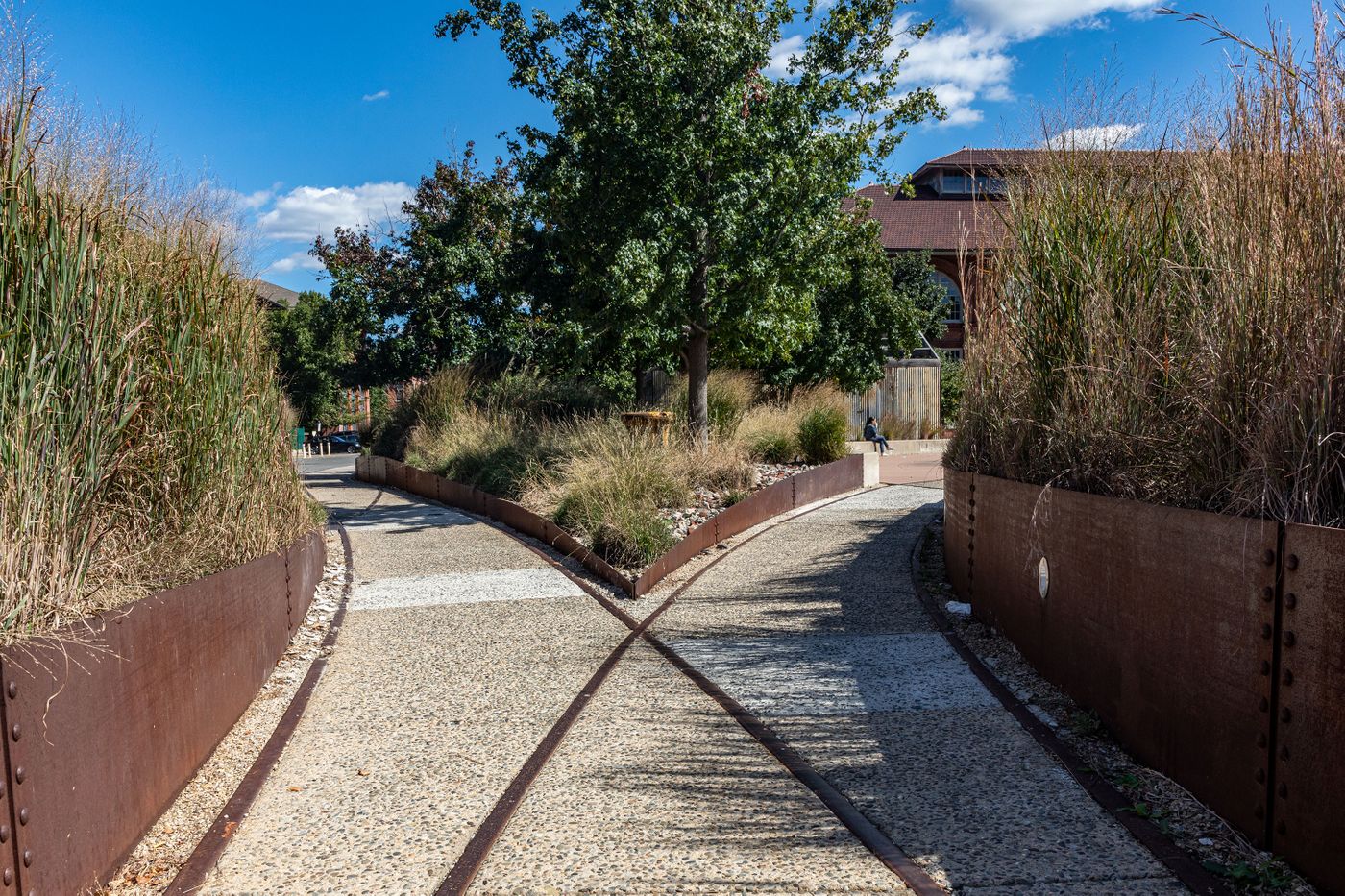
Photo: Barrett Doherty, Cultural Landscape Foundation.
D.I.R.T.’s corporate campus for Urban Outfitters in the Philadelphia Navy Yard.

When you rehab a Superfund site or other industrial dead zone, should you wipe out the history or make the interesting parts work for a new generation? You can guess that I’m going to answer that question on the side of the landscape architect mentioned in today’s story. Read on.

Justin Davidson reports at Curbed, “If there was a childhood moment when Julie Bargmann had intimations of her future as a landscape architect, it came not during some backwoods tromp or while touring a lavish garden but when she was sitting in the back seat of her family’s station wagon on the New Jersey Turnpike. The great chemical plants exhaling sulfurous plumes seemed to her like magic kingdoms, and she wondered about the lives of the people inside. Later, when she was in college at Carnegie Mellon in the 1980s, Pittsburgh’s ozone-laced air gave her the same jolt of industrial excitement. …

“Bargmann, who has just been awarded the first $100,000 Cornelia Hahn Oberlander prize in landscape architecture, never lost her taste for such wounded and poisonous places, even after they’ve stopped being productive. Old industrial areas bring out her desire to nurse them slowly back to health.

As a professor at UVA and the founder of a firm she called D.I.R.T. (short for ‘Dump It Right There’) studio, she rejects the urge to demolish dead factories and scrub the land of memory, to conflate cleanup and obliteration.

“ ‘For me, the modest or the genuine way to approach these ugly-duckling sites is to be empathetic. I see a place that’s impregnated with the labor of generations of workers. That goes deep. How do you honor that history without just resorting to plaques?’

“The answer lies in projects like Detroit’s Core City Park, where Bargmann unpaved a parking lot and bared the foundations of a fire station that had been razed long ago. ‘I blurted out “Dig!” and up comes this beautiful red sandstone from the former engine house,’ she says. ‘The miraculous moment was when they hoisted out of the ground the cornerstone with “1893” written on it. The client wanted to stand it up and put it on a pedestal, and I said no — “Put it in the ground and put it back to work.” ‘ Stones, bricks, and asphalt became the raw materials for a new pattern of pavers, interspersed with trees to form an urban woodland. The result is a public space layered with memory.

“Bargmann preaches an ethic of modesty and restraint. Instead of moving great mountains of earth, making the land conform to a drawing, sift through what is already there. Don’t delete; preserve. …

“The conventional technique for cleaning up a contaminated site is [scooping] polluted soil and carting it to other dumps — essentially, moving dirty dirt around. Bargmann prefers to leave as much of the stuff in place as possible to avoid spreading toxins ‘to someone else’s backyard’ and help nature perform its slow-motion cleanup. She starts by visualizing the different levels of contamination and letting those variations suggest a strategy. ‘I love to take the data from the engineers and do a map of what’s hot and what’s not,’ Bargmann says.

“Where conditions allow, she opts for phytoremediation: using plants to clean the soil. At AMD&ART Park in Vintondale, Pennsylvania, acidic mine runoff filters through a series of rock-lined ponds that raises the pH to safe levels, then washes through a sculpture park and flows into a restored wetland.

“The mission to use landscape as a ledger inscribed with both heroic and unsavory history can smack up against her clients’ goals. Sometimes she finds herself working for the companies that ravaged the landscape in the first place and then want to erase that stigma as quickly and cleanly as possible. When Ford opened its River Rouge plant in Dearborn, Michigan, in 1928, it was a marvel of Machine Age efficiency that beguiled filmmakers, painters, and photographers. …

“ ‘They were going to wipe out everything, and I was just … Why?‘ Bargmann recalls. ‘This is the most critical part of an integrated manufacturing world — the first anywhere! Some structures were really nasty and best dealt with off-site, but we also planted remediation gardens in front of the old coke ovens, which were preserved. If you’re going to honor history and work on the toxic legacy, storytelling is a really powerful tool.’ …

“Bargmann’s approach coexists uneasily with Instagram culture, in which landscape is treated as a frame for a preening object. Her projects aren’t conceived to be photogenic on opening day since they set up processes that can grind on for years. Rather than plant meticulously coordinated gardens that require constant tending, she pops in trees and grasses that can be relied on to fend for themselves. Bargmann also has a soft spot for rough hardscape. …

“She has trained contractors to chop up concrete into big reusable slabs she calls ‘Barney rubble’ and mix smaller chunks with crushed brick to produce ‘Betty rubble.’ The combination can produce results that verge on the chic, as at Urban Outfitters’ headquarters at the Philadelphia Navy Yard.”

Read more — including why a developer in Detroit says he “inhales her ideas” — here.

More at Curbed, here.

Read Full Post »

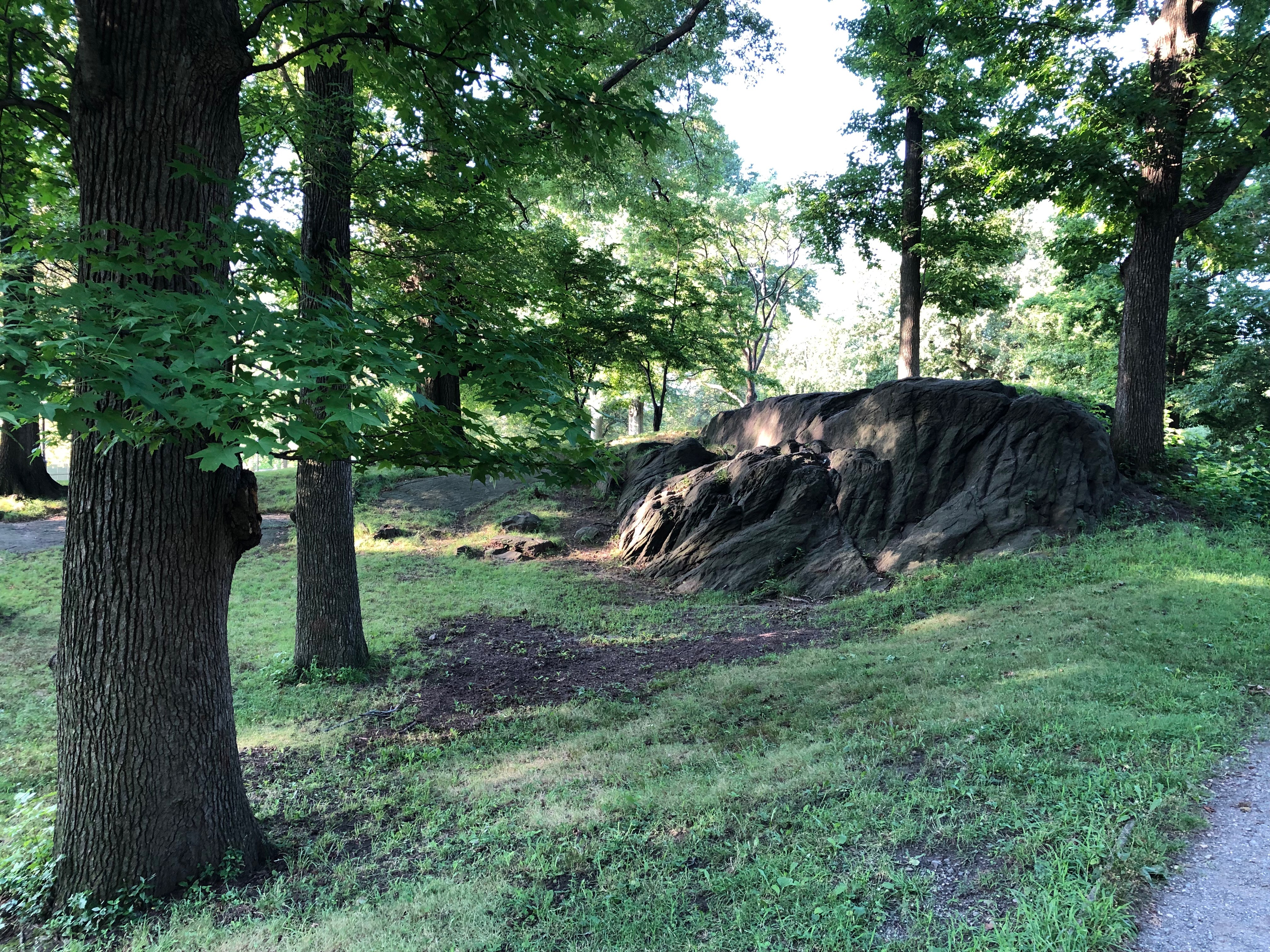
072519-love-Central-Park-rock-formations

I can’t stop talking about how much I love New York’s Central Park in the morning, especially as I remember being 14 and told not to walk my aunt’s Corgi anywhere near there in the morning.

In those days, the park had fallen on hard times and wasn’t being loved and protected. Nowadays in the mornings, half the word is there — bikers, walkers, runners, dog exercisers, tennis players, baseball teams, New Yorkers doing tai chi or push-ups or taking a detour to the office surrounded by birdsong and beauty. It’s a welcoming place for people of every background and income, who mingle there unselfconsciously, often with friendly smiles.

The experience is the genius of 19th century landscape architect Frederick Law Olmstead and the ordinary people who supported his vision. Perhaps you have an Olmstead park near you. You do if you live near Buffalo, Niagara Falls, New York City, or Rochester in New York State, or Boston in Massachusetts, Trenton in New Jersey, Riverside in Illinois, Detroit in Michigan, Louisville in Kentucky, Milwaukee in Wisconsin, Asheville in North Carolina … the list goes on.

I took a few highlights from the Wikipedia entry on Olmstead, here.

“The design of Central Park embodies Olmsted’s social consciousness and commitment to egalitarian ideals. Influenced by [landscape architect Andrew Jackson] Downing and his own observations regarding social class in England, China, and the American South, Olmsted believed that the common green space must always be equally accessible to all citizens, and was to be defended against private encroachment. This principle is now fundamental to the idea of a ‘public park,’ but was not assumed as necessary then. Olmsted’s tenure as park commissioner in New York was a long struggle to preserve that idea. …

“Olmsted’s principles of design, generally speaking, encourage the full utilization of the naturally occurring features of a given space, its ‘genius’; the subordination of individual details to the whole so that decorative elements do not take precedence, but rather the whole space; concealment of design, design that does not call attention to itself; design which works on the unconscious to produce relaxation; and utility or purpose over ornamentation. …

“The pastoral style featured vast expanses of green with small lakes, trees and groves and produced a soothing, restorative effect on the viewer. The picturesque style covered rocky, broken terrain with teeming shrubs and creepers and struck the viewer with a sense of nature’s richness. The picturesque style played with light and shade to lend the landscape a sense of mystery.”

Above you see his characteristic use of the elephantine rocks that jut out of the Manhattan landscape. I can’t tell you how mysteriously happy these sleeping giants make me, having grown up in Rockland County, where rocks are king.

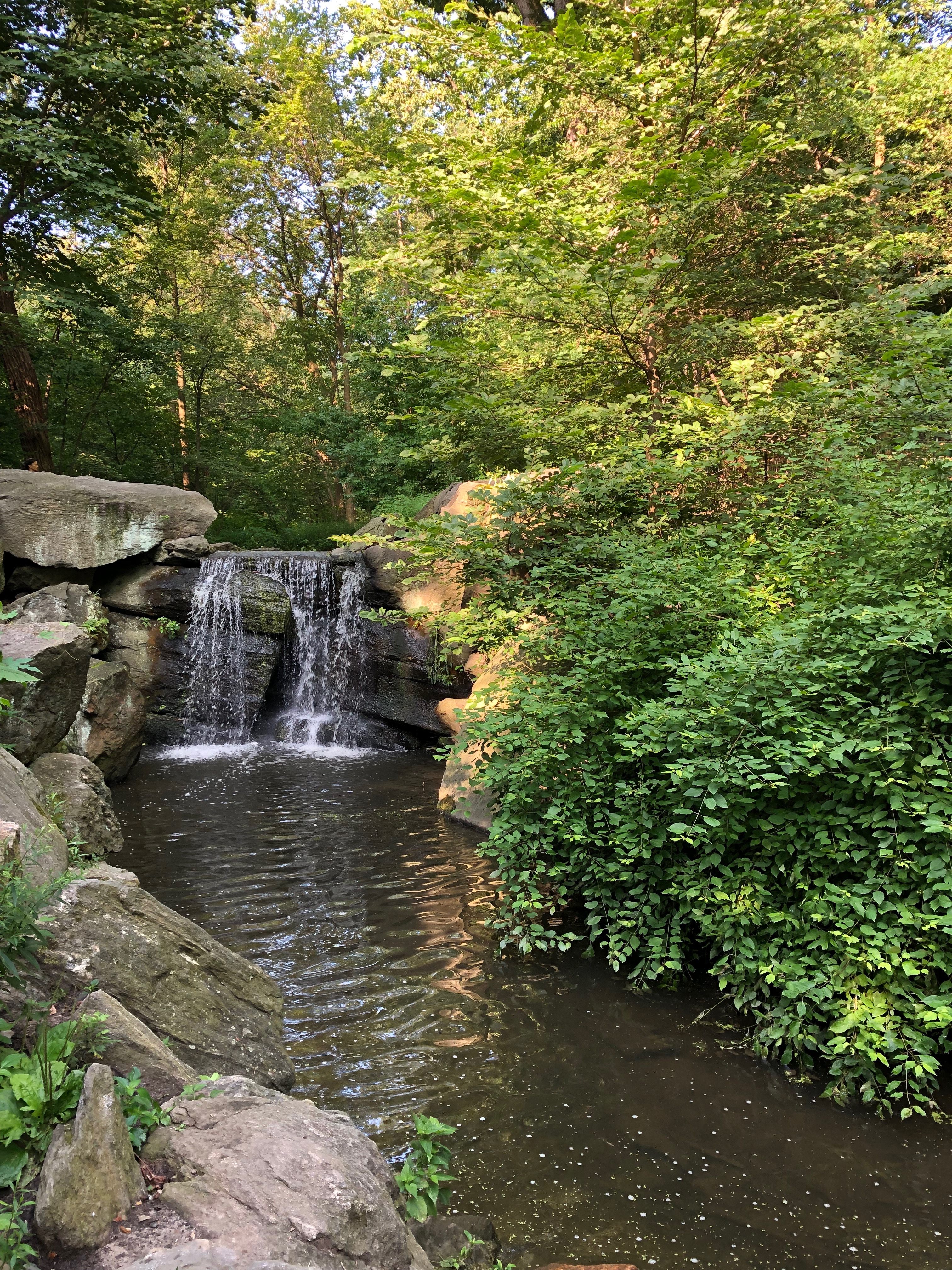
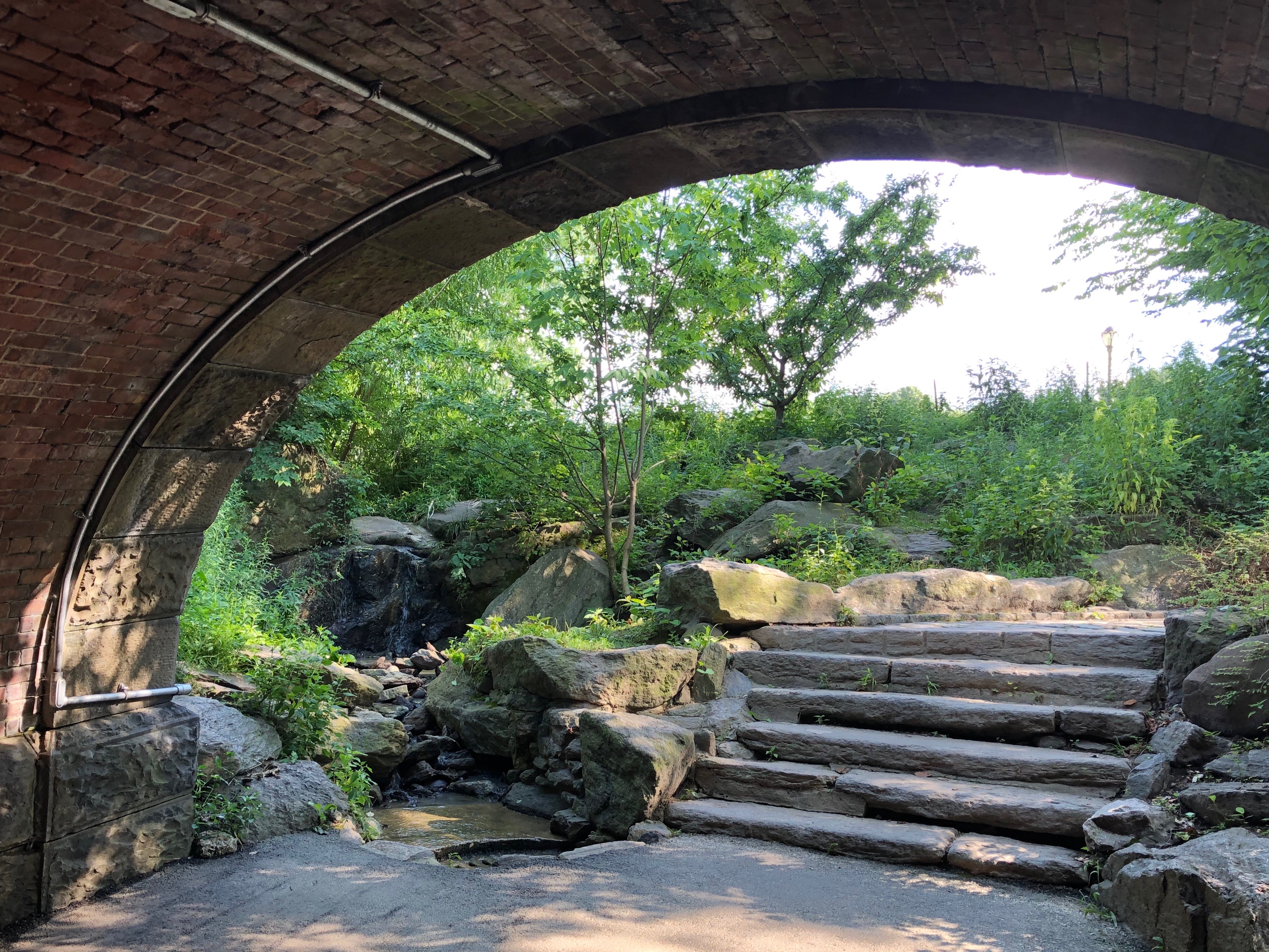
Below are my photos of one of Central Park’s fairylike bridges over a babbling brook, a musical waterfall, and a beckoning path under an arched bridge.

072419-Central-Park-stream

072619-babbling-brook-Central-Park

072419-Central-Park-NYC

Read Full Post »

Here’s a good one from The Atlantic’s City Lab on how Cleveland is turning a traffic circle into a park.

Eric Jaffe writes, “To hear Clevelanders talk, Public Square is a place you pass through to reach somewhere else. When Moses Cleaveland laid out the town in 1796, he imagined the open area at its center as a New England-style commons: a gathering space for settlers, a grazing area for livestock. …

” ‘Over the years, it just turned into more like a series of big traffic islands,’ says the landscape architect James Corner. …

“Locals who find themselves in one of the quadrants have a tough time getting to another. If the cars aren’t enough of a hindrance, the lack of things to do or see in the area is: of the square’s 10 acres, more than six are paved over with concrete or asphalt. …

“By the time Cleveland engaged Corner’s help, in 2008, many ideas for how to revamp the square had come and gone.

“They all suffered from the assumption that traffic around the site could not be disturbed. Corner came in with a bold idea: if we can’t remove the streets, let’s build an elevated park above them.

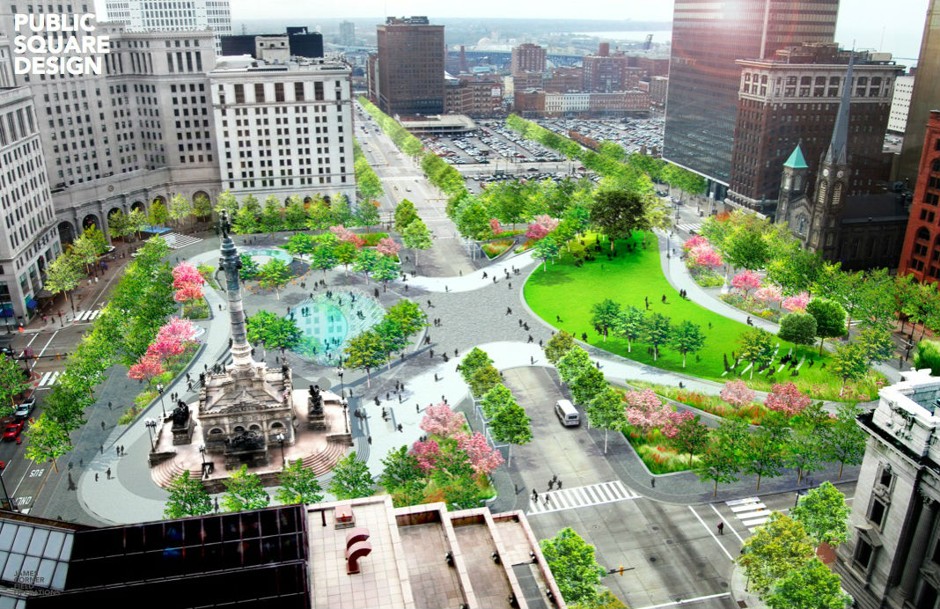
“The hilltop-park concept didn’t pan out, because of the cost and complexity, but [Land Studio executive director Ann Zoller] says it got locals reimagining Public Square as a place prioritizing people over cars. A traffic analysis determined that the city could close one of the streets and narrow the other to a passage for buses, which could be rerouted during major events. Construction started this spring on Corner’s final design, which is estimated to cost $32 million.”

Read more here on how cities are thinking about improved public spaces.

Image: James Corner Field Operations
A rendering of the new design  for Public Square in Cleveland

Read Full Post »