Feeds:
Posts
Comments

Posts Tagged ‘language’

The Duolingo bird can be very encouraging to a language learner. But it can also get angry.

With Suzanne’s family leaving soon for six months in Stockholm, I’ve been trying to learn some Swedish. I hope to try it on my grandchildren come next January. So it’s daily Duolingo for me. If I ever get to the point where I can understand Erik when he uses Swedish with the kids, I might also try expanding my French. I like the way the silly Duolingo bird cheers me on.

I was surprised to learn how many new languages the app has been adding lately. In the beginning, it didn’t even have Swedish. Now, according to an article in the Verge, it’s adding things like Maori, Tagalog, Haitian Creole, and isiZulu.

Jay Peters reports, “Duolingo is ‘more than doubling’ the number of courses it has available, a feat it says was only possible because it used generative AI to help create them in ‘less than a year.’

“The company [said] that it’s launching 148 new language courses. ‘This launch makes Duolingo’s seven most popular non-English languages – Spanish, French, German, Italian, Japanese, Korean, and Mandarin – available to all 28 supported user interface (UI) languages,’ dramatically expanding learning options for over a billion potential learners worldwide’ … the company writes.

“Duolingo says that building one new course historically has taken ‘years,’ but the company was able to build this new suite of courses more quickly ‘through advances in generative AI, shared content systems, and internal tooling.’ The new approach is internally called ‘shared content,’ and the company says it allows employees to make a base course and quickly customize it. …

“ ‘Now, by using generative AI to create and validate content, we’re able to focus our expertise where it’s most impactful, ensuring every course meets Duolingo’s rigorous quality standards,’ Duolingo’s senior director of learning design, Jessie Becker, says in a statement.

“The announcement follows a recent memo sent by cofounder and CEO Luis von Ahn to staff saying that … it would ‘gradually stop using contractors to do work that AI can handle.’ AI use will now be evaluated during the hiring process and as part of performance reviews, and von Ahn says that ‘headcount will only be given if a team cannot automate more of their work.’

“Spokesperson Sam Dalsimer tells The Verge in response to questions sent following von Ahn’s memo. ‘We’ve already been moving in this direction, and it has been game-changing for our company. One of the best decisions we made recently was replacing a slow, manual content creation process with one powered by AI, under the direction of our learning design experts. That shift allowed us to create and launch 148 new language courses today.’ …

“Dalsimer acknowledges that there have been ‘negative reactions’ to von Ahn’s memo. Dalsimer also notes that Duolingo has ‘no intention to reduce full-time headcount or hiring’ and that ‘any changes to contractor staffing will be considered on a case-by-case basis.’ “

Hmm. That is giving me pause. But I do like the app and the way that for English-speaking students like me, Duolingo starts out with some vocabulary that sounds like English. It makes me wonder if it does the same for learners who come from other languages. That could be really tricky.

Have you used Duolingo? I know that blogger Asakiyume, a mega language learner, used Duolingo to add Spanish and Portuguese to what she already knew in Japanese and more obscure languages. One thing I know for sure: she won’t like that Duolingo contractors will lose jobs thanks to AI.

More at the Verge, here.

Read Full Post »

Photo: Michael Fox/The World.
Rita Álvarez has been selling handicrafts and homemade jewelry on the streets of Asunción, Paraguay, for more than 40 years. She said that most of her customers in the city speak a combination of Guaraní with Spanish.

Most of our stories on indigenous languages are about struggles in the face of looming extinction.

It’s different for an indigenous language called Guaraní in Paraguay. Michael Fox reports on the phenomenon at Public Radio International’s The World.

Tomas Zayas, who lives in the Paraguayan countryside, spoke only the Indigenous Guaraní language until he was 22 years old. 

“Later, he started to speak Spanish to be better prepared as a community leader. But Guaraní has remained his main language.

“ ‘For me, Guaraní is identity,’ said Zayas, a longtime campesino leader with the Alto Parana Small Farmers Association. ‘It’s happiness. It’s beauty. Because a joke in Spanish isn’t funny at all.’ 

“The Guaraní language, along with its many dialects, comes from the Indigenous Guaraní people who have lived in this region since long before the Spanish conquest. 

“Today, nearly 300,000 Indigenous Guaraní still live in Paraguay, Brazil, Bolivia and Argentina. In some of these countries, their language has influenced Portuguese and Spanish. 

“But in Paraguay, Guaraní is spoken as an official language alongside Spanish. Most Paraguayans speak Guaraní or a mixture of Spanish and Guaraní as their first language, whether they are of Indigenous descent or not. 

“Although there are several theories about how Paraguayans have been able to preserve their Indigenous language, one that stands out focuses on the Triple Alliance War of the 1860s.

“Most of Paraguay’s male population was killed after Brazil, Argentina and Uruguay invaded the country. ‘As a question of survival, the women who were left would only speak Guaraní,’ Zayas said. ‘They passed it on to their children.’ …

“Under the dictatorship of Alfredo Stroessner, which lasted from the 1950s until the late 1980s, Guaraní was banned in Paraguay. It has also been stigmatized as a language of the poor.

“But many Paraguayans say that Guaraní is a language of metaphor and beauty.

“Rita Álvarez has been selling handicrafts and homemade jewelry on the streets of Asunción, Paraguay’s capital, for more than 40 years. ‘For me, it’s the sweetest language,’ she said. ‘Because you can say with one word in Guaraní what you would need 10 to say in Spanish.’

“She said that most of her customers in the city speak a combination of Guaraní with Spanish, or jopara, which means ‘mixture’ in Guaraní. …

“Blanca Estela González is a retired elementary schoolteacher who now teaches Guaraní at IDIPAR Language School in Asunción.

“Gonzalez said that foreigners often pick up Guaraní rather quickly, because, unlike Spanish, there are only three types of verb conjugations: past, present and future. And Gonzalez said the language has received a boost in recent decades.

“ ‘Now, it’s an official language,’ she said. ‘And half of the lessons at the public schools are taught in Guaraní.’ ” More at The World, here.

Happy New Year to all blog friends, whatever language you speak. Any plans for celebrating?

Read Full Post »

Photo: Jastrow at Wikimedia.
Slab with dedicatory Aramaic inscription to the god Salm. Sandstone, 5th century BC. Found in Tayma, Saudi Arabia, by Charles Huber in 1884. Now in the Louvre.

Among the world’s many endangered languages is one cherished today by a branch of Christianity in Iraq, a language close to the Aramaic Jesus spoke.

Sara Hassan reports at PRI’s The World, “In a small church in Baghdad, Iraq, a couple dozen people have gathered for prayers on a sunny Sunday morning. They stand in pews facing a crimson-colored curtain and a podium with a gold Syriac cross on it. The distinctive cross has a total of 12 circles at its points to represent the 12 disciples of Jesus.

“The congregants are reciting their prayers in an ancient language called Syriac. Today, it’s spoken mostly by Christians in Iraq and neighboring Syria. The language traces its roots to Aramaic, which was the script of the original Christian Bible and spoken by Jesus Christ. And it’s part of the family of Semitic languages in the Middle East region.

“The Syriac language is disappearing, with fewer and fewer people speaking it. The official languages of Iraq are Arabic and Kurdish.

“But now, after campaigning by some groups, a newly launched television channel, Al-Syriania, with funding from the Iraqi government, is hoping to change that. The community says it’s a good move toward preserving Syriac and in helping people stay connected with their language and culture.

“The channel has about 40 staff members and can be viewed in Iraq and around the world through satellite networks, such as NileSat and ArabSat. It’s a sister station of Al-Iraqiya, an Arabic television network that was set up in the country after the fall of Saddam Hussein in 2003, which also broadcasts in Kurdish and Turkmen.

“The news bulletins for the new channel are read in classical Syriac, but many of the other programs — which include cinema, art, history, cultural events and music — are presented in a dialect of the language.

“ ‘We have daily segments, like news and morning shows, and also, documentary programs about the history of the church and historical sites,’ said Jack Anwia, the station director. ‘We also play classical Syriac songs and music, the top-100 movies, and we have correspondents reporting from the field.’ …

“In 2003, the country was home to about 1.5 million Christians. Since then, that number has dropped to about 400,000. The war caused many of them to flee to other safer countries. But much of the decline also followed the onslaught of ISIS in 2014, which targeted Christians and other minorities.

“Many of the families settled down in other countries around the world, and younger generations have tried to adopt the languages of their host countries to assimilate better, losing touch with Syriac unless it’s spoken at home. …

“[Father Qasha Shamoun, a priest at the Ancient Church of the East in Baghdad] said the security situation has improved in Iraq over the past several years, but the Christian community is so small that it’s hard to bring people together for programs. … He added that Al-Syriania has been good for providing Syriac programming and that people in his community have told him they like watching it.

“Hundreds of Syriac books and manuscripts have still survived decades of war and migration. In fact, right before ISIS fighters captured large parts of northern Iraq in 2014, the Chaldean Catholic archbishop of Mosul, Najeeb Michaeel, rescued a collection of centuries-old Syriac manuscripts as he fled.

“Now, many of them are preserved at the Digital Center for Eastern Manuscripts in Erbil, the capital of the Kurdish region, which is supported by UNESCO, USAID and the Catholic Dominican Order.

“Back at the news station, Anwia said that it’s important not to lose Syriac. ‘It is one of the oldest languages of Iraq,’ he said. ‘And it needs to be protected from extinction.’ ”

More at The World, here.

Read Full Post »

Photo: Riley Robinson/Monitor Staff.
Kawehnokwiiosthe teaches the Mohawk language to students from both sides of the US-Canada border at the Akwesasne Freedom School, St. Regis Mohawk Reservation, northern New York.

Today many languages are in danger of dying out as the elders who speak them die off and young people don’t learn them.

Fortunately, in some places there are efforts to educate new speakers. Consider this Mohawk language school at a reservation in upstate New York.

Sara Miller Llana writes at the Christian Science Monitor, “Students and teachers, as well as some parents, sit on two wooden benches running the length of the hallway of their school, organized not by age or grade but by their clans.

“They take turns reading from the Ohén:ton Karihwatéhkwen, which translates from the Mohawk language to ‘Words before all else.’ These words, which recognize all life forces in creation, mark the day’s start at the Akwesasne Freedom School.

“But the 60-odd students here wouldn’t understand these lessons if it weren’t for this little schoolhouse at the United States-Canada border that for decades has been fighting to preserve Mohawk language and culture. ‘This makes us who we are, and if we don’t have this, who are we going to be?’ asks teacher Kawehnokwiiosthe, whose name in English means ‘She makes the island beautiful.’ …

“Kawehnokwiiosthe turns to her young pupils, who introduce themselves by their clans – Wolf, Bear, and Eel – and state that they are wisk, or age 5. Every class in K-8 that students take is full language immersion.

When a child asks a question in English, Kawehnokwiiosthe responds in Mohawk.

“Most parents pay tuition with a quilt sold at an annual auction in August. The school is run as a co-op, where parents do the cleaning (along with the students) and the maintenance work. Students come from American and Canadian sides of the border, but the school has never accepted funds from either government, says Alvera Sargent, who heads the nonprofit Friends of the Akwesasne Freedom School and is one of the last first-language speakers of Mohawk.

“That makes her precious, says Waylon Cook, former teacher and now project manager of the school’s nonprofit arm. ‘We treasure our first-language speakers,’ he says. … ‘If you lose [Mohawk], you can’t go to France like you could to learn French. There is nowhere else to do it but here.’ More at the Monitor, here.

Meanwhile, in the state of Washington, there’s an effort to bring Native language teaching into public school, too.

Lauren Gallup wrote at Northwest Public Broadcasting, “A number of Washington state public schools are partnering with tribes to bring Indigenous languages into classrooms in an effort to rectify the marred history of Native American boarding schools.

“Rachael Barger is a teacher on special assignment with Bethel School District, one of the districts partnering with the Nisqually Tribe to bring its Southern Lushootseed language into the classroom for a small subset of students. 

“5% of Bethel’s student population identifies as American Indian, Alaskan Native, two or more races or Hispanic and Native. Barger serves over 200 Title VI Indian Education Program students for the district. Title VI is a federal program that aims to meet the specific needs of Native American students. 

“The tribe and district have partnered, so far, to bring the language classes to two elementary schools for students who qualify for Title VI. Bethel School District had 461 qualifying students this last school year, which is around 2% of its student population.  Barger said those students were excited to learn the language because it felt unique to them. …

“The tribe’s partnership with the Bethel schools is part of the Nisqually Language Resource Center which started two years ago.

“ ‘It makes  it chokes me up,’ said Catalina Sanchez, research coordinator for the center. ‘It’s just something new that we’ve always needed in our community. So I’m proud of us for finally getting our own program in our schools and in our community.’

“The language work being undertaken by the tribe is part of broader efforts to expand and uplift culture and identity for the tribe. 

“ ‘You’re starting to see everything kind of awakening right now here in Nisqually,’ said Willie Frank III, chairman of the Nisqually Tribe. …

“Frank said he thinks it’s a perfect time to focus again on the tribe’s cultural traditions. ‘What I was taught was to tell our story, and, you know, keep building our people up,’ Frank said, ‘and that’s what we’re doing with all this great work in here. I think about the art, the culture and the language; that’s going to be something that sustains us.’ ” 

More at Northwest Public Broadcasting, here. No paywall for either article.

Read Full Post »

Photo: Miami Herald/Getty.
The English language in Miami is changing.

Here’s something for readers interested in the evolution of languages. Miami has such a vibrant Spanish-speaking community that it’s developing its own version of English.

Phillip M Carter of Florida International University describes the new dialect at the Conversation, ” ‘We got down from the car and went inside.’

“ ‘I made the line to pay for groceries.’

“ ‘He made a party to celebrate his son’s birthday.’

“These phrases might sound off to the ears of most English-speaking Americans. In Miami, however, they’ve become part of the local parlance.

“According to my recently published research, these expressions – along with a host of others – form part of a new dialect taking shape in South Florida. This language variety came about through sustained contact between Spanish and English speakers, particularly when speakers translated directly from Spanish.

“Whether you’re an English speaker living in Miami or elsewhere, chances are you don’t know where the words you know and use come from…. Borrowed words are far more pervasive than you might think.

“They’re all over English vocabulary: ‘pajamas‘ from Hindi; ‘gazelle‘ from Arabic, via French; and ‘tsunami‘ from Japanese.

“Borrowed words usually come from the minds and mouths of bilingual speakers who end up moving between different cultures and places. …

“One bilingual confluence famously changed the trajectory of the English language. In 1066, the Norman French, led by William the Conqueror, invaded England in an event now known as ‘the Norman Conquest.’

‘Soon thereafter, a French-speaking ruling class replaced the English-speaking aristocracy, and for roughly 200 years, the elites of England – including the kings – did their business in French.

“English never really caught on with the aristocracy, but since servants and the middle classes needed to communicate with aristocrats – and with people of different classes intermarrying – French words trickled down the class hierarchy and into the language.

“During this period, more than 10,000 loanwords from French entered the English language, mostly in domains where the aristocracy held sway: the arts, military, medicine, law and religion. Words that today seem basic, even fundamental, to English vocabulary were, just 800 years ago, borrowed from French: prince, government, administer, liberty, court, prayer, judge, justice, literature, music, poetry, to name just a few.

“Fast forward to today, where a similar form of language contact involving Spanish and English has been going on in Miami since the end of the Cuban Revolution in 1959.

“In the years following the revolution, hundreds of thousands of Cubans left the island nation for South Florida, setting the stage for what would become one of the most important linguistic convergences in all of the Americas.

“Today, the vast majority of the population is bilingual. In 2010, more than 65% of the population of Miami-Dade County identified as Hispanic or Latina/o, and in the large municipalities of Doral and Hialeah, the figure is 80% and 95%, respectively.

“Of course, identifying as Latina/o is not synonymous with speaking Spanish, and language loss has occurred among second- and third-generation Cuban Americans. But the point is that there is a lot of Spanish – and a lot of English – being spoken in Miami.

“Among this mix are bilinguals. Some are more proficient in Spanish, and others are more skilled English speakers. Together, they navigate the sociolinguistic landscape of South Florida in complex ways, knowing when and with whom to use which language – and when it’s OK to mix them.

“When the first large group of Cubans came to Miami in the wake of the revolution, they did precisely this, in two ways.

“First, people alternated between Spanish and English, sometimes within the same sentence or clause. This set the stage for the enduring presence of Spanish vocabulary in South Florida, as well as the emergence of what some people refer to as ‘Spanglish.’

‘Second, as people learned English, they tended to translate directly from Spanish. These translations are a type of borrowing that linguists call ‘calques.’
Calques are all over the English language.

“Take ‘dandelion.’ This flower grows in central Europe, and when the Germans realized they didn’t have a word for it, they looked to botany books written in Latin, where it was called dens lionis, or ‘lion’s tooth.’ The Germans borrowed that concept and named the flower ‘Löwenzahn‘ – a literal translation of ‘lion’s tooth.’ The French didn’t have a word for the flower, so they too borrowed the concept of ‘lion’s tooth,’ calquing it as ‘dent de lion.’ The English [brought] ‘dent de lion’ into English, calling it ‘dandelion.’

“This is exactly the sort of thing that’s been happening in Miami.”

Since people whose first language is Spanish live all over the US, I think any of us could come up with similar blends if we thought about it. Maybe there are some specific to English as spoken in England.

At the Conversation, here, you can read about the three kinds of calques the researchers identified in Miami. No firewall.

Read Full Post »

Photo: Anthony Camerlo/Unsplash.
Can you get a hearing test if the only language you know is rare?

Where we live now, it’s more common than not for people to need hearing aids. Whether those people actually wear their hearing aids is another issue, but folks around them seem tolerant of having to repeat — or shout.

One thing I never thought about until I read today’s article is the fact that getting an audiology test can be a problem if you speak an uncommon language.

Lina Tran reports at WUWM, “About four years ago, Maichou Lor was living in New York completing a postdoctoral fellowship, when family members back home in Wisconsin kept telling her that her dad’s hearing was getting worse.

“ ‘He wasn’t responding to conversations even though he had a hearing aid,’ said Lor, now an assistant professor of nursing at the University of Wisconsin-Madison. ‘I brought him in to see his doctor through the ENT clinic here at UW-Health.’

“Lor and her father are Hmong; she joined him at the appointment as an interpreter, since he doesn’t speak English. At the clinic, his physician told Lor there was a limit to what he could offer him.

“ ‘I told her that there was a limitation in the test,’ said Burke Richmond, an assistant professor in the ear, nose, and throat division [at] the University of Wisconsin-Madison. …

“Part of the evaluation is a word recognition test, which assesses when speech is loud enough for someone to understand. It helps doctors identify the severity and type of hearing loss and come up with a treatment plan, such as whether hearing aids will work or if a cochlear implant is viable.

“During the test, patients listen to a recording of words, with instructions to repeat the words as they hear them. But, for the most part, the test is only available in the most common languages. … Few clinics are equipped to treat Hmong-speaking patients. …

“After Lor and Richmond met, they undertook a years-long, interdisciplinary collaboration that resulted in the first Hmong hearing test of its kind.

“Hearing evaluations typically involve a couple different tests. In one of them, patients listen to beeps and tones and press a button when they hear it. ‘That’s easy enough to explain to someone who speaks a different language,’ said Jennifer Ploch, a clinical audiologist involved with the project, then at UW-Madison. …

“When Lor and her father came through his office, Richmond knew about Lor’s research on health disparities. He asked if she wanted to make a Hmong word test with him. …

“The English test is designed to use everyday words like ‘bat’ and ‘kick’ that anyone would understand. At the same time, it shouldn’t be possible for test-takers to predict or guess what the words are without actually hearing them. Historically, one of the ways audiologists have accomplished that is by writing the word list so that it reflects the phonetic make-up of the language.

“ ‘If the language has a bunch of S’s, you want to have a bunch of S’s in the words,’ explained Lynsey Wolter, an associate linguistics professor at the University of Wisconsin-Eau Claire, who led the writing of the Hmong word list. ‘But not too many because then someone will just guess.’

“But no one had studied how frequent different sounds are in Hmong.

“ ‘And there are a lot,’ Wolter said. ‘There are about twice as many consonant sounds in Hmong as in English. Hmong is also a tonal language. The intonation of the word — whether the tone is higher or lower, going up or going down — can change the meaning.’ …

“Wolter said it was critical to work with native Hmong speakers, so she quickly brought two of her students onboard. … Kao Lee Lor, then a senior, was one of the student collaborators. She always loved languages and grew up hearing many of them at home, reflecting the places her parents had lived before immigrating to Wausau, Wisconsin. They were born in Laos and grew up in a Thai refugee camp. They enjoyed television shows, films, and music in Thai, Hmong, and Hindi. …

“To pick words for the list, the students dug through Hmong texts, entering all the words into a massive spreadsheet.

“ ‘We compiled a bunch of different Hmong folklore and folktales, Hmong kids’ books, anything we could find,’ Lor said. Some of the tales were familiar to her and her collaborator, oral traditions that had been passed down from their grandparents and parents. But there was little time to appreciate the stories in a new light; their focus was gathering as many words as they could.

“ ‘Once we were able to extract these words from these texts, we were able to break these words up into [their] parts, and then count the frequency of how much these consonants, sounds, vowels, and tones occurred,’ Lor said. …

“With numbers on how frequent different sounds are in the language, the linguistics team picked words to meet those targets. They wrote four lists of 50 words each, and sent it back to the UW-Madison researchers.

“Word lists in hand, the researchers asked the Hmong community to nominate clear, fluent speakers. Then, to validate the list, they tested the Hmong test against the English version on a group of bilingual speakers. They published their results in December.”

More at Milwaukee’s WUWM, here. No firewall. And for more on Hmong people in America, read the lovely memoir The Late Homecomer.

Read Full Post »

Photo: Whitney Eulich.
Angel del Rosario Hau Paat, who raps as ADR Maya, is seen here with his mother in Tulum, Mexico. He grew up resistant to speaking Maya but now embraces it.

When a new generation decides that the old folks’ way of speaking could actually be cool and even powerful, a language that is in danger of dying out may get an extension.

Whitney Eulich writes at the Christian Science Monitor, “Angel del Rosario Hau Paat leans over the rainbow-colored hammock where his grandmother lies and speaks directly into her ear: ‘What do you think of my singing?’ he shouts in Maya, the Indigenous language of Mexico’s Yucatan.

“Hard of hearing, she strokes his face as she responds. ‘She’s happy,’ he translates, with a bashful laugh. ‘She says my Maya is good.’

“Growing up in the southern Mexican state of Quintana Roo, Mr. del Rosario says he wasn’t interested in learning Maya, the only language his grandmother speaks and which his mother grew up speaking. Spanish is what was useful for him at school and among friends.

“But today he is part of a growing trend among young people – here and across the Americas, from Canada to Chile – who are rapping in Indigenous languages. It’s strengthened his connection to the language his mother raised him speaking (and to which he grew up responding in Spanish) and to his family’s traditions.

“ ‘I never imagined myself using Maya so much. I’m making more connections with my culture and with people from other countries also rapping in Indigenous languages,’ says Mr. del Rosario, a pool technician in the resort town of Tulum who records music under the name ADR Maya in his free time. ‘It feels really good.’ 

“Mexico is home to more than 60 officially recognized Indigenous languages. Many of them, and their associated cultures, are at risk – despite a 2002 law protecting the right to use one’s Indigenous language and education reforms in recent years that require some languages be taught in public schools.

“At least 40% of the world’s Indigenous languages are also in danger of disappearing, according to the United Nations. But, for young artists like Mr. del Rosario, the discovery of rap in Maya is serving as a motivation to double down on learning more. …

“Says José Antonio Flores Farfán, a professor of linguistics and anthropology at the Center for Research and Higher Studies in Social Anthropology in Mexico City, ‘Treasures that human beings have accumulated for centuries are encrypted in language. … It’s these kids, these rappers, these artists who give me hope. … They are talented, doing something about it from the bottom up, and they’re inspiring younger kids and new generations to see value in the language in the process.’

“In the Yucatec-Maya-speaking region of southern Mexico, Jesús Cristobal Pat Chablé, more popularly known as ‘Pat Boy,’ could be considered the Johnny Appleseed of Indigenous rap. The artist, in his early 30s, started playing music when he was 5 years old and experimented with different genres, from rancheras (Mexican ballads) to rock to reggae, launching his solo rap career in 2009. 

“Today, he travels internationally, rapping in Maya; collaborates with artists who speak other Indigenous languages; and encourages young Maya speakers to write and record their own music, some of which ends up on albums he produces through his label ADN Maya. He’s currently building a recording studio in the town of Felipe Carrillo Puerto, about 140 miles south of Cancun. 

“Themes of daily life in Maya communities – customs, education, love, and traditions – populate his lyrics. His efforts have won him international recognition, including the 2022 Linguapax Award.

Last year, a song Pat Boy collaborated in writing and singing was featured on the ‘Wakanda Forever’ soundtrack.

“[It brought] the Maya language to theaters around the world with lyrics like: ‘They say we disappeared from this earth, what do you think? / It isn’t true … years passed, we became stronger. / Today I treasure the Mayan culture.’

“It’s a far cry from how he started.

“ ‘It was tough. I’d try to get a spot in a public festival and people would say, “But what do your songs say?” ‘ he recalls of his early years performing in Quintana Roo. ‘I was in my right to speak and sing in my maternal language, but there was this fear [among organizers] that I was motivating people to do things against the government, to rise up, because it was written in Maya and they didn’t understand the words,’ he says.      

“ ‘People in the city say, “You can’t achieve things if you’re Maya, you come from the countryside. You can’t be an artist or a painter or a writer,” ‘ he says. ‘When I started there wasn’t a lot of interest in what I was doing. Now, everywhere I go I meet young people dreaming of singing in Maya.’ ”

More at the Monitor, here. No firewall.

Read Full Post »

Photo: Paul Salopek/ National Geographic.
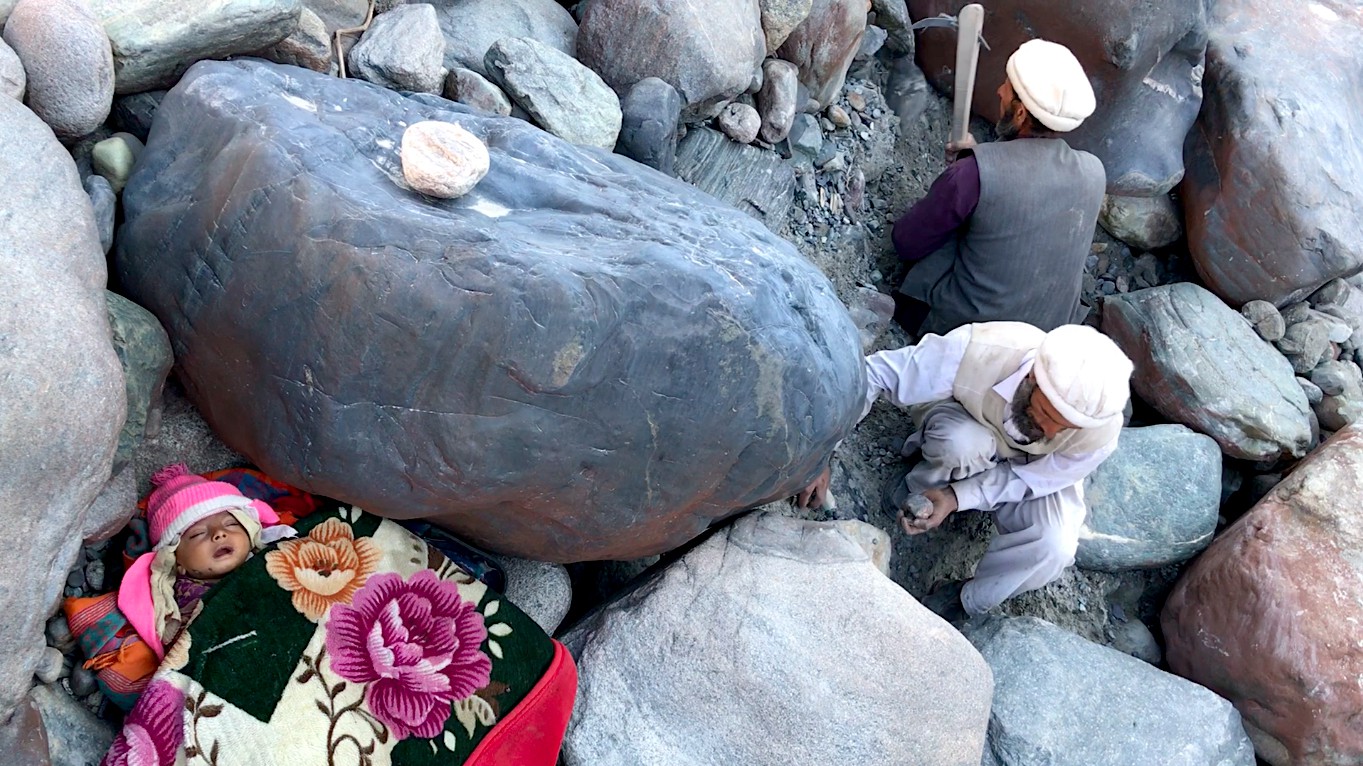
A baby sleeps near a gold prospector’s diggings in northern Pakistan.

I’m not sure how many readers will be interested in today’s rather academic treatment of an exotic part of the world and its many languages. Although I am not fluent in anything but English, I myself like learning about languages, especially those that are spoken by a small number of people and don’t even have a written form.

Language activist Zubair Torwali writes at Aeon about the many languages of ‘Dardistan,’ which includes northern Pakistan, parts of Eastern Tibet in China, eastern Afghanistan and the Kashmir valley on both sides of the Pakistan-India border.

“Dardistan is one of the most diverse linguistic regions in the world. … The region has the large Dardic languages such as Kashmiri, Shina and Khowar on the one hand and, on the other, it is home to the Burushaski language, which could not be placed within any language family because of its unique features. The Nuristani, formerly Kafiri, languages are spoken here, too. There are minor languages such as Kalasha, spoken by the Kalash community of hardly 4,000 people who still follow the ancient animistic religion that was once practiced across Dardistan.

“The name ‘Dardistan’ describes the area comprising the highest mountain ranges of Hindu Kush, Karakoram, western Himalaya and the Pamir mountains. … Dardistan’s enormous linguistic diversity occurs despite the fact that, culturally, the area is fairly homogeneous. [Anthropologist Augusto] Cacopardo says there is no match for this region in terms of linguistic and cultural diversity, except the Caucasus. Though, of course, minor differences exist, the same religious rituals and religious pantheon prevailed among the polyglot peoples of Dardistan.

“The many languages spoken here, though mostly belonging to the Indo-European family, still more narrowly to the Dardic sub-family within the Indo-Aryan group, are so different from each other that the people of one linguistic community have to rely on a third language, Pashto or Urdu, to communicate with members of another community. For instance, the people belonging to the Torwali and Gawri communities of the upper Swat valley in Pakistan need Pashto to converse with each other. This is despite the fact that the Torwali and Gawri languages are ‘sister languages’ and seem to have evolved from one single language a few centuries ago. …

“In 1986, the Summer Institute of Linguistics in collaboration with the National Institute of Folk Heritage, Lok Virsa, and the National Institute of Pakistan Studies at the Quad-e-Azam University in Islamabad, undertook a survey of the languages of northern Pakistan. Published in five volumes, this Sociolinguistic Survey of Northern Pakistan (1992) documented 25 languages. In fact, there are even more – at least 35 – languages in north Pakistan. …

“In his paper ‘India as a Linguistic Area’ (1956), the linguist M B Emeneau uses the phrase ‘linguistic area’ as a technical term to mean an area that includes languages of more than one family sharing some common traits with one another, but not all the linguistic features are alike among the language families. …

“[Swedish linguist Henrik Liljegren] argues that the Hindu Kush–Karakorum (HK) – also known as Dardistan – is a ‘linguistic area’ in the sense that it is a ‘convergence zone with a core that shares certain linguistic features’ as a result of a prolonged period of contact with other subareas. …

“Writing a century earlier, Morgenstierne was correct to claim that the region is among the most linguistically diverse in the world. Presently, about 50 languages are spoken here. [The] region has maintained this linguistic diversity, but it is under grave threat. Dardistan is at the crossroads of South Asia and Central Asia. It is mountainous and makes for very hard traveling. … It is perhaps thanks to Dardistan’s mountainous geography that we still find such a rich array of languages. …

“Dardistan is home to six language groups: namely Indo-Aryan, Iranian and Nuristani (all branches of the Indo-European language family), as well as Turkic, Sino-Tibetan and Burushaski. The Indo-Aryan phylum is the largest, including about 30 languages that have also been lumped together as ‘Dardic’ (North-Western Indo-Aryan) by linguists. … My work as an ethnographer and linguist has focused on north Pakistan. ….

“North Pakistan is a spectacular mountainous land of immense linguistic, ethnic and geographic diversity. It is undoubtedly one of the most multilingual places on planet Earth. Over many centuries, the movement and contact of people at this crossroads of Central and South Asia have left a complex pattern of languages and dialects. …

“None of Pakistan’s governments nor a university has ever taken any initiative in profiling the languages spoken by the people of Pakistan. Only a few – Urdu, Pashto, Punjabi, Balochi, Sindhi and Saraiki – are mentioned in any media, teaching materials and in any kind of national database. It is, therefore, difficult to estimate the exact number of speakers of each language because none of these languages has been counted in the six national censuses so far conducted in Pakistan. The number of speakers of these languages may vary from a few hundred to a million. Many are also spoken in Pakistan’s neighboring countries – Afghanistan, India and China.

“All these languages are categorized as ‘endangered’ in the Routledge Encyclopedia of World’s Endangered Languages (2007) edited by Christopher Moseley. Many of them are ‘severely endangered’ whereas a few are ‘moribund’ or already ‘extinct.’ “

The author details six of the languages at Aeon, here, and posts videos of people singing in them. No firewall.

Read Full Post »

Photo: Storytime Online.
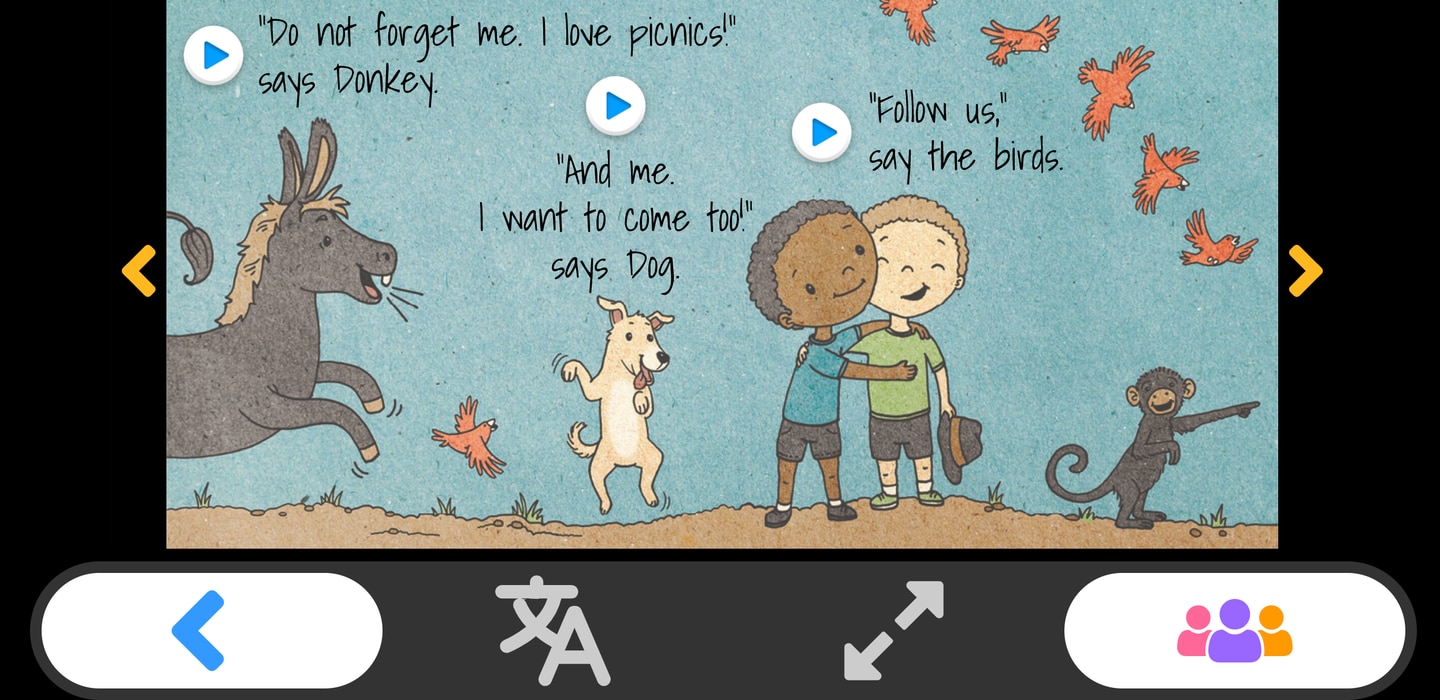
An inside page of “A Beautiful Day,” which is currently available in English, Spanish, and German.

Speaking of languages, today’s post is about making children’s books available in more languages. It’s from an interview that Boston Globe reporter Alexa Gagosz conducted with Andreas von Sachsen-Altenburg, founder of Storytime Online.

Writes Gagosz, “Storytime Online is a new German-Rhode Island educational technology platform where children can read and listen to interactive children’s books from cultures around the world, translated and narrated in more than 15 different languages.

“It works with authors and artists to digitize and publish stories on a global scale. … Founder Andreas von Sachsen-Altenburg is launching the Storytime Online platform internationally this month.

Globe: How did you come up with this idea?

von Sachsen-Altenburg: I was back in Germany with my family when I was with my sister Julia, who was 9 at the time, and had just moved there from Georgia (the country). I’d bring her to bookstores there, but we didn’t always actually purchase a book. She was just learning German as her second language, and she would quickly advance to the next level or simply get bored with reading the same book — like most kids. At the same time, while around the rest of my family, she was learning English; so, trying to learn two different languages at the same time. I looked for resources for her, but it was difficult to find anything in German, especially for a Georgian. I could find resources in English, but they were expensive. …

“If you go to another country where your language isn’t supported, especially as a child, it makes learning in school nearly impossible. Julia made me aware of this problem, so it became our problem. And I built my own solution.

How does Storytime Online work?

“It’s really easy to use, which was the key. The point is to allow a child to use this technology on their own, even as young as 3. After choosing a language and reading level, various book covers are displayed, and then the child can flip through the pages of the book online. You can read the book to the child, clicking through the pages on your own, or have a narrator read the book by clicking the play buttons.

You can also alter the language of each book in any of the other languages that it is available in.

Which languages are available?

“The languages that are currently on deck or in development include English, Spanish, French, German, Italian, Portuguese (European and Brazilian); Armenian, Georgian, Hungarian, Polish, Romanian, Russian, Slovak, Ukrainian, Arabic (Modern Standard); Kurdish, Pashto, Persian (Farsi/Dari), Swahili, Turkish, and Urdu. …

How much does it cost?

“For unlimited access to all languages, it’s an average of $5 each month. It’s designed to be affordable, even in developing countries.

How do you get authors and artists to be on the platform?

“Our model is similar to Spotify for artists. You get published and then get royalties, not just for that one language that you wrote the book in, but in all the languages I get it translated and narrated in. But this also multiplies their reach to other cultural markets without doing any additional work.

“Also, all authors, designers, illustrators, translators, and narrators get credit for being part of this effort right on the book’s landing page. If your child wants to continue reading a book from one particular author or narrator, you can click on the person’s profile to see what other books they worked on. …

How are you identifying global refugees to work with?

“I just started working with a digital skills and marketing firm in the UK that trains and employs refugees in Africa. Also, the CEO of the Cambridge Innovation Center recently sent out a newsletter about the company’s initiatives to support Ukraine during the war, and I replied to it regarding Storytime Online. I was connected with a CIC director in Poland, and he was able to put me in touch with more translators.

“I developed a partnership with the Ukrainian National Women’s League of America, and they have a network of thousands of migrants. Right now, I’m prioritizing Ukrainian narrations and translations, but also working with Ukrainian refugees to support them during this time. With the League’s help, I’m looking to quickly translate and narrate 100 stories in Ukrainian.

How does Storytime Online fit into your background?

“I grew up between the US and Germany. Learning another language was much different in Europe than here in the US. I took Spanish classes in both Germany and the US, but I actually learned Spanish in Germany. In Germany, you’re not just learning for the next test, you’re learning to become fluent.”

More at the Globe, here.

Read Full Post »

Photo: The Intrepid Guide.

Don’t you love the way quirky idioms reflect a whole culture? I’ve written about this a few times before. Today I’m sharing what the Intrepid Guide has to say on the subject.

Michelle, the founder, writes, “If you’ve ever tried to learn a language, then you’ll know that translating is not always an easy task. There are over 7,000 languages in the world and just as many words and ideas that get ‘lost in translation’ due to differences in grammar and semantics, or even linguistic complications. When a language fails to convey the essence of a word during translation, the word is considered to be ‘untranslatable.’

“There are many terms that … can give us a glimpse into different cultures and belief systems that help us to understand the people who speak these marvelous languages. 

“English is no stranger to borrowing words from other languages and even inventing new ones like hangry, a combination of anger and hunger because you need something to eat asap. Then there is nomophobia, an irrational fear or sense of panic felt when you’ve lost your phone or are unable to use it. … New words have entered English dictionaries at a fast pace, keeping up with the diversity of the English-speaking world. 

“In spite of this, the English language can’t explain everything so succinctly, and yet there are many other languages that have, in just one word. This comprehensive list looks at some of the most beautiful words in different languages that are simply untranslatable into English. …

“From Afrikaans to Zulu, here are 203 of the most beautiful untranslatable words from other languages.

“Afrikaans: Loskop – Used to describe someone who is forgetful, absent-minded and a bit air-headed. It’s literally means, ‘loose (los) head (kop).’

“Albanian: Besa –  An Albanian verb and pledge of honor that means to keep a promise by honoring your word. It’s usually translated as ‘faith”’ or ‘oath.’ …

“Arabic: Taarradhin  (تراض)Taarradhin is the act of coming to a happy compromise where everyone wins. It’s a way of reconciling without anyone losing face. …

“Bengali: Ghodar-dim (ঘোড়ার ডিম) – Pronounced [gho-rar-deem], this Bengali word is a sarcastic term for ‘nothing’ or false hope. It literally means ‘horse’s egg,’ therefore representing something that doesn’t exist. …

“Malay: pisan zapra – the time it takes to eat a banana. …

“Spanish: VacinlandoVacilando is a beautiful Spanish word which describes the journey or experience of travelling, is more important than reaching the specific destination.”

There’s a very long list of untranslatable Swedish. Here’s the first: “Badkruka – A person who feels somewhat hesitant or doesn’t like to swim in an open body of water due to its low temperature. …

“Tagalog (Philippines): GigilGigil is the overwhelming feeling that comes over you when you see something unbearably cute that you want to squeeze or pinch it. Kind of like when your grandma wanted to pinch your cheeks when you were a child. …

“Wagiman (Australia): Murr-ma – This beautiful word comes from Wagiman, an almost extinct Australian Aboriginal language spoken in Australia’s Northern Territory. It describes feeling around in water with your feet to find something. …

“Yaghan (Southern Argentina): Mamihlapinatapei – The word mamihlapinatapai (sometimes also spelled mamihlapinatapei) comes from the Yaghan language of Tierra del Fuego in Southern Argentina. Mamihlapinatapai is listed in the Guinness Book of World Records as the ‘most succinct word’ and is considered extremely difficult to translate. Mamihlapinatapai is a meaningful, but wordless, exchange between two people, who both desire to initiate something but are hesitant to act on it. It also can refer to a private but non-verbal exchange shared by two people, one where each knows that the other understands and agrees what is being expressed. …

“Yiddish: Trepverter – Literally, ‘staircase words,’ trepverter is a witty comeback you think of only after it’s too late. 

“Zulu: Ubuntu – The act of being kind to others because of one’s common humanity. Ubuntu is frequently translated as ‘I am because we are,’ or ‘humanity towards others.’ “

More at the Intrepid Guide, here. The selections are pretty amazing. Dip in anywhere. A couple of my previous posts on the topic are here and here.

Read Full Post »

Photo: Annabel Lankai.
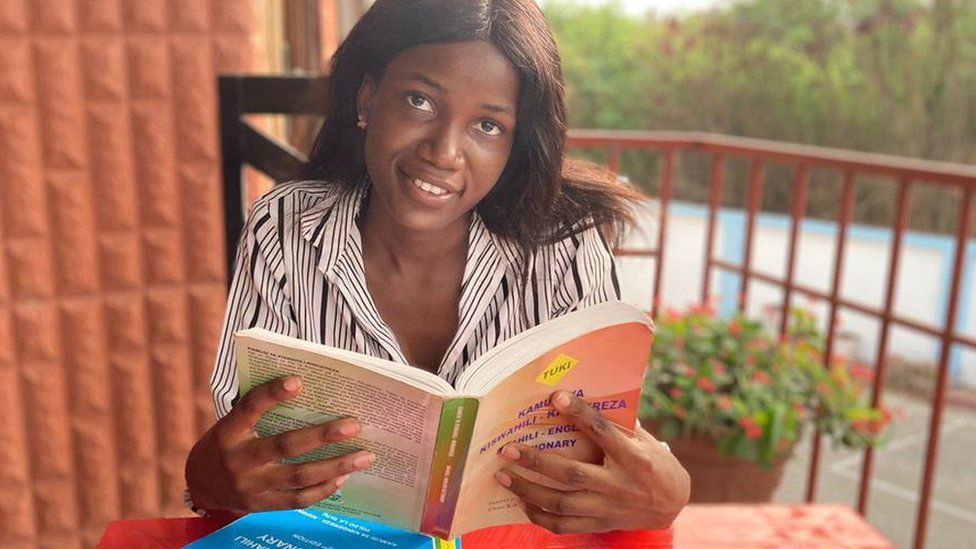
Ghanaian Swahili student Annabel Naa Odarley Lankai is advocating to make Swahili the lingua franca of Africa.

The BBC reports on renewed efforts to make Swahili the Esperanto of Africa, the universal language on the continent.

“With more than 200 million speakers, Swahili, which originated in East Africa, is one of the world’s 10 most widely spoken languages and, as Priya Sippy writes, there is a renewed push for it to become the continent’s lingua franca.

” ‘It’s high time we move from the colonizer’s language.’

“This is not part of a rousing speech by a pan-African idealist but rather the sentence is uttered quietly and calmly by Ghanaian Swahili student Annabel Naa Odarley Lankai. … Africa should ‘have something that is of us and for us,’ the 23-year-old adds.

“In its heartland, Swahili and its dialects stretch from parts of Somalia down to Mozambique and across to the western parts of the Democratic Republic of Congo. But Ms Lankai’s classroom at the University of Ghana in the capital, Accra, is some 4,500km (2,800 miles) west of Swahili’s birthplace – coastal Kenya and Tanzania. The distance could be seen as a measure of the spread of the language and its growing appeal. …

“Swahili, which takes around 40% of its vocabulary directly from Arabic, was initially spread by Arab traders along East Africa’s coast. It was then formalized under the German and British colonial regimes in the region in the late 19th and early 20th Centuries, as a language of administration and education. …

“At its recent heads of state meeting, the African Union (AU) adopted Swahili as an official working language. It is also the official language of the East African Community (EAC), which DR Congo is poised to join.

“In 2019, Swahili became the only African language to be recognized by the Southern African Development Community (SADC). Shortly after, it was introduced in classrooms across South Africa and Botswana. Most recently, Ethiopia’s Addis Ababa University announced it would start teaching Swahili. …

“Tom Jelpke, a researcher of Swahili at London’s School of Oriental and African Studies, argues that as connections grow across the continent, people will want a common way to communicate. He believes that its closeness to other languages in east and central Africa will cement its position there. But beyond those regions there may also be an ideological element. …

“Says Ally Khalfan, a lecturer at the State University of Zanzibar … ‘It is about our property and our identity as Africans.’ …

“Currently, English is the official or second language in 27 out of the 54 countries in Africa, and French is the official language in 21 of them.

” ‘English is still the language of power,’ says Chege Githiora, a linguistics professor in Kenya, in recognition of the political and economic reality. He advocates what he calls ‘fluent multilingualism,’ where people are comfortable speaking more than one trans-national language. …

“But whereas Swahili has an appeal in east, central and southern Africa, it has more competition in the west and the north. Arabic is dominant in the north, but in the west there are African languages – such as Hausa, Igbo and Yoruba – which could vie for the status of lingua franca.

“If Swahili is to become truly pan-African it will take political will, an economic imperative and financial investment to reach all regions.”

More at the BBC, here. No firewall.

Read Full Post »

Your Bilingual Dog

Photo: Raúl Hernández.
Kun Kun has been participating in tests to tell if dogs can distinguish one language from another. Here is Kun Kun taking a break from the MRI machine.

Anyone who has ever been attached to a dog, talking to the dog and studying its reactions, must have wondered what dogs understand and how they understand it. Among the studies that have been done on the question is a recent one about being able to understand different languages.

Alejandra Marquez Janse and Christopher Intagliata present the story at National Public Radio.

“Imagine you’re moving to a new country on the other side of the world. Besides the geographical and cultural changes, you will find a key difference will be the language. But will your pets notice the difference?

“It was a question that nagged at Laura Cuaya, a brain researcher at the Neuroethology of Communication Lab at at Eötvös Loránd University in Budapest.

” ‘When I moved from Mexico to Hungary to start my post-doc research, all was new for me. Obviously, here, people in Budapest speak Hungarian. So you’ve had a different language, completely different for me,’ she said.

“The language was also new to her two dogs: Kun Kun and Odín.

” ‘People are super friendly with their dogs [in Budapest]. And my dogs, they are interested in interacting with people,’ Cuaya said. ‘But I wonder, did they also notice people here … spoke a different language?”

“Cuaya set out to find the answer. She and her colleagues designed an experiment with 18 volunteer dogs — including her two border collies — to see if they could differentiate between two languages. Kun Kun and Odín were used to hearing Spanish; the other dogs Hungarian.

The dogs sat still within an MRI machine, while listening to an excerpt from the story The Little Prince. They heard one version in Spanish, and another in Hungarian. Then the scientists analyzed the dogs’ brain activity.

“Attila Andics leads the lab where the study took place and said researchers were looking for brain regions that showed a different activity pattern for one language versus the other.

” ‘And we found a brain region — the secondary auditory cortex, which is a higher level processing region in the auditory hierarchy — which showed a different activity pattern for the familiar language and for the unfamiliar language,’ Andics said.

“This activity pattern difference to the two languages suggests that dogs’ brain can differentiate between these two languages. In terms of brain imaging studies, this study is the very first one which showed that a non-human species brain can discriminate between languages.

“They also found that older dogs brains’ showed bigger differences in brain activity between the two languages, perhaps because older dogs have more experience listening to human language. Their findings were published this week in the journal NeuroImage.

“Amritha Mallikarjun is a researcher at the Penn Vet Working Dog Center in Philadelphia. She wasn’t involved in this study, but has been working on similar research about dogs and language. … While this work relied on brain imaging, Mallikarjun said it would be worth investigating whether dogs could differentiate between languages in behavioral studies, too…. ‘Because often with neural studies, you can find differences that don’t play out in the behavior.’ ” More at NPR, here.

Being curious about the choice of The Little Prince for the text, I went to the original study: “Our linguistic material consisted of a recording of the XXI chapter of The Little Prince written by Antoine de Saint-Exupéry read by two different native, female speakers, with similar timbre, and vocal characteristics [one] in each language. … The text, as well as the speakers were unknown to all dogs and the text was recorded with a lively, engaging intonation.”

So then I looked up the passage, finding it described at a website call Shmoop: “The little prince tells the fox that he is unhappy and asks him to come play with him; but the fox says he cannot because he is not ‘tamed’ (21.8). He explains that ‘to tame’ means ‘to establish ties’ (21.16). Through the process of taming, they will come to need each other, and will become special to one another. The fox requests the little prince to tame him.”

Read Full Post »

Map: Wikipedia.
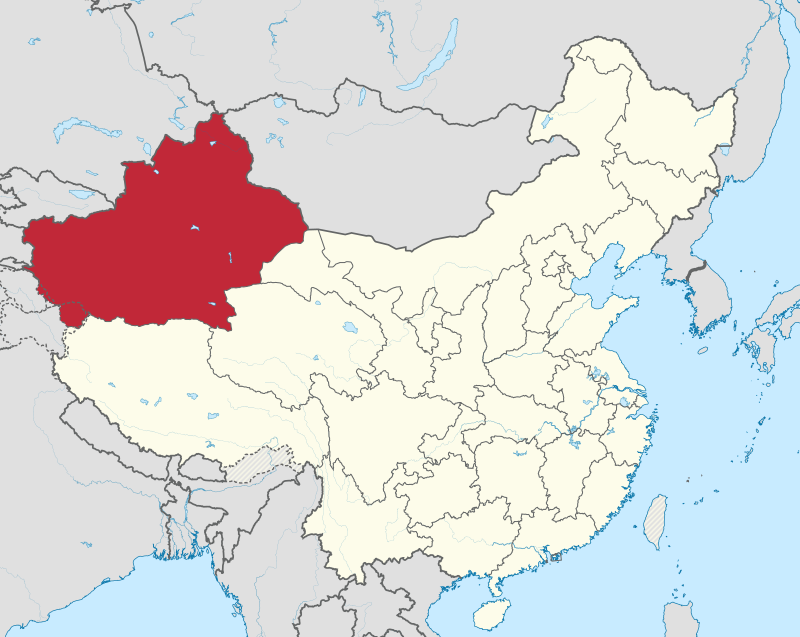
Map showing the location of the Xinjiang Uygur Autonomous Region.

Before the pandemic, I had a conversation with a friend in her 80s who was raised in the Sephardic Jewish tradition. Along with others in her age group she has gone online to try to preserve the Spanish-based language Ladino, which goes way back to 15th century, when there was a large Jewish community living in Spain.

This blog has often covered the topic of endangered languages and efforts to protect them. Sometimes the danger to a language results from the dying out of aging speakers. Sometimes the danger comes from government policy, as was the case for many years with America’s indigenous tribes.

Filip Noubel writes at Global Voices about the language of a Muslim community in China whose proponents are working to adapt it to online use.

“Languages need to adapt to the modern world to catch-up with new technology and concepts if they want to remain competitive, particularly among younger speakers. This is particularly true for Uyghur, a Turkic language spoken in Western China that is under threat due to targeted discrimination conducted by Chinese authorities in the hope that Chinese may appear more attractive and technology-friendly among Uyghur youth.

“Uyghur linguists have long been aware of the fact that Uyghur, a Turkic language with an estimated 10 million speakers, written in the Arabic alphabet in China, and with a rich tradition of intricate poetry, philosophy and songs written in that language, needs to include elements of modern life to serve the needs of the younger generation, as well as of social media where more and more conversations are taking place.

“To have a rare insight into those efforts, Global Voices spoke to Elise Anderson, an expert on Uyghur language and music who spent years in Xinjiang, and now works as a Senior Program Officer with the Uyghur Human Rights Project. Anderson, who spent most of her time in Xinjiang from 2012 to 2016, was invited in January 2014 by an Uyghur linguist friend to join their WeChat group called ‘Tilchilar’ (Linguists) as she was herself studying the language in-depth as part of her doctoral research on Uyghur music and songs. Here is how she describes the group hosted on China’s most popular social media platform, WeChat:

” ‘The group had around 100 members at any given moment, most of whom were highly educated native speakers, including academics, translators, bureaucrats, and even a few officials from regional-level institutions. We discussed persistent “problems” in the language, including spelling, grammar, translation. Most often, our conversations centered on terminology and whether we could replace Chinese loanwords to preserve the “purity” (sapliq) of Uyghur. A group member might say, “I noticed teenagers are using [Mandarin word]. What could we say instead?” We would then cycle through possibilities: Was there a word to “resurrect” from pre-modern Uyghur? No? What about “borrowing” from other Turkic languages? No? What about ‘importing’ from a more distant language? And so on. In a few cases, we settled on terms, which more influential group members then attempted to lexicalize. But discussions of single words could last days and often went unresolved.’

“As Anderson explains, the group was also trading examples of bad translations, some of which were comical, but also raised an uncomfortable questions such as why would there be unedited translations in Uyghur in a territory inhabited by millions of native speakers of the language.

“For languages that do not have a dominating position in a country, or have a small number of speakers, their digital footprint is often an indicator of their chances for long-term survival. For Uyghur language, WeChat offered a unique opportunity with its voice messaging feature. As Anderson explains, the platform became so popular it was given an Uyghur name, ‘Ündidar,’ a portmanteau word made of the Turkic word ‘ün’ which means voice, and the Persian term ‘didar’ which refers to encounter. The poetic term was coined by the poet and intellectual Abduqadir Jalaliddin, who disappeared from his Ürümqi home in 2018 and is currently incarcerated. …

“Today the Uyghur diaspora living outside a Beijing-censored internet is probably the most active user of Uyghur language over social media. Microsoft has offered full operating systems in Uyghur since 2016, and most smartphones allow Uyghur on their keyboard. In February 2020, Google also added Uyghur on its free translation platform, expanding the space for Uyghur online. …

“According to Anderson: ‘The Uyghur web, most of which was hosted inside the borders of China, used to be a vibrant space, where popular message boards gave users space to discuss everything under the sun (or at least everything under the sun that made it through the censors). … Since 2016, authorities in the Uyghur region have managed to scrub that web nearly completely, such that today there are very few Uyghur-language sites left. …

” ‘The way to keep anything alive, including a language, is to create space for it to live and provide material support so it can thrive. The Uyghur language will survive if it is put it on equal footing with other languages, if it “counts” in professional and formal settings, if it has support as a language of literary and scientific production.’ “

More at Global Voices, here.

Photo: Thomas Peter/Reuters.
Workers walk along the fence of a fortification thought to be a Muslim detention center in Xinjiang, China, on September 4, 2018. Read more at the Council on Foreign Relations.

Read Full Post »

Photo: Youtube.
The way hamsters store food is the inspiration behind a word in German that emerged amid wartime hoarding. It has found new life during the pandemic.

Back in the early 1980s, when I was trying to learn Esperanto, I loved how you could make very specific words by gluing other words together. For example, we had a word in our house for me when I was the one to taste the filtered coffee to see if it was ready: kafgustumistino. If it had been my husband, we would have said kafgustumisto.

Rebecca Schuman at Slate explains why agglutinative languages are perfect for creating pandemic-appropriate vocabulary to suit one’s every need.

“During the otherwise Nietzschean abyss of the early pandemic, ” she writes, “one of the few bright lights was a German word: Hamsterkauf, which first emerged during World War II and began circulating in German media last March. Literally ‘hamster buy,’ this coinage described the act of succumbing to our basest animal-brain instincts to hoard more necessities than we would ever actually need. …

“Ah, those delightful Germans! Always with the single word that describes a very specific thing that any normal language would never have a single word to describe! … Over the past year, German has coined some 1,000-plus new terms endemic to the Now Times — ironic capitalization, by the way, being an annoying method that English speakers use to create new language.

“Speaking of which: Unlike English, whose own recent neologisms often read as nonwords that are only cute the first time you encounter them [such as] coronasomnia, situationship … German’s COVID lexicon just looks German. …

“Now, to really make a decent German compound noun, you have to either memorize a very long if-then chart, be a native speaker, or have what’s called a Sprachgefühl — literally ‘language feel,’ or an instinct for what sounds right. But for a semi-workable shortcut, it comes down to this: You start with two nouns, or an adjective and then a noun. … Now here comes the tricky part: Often you have to put in connecting letters, and which letter you use depends on the smaller words’ last letters; this will ostensibly make your big new word easier to pronounce. …

“There’s already a magniloquent viral Twitter thread in appreciation of new superstars such as Impfneid (vaccine envy) — but what about the particular cacophony of imperious voices bickering over how (or when, or if) to relax social distancing and lockdown measures? That’s an Öffnungsdiskusionorgie (OOF-nungs-dee-skoo-ZEEONS-or-ghee), literally an ‘orgy of discussions regarding opening,’ which is coincidentally also the only orgy it’s currently safe to attend.

“Then of course there’s the ol’ socially distanced drink, or Abstandsbier (AHB-stonds-BEE-uh, or ‘distance beer’), which carries with it the many connotations of the word Abstand, including ‘gap,’ ‘interval,’ ’empty space,’ and ‘difference,’ truly encapsulating just why chugging a Godforsaken Beck’s on a frigid sidewalk whilst avoiding small talk might be an unsatisfying Quarentänebruch (KVAH-ren-TAYN-uh-BRUK), or quarantine violation. …

“Here’s a new one: Risikoeinreisender (REE-SEE-koh-AYN-RYE-sun-duh), literally ‘risk-arriver,’ aka one who tromps undeterred into another country straight from an outbreak-rich region without regard to whether he might infect the entire staff of his $309 cabana at the Cancún Ritz-Carlton. (Hopefully the check-in counter at said Ritz-Carlton was already equipped with my personal favorite of this entire Teutonic enterprise: a clear fiberglass Spuckshutztrennscheibe (SHPOOK-shoots-TREN-shy-buh) — literally ‘spittle-protection separation pane.’)

“While it’s always fun to see exactly which surprisingly singular phenomena have heretofore claimed their own German word, I think that the nomenclatures of the Coronazeit (ko-RO-nah-TSITE) are particularly resonant for non-German-speakers because this really is a singular moment in time. …

“Even I, a blasé Germanist, could ruminate all night on such lexicographic majesty as Geisterspieltag (GUY-stuh-SHPEEL-tak), literally ‘ghost game day,’ or the practice of playing Fußball in an empty stadium. But alas, I don’t have time for all 1,000-plus words, given that my daughter has been in Zoom school for a year and possibly just set something on fire. But here’s one new German word that even I don’t really understand: Coronakindergeld (koh-RO-na-KIN-duh-gelt), the ongoing financial support for parents stuck at home with their kids.” Wow, is Germany really paying parents?

More at Slate, here.

Read Full Post »

Saving a language, according to a recent article in Smithsonian magazine, involves more than learning to speak it. A language is an expression of a culture, a way of life, and speakers must appreciate all of that if the language is to survive.

Alia Wong writes about a married couple who have been putting in the work to see that both the Hawaiian language and the Hawaiian culture get passed down to new generations.

“Pelehonuamea Suganuma and Kekoa Harman were bright-eyed high schoolers in Honolulu when they first crossed paths, in the 1990s. The two were paired for a performance — a ho‘ike, as such shows are known in Hawaiian. Both teenagers had a passion for hula and mele (Hawaiian songs and chants), and they liked performing at the school they’d chosen to attend — Kamehameha High School, part of a 133-year-old private network that gave admissions preference to students of Hawaiian Polynesian ancestry. Still, one part of Hawaiian culture remained frustratingly out of reach for Pele and Kekoa: the language.

“Over many generations, the native tongue of the islands had been systematically eliminated from everyday life, and even the Kamehameha Schools weren’t able to bring it back. Part of it was a lack of interest — students seemed to prefer learning Japanese, Spanish or French. But more important, Hawaii’s educators generally hadn’t yet figured out how to teach Hawaiian vocabulary and grammar, or give eager youngsters like Pele and Kekoa opportunities to immerse themselves in Hawaiian speech.

“A few years later, Pele and Kekoa found themselves together again. Both of them enrolled in a brand-new Hawaiian language program at the University of Hawaii at Hilo. The two former schoolmates became part of a pioneering cohort that was innovating ways to bring Hawaiian back to life. They helped develop some of the first truly successful Hawaiian language programs throughout the state’s islands. Along the way, they started dating, got married and had four children, and raised them to speak fluent Hawaiian.

“Today, Pele teaches at a Hawaiian-language K-12 school and Kekoa teaches Hawaiian language and culture at the college they both attended. At home, their family speaks almost exclusively Hawaiian. The Harmans are proud of the revival they helped carry out in just one generation. But Unesco still lists the language as critically endangered, and there’s a long way to go before it’s spoken again as a part of everyday life. ‘There’s a false sense of security sometimes,’ says Pele, ‘that our language is coming back.’ …

“For centuries, Hawaiian had been an oral tongue — one steeped in mo‘olelo (story, legend, history). But after missionaries helped create a written version of the language, the local people took to it. They established more than 100 Hawaiian-language newspapers, according to some records. By 1834, more than 90 percent of Hawaiians were literate — up from virtually zero just 14 years earlier.

“Yet these strides in Hawaiian literacy were soon overtaken by efforts to erase Hawaiian culture altogether. American tycoons had also come to the islands, planting lucrative crops like sugar cane and coffee. …

“Outsiders helped to phase out the Hawaiian system of governance. They replaced traditional foods like taro with rice and imported wheat. They started issuing fines for performing hula, the ancient Hawaiian form of dance and expression. And as the 19th century was winding down, the Americans overthrew Queen Lili‘uokalani, Hawaii’s last monarch. They annexed the archipelago as a territory in 1898. By the time Hawaii became a state, in 1959, fewer than 2,000 people could speak Hawaiian fluently. …

“But there were still people left who remembered. Both Pele and Kekoa were close to their great-grandmothers — women born in the early 1900s, who spoke some Hawaiian, even though they were raised to think of their mother tongue as inferior to English. The great-grandmothers were the last members of each family to retain any fluency. …

“When Kekoa was a kid, his grandmother, who passed away a few years ago, used to take him to Hawaiian musical and hula performances. She’d make leis for tourist-targeted luaus, and he’d help her gather and string the flower garlands. ‘I loved going to those events,’ Kekoa says. …

“1997 was the year the Hawaiian legislature mandated a new program at the Hilo campus. It was called Ka Haka ‘Ula O Ke‘elikōlani, named after [a] woman from an ancient Hawaiian dynasty who was the governor of Hawaii during the mid-1800s. She was a defender of Hawaiian culture — although she came from a wealthy family and understood English, she lived in a traditional grass-roofed house and spoke only Hawaiian. The new program at Hilo had the motto O ka ‘ōlelo ke ka‘ā o ka Mauli: ‘Language is the fiber that binds us to our cultural identity.’

“Enrolling in this new program, Pele and Kekoa spoke Hawaiian as much as they could outside of class to become fluent. They ‘talked story’ with their professors in the hallways. Their teachers hosted little get-togethers every week. … At these gatherings, the students fumbled with the language over card games, with music in the background and snacks on the table. ‘That’s how we got comfortable,’ Pele says. …

“As the Harmans see it, Hawaiian will survive only if people value the culture around it. After all, Hawaiian doesn’t have the same marketing value as a massive international language like Spanish or Mandarin. Hawaiian is a language that describes local geographical features and captures an ancient worldview. … ‘Now we have a generation of Hawaiian speakers, but if we don’t also teach them [old Hawaiian] behaviors and beliefs, that fluency will only go so far,’ Kekoa says. ‘Hawaiian isn’t just a language but a way of life.’ ” More at Smithsonian, here.

And in a related article from today’s Associated Press, note that the Standing Rock Sioux tribe has prioritized Covid-19 vaccine for elderly speakers of Dakota and Lokata languages, here.

Read Full Post »

Older Posts »