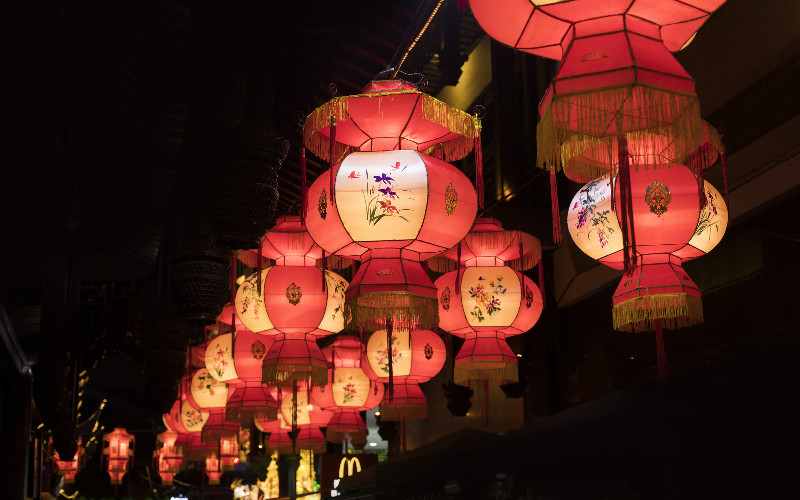
“In ancient China, lanterns were used to provide light and as aspects of worship. Today, they are used only for decoration,” says China Highlights.
There is something about candles and lanterns that seem to take one back in time. If I light candles in a hurricane when the electricity goes out, I don’t think of lighting candles last week for a dinner or a birthday party, I think of being a little girl in a long ago hurricane. Lanterns also take me back in time — to my college’s traditions and our night-time processions with the lanterns of our particular year and the songs we’d learned to sing in ancient Greek.
Rebecca Kathor at Public Radio International’s The World reports on how China passes the ancient tradition of lantern making to new generations.
“Sixty-five-year-old Li Jianguo grew up in Shanghai during the Cultural Revolution,” she writes. “He remembers not always having enough to eat when he was young and having to drop out of school. Yet, his happiest memories as a child were during the Lunar New Year.
“ ‘That was when we had new clothes to wear and good food to eat,’ he said. ‘After dinner, [we] kids would run outside and play with our lanterns in the alleyways.’
“In China, the tradition of children playing with handmade paper lanterns during the Lunar New Year has been passed down for generations. During Lantern Festival, the last day of Lunar New Year celebrations, families gather for a meal of dumplings and light lanterns together. …
“Today, most lanterns are manufactured, but when Li was a boy, everyone had simple bamboo and paper ones. His was made by his father who learned from his own father. It was lit by a candle and had four wooden wheels and a string to pull it along.
“ ‘At the time, the streets in Shanghai weren’t well-paved and our rabbit lanterns would bump along behind us as we ran,’ he said. ‘If the rabbit fell over, the candle inside would burn up the lantern. The other kids would laugh at you, but it was also considered good luck — like you burned up all your bad luck and could start fresh in the new year.’
“These days, Li doesn’t play with lanterns anymore. He makes them. Li is one of the last remaining lantern craftspeople in Shanghai. His cramped apartment is covered floor to ceiling with paper lanterns shaped like rabbits, dragons and lotus flowers. He and his wife spend the entire year making 600 lanterns to sell during the 15 days of the Lunar New Year. Sometimes, he’s so busy, he said, that he doesn’t have time to sit down for a meal.
“ ‘This isn’t the busiest time of the year for me. Every day, I’m busy,’ Li said. ‘If I don’t keep up the pace during the year, when it comes time to sell my lanterns, people will be disappointed if I run out too fast.’ …
“Li demonstrated how to make a rabbit lantern. It takes 60 intricate steps to build the bamboo frame and decorate each one — a nearly six-hour process that he learned from watching his father. Each sells for $15. …
“Craftspeople like Li are disappearing, though, in a rapidly modernizing Shanghai.
“Zhou Qi is the author of a book featuring 60 of Shanghai’s remaining craftspeople. Over the course of eight years, she searched out artisans who make everything from handspun cloth to woven bamboo shopping baskets to hand-stitched cotton shoes.
“ ‘They all make everyday things I used as a child growing up here in the ’80s,’ she said. ‘But they are more than just things we use, they are also a part of our culture.’
“Many of the craftspeople in her book are elderly. And they haven’t passed down their skills because there are few people who want to learn these crafts. Zhou said that she found only four lantern makers in Shanghai. …
“The craftsmen are tough to find — most of them don’t have a storefront and aren’t on social media.
“One place you can find lanterns is at Yu Gardens, in Shanghai’s Old City. Every year at this time, crowds flock here to take photos of the massive lantern displays near the City God Temple.
“Rabbit lantern maker Li is here too, but … many people are buying their children cheaper, mass-produced plastic and paper versions instead. And these days, they are lit up by battery-powered light bulbs.
“Li said that he doesn’t make lanterns for the money. He and his wife live off their retirement pension.
“ ‘I want my children and grandchildren to have a memory of playing with rabbit lanterns just like I did,’ he said.”
More at the World, here. No firewall.


 Suzanne's Mom's Blog