Feeds:
Posts
Comments

Posts Tagged ‘Latin’

Photo:The Metropolitan Museum of Art.
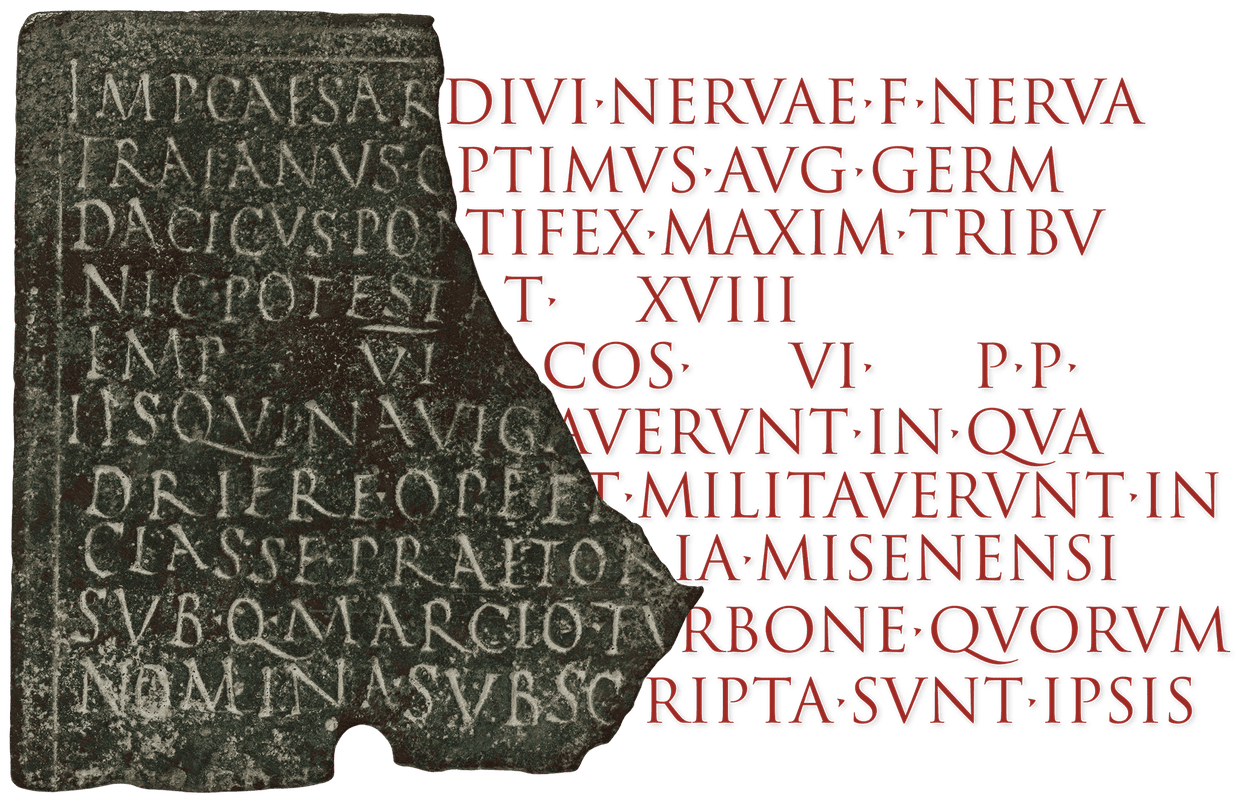
Google’s Aeneas AI program proposes words to fill the gaps in worn and damaged artifacts. 

Whenever I start to worry that Google has too much power, it does something useful. Today’s story is about its artificial intelligence program Aeneas, which can make a guess about half-obliterated letters in ancient inscriptions.

Ian Sample, science editor at the Guardian, writes, “In addition to sanitation, medicine, education, wine, public order, irrigation, roads, a freshwater system and public health, the Romans also produced a lot of inscriptions.

“Making sense of the ancient texts can be a slog for scholars, but a new artificial intelligence tool from Google DeepMind aims to ease the process. Named Aeneas after the mythical Trojan hero, the program predicts where and when inscriptions were made and makes suggestions where words are missing.

“Historians who put the program through its paces said it transformed their work by helping them identify similar inscriptions to those they were studying, a crucial step for setting the texts in context, and proposing words to fill the inevitable gaps in worn and damaged artifacts.

” ‘Aeneas helps historians interpret, attribute and restore fragmentary Latin texts,’ said Dr Thea Sommerschield, a historian at the University of Nottingham who developed Aeneas with the tech firm. …

“Inscriptions are among the most important records of life in the ancient world. The most elaborate can cover monument walls, but many more take the form of decrees from emperors, political graffiti, love poems, business records, epitaphs on tombs and writings on everyday life. Scholars estimate that about 1,500 new inscriptions are found every year. …

“But there is a problem. The texts are often broken into pieces or so ravaged by time that parts are illegible. And many inscribed objects have been scattered over the years, making their origins uncertain.

“The Google team led by Yannis Assael worked with historians to create an AI tool that would aid the research process. The program is trained on an enormous database of nearly 200,000 known inscriptions, amounting to 16m characters.

“Aeneas takes text, and in some cases images, from the inscription being studied and draws on its training to build a list of related inscriptions from 7th century BC to 8th century AD. Rather than merely searching for similar words, the AI identifies and links inscriptions through deeper historical connections. …

“The AI can assign study texts to one of 62 Roman provinces and estimate when it was written to within 13 years. It also provides potential words to fill in any gaps, though this has only been tested on known inscriptions where text is blocked out.

“In a test … Aeneas analyzed inscriptions on a votive altar from Mogontiacum, now Mainz in Germany, and revealed through subtle linguistic similarities how it had been influenced by an older votive altar in the region. ‘Those were jaw-dropping moments for us,’ said Sommerschield. Details are published in Nature. …

“In a collaboration, 23 historians used Aeneas to analyze Latin inscriptions. The context provided by the tool was helpful in 90% of cases. “’t promises to be transformative,’ said Mary Beard, a professor of classics at the University of Cambridge.

“Jonathan Prag, a co-author and professor of ancient history at the University of Oxford, said Aeneas could be run on the existing corpus of inscriptions to see if the interpretations could be improved. He added that Aeneas would enable a wider range of people to work on the texts.

“ ‘The only way you can do it without a tool like this is by building up an enormous personal knowledge or having access to an enormous library,’ he said. ‘But you do need to be able to use it critically.’ “

More at the Guardian, here. Please remember that this free news outlet needs donations.
Read Full Post »

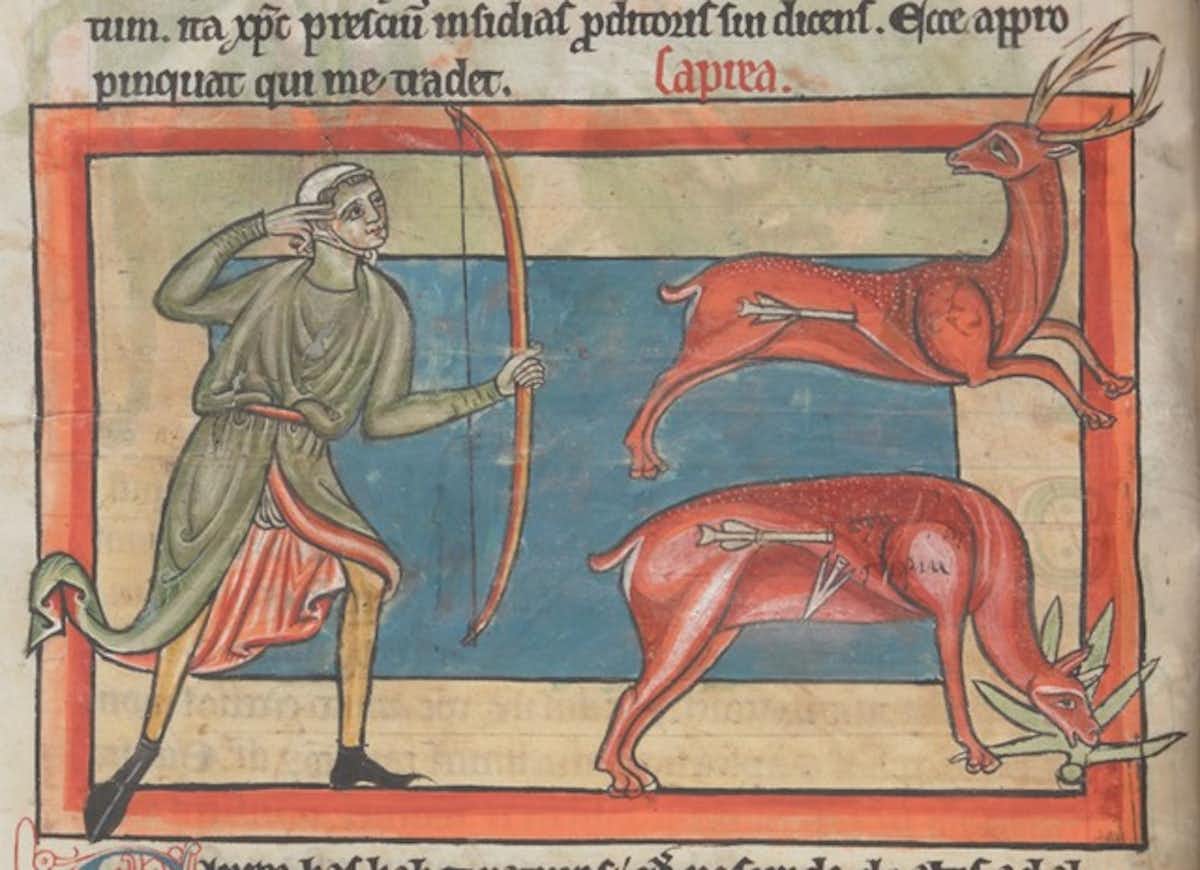
Photo:  British Library, Harley MS 4751 (Harley Bestiary).
As a hunter lands several arrows in his quarry, a wounded doe nibbles dittany to heal herself.

I think we don’t give enough credit to ancient wisdom. Researchers of former times may have been ignorant of cars and computers and smart phones, but why do we think they were unintelligent? (I’m a little cranky because I recently attended a talk on reflexology that barely mentioned traditional Chinese medicine.)

Today we learn that art works from centuries ago suggest humans were observing animals self-medicating long before contemporary scientists started publishing papers on the practice.

Adrienne Mayor, a classics, history and philosophy of science scholar at Stanford University, writes in the Conversation, When a wild orangutan in Sumatra recently suffered a facial wound, apparently after fighting with another male, he did something that caught the attention of the scientists observing him.

“The animal chewed the leaves of a liana vine – a plant not normally eaten by apes. Over several days, the orangutan carefully applied the juice to its wound, then covered it with a paste of chewed-up liana. The wound healed with only a faint scar. The tropical plant he selected has antibacterial and antioxidant properties and is known to alleviate pain, fever, bleeding and inflammation. …

“In interviews and in their research paper, the scientists stated that this is ‘the first systematically documented case of active wound treatment by a wild animal’ with a biologically active plant. …

“To me, the behavior of the orangutan sounded familiar. As a historian of ancient science who investigates what Greeks and Romans knew about plants and animals, I was reminded of similar cases reported by Aristotle, Pliny the Elder, Aelian and other naturalists from antiquity. A remarkable body of accounts from ancient to medieval times describes self-medication by many different animals. The animals used plants to treat illness, repel parasites, neutralize poisons and heal wounds.

“The term zoopharmacognosy – ‘animal medicine knowledge’ – was invented in 1987. But as the Roman natural historian Pliny pointed out 2,000 years ago, many animals have made medical discoveries useful for humans.

Indeed, a large number of medicinal plants used in modern drugs were first discovered by Indigenous peoples and past cultures who observed animals employing plants and emulated them.

“Some of the earliest written examples of animal self-medication appear in Aristotle’s ‘History of Animals‘ from the fourth century BCE, such as the well-known habit of dogs to eat grass when ill, probably for purging and deworming.

“Aristotle also noted that after hibernation, bears seek wild garlic as their first food. It is rich in vitamin C, iron and magnesium, healthful nutrients after a long winter’s nap. The Latin name reflects this folk belief: Allium ursinum translates to ‘bear lily,’ and the common name in many other languages refers to bears.

“Pliny explained how the use of dittany, also known as wild oregano, to treat arrow wounds arose from watching wounded stags grazing on the herb. Aristotle and Dioscorides credited wild goats with the discovery. Vergil, Cicero, Plutarch, Solinus, Celsus and Galen claimed that dittany has the ability to expel an arrowhead and close the wound. Among dittany’s many known phytochemical properties are antiseptic, anti-inflammatory and coagulating effects.

“According to Pliny, deer also knew an antidote for toxic plants: wild artichokes. The leaves relieve nausea and stomach cramps and protect the liver. To cure themselves of spider bites, Pliny wrote, deer ate crabs washed up on the beach, and sick goats did the same. Notably, crab shells contain chitosan, which boosts the immune system.

“When elephants accidentally swallowed chameleons hidden on green foliage, they ate olive leaves, a natural antibiotic to combat salmonella harbored by lizards. Pliny said ravens eat chameleons, but then ingest bay leaves to counter the lizards’ toxicity. Antibacterial bay leaves relieve diarrhea and gastrointestinal distress. Pliny noted that blackbirds, partridges, jays and pigeons also eat bay leaves for digestive problems.

“Weasels were said to roll in the evergreen plant rue to counter wounds and snakebites. Fresh rue is toxic. Its medical value is unclear, but the dried plant is included in many traditional folk medicines. Swallows collect another toxic plant, celandine, to make a poultice for their chicks’ eyes. Snakes emerging from hibernation rub their eyes on fennel. Fennel bulbs contain compounds that promote tissue repair and immunity.

“According to the naturalist Aelian, who lived in the third century BCE, the Egyptians traced much of their medical knowledge to the wisdom of animals. Aelian described elephants treating spear wounds with olive flowers and oil. He also mentioned storks, partridges and turtledoves crushing oregano leaves and applying the paste to wounds.”

Need more proof that modern science sometimes just reinvents the wheel? Read the Conversation, here. No paywall. Fun artworks.

Read Full Post »

Do you remember the British comedy group “Beyond the Fringe”? We love the LP record in our house.

I was thinking about a Peter Cook “Beyond the Fringe” sketch today because I have been reading tweets in Latin and my husband and I always joke about the English miner in Cook’s “Sitting on the Bench” routine who was wistful about not becoming a judge.

“I could have been a judge, but I never had the Latin, never had the Latin for the judgin’.”

The Latin tweets I’ve been following are from Pope Francis, who is said to have gathered a large following who just like Latin. I am not a Catholic, but a lot of what the new Pope has said impresses me, especially his cautions against materialism and his concern for those who suffer. I also like exercising the rusty hinges in my brain where fuzzy memories of Latin are stored. And if I don’t quite get the whole tweet, Google Translate is available — and turns out to be much better at Latin than, say, Swedish or Arabic.

I retweeted this missive:

Papa Franciscus ‏@Pontifex_ln 22 Jun
Si sensum vitae in Iesu invenimus, eos negligere non possumus qui patiuntur quique sunt tristes.

Google Translate: If we find the meaning of life in Jesus, we can not ignore those who suffer and those who are sad.

Photo: AFP/Getty Images

Read Full Post »

When you consider all the minority languages that are endangered today — many of which I’ve blogged about (for example, here) — it seems a bit perverse to be bringing back Latin on the radio. But as one more way to interest people in languages, how bad can it be?

For the Finns, who have to speak many languages because hardly anyone speaks theirs, it’s just one more.

As John Tagliabue wrote in yesterday’s New York Times, the Internet has given a boost to “a weekly summary of world events and news broadcast by Finnish state radio — not in Finnish, but in classical Latin. …

“In recent weeks, the subjects have included the financial crisis in Cyprus, an unusually brilliant aurora borealis and the election of Pope Francis. …

“It may be no coincidence that the broadcast began in 1989, the year Communism collapsed in Eastern Europe and the Finns turned toward Western Europe. For educated Finns, Latin had long been the country’s link to Western culture, and they were required to study the language in school. …

“While the broadcasts once went out over the airwaves, with shortwave reception for listeners outside Finland, more and more listeners tune in to the program’s Web site, through podcasts and MP3 downloads.” More.

Image: Wikipedia
Cicero Denounces Catiline, fresco by Cesare Maccari, 1882–1888. It’s what Suzanne’s Mom thinks of when she thinks “Latin.”

Read Full Post »