Feeds:
Posts
Comments

Posts Tagged ‘letters’

Photo: Amir Hamja for The New York Times.
Bracelets sent to Gabrielle Nevaeh, the former star of Nickelodeon’s That Girl Lay Lay, who is in Stranger Things: The First Shadow on Broadway. “It’s a reminder that my work is reaching people,” she says.

Did you ever ask for an autograph? Mail a fan letter? Throw “jelly babies” at the Beatles?

I have sometimes written a letter to an actor or author, but mostly to argue about some interpretation. I am not sure anyone would consider me a true fan, but there are people out there who go to enormous lengths to connect to the object of their admiration.

At the New York Times, Sarah Bahr shares what she has learned about them.

“The fan mail landscape in New York theater is alive and well. Across the theater district, stage managers and theater employees collect fan art, stuffed animals and other gifts of appreciation that are sent to stars, ferrying the items to mailboxes and dressing rooms.

“ ‘It’s so cool that people still send me things after all these years,’ said Joey Fatone, the former ’N Sync singer who recently ended his run in the Broadway musical & Juliet.

“He estimated that each week he received about a dozen handwritten letters and several packages, including one containing a track suit emblazoned with “& Joeyet,” a play on his name and the jukebox musical’s. ‘I read as much as I can, but there’s so much,’ said Fatone, 48. …

Somewhat unexpectedly, these decidedly analog gestures have endured in the age of social media.

“Fans are combing stars’ Instagram feeds and TikTok reels for clues to their favorite snacks, their astrological signs and even the names of their pets.

“ ‘It’s surprising how well they know your interests,’ said Elizabeth Gillies, 32, the Victorious star who recently finished a five-month run as Audrey in the Off Broadway revival of Little Shop of Horrors.

“During the run, a fan sent her a large pillow with a photo of her French bulldog, Otis, and another got her a set of miniature cans of Canada Dry Ginger Ale, a favorite drink. She also received a custom hat with the plumbob mood icon that floats above characters heads in The Sims, which is her favorite video game. One even drew a picture of Otis dressed as Audrey, and her co-star Milo Manheim’s spaniel, Louie, dressed as Seymour.

“ ‘The creativity and the attention to detail are extraordinarily impressive,’ said Gillies, who framed the portrait. ‘It’s incredibly heartwarming to know that people are not only paying attention to your artistry, but they’re also paying attention to you.’

“Gabrielle Nevaeh, the former star of Nickelodeon’s That Girl Lay Lay who is in Stranger Things: The First Shadow on Broadway, likes to read letters in her dressing room during intermission.

“ ‘It’s a reminder that my work is reaching people,’ said Nevaeh, 20, who plays the strong-willed high school student Patty Newby in the show.

“So what do people write to stars? Often, Fatone said, people express gratitude — for his music, for the joy his performance brought them, for his decades-long career.

“ ‘I get letters that say, “Thank you so much for being in my life all these years,” ‘ he said.

“Michelle Williams, the former Destiny’s Child singer who is playing the mysterious Viola Van Horn in the stage adaptation of Death Becomes Her on Broadway, said it makes her day when she reads a letter from a writer who is struggling and has found inspiration in her work.

“ ‘Someone sent me a letter last week saying, “I deal with depression and anxiety, and I see how you’ve overcome and you’re back on Broadway,” ‘ said Williams, 46, who took a break from the Broadway musical Once on This Island in 2018 to seek treatment for depression. …

“Some of the letters are typed; some are handwritten. Fatone said he also receives invitations to weddings and bar mitzvahs — or sometimes requests for him to sign the invitations themselves. …

“As much as the stars said they have appreciated the mail, it just isn’t possible keep all of it.

“ ‘I can’t throw away anything handmade or handwritten,’ Gillies said on a recent afternoon, shortly before clearing out her dressing room — including two large storage bins of fan mail — at the Westside Theater following her Little Shop run. ‘So I’m sort of an organized hoarder for all of the fan letters and fan gifts that I’ve received.’ ” More at the Times, here.

I once wrote René Auberjonois to see if my family could visit backstage at Big River. He wrote back a welcoming postcard, and we got to chat a bit after the show.

Read Full Post »

Photo: Library of Congress.

I have often thought about what we’ve lost in the digital age, when we can no longer scrutinize the thought process of a novelist from seeing her many revisions. Nor can we learn much about the significant people in her life, given that so many of her emails and texts will have been erased.

What will biographers do? How will today’s archivists deal with the challenge?

Michael Waters writes at the Atlantic (via MSN), “It was long the case that archives were full of physical ephemera. Think of Oscar Wilde’s love letters to Lord Alfred Douglas; … Sylvia Plath’s shopping list; Malcolm X’s lost poem; and other scraps of paper buried in boxes. Today, text messages and disappearing voice notes have replaced letters between close friends, Instagram Stories vanish by default, and encrypted platforms such as Signal, where social movements flourish, let users automatically erase messages. Many people write to-do lists in notes apps and then delete them, line by line, when each task is complete.

“The problem for [historians]: On the one hand, celebrities, artists, executives, and social-movement leaders are generating more personal records than ever, meaning a lucky researcher might have access to a public figure’s entire hard drive but struggle to interpret its contents. On the other hand, historians might lose access to the kind of intimate material that reveals the most. …

“The work of history starts with a negotiation. A public figure or their descendant — or, say, an activist group or a college club — works with an institution, such as a university library, to decide which of the figure’s papers, correspondence, photos, and other materials to donate. Archivists then organize these records for researchers, who, over subsequent years, physically flip through them. These tidbits are deeply valuable. They reveal crucial details about our most famous figures and important historical events. …

“Over the past two decades, the volume of these donations has increased dramatically. When Donald Mennerich, a digital archivist at NYU, first started working in the field, 15 years ago, writers or activists or public figures would hand over boxes of letters, notes, photos, meeting minutes, and maybe a floppy disk or a ‘small computer that had a gigabyte hard drive,’ he told me. Now, Mennerich said, ‘everyone has a terabyte of data on their laptop and a 4-terabyte hard drive’ … plus an email inbox with 10,000 messages or more. …

“Now many libraries possess emails that they don’t have the bandwidth to make accessible to researchers. … Even when an email archive is made public … it’s easy to get lost in the chaos. Jacquelyn Ardam, a writer and a literary scholar, was one of the first people to visit Susan Sontag’s archive, which she told me was filled with digital clutter: Sephora marketing emails, files with unlabeled collections of words (rubberyineluctable), and lots and lots of lists — of movies she’d liked, drinks she’d enjoyed. …

“Among that mess of information, however, Ardam found emails confirming Sontag’s relationship with the photographer Annie Leibovitz, which Sontag had denied. All Ardam had to do to locate them was ‘search her computer for the word Annie,’ she said. …

“In the past, even a writer of Sontag’s stature would typically have a small-enough correspondence collection that they could plausibly review the letters they were planning to donate to an archive—and perhaps wouldn’t have included missives from a secret lover. But the scope of our digital lives can make it much harder to account for everything (imagine giving up your whole social-media history to a researcher) and much easier for a historian to locate the tantalizing parts with a single search.

“Of course, that’s if historians are lucky enough to access records at all. Many people delete their old texts to save storage space. … Mennerich said he’s been locked out of the email accounts of several deceased public figures because they never shared their passwords. …

“Archivists might be able to sidestep some of these problems by rethinking how they present collections of digital records. Today, after archivists do their initial review of a collection, visitors can typically get a complete box of someone’s letters with no questions asked. With emails, conducting that whole initial review up front would be so much more time intensive that blanket access might no longer be realistic. …

“The archivists I spoke with told me they’re all bracing themselves for the moment when, inevitably, a public figure donates their smartphone. It is in some ways the most personal kind of donation someone can make, offering access to text and WhatsApp histories, photos, Tinder messages, saved recipes, TikTok likes. Such a donation seems both likely to reveal more than a person’s emails ever could and even harder to sort through and interpret.”

More at the Atlantic, here.

Read Full Post »

Did you ever have a correspondence with an author or other celebrity? I know that as a child, author Francesca Forrest got to know the fantasy writer Lloyd Alexander and his family really well. And it all started with fan letters.

In today’s story from the Comics Journal, we learn about a family’s relationship with Edward Gorey.

Cynthis Rose wrties, “Edward Gorey’s friends apparently called him ‘Ted.’ But, in our family, he was always ‘Mr. Gorey.’ My father chanced on his works during a business trip, back when they were small, slight booklets that seemed handmade. With them came an entire world, curious and enticing, fashioned out of the finest and most meticulous pen strokes. It was focused on luckless protagonists with preposterous names, languorous figures who proved surprisingly gritty. Their startling encounters and unforeseen fates soon established a hold on my preteen mind.

“Looking back, this is not surprising. I was a kid who worked in theatre, spending half of every day in a theatre school. Since the age of eleven, I had been portraying other children onstage. This surrounded me with ideas of glamour that, if not quite real, were certainly persuasive. Filled as it was with fantasy, costume and wit, Mr. Gorey’s esoteric universe did not seem strange.

“All the more since my theatrical world was not the same one as the sunny productions of local schools. Instead of joining my classmates in Oklahoma!, I was emoting in Lady Audley’s Secret or The Diary of Anne Frank. I wasn’t reading A Wrinkle in Time and Judy Blume, but grappling with Ionesco, Chekhov and Oscar Wilde. 

“Mr. Gorey’s books made him seem a fellow traveler. I saw his kohl-eyed vamps as shady White Russians and his muscular villains as figures out of Bram Stoker. Even his trailing aspidistras felt familiar – just like the herringbone suits in his characters’ closets, they were the hallmarks of a period stage set. Maybe that’s why it seemed logical to write him, once my father looked him up in a Manhattan phone book. 

“Was I surprised when Mr. Gorey wrote me back? I don’t recollect, but most probably not. Ours was a family who liked filling envelopes. We all wrote postcards, birthday letters, condolence notes, thank-yous and regular, chatty epistles. Almost everyone I knew had a pen pal. Once, when my dad opened a box of chocolates and found one missing, he grabbed his Underwood and wrote the head of the candy company. His typed rebuke (why was the workforce kept so hungry they were forced to pilfer bonbons?) was rewarded by a new and bigger box of chocolates.  

“Mr. Gorey made himself a Proustian part of my postal history. He wrote on discreet, elegant, letter-size paper, almost always ivory or pale dove grey. The inks he favored were sepia and navy blue and the pen he used had a small, blunt nib. As everyone now knows, he also liked to decorate envelopes. However fanciful their design might be, those I received always included his famous black doll.

“What were his letters like? Like his stories and the little books he sent, they were florid and funny and full of deliberate effects. Mr. Gorey seemed to be insatiably curious, with catholic tastes that informed his literary style. He was a voracious reader and would cite both classic tomes and modern trash, differences in form or century notwithstanding. He once wrote that he had found ‘the definitive list of phobias.’ Another time, he sent me a recipe for grapefruit slices ‘bathed in’ Coca-Cola. 

But any letter from Mr. G was instructive, because he was never, ever lazy with language. Always reaching for the mot juste, he cherished terms like ‘habituated,’ ‘diverting’ and ‘gelatinous.’

“He made words perform and took the time to make every letter an event. His missives were as lively as those of Dickens and, like his little stories, owed much to Ronald Firbank

“Over time, we discussed a range of topics: the Moors murders, the benefits provided by a ha-ha, Gustave Doré’s views about the London slums, Lillian Gish in The Wind, Japanese ghost behavior in the Edo era, spirit photography, London’s cheap bookstores, Rudolf Nureyev’s feet, illicit dissections and why green wallpaper had killed Victorians. 

“My own life at this time had a Gorey-esque cast. At fifteen, for instance, my parents sent me off to London by myself. I had earned the money through my theatre school, which ‘loaned out’ their pupils to make commercials. I spent three happy weeks in an English hostel, quartered on the eighth floor of a nine-storey building. From here, I searched out genuine art by Aubrey Beardsley, talked my way into Scotland Yard’s ‘Black Museum‘ and explored a then-almost-derelict East End. I also managed to meet another pen pal – the retired costume historian James Laver. An ex-museum staffer and theatrical bon vivant, Mr. Laver was an expert on dandies and the Decadents. 

“When we met for tea in the Charing Cross Hotel, he invited me to dinner at his Greenwich home. This turned out to be a memorable evening, not least because of the Zulu dignitary who arrived with a leopard skin over his suit. To honour my interest in the Yellow Book era, dinner was also followed by a vintage absinthe. Served through the requisite slotted spoon and sugar cube, it was extraordinarily bitter – and extremely strong.

“Mr Gorey liked to hear about such episodes. I wrote him about the streetlamp that ran on sewer fumes, the private museum of Teddy bears and toy theatres – even the Lava soap (largely pumice) that produced my grandma’s youthful skin. I sent him the label of J. Collis Browne’s Mixture, a morphine-and-peppermint-oil cure still popular in London. I wrote him a great deal about cemeteries and tombs, from English boneyards to the graves of Clyde Barrow and Bonnie Parker. When it came to things that no-one else cared about, I could always depend on Mr. Gorey. I could tell him how Pearl Bixby Wait got the whole idea of Jell-O from Orator Francis Woodward. 

“To this day, many things Mr. Gorey told me – some true, many not – have remained stuck in my mind. (Notably, that someone called ‘Sebastian Chaveau’ invented the marshmallow.) I’ve never tried to verify one of these assertions and I’ve avoided reading about their author. But, from time to time, something makes me think of him. Like a phrase I read last month in Daniil Harms’ diary : ‘Poisoning children is cruel. But something has to be done about them!’ ” 

If you’re a Gorey fan, you’ll understand. More at the Comics Journal, here.

Read Full Post »

Photo: Letters Against Isolation
The Patel sisters from Boston founded Letters Against Isolation, an organization that has sent thousands of cards to seniors during the coronavirus pandemic.

I always liked writing letters as a kid. I think I was about 8 when I made a big push for my friends to send me letters or postcards when I was away over the summer. I liked receiving them and I liked writing back. I still have a great letter from Patsy about seeing a dead rabbit in the orchard. “It was squooshed!” she wrote. But Joan’s parents thought it would be too expensive for her to keep sending postcards. (At the time, postcards were 2 cents.)

Recently I got an unexpected treat — letters from both of John’s kids, ages 10 and 7. Then there’s my niece Barbara. She began writing letters when she was about 10 and holds the record as the most prolific letter-writing kid I have ever known. Today, having passed age 50, Barbara writes long, newsy emails.

Here’s a story about sisters who have managed to sustain a generous letter-writing campaign … with a little help from strangers.

Emily Giambalvo wrote at the Washington Post in June, “Shreya and Saffron Patel usually FaceTime their grandparents in England every weekend, but during the novel coronavirus pandemic, they have typically reached out each day. Their grandmother on their mom’s side hasn’t left her apartment in nearly four months. She lives alone and can no longer socialize at the gym. Some of her younger friends have stopped by, and she leans out her kitchen window to chat. One friend sends handwritten letters.

“When the Patel sisters, who live in Boston, spoke to their grandmother, they noticed her mood improve. She texted them about the cards and showed them to her teenage granddaughters during their video calls.

‘We wanted to share that joy she was feeling with other seniors,’ said Saffron, a 16-year-old who recently finished 10th grade.

“They started Letters Against Isolation in early April with a plan to send cards to seniors at care centers, where residents have lost in-person contact with their family and friends because of the coronavirus. Shreya, 18, who will begin her freshman year at Washington University in St. Louis this fall, reached out to a few local nursing homes, expecting maybe one to respond and ask for 10 cards. Instead, several agreed and hoped to receive a combined 200 cards.

“ ‘We can’t do that on our own,’ Shreya said. ‘We can’t do that on our kitchen table.’

“The sisters reached out to others asking for help.” More at the Post.

Lauren Daley continued the story in July at the Boston Globe: “The response was massive. Overwhelmed, they put out a call for volunteers on Reddit, Facebook, and All For Good. It grew like wildfire. …

“One nursing home staffer says ‘everywhere she looks, she can see the letters and cards stuck up on [residents’] walls,’ says Saffron.

“Post-pandemic, the Patels have no plans to stop. ‘This pandemic has made us aware that senior loneliness is a massive problem — it’s not going away, and it was here before the pandemic started,’ says Saffron.” More at the Globe.

Read Full Post »

2019-11-14-verona-balcony

Credit: Frank Bienewald/LightRocket via Getty Images
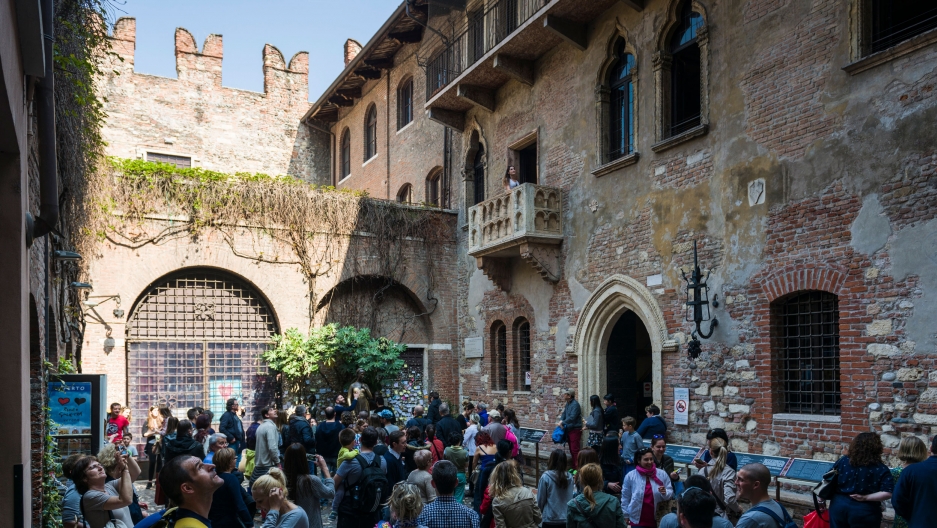
To see the famous balcony, tourists crowd the backyard of the building in Verona said to be Juliet’s house.

Having read recently that there are tens of thousands of people writing PostcardsToVoters these days, I was intrigued to learn about a letter-writing club with quite a different purpose. The letter writers in today’s post are making sure that anyone who writes to Shakespeare’s Juliet gets a personalized response.

Bianca Hillier reports at Public Radio International’s The World, “Verona, Italy, is filled with references to Romeo and Juliet, the city’s most famous literary residents. Tourists can pretend to be Juliet by standing on the balcony at what is said to be her 14th-century house.

“They can also write Juliet a letter. Each year, tens of thousands of people do, asking for advice on life and love.  They may be surprised to learn Juliet writes back.

“The personalized responses come from volunteers with the Juliet Club. Their work began decades ago as a group of friends answering letters to Juliet. … The letters have grown into a worldwide phenomenon.

“ ‘The letters started arriving in Verona maybe 100 years ago. So it’s a long tradition that belongs to the story of the city,’ said Giovanna Tamassia, manager of the Juliet Club. Giovanna’s father, Giulio Tamassia, founded the club in 1972.

“People can send letters by traditional mail, email, or by dropping a letter in Juliet’s mailbox at her house in Verona.

‘If you think, “Who writes to Juliet? Who takes the pen and writes to someone they don’t know?” It can sound crazy,’ Tamassia said. ‘But if you read the letters, you discover it’s not crazy. It has a meaning.’ …

“When the letters finally make it to the club’s modest office in Verona, they are sorted by language. Tamassia said some people write in looking for advice on love, while some simply want to express their emotions.

“ ‘We can see in these letters that [this opportunity] is a really unique thing. It’s not like writing to a doctor or a psychologist or someone you know,’ Tamassia said. ‘They don’t know who will read the letter [or] who will answer. It’s like writing to yourself, in a way. Writing is a therapy.’

“Juliet’s secretaries, as they’re called, respond to letters every day during the club’s limited hours of operation. A few remote secretaries in the United States, England, and Moscow reply to the email messages, but most letters are answered from Romeo and Juliet’s home city of Verona.

“An influx of Americans began volunteering as secretaries after a 2010 movie starring Amanda Seyfried called ‘Letters to Juliet’ popularized the club. …

“ ‘When people come to reply, it’s very heartfelt. They feel like [they are] in a mission of love. In the name of Juliet,’ Tamassia said. … ‘It’s like seeing in the hearts of many people. [We] try to give help or support or friendship. But we also receive a lot when we have the chance to read others’ lives, others’ experiences. It opens your mind to different kinds of love.’

“There are no standard replies to the letters Juliet receives, Tamassia said, and it takes secretaries 30 to 60 minutes to craft each thoughtful response.

“Only one aspect of the letters is standardized: they’re all signed, ‘All my love, Juliet.’ ” …

“As the Juliet Club nears its 50th anniversary, Tamassia said there is no plan to close the doors anytime soon.

“ ‘It’s a job I have because I love it,’ she said. ‘It started as a passion but maybe, now, I can’t stop because the letters continue and continue to arrive.’

“The doors also remain open, in part, due to donations. A local bank pays for the office space and the city of Verona pays for the stamps.

“ ‘The letters are really like a treasure. So many love stories in all languages from every corner of the world,’ Tamassia said. ‘There isn’t anything else that can be compared.’

“Instructions for writing a letter to Juliet can be found on the Juliet Club’s website.” More at PRI, here.

You know what really impressed me? That the people in the club take 30 to 60 minutes to craft a response. That’s longer than I would have thought. This is not like writing to Santa and getting no response.

Hat Tip: Twitter

Photo: David Simchi-Levi MIT

psp_4321

Read Full Post »


Art: JRR Tolkien
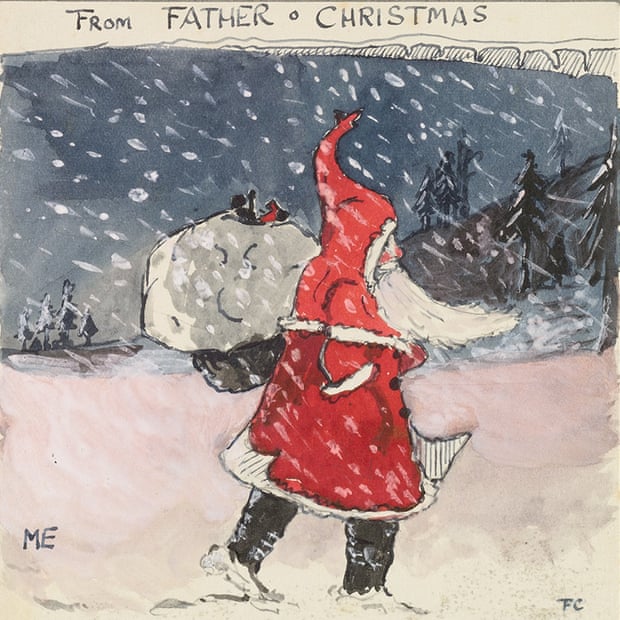
An Oxford exhibit will feature decades of illustrated letters from “Father Christmas” to the children of Middle Earth wizard JRR Tolkien.

This is more of a Christmas post, but as the exhibit won’t go up until next summer, you have time to plan a trip to Oxford, England, to see JRR Tolkien’s illustrated Father Christmas letters. They will be on display from June 1 to October 28, 2018. If you can’t go, there is a heavenly array at the Guardian.

Maev Kennedy writes at the Guardian, “In December 1920 Father Christmas wrote a letter to a modest house in the Oxford suburbs, enclosing a watercolour sketch of his own rather more exotic domed snow house, approached by a flight of steps lit by ice lanterns. ‘I heard you ask Daddy what I was like and where I lived,’ he wrote to three-year-old John Tolkien, and as the family grew to four children, he continued to write every Christmas for 23 years. …

“The illustrated letters continued to arrive every Christmas Eve, sometimes delivered by a postman who had been persuaded to include them with the more boring letters and cards, sometimes materialising on the hearth rug with a handmade stamp. Some years Father Christmas was evidently very busy, and could only pass on the briefest snippets of news, and other years, when he had time on his hands, he could include elaborate multi-layered paintings. One showed his reindeer and sleigh arriving over the Oxford skyline – ‘your house is just about where the three little black points stick up out of shadow on the right.’

“Many recount the adventures of his friend and helper the Polar Bear – in 1926 he accidentally switched on all the Northern Lights – or the goblins who attempted to steal the stored presents in 1932. In one letter Polar Bear ‘found a hole in the side of a hill & went inside because it was snowing.’ He slid down a rocky slope, more rock fell on him, and he could not climb back: ‘But almost at once he smelled goblin & became interested & started to explore. Not very wise for of course goblins can’t hurt HIM but their caves are very dangerous.’

“The snow, the entrance to treacherous caves and the smell of goblin will be instantly familiar to readers of the book Tolkien was working on at the time, The Hobbit, the first of the adventures of Middle-earth. …

“Catherine McIlwaine, Tolkien archivist at the Bodleian, [says,] “There couldn’t be a clearer demonstration of how important his family was to him. He was orphaned from the age of 12, when his mother died, and then he spent years boarded out in lodging houses in Birmingham.’ ”

More at the Guardian, here.

Read Full Post »