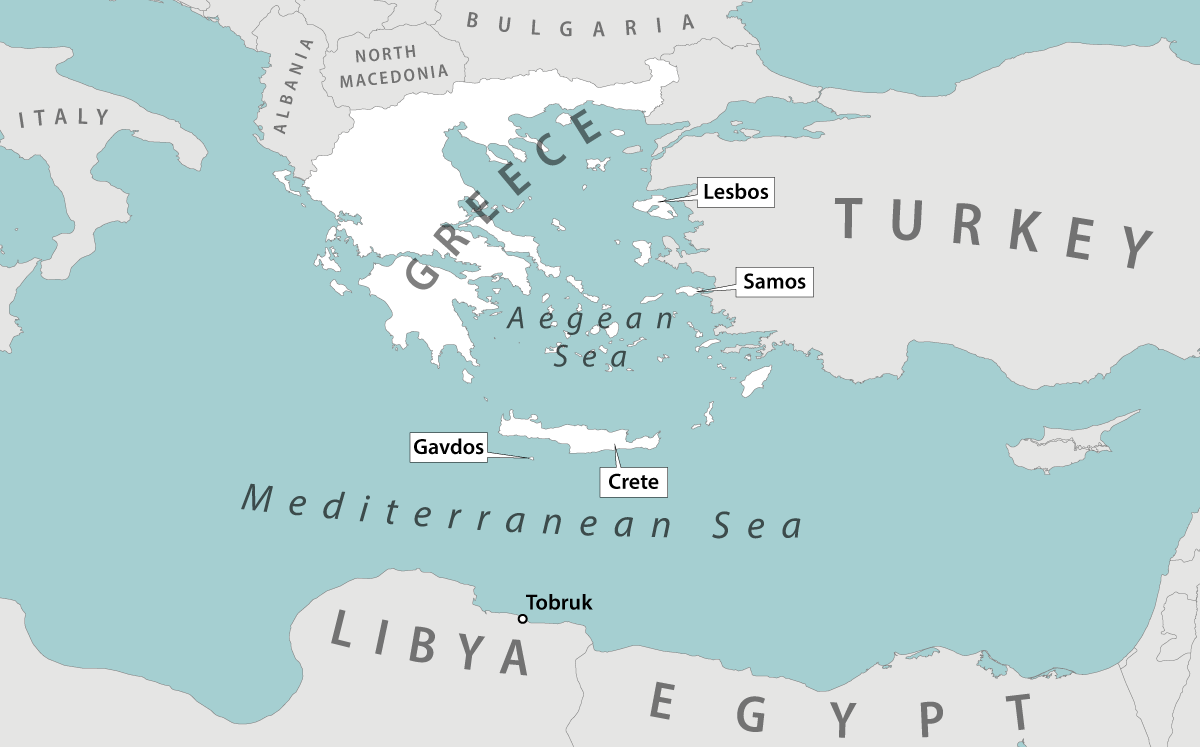
Map: Jacob Turcotte/CSM Staff.
Little islands with big responsibilities.
Because world leaders are not dealing effectively with the causes of mass migration, sometimes tiny communities and a handful of sympathetic residents are left holding the bag.
Christian Science Monitor contributor Nick Squires has a report from the little island of Gavdos in Greece.
“A tawny smudge on the blue horizon of the Mediterranean, it is the southernmost point of Europe, a sun-baked outpost of deserted beaches, gnarled juniper trees, and flocks of shaggy goats. The tiny Greek island of Gavdos, which lies to the south of Crete, [is thought to be] the place where Odysseus was shipwrecked and held captive by the nymph Calypso. …
“The island finds itself thrust to the forefront of Europe’s migration crisis, which erupted in 2015 when more than 1 million asylum-seekers reached the Continent.
Islanders may be sympathetic, but they want the migrant arrivals to stop as soon as possible, especially as the summer tourist season approaches.
“Since the beginning of the year, around 1,200 migrants have arrived on Gavdos by boat, with most of them setting out from Tobruk on the coast of Libya. In the same period last year, there were no arrivals at all. …
“The impact on such a small island is huge. The population of Gavdos is just 70 – on one occasion recently, islanders were outnumbered by the 91 migrants who arrived on a single boat from the Libyan coast.
“Most of the arrivals are economic migrants from Egypt. They are fleeing poverty and political tensions. There is a smattering of other nationalities, including Pakistanis, Bangladeshis, Syrians, and Sudanese.
“It is an influx that Gavdos is totally unprepared for. There are no facilities for the migrants – no reception center, no soup kitchen, no nongovernmental organizations. Unlike Greek islands in the Aegean such as Lesbos and Samos, which have been dealing with migrant arrivals from nearby Turkey for years, there are no personnel from charities such as the Red Cross or Doctors Without Borders.
“The task of dealing with the migrants is left to just three men – the deputy mayor, his twin brother, and the island’s sole police officer. …
“Says Lefteris Lougiakis, the deputy mayor, ‘We have the responsibility of providing them with shelter and food. During the winter, we cut wood to keep them warm. It’s a very difficult situation.’
“Islanders do what they can to care for the migrants and many feel empathy for them. ‘They travel for 20 hours in very small boats with no life jackets. It’s just by luck that we are not in their position. I feel sorry for them,’ says Stella Stefanaki, who runs a small bakery on the island. She provides sandwiches for the new arrivals, for which she is reimbursed by the council.
“Islanders may be sympathetic, but they want the migrant arrivals to stop as soon as possible, especially as the summer tourist season approaches. …
“The migrants have to cross 170 nautical miles of open sea to reach the island from North Africa. It is highly dangerous, but that has not stopped smugglers from promoting it as an effective way of getting into Europe by the back door. Each migrant pays up to $5,000 for the crossing. …
“The ‘capital’ of the island is the village of Kastri, a cluster of about a dozen houses on a ridge. The other main settlement, Sarakiniko, consists of a few cottages and tavernas hidden among sand dunes and facing a huge sweep of beach.
“There are just four children living on the island. Three of them belong to Efi Georgaka, who sells honey; keeps sheep, pigs, and goats; and, during the summer, works in the ferry ticket office in the island’s minuscule harbor.
“ ‘If things keep going like this then the island will change,’ she says, sitting on the harbor wall. ‘There will be a need for police and coast guard officers and the navy, like on other Greek islands. We don’t want [the authorities] here. We treasure the freedom and tranquillity that we have,’ says Ms. Georgaka. …
“Gavdos has emerged as a new migrant destination because of pressures elsewhere: a crackdown onmigrant boats by Greek authorities and the EU border agency Frontex in the Aegean, twinned with the hard-line policies pursued in Italy by Prime Minister Giorgia Meloni, who has staked much political capital on stopping the boats coming from North Africa.
“Earlier this month, Greece’s government promised to provide money and personnel to help Gavdos and its much larger neighbor, Crete, deal with the dramatic rise in migrant arrivals.
“ ‘Crete will not be left alone, and even more so Gavdos,’ said Dimitris Kairidis, the migration minister, after paying a visit to both islands.” More at the Monitor, here.
To me, this is a failure of leadership at a national and international level. People don’t leave home and throw themselves into danger because home is safe. It’s not fair for the little guys to have to fix what they have no power to fix.

 Suzanne's Mom's Blog