Feeds:
Posts
Comments

Posts Tagged ‘linguist’

Photo: SkoolGo.com.

We all use a lot of verbal pauses as we collect our wits to say whatever is on our mind. Lots of “ums” and “uhs.” And I remember that in teenage years, we couldn’t get through a sentence without several “ya knows.” It used to drive the grownups crazy.

Now at Knowable magazine, we learn that these interjections are actually valuable.

“Listen carefully to a spoken conversation,” Bob Holmes writes, “and you’ll notice that the speakers use a lot of little quasi-words — mm-hmmumhuh? and the like — that don’t convey any information about the topic of the conversation itself. For many decades, linguists regarded such utterances as largely irrelevant noise, the flotsam and jetsam that accumulate on the margins of language when speakers aren’t as articulate as they’d like to be.

“But these little words may be much more important than that. A few linguists now think that far from being detritus, they may be crucial traffic signals to regulate the flow of conversation as well as tools to negotiate mutual understanding. That puts them at the heart of language itself and …

… they may be the hardest part of language for artificial intelligence to master.

“ ‘Here is this phenomenon that lives right under our nose, that we barely noticed,’ says Mark Dingemanse, a linguist at Radboud University in the Netherlands, ‘that turns out to upend our ideas of what makes complex language even possible in the first place.’

“For most of the history of linguistics, scholars have tended to focus on written language, in large part because that’s what they had records of. But once recordings of conversation became available, they could begin to analyze spoken language the same way as writing.

“When they did, they observed that interjections — that is, short utterances of just a word or two that are not part of a larger sentence — were ubiquitous in everyday speech. ‘One in every seven utterances are one of these things,’ says Dingemanse, who explores the use of interjections in the 2024 Annual Review of Linguistics. ‘You’re going to find one of those little guys flying by every 12 seconds. Apparently, we need them.’

“Many of these interjections serve to regulate the flow of conversation. ‘Think of it as a tool kit for conducting interactions,’ says Dingemanse. ‘If you want to have streamlined conversations, these are the tools you need.’ An um or uh from the speaker, for example, signals that they’re about to pause, but aren’t finished speaking. A quick huh? or what? from the listener, on the other hand, can signal a failure of communication that the speaker needs to repair.

“That need seems to be universal: In a survey of 31 languages around the world, Dingemanse and his colleagues found that all of them used a short, neutral syllable similar to huh? as a repair signal, probably because it’s quick. …

“Other interjections serve as what some linguists call ‘continuers,’ such as mm-hmm — signals from the listener that they’re paying attention and the speaker should keep going. Once again, the form of the word is well suited to its function: Because mm-hmm is made with a closed mouth, it’s clear that the signaler does not intend to speak.

“Sign languages often handle continuers differently, but then again, two people signing at the same time can be less disruptive than two people speaking, says Carl Börstell, a linguist at the University of Bergen in Norway.

In Swedish Sign Language, for example, listeners often sign yes as a continuer for long stretches, but to keep this continuer unobtrusive, the sender tends to hold their hands lower than usual.

“Different interjections can send slightly different signals. Consider, for example, one person describing to another how to build a piece of IKEA furniture, says Allison Nguyen, a psycholinguist at Illinois State University. In such a conversation, mm-hmm might indicate that the speaker should continue explaining the current step, while yeah or OK would imply that the listener is done with that step and it’s time to move on to the next.

“Continuers aren’t merely for politeness — they really matter to a conversation, says Dingemanse. In one classic experiment from more than two decades ago, 34 undergraduate students listened as another volunteer told them a story. Some of the listeners gave the usual ‘I’m listening’ signals, while others — who had been instructed to count the number of words beginning with the letter t — were too distracted to do so. The lack of normal signals from the listeners led to stories that were less well crafted, the researchers found. …

“Nguyen [says] such words are far from meaningless. ‘They really do a lot for mutual understanding and mutual conversation,’ she says. She’s now working to see if emojis serve similar functions in text conversations.

“The role of interjections goes even deeper than regulating the flow of conversation. Interjections also help in negotiating the ground rules of a conversation. Every time two people converse, they need to establish an understanding of where each is coming from: what each participant knows to begin with, what they think the other person knows and how much detail they want to hear. Much of this work — what linguists call ‘grounding’ — is carried out by interjections.

“ ‘If I’m telling you a story and you say something like “Wow!” I might find that encouraging and add more detail,’ says Nguyen. ‘But if you do something like, “Uh-huh,” I’m going to assume you aren’t interested in more detail.’ “

We all know something about this, although we probably haven’t considered the science of it. Dinner conversations in our house used to have us stepping over each other’s speech, so we had a kind of rule: If you had “your ‘um’ in,” the floor was still yours.

More at Knowable, here. And, ya know, you can read the same article in Spanish at that site.
Read Full Post »

Image: The Dial.

I read a lot of murder mysteries. They are not the only type of book I like, but I like the puzzles and sometimes even the writing. So I was drawn to today’s article on the emergence of an unlikely crew that has gotten involved in solving tough cases.

Julia Webster Ayuso wrote recently at the Dial about forensic linguists.

“On the evening of October 16, 1984, the body of four-year-old Grégory Villemin was pulled out of the Vologne river in Eastern France. The little boy had disappeared from the front garden of his home in Lépanges-sur-Vologne earlier that afternoon. His mother had searched desperately all over the small village, but nobody had seen him.

“It quickly became clear that his death wasn’t a tragic accident. The boy’s hands and feet had been tied with string, and the family had received several threatening letters and voicemails before he disappeared. The following day, another letter was sent to the boy’s father, Jean-Marie Villemin. ‘I hope you will die of grief, boss,’ it read in messy, joined-up handwriting. ‘Your money will not bring your son back. This is my revenge, you bastard.’

“It was the beginning of what would become France’s best-known unsolved murder case. The case has been reopened several times, and multiple suspects have been arrested. Grégory’s mother, Christine, was charged with the crime and briefly jailed but later acquitted. Jean-Marie also served prison time after he shot dead his cousin Bernard Laroche, who had emerged as a prime suspect. …

“More than three decades after Grégory’s murder, police brought in a team of Swiss linguists from a company called OrphAnalytics to examine the letters and their use of vocabulary, spelling and sentence structure. Their report, submitted in 2020, and part of which was leaked to the press, pointed to Grégory’s great-aunt, Jacqueline Jacob. The results echoed earlier handwriting and linguistic analysis that had led to Jacob and her husband’s arrest in 2017. (The couple was freed later that year over procedural issues.)

“While the new evidence has not yet been presented in court, some believe it could help to solve the case that has haunted an entire generation. It has also shone a spotlight on the little-known field of forensic linguistics. In France, the use of stylometry — the study of variations in literary styles — has largely been confined to academic circles. The Grégory case is the first time it has been applied in a major criminal investigation.

“The use of forensic linguistics in the case was initially treated with skepticism. … The general prosecutor at the Court of Appeal of Dijon, Philippe Astruc … cautioned: ‘To imagine that it will suddenly be settled with a single report is an illusion.’

“ ‘The press didn’t understand it, and the lawyers are saying it can’t work,’ Claude-Alain Roten, CEO of Orphanalytics, told me over the phone from his office in Vevey, a Swiss town on Lac Léman. But he assured me his results are reliable. ‘We came to similar conclusions to the conclusions they had already reached by other means,’ he said, adding that OrphAnalytics last year completed another report commissioned by the general prosecutor of Dijon, who oversees the Villemin investigation, analyzing an additional anonymous letter. ‘It gives us a very precise idea of who the person who wrote the letter is.’

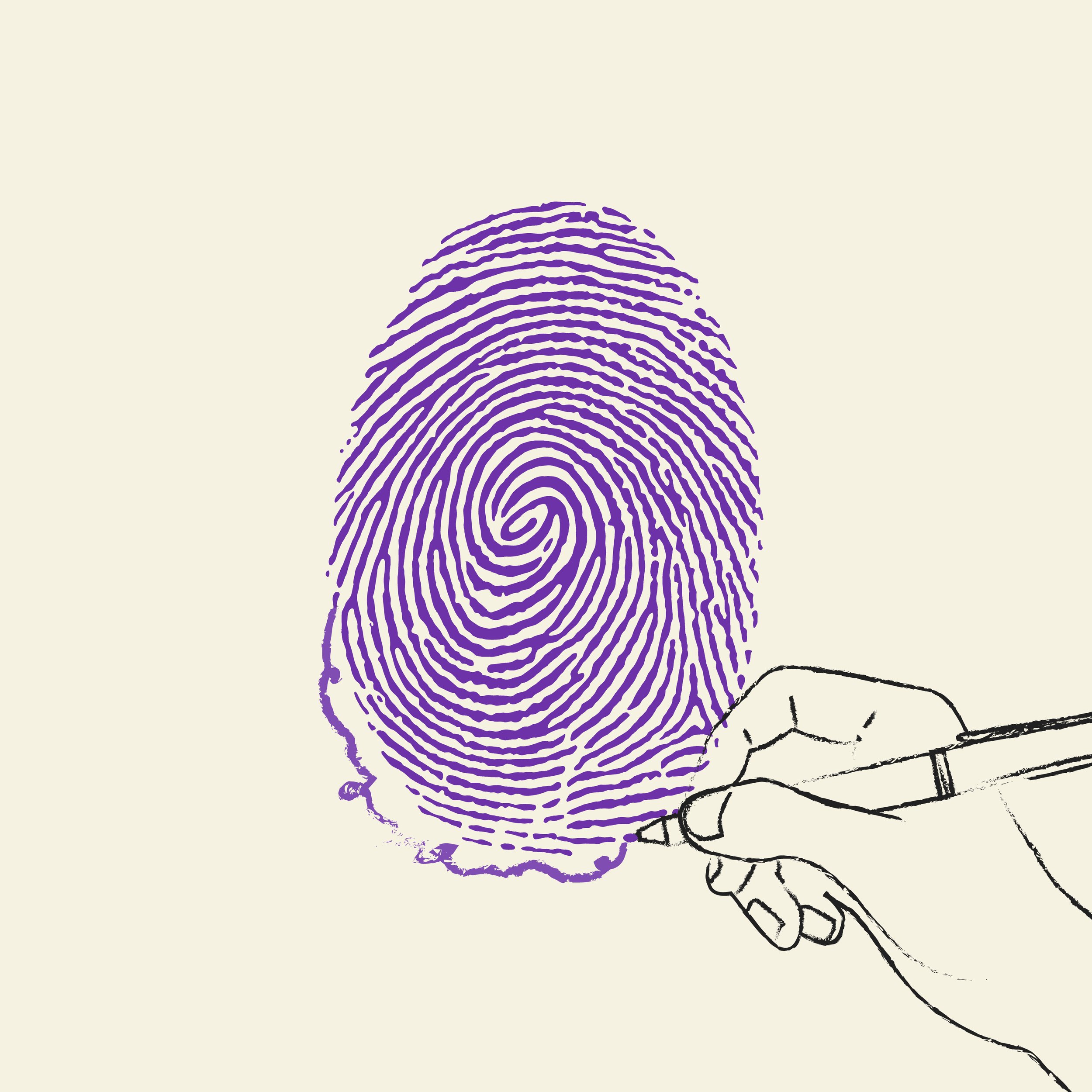
“According to forensic linguists, we all use language in a uniquely identifiable way that can be as incriminating as a fingerprint. … The term ‘forensic linguistics’ was likely coined in the 1960s by Jan Svartvik, a Swedish linguist who re-examined the controversial case of Timothy John Evans, a Welshman who was wrongfully accused of murdering his wife and daughter and was convicted and hanged in 1950. Svartvik found that it was unlikely that Evans, who was illiterate, had written the most damning parts of his confession, which had been transcribed by police and likely tampered with. The real murderer was the Evans’ downstairs neighbor, who turned out to be a serial killer.

“Today, the field is perhaps still best known for its role in solving the ‘Unabomber’ case in the United States. Between 1978 and 1995, a mysterious figure sent letter bombs to academics, businessmen and random civilians, killing three people and injuring at least 24. The lone bomber was careful not to leave any fingerprints or DNA traces, evading the authorities for 17 years and triggering one of the longest and most expensive criminal investigations in U.S. history. But in 1995, he made a crucial mistake. He told the police he would pause his attacks on the condition that a newspaper publish his 35,000-word anti-technology manifesto.

“When the document appeared in the Washington Post, the New York Times and Penthouse magazine, several people — including the perpetrator’s brother— reached out to say they recognized the writing style. Meanwhile, FBI linguist James Fitzgerald and sociolinguist Roger Shuy, who had been studying the bomber’s letters, had identified patterns in his language that helped narrow the list of suspects: Spellings such as ‘wilfully for ‘willfully’ and ‘clew’ for ‘clue’ pointed to someone from the Chicago area, for example. Eventually, the linguistic evidence was strong enough to issue a search warrant for the home of a reclusive mathematician named Theodore Kaczynski, raised in Chicago but living in rural Montana, where investigators found copies of the manifesto and homemade bombs. …

“At OrphAnalytics, Roten, who has a PhD in microbiology, explains that algorithms identify patterns in syntax much like in a DNA sequence. The difference, he tells me, is ‘there are very few errors in genome sequences, which is not the case when we compare texts,’ he said. Unlike with DNA, which a perpetrator can’t control, the author of a poison-pen letter is likely to try to obscure his writing style, for example by trying to sound less educated or to seem foreign.

“Still, linguists argue that style is almost impossible to hide because many of the choices we make are unconscious. Someone may decide to spell a word wrong, but forget to modify less noticeable details, such as their use of punctuation. ‘People say a lot about themselves when they’re trying to hide their writing,’ said Roten.”

More at the Dial, here. No firewall.

Read Full Post »

To me it’s tragic that languages are disappearing and, with them, unique cultures.

Small, determined efforts can bring attention to the problem, as I noted this morning when the filmmaker behind Marie’s Dictionary retweeted this from North Carolina’s Pilot Mountain Elementary School (@pilotMtnElem).

Third grade students are learning about Marie’s Dictionary and endangered languages. @goproject #scsed #pmespirates @UNESCO

Excellent. Third graders are sure to spread the word.

Recently, I came across an article on another threatened language, Hawaii Sign Language.

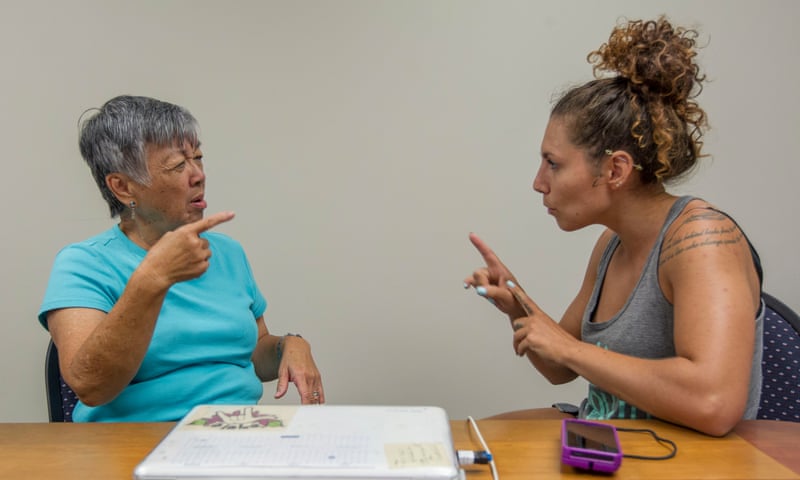
“In 2013, at a conference on endangered languages, a retired teacher named Linda Lambrecht announced the extraordinary discovery of a previously unknown language. Lambrecht – who is Chinese-Hawaiian, 71 years old, warm but no-nonsense – called it Hawaii Sign Language, or HSL.

“In front of a room full of linguists, she demonstrated that its core vocabulary – words such as ‘mother,’ ‘pig’ and ‘small’ – was distinct from that of other sign languages. …

“The last-minute arrival of recognition and support for HSL was a powerful, almost surreal vindication for Lambrecht, whose first language is HSL. For decades, it was stigmatised or ignored; now the language has acquired an agreed-upon name, an official ‘language code’ from the International Organization for Standardization, the attention of linguists around the world, and a three-year grant from the Endangered Languages Documentation Programme at the School of Oriental and African Studies in London. …

“An initial estimate of up to 280 surviving HSL signers was soon revised down to 40, then down to just 10 or so old-timers still likely to be competent in HSL. ASL had made deep inroads even among these signers, but there was evidence, especially from Lambrecht’s signs, that HSL was distinct, and lay close enough to the surface to be recovered. Spoken languages such as Basque, Welsh, and Hawaiian have come back from the brink of extinction – could HSL be the first sign language to do it?”

The article is from the Guardian by way of the blog Arts Journal. Read it here.

Photo: Eugene Tanner Photography, LLC
Linda Lambrecht, left, teaches Hawaii Sign Language.


Read Full Post »

Not sure who put me on to this story — maybe Asakiyume, who has an interest in different cultures. It’s about languages in which a slight change in tone can change the meaning of a word.

John McWhorter writes at the Atlantic, “People don’t generally speak in a monotone. Even someone who couldn’t carry a tune if it had a handle on it uses a different melody to ask a question than to make a statement, and in a sentence like ‘It was the first time I had even been there,’ says ‘been’ on a higher pitch than the rest of the words.

“Still, if someone speaks in a monotone in English, other English-speakers can easily understand. But in many languages, pitch is as important as consonants and vowels for distinguishing one word from another. In English, ‘pay’ and ‘bay’ are different because they have different starting sounds. But imagine if ‘pay’ said on a high pitch meant ‘to give money,’ while ‘pay’ said on a low pitch meant ‘a broad inlet of the sea where the land curves inward.’

“That’s what it feels like to speak what linguists call a tonal language. At least a billion and a half people worldwide do it their entire lives and think nothing of it. …

“There are certain advantages to speaking tone languages. Speakers of some African languages can communicate across long distances playing the tones on drums, and Mazatec-speakers in Mexico use whistling for the same purpose.

“You know those people who can hear a stray note and instantly identify its pitch, for instance recognizing that a certain car horn is an A flat? They have ‘absolute pitch,’ and there is evidence that speakers of tone languages are more likely to have it. In one experiment, for instance, Mandarin-speaking musicians were better at identifying musical pitches than English-speaking ones. The same has been found for speakers of Cantonese—which has six or even nine tones, depending on how you count—relative to English- and French-speakers.” More here.

I used to be quite good at Mom Tonal Language. A change in tone pronouncing a kid’s name can convey anger or amusement or affection. I don’t use the subtleties much now that I’m a grandmother. It’s mostly the affection tone.

Photo: China Stringer Network/Reuters

Read Full Post »

My husband’s latest alumni bulletin had a lot of great articles. One was about a new effort to save endangered languages, starting with Zapotec, an indigenous Mexican language.

If you go to this website and click the buttons, you can see and hear the effort that has gone into recording the ways that Zapotec words are pronounced. It’s the “Tlacolula Valley Zapotec online talking dictionary.”

The initiative has received support from the National Geographic and the Living Tongues Institute for Endangered Languages.

Photo: AxisOfLogic.com

Read Full Post »

Raise your hand if you were taught that one day centuries ago people in Siberia woke up and crossed a land bridge to North America and became the first Native Americans.

That’s OK as far as it goes, but history doesn’t stand still, and new discoveries suggest that before they got to North America, the Siberians stayed over on the bridge for a few thousand years. Who figured out the new chapters? Archaeologists and geneticists. And linguists.

Nicholas Wade writes in the NY Times, “Using a new method for exploring ancient relationships among languages, linguists have found evidence further illuminating the peopling of North America about 14,000 years ago. Their findings follow a recent proposal that the ancestors of Native Americans were marooned for some 15,000 years on a now sunken plain before they reached North America.

“This idea, known as the Beringian standstill hypothesis, has been developed by geneticists and archaeologists over the last seven years. …

“Though often referred to as a bridge, the now sunken region, known as Beringia, was in fact a broad plain. It was also relatively warm, and supported trees such as spruce and birch, as well as grazing animals.

Writing in the journal Science last month, John F. Hoffecker, an archaeologist at the University of Colorado, summarized the evidence for thinking the Beringian plain was the refuge for the ancestral Native American population identified by the geneticists. ‘The shrub tundra zone in central Beringia represents the most plausible home for the isolated standstill population,” he and colleagues wrote. …

“Linguists have until now been unable to contribute to this synthesis of genetic and archaeological data. The first migrations to North America occurred between 15,000 and 10,000 years ago, but most linguists have long believed that language trees cannot be reconstructed back further than 8,500 years. …

“But in 2008, Edward Vajda, a linguist at Western Washington University, said he had documented a relationship between Yeniseian, a group of mostly extinct languages spoken along the Yenisei River in central Siberia, and Na-Dene.

“The Na-Dene languages are spoken in Alaska and western Canada, with two outliers in the American Southwest, Navajo and Apache.” More here.

This is why it’s important for someone to be interested in studying mostly extinct languages spoken along the Yenisei River in central Siberia.

Map: Science, a journal, and the New York Times

Read Full Post »

The other day I was chatting with my three-year-old grandson about language. I can’t remember how we got started, but I found myself talking to him in “Goose Latin,” which was all the rage when I was about 10. He listened with a bemused look on his face and then said politely, “I don’t know that language.”

I may not be able to speak anything but English and a few lines of French poetry, but I do love learning about language. So I appreciated receiving this tidbit from the Economist magazine on how language interacts with personality.

The reporter RLG writes, “Many multilinguals report different personalities, or even different worldviews, when they speak their different languages.

“It’s an exciting notion, the idea that one’s very self could be broadened by the mastery of two or more languages. In obvious ways (exposure to new friends, literature and so forth) the self really is broadened. Yet it is different to claim—as many people do—to have a different personality when using a different language. A former Economist colleague, for example, reported being ruder in Hebrew than in English. So what is going on here?

“Benjamin Lee Whorf, an American linguist who died in 1941, held that each language encodes a worldview that significantly influences its speakers. Often called ‘Whorfianism,’ this idea has its sceptics, including The Economist, which hosted a debate on the subject in 2010. But there are still good reasons to believe language shapes thought. …

“Bilinguals usually have different strengths and weaknesses in their different languages—and they are not always best in their first language. For example, when tested in a foreign language, people are less likely to fall into a cognitive trap (answering a test question with an obvious-seeming but wrong answer) than when tested in their native language. In part this is because working in a second language slows down the thinking. …

“What of ‘crib’ bilinguals, raised in two languages? Even they do not usually have perfectly symmetrical competence in their two languages. But even for a speaker whose two languages are very nearly the same in ability, there is another big reason that person will feel different in the two languages. This is because there is an important distinction between bilingualism and biculturalism.

“Many bilinguals are not bicultural. But some are. And of those bicultural bilinguals, we should be little surprised that they feel different in their two languages.”

If you’re interested, there’s a great deal more explanation at the Economist, here.

Photo: Alamy

Read Full Post »

I’ve written several posts on the threat to languages that have few speakers — and on the linguistic preservationists racing against time. (Here, for example.)

Why does language extinction matter, you ask? Because language embodies so much about culture. We are poorer in being ignorant of how different people live and in having a chance to learn taken away from us.

Now the last speaker of a rare Scots dialect is gone. Writes the Associated Press, “In a remote fishing town on the tip of Scotland’s Black Isle, the last native speaker of the Cromarty dialect has passed away, taking with him a little fragment of the English linguistic mosaic.

“Academics said [October 3] that Bobby Hogg, who was 92 when he died … was the last person fluent in the dialect once common to the seaside town of Cromarty, 175 miles (280 kilometers) north of Edinburgh.

“ ‘I think that’s a terrible thing,’ said Robert Millar, a linguist at the University of Aberdeen in northern Scotland. ‘The more diversity in terms of nature we have, the healthier we are. It’s the same with language.’ …

“It’s part of a relentless trend toward standardization which has driven many regional dialects and local languages into oblivion. Linguists often debate how to define and differentiate the world’s many dialects, but most agree that urbanization, compulsory education and mass media have conspired to iron out many of the kinks that make rural speech unique.” More.

Photograph: Am Baile-High Life Highland/Associated Press.
Bobby Hogg, who recently passed away aged 92.

Read Full Post »